

ETHE
19.9402.52%
链
Jul 27 at 05:00 AM
Ethereum Foundation Report: A Basic Guide to Ethereum for Governments and Financial Institutions
 I'm LongbridgeAI, I can summarize articles.
Author:Ethereum Foundation
Compiled by: Jiahuan, ChainCatcher
Core Viewpoint of the Report: The critical systems for finance, data, and institutional collaboration remain in the hands of a few intermediaries, whose access can be cut off at any time. Ethereum provides a layer of neutral digital public infrastructure that is not controlled by any company, consortium, or nation.
The report supports this judgment with a set of data: The network is protected by $76 billion in staked ETH, requiring over $50.7 billion to manipulate and facing automatic slashing; it has never been interrupted since its launch in 2015, whereas Solana has experienced at least 7 outages during the same period; $159 billion in stablecoins and over $15.2 billion in tokenized assets have chosen Ethereum for settlement, with projects from BlackRock, JPMorgan Chase, Visa, SWIFT, as well as governments like Bhutan and India building on it.
The report also specifically responds to permissioned chains like Canton, Tempo, and GCUL: they merely replace the old system's power holders with a new batch. Rules can still be modified by a few, but for governments and institutions, "no one can change the rules" is precisely the attribute that should be valued most.
Executive Summary
Modern society increasingly relies on digital systems to transfer value and collaborate at scale, yet the core systems for finance, data, and institutional collaboration remain fragmented, opaque, and controlled by a few intermediaries. This concentration of power means intermediaries can cut off access at any time or under external pressure, creating single points of failure and limiting user autonomy.
As governments and institutions face growing pressure in geopolitics, financial infrastructure, digital identity, data integrity, and AI governance, they increasingly need a shared, neutral digital public infrastructure not controlled by any centralized entity or single nation. Ethereum was born for this purpose.
Ethereum is not controlled by any organization, individual, or nation. Like the core protocols of the internet, it is open, programmable, and globally accessible. The report lists a set of system-level metrics (unless otherwise specified, data as of March 2026, from OpenZeppelin's technical risk assessment):
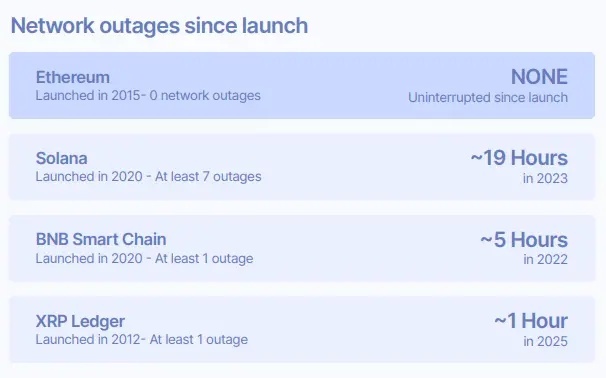
Most Reliable: Ethereum has run without interruption since its launch in 2015. In contrast, large Layer 1s like Solana, Ripple, BNB Smart Chain, Canton, and TRON have all experienced 1 to 7 instances of inability to process transactions, with one Solana outage lasting approximately 19 hours.
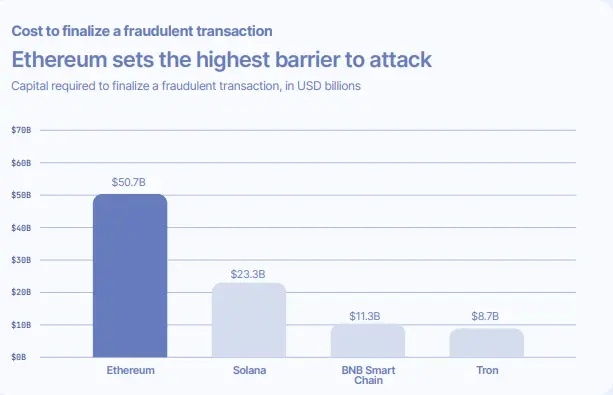
Highest Economic Security: Attacking Ethereum is designed to be prohibitively expensive. To unilaterally manipulate consensus and have a fraudulent transaction confirmed as final, an attacker would need approximately $50.7 billion, while the entire network is protected by about $76 billion in staked ETH. Besides buying $50.7 billion worth of ETH, the attacker would also lose billions due to on-chain automatic slashing. For comparison, the cost to attack Solana, BNB Smart Chain, and TRON is approximately $23.3 billion, $11.3 billion, and $8.7 billion respectively, and both Solana and TRON lack the additional deterrent of automatic slashing.
Most Trusted by Institutions: As of March 2026, Ethereum hosts $159 billion in stablecoins, Solana holds about $15 billion, and BNB Smart Chain holds about $14 billion. Ethereum also hosts over $15.2 billion in tokenized real-world assets, which is three times the sum of BNB Smart Chain ($3 billion) and Solana ($2.1 billion). Major institutions building, deploying, or trading on Ethereum include the European Investment Bank, Franklin Templeton, BlackRock, JPMorgan Chase, China AMC, Amundi, Ernst & Young, Deutsche Bank, Fidelity, BNP Paribas Forge, Visa, PayPal, UBS, SWIFT, DTCC, Robinhood, Ant Group, among others.
Most Trusted by Governments and Multilateral Institutions: National or city-level identity systems in Bhutan and Buenos Aires, land registration in India, and humanitarian cash disbursements by UNICEF and UNHCR are all built on Ethereum or its standards.
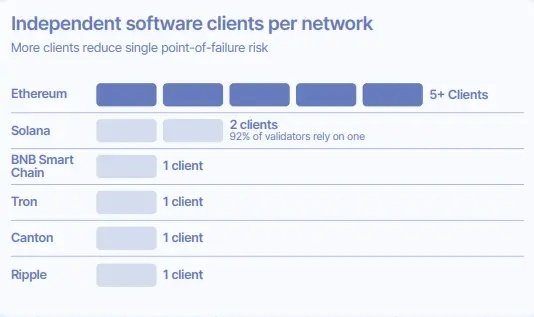
Most Robust Software: Ethereum maintains more than five independently developed clients, effectively hedging against vulnerabilities in a single implementation. In contrast, 92% of Solana validators rely on a single client (Agave as of June 2025), while BNB Smart Chain, TRON, Canton, and Ripple have no client diversity whatsoever.
Largest Developer Network: As of May 2026, the EVM tech stack is supported by nearly 11,000 developers, compared to Solana's ~2,600, BNB Smart Chain's 837, TRON's ~359, and Ripple's ~272.
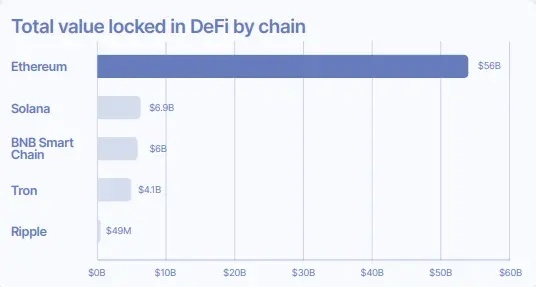
Largest DeFi Ecosystem: As of March 2026, Ethereum's DeFi Total Value Locked (TVL) exceeds $56 billion, while Solana stands at $6.9 billion, BNB Smart Chain at $6 billion, TRON at $4.11 billion, and Ripple at only $49 million.
Strongest Interoperability: ERC-20 has become the de facto standard for tokenized assets, and EVM is the most widely adopted execution environment. Building on Ethereum means migrating to compatible networks with minimal changes. Networks using proprietary languages or non-EVM runtimes (like Solana) require custom bridges and complete rewrites to interoperate with the broader ecosystem.
Environmentally Friendly: After transitioning to Proof of Stake, Ethereum's electricity consumption dropped by 99.98%, and its carbon footprint decreased by approximately 99.99%, with energy efficiency roughly 53,000 times that of the Bitcoin network and 100 times that of PayPal.
Future-Oriented: Ethereum is the first Layer 1 network to incorporate post-quantum security into its core protocol roadmap, including a dedicated research team, a $2 million cryptography bounty pool, and a phased migration path that requires no downtime and does not risk user funds.
System Overview and Basic Concepts
What is a blockchain?
A blockchain is a distributed digital ledger jointly generated by a network of participants running the same protocol. The protocol defines how transactions are validated, how blocks are generated, and how consensus on transaction order is reached.
The ledger itself is the result: a chain of blocks linked by cryptography, containing verified transactions. The core feature of a "public chain" is that no single institution has exclusive control over transaction records; the integrity of the ledger is maintained through cryptographic verification and the economic incentives of participants.
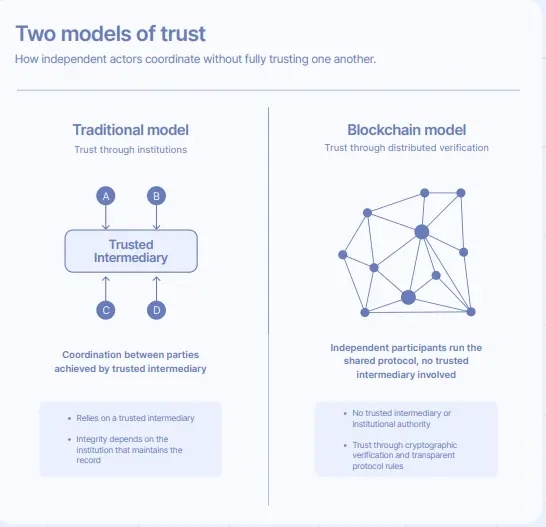
Modern economies and public systems rely on collaboration between independent entities that do not fully trust each other. The traditional approach is to introduce trusted intermediaries, such as banks, land registries, clearinghouses, and licensed institutions, replacing direct trust between parties with the authority of the institution. In this model, the integrity of records is tied to the integrity of the institution maintaining them.
Sufficiently decentralized blockchains provide a more reliable solution for the same collaboration needs: consensus no longer comes from institutional authority but from transparent protocol rules and cryptographic verification, with transactions validated by a distributed network of independent participants. Trust is strengthened on two levels: verifiable technical rules during protocol operation, and collective governance when changes are needed.
How does Ethereum work?
Ethereum is a shared digital record maintained by a global network of independent computer nodes, serving as the foundation for building applications and organizations in a decentralized, permissionless manner. With no single owner, Ethereum possesses censorship resistance: no one has the right to unilaterally cut off access, intercept transactions, shut down the network, or refuse service to specific participants.
A useful analogy is the internet. The internet allows anyone to publish information and build services without central operator approval. If the internet is the public infrastructure for information, Ethereum is the public infrastructure for transactions and programmable commitments.
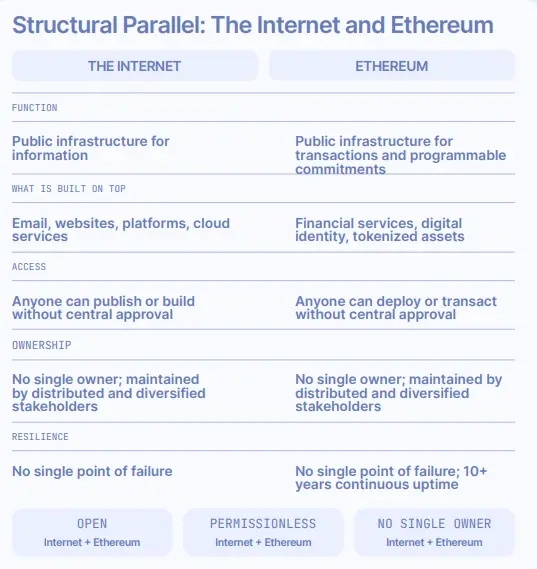
The underlying layer of Ethereum consists of thousands of independent computers called nodes worldwide. As of June 1, 2026, the Ethereum network has over 11,000 active nodes. The Ethereum Virtual Machine (EVM) is the execution engine, processing transactions and running programs deterministically across all nodes.
Each full node maintains a copy of the Ethereum state, which is the authoritative record of all account balances, contract storage, and code.
When a user broadcasts a transaction, nodes execute it locally via the EVM, using the current state and the transaction as inputs to produce a new state, then verify if the results are consistent. Validators check if transactions comply with rules; valid transactions are packaged into blocks and added to the permanent record, with a new block produced approximately every 12 seconds.
Users pay fees to compensate validators for computational resources consumed and to prevent network abuse.
Block production and finality are secured by ETH staked by validators as economic collateral. For a block to be finalized, at least two-thirds of active staked ETH must attest to it within a window of approximately 13 minutes.
If two conflicting finalized histories appear, it means at least one-third of stakers signed both versions, which is a punishable offense. The relevant validators' staked ETH will be automatically slashed and ejected from the validator set. The larger the attack, the greater the loss, making large-scale coordinated attacks economically equivalent to self-destruction.
Ethereum also supports running programs on-chain, known as smart contracts: sets of code and data residing at specific addresses. Smart contracts can define rules like ordinary contracts and additionally possess the ability to automatically execute rules via code.
Any developer can create smart contracts and make them public to the entire network, thereby building markets, stablecoins, games, and other user-facing applications. Effectively, Ethereum acts as a shared global settlement layer, just as the internet is a shared communication layer.
What gaps in today's internet does Ethereum fill?
The internet was originally designed as an open, permissionless public utility. Early standards like TCP/IP, HTTP, and SMTP were deliberately kept neutral, interoperable, and freely implementable by anyone, with no entity deciding who could connect or what could be published. This architectural neutrality made the internet the foundation of the modern global economy.
However, the layer of the internet most users actually interact with today is far removed from its original design. Over thirty years, companies have built proprietary platforms atop open protocols, becoming the de facto entry points for most digital activities.
Commerce, communication, identity, payments, and content distribution are mediated by a few operators whose terms of service, opaque policies, and commercial motives actually determine user experience. User data is captured and monetized by platforms, and access to APIs, audiences, and payment channels can be unilaterally revoked. While the underlying protocols remain public, the surface layer used daily has become private territory built on public pipes.
This analysis applies equally to AI. Cutting-edge AI models are controlled by a few companies, creating single points of pressure: jurisdictions with legal authority over central operators can demand they cut off AI access for millions of users overnight.
Ethereum aims to fill this gap. It does not seek to replace the open protocols of the internet but extends these protocols upward to the layer where openness has thinned, providing a neutral, auditable, and programmable settlement layer.
It operates at the same level as commercial platforms but runs according to the principles of the underlying internet. Assets and data are held by their owners, applications are composable rather than isolated, and the network runs continuously without a central operator that can take it offline, kick out participants, or change rules retroactively.
This distinction is important for policy and institutional decision-making. Core issues in contemporary digital policy—data sovereignty, market concentration, financial inclusion, system resilience, and censorship resistance—are not failures of internet base protocols but products of the commercialization of the experience layer. Regulation can constrain big platforms, but it cannot rebuild the inherent structural neutrality of the protocol layer at the experience layer.
Ethereum provides exactly such a foundation: rules apply equally to all participants, no party (including its developers) can unilaterally change them, every transaction and contract is recorded on a public ledger independently verifiable by anyone, applications default to sharing the same settlement layer rather than forming data silos, and the economic and cryptographic mechanisms ensuring its security are distributed among thousands of independent participants globally.
What is ETH, and what role does it play?
ETH is the native asset of the Ethereum protocol, a mechanism for pricing computation, securing consensus, and coordinating the economic incentives of the entire decentralized network.
Its most basic use is paying for computation. Every update to the shared state by transactions and smart contracts consumes computational resources, measured in gas. Users pay for this using ETH at prices that dynamically adjust based on network demand. This pricing mechanism allocates scarce block space via the market, prevents spam from filling the network, stops infinite execution, and eliminates the need for central authorities to approve or ration network usage.
ETH is also the core of network security. Ethereum uses Proof of Stake consensus, where validators must stake ETH as economic collateral to participate. Correct performance yields rewards, while violating protocol rules results in partial slashing of stakes. Security comes from aligned economic incentives, not reliance on trusted intermediaries.
Furthermore, ETH coordinates incentives between users and validators through a protocol-defined supply mechanism. New ETH compensates validators securing the network, while a portion of transaction fees is automatically burned.
Burning is algorithmic and usage-driven: higher usage leads to more burning; lower usage leads to less. When demand remains high, burning may exceed new issuance, resulting in a net reduction of total ETH supply. ETH is best understood as a protocol resource that allows Ethereum to operate as neutral infrastructure independent of any single organization's continuous operation.
What is staking, and how does it work?
Staking is the mechanism securing Ethereum under the Proof of Stake model, replacing the high-energy "mining" of Proof of Work (like Bitcoin) with economic collateral.
Participating in consensus requires locking a certain amount of ETH (currently a minimum of 32 coins) into a staking deposit smart contract to activate a validator node. Anyone meeting the staking requirement and running validator software can participate, and a globally diverse group of validators constitutes the network's distributed security model.
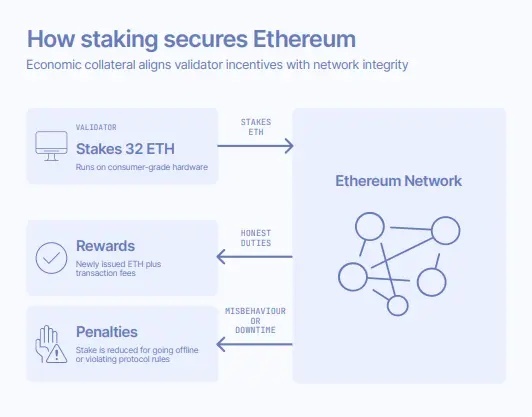
Validators are pseudorandomly selected to propose new blocks, and all active validators periodically attest to blocks proposed by others. Correct performance earns transaction fees and newly issued ETH. If a validator misbehaves (e.g., signing conflicting histories), part or all of their staked ETH is destroyed, i.e., slashed.
For unintentional errors threatening system stability, such as mass downtime preventing finality, an emergency mechanism called "inactivity penalty" causes the stakes of inactive participants to gradually shrink.
After Ethereum transitioned to Proof of Stake, electricity consumption dropped by 99.98%, and the carbon footprint decreased by approximately 99.99%.
How does Ethereum achieve settlement and finality?
Ethereum distinguishes between settlement and finality: the former refers to transactions being executed and reflected in the system state, while the latter means this result becomes irreversible at the protocol level.
Settlement occurs continuously, with transactions typically packaged into blocks and executed within 12 seconds. Finality occurs periodically, normally about every 13 minutes: when a supermajority of validators agree on a checkpoint, that checkpoint and all preceding blocks are considered final by the protocol.
As of March 2026, over $76 billion in ETH is locked in the protocol. Finalizing a block requires at least two-thirds of the total staked amount to attest within a window of approximately 13 minutes.
In contrast, Proof of Work networks like Bitcoin have no concept of "finality." Once 51% of hash power is acquired, history can theoretically be rolled back indefinitely. On Ethereum, creating two conflicting finalized histories requires at least one-third of stakers to double-sign, triggering automatic slashing and ejection from the validator set. Penalties expand with the number of involved validators, making flipping finalized blocks economically unfeasible.
The practical effect is that Ethereum combines fast transaction execution with protocol-defined irreversible settlement.
How do self-custody wallets work, and why are they crucial?
Self-custody wallets are software tools allowing users to interact with the blockchain while maintaining full control of their private keys. Unlike bank accounts where third parties manage funds, self-custody wallets give users exclusive power to sign transactions.
Wallets do not "store" assets; assets exist on the blockchain as records, and wallets store private keys—the cryptographic proof of ownership required to authorize transfers. Losing a private key means losing access to assets unless the wallet has a recovery mechanism.
The key value of self-custody lies in eliminating counterparty risk: when centralized exchanges fail (e.g., FTX), users with self-custody wallets are unaffected because they do not rely on the platform's solvency. This is a "non-custodial" ownership model where individuals hold digital assets directly, similar to holding cash or gold.
Self-custody wallets also offer programmability. Multi-signature configurations require a preset number of approvals to execute transactions, dispersing control among individuals, communities, or institutions to reduce single points of failure and enable transparent, auditable management of shared assets.
Social recovery mechanisms allow users to designate trusted guardians to collaboratively restore account access if credentials are lost. Both rely on threshold collaboration (operations only take effect once a preset number of participants join), but multi-sig governs transaction execution, while social recovery is generally only used to regain access, not to maintain ongoing control over funds.
For financial stability, consumer protection, and market access, the implications of this shift include: eliminating counterparty risk; data autonomy, where individuals manage their own data and identities; financial inclusion, allowing anyone with an internet connection to participate in the global financial system without gatekeeper approval; design-layer integrity, where transaction rules are written in open-source code and verified by a distributed network; and built-in interoperability, where a single wallet seamlessly connects to any application on the network.
What is Layer 2?
Layer 2 is an independent execution environment that inherits the security of its underlying Layer 1 blockchain. Layer 2s on Ethereum use the base layer as a security anchor and final settlement point, though the degree of security inheritance depends on each network's specific design choices.
The role of Layer 2 has changed significantly as the ecosystem matured. Initially, they were scaling solutions to address high transaction costs on the base layer. However, as Ethereum's base layer efficiency improves, Layer 2's value lies less in raw throughput and more in differentiated features: custom execution environments, integrated data layers, and specialized application designs. Examples include privacy-preserving execution environments, high-throughput systems for gaming or social apps, and dedicated networks tuned for specific applications. In this model, Layer 2s distribute along a spectrum of integration depth with the mainnet, making different assumptions about security, trust, functionality, and decentralization.
What core technologies does Ethereum use to protect privacy?
Privacy is not just about personal safety but is also a key guarantee of decentralization. Avoiding centralized control of information, allowing end-users to decide what data to share, and building a privacy-first Ethereum are priorities for the Ethereum ecosystem. The community has deployed various cryptographic technologies.
Zero-Knowledge Proofs (ZKP) allow someone to prove a statement is true without revealing the data used for the proof. For example, in identity verification: many services only need to confirm a specific attribute, such as whether someone is of age, passed sanctions screening, or resides in a certain jurisdiction, but today often require presenting a full ID card. With ZKPs, users can provide only the cryptographic confirmation of "being over 18" without revealing name, date of birth, or any other information. Various Decentralized Identity (DID) protocols built on Ethereum already support generating zero-knowledge proofs from verifiable credentials, enabling privacy-preserving KYC.
Multi-Party Computation (MPC) allows multiple parties to jointly compute a result without exposing their individual inputs. It is currently often used for institutional-grade digital asset custody: private keys are no longer stored in a single location but control is dispersed among multiple parties, requiring collaboration from participants reaching a preset threshold to authorize transactions, aligning with quorum approvals and separation of duties governance models. Ethereum itself does not require MPC to run; MPC operates at the wallet or custody layer above the protocol. For policymakers, MPC demonstrates how cryptography can replicate familiar institutional control structures within decentralized infrastructure.
Fully Homomorphic Encryption (FHE) allows computation on encrypted data without decryption, keeping data encrypted throughout until only the final result is decrypted. FHE currently has high computational overhead and is not yet widely deployed, but it is an active research direction that may support confidential analysis or financial logic without exposing sensitive data on-chain. FHE also illustrates that privacy and transparency are not mutually exclusive: advanced cryptographic tools are expanding the policy design space between complete opacity and complete openness.
Governance, Control, and Accountability
Who operates Ethereum?
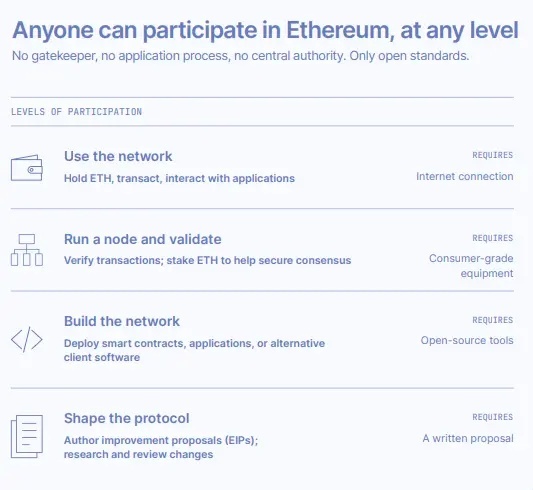
Ethereum is not operated by any individual, company, or organization. It has no CEO, board of directors, or central authority, but is a decentralized ecosystem maintained by thousands of diverse contributors. Key participant types include:
Core Developers and Researchers. A global community proposes, discusses, and implements improvements through open processes. Decisions are made by the collective rather than any individual, similar to the Internet Engineering Task Force (IETF).
Node Operators and Validators. Independent node operators run software to validate blocks, transactions, and the current state of the chain; some of these become validators by staking ETH, participating in block production and attestation. Thousands of validators and nodes are distributed across different jurisdictions, organizations, and infrastructures, keeping network control broadly dispersed.
EIP Authors. Ethereum Improvement Proposals (EIPs) are standards describing new features or processes. Anyone can write an EIP, introducing a formal, open, and transparent process based entirely on consensus.
Client Developers. Clients are software implementations of the Ethereum protocol. A node requires running both a consensus client and an execution client, with multiple versions of each in different programming languages developed by different teams.
The Ethereum ecosystem is open to everyone. A consumer-grade computer, an internet connection, and client software are sufficient to run a node. This forms an intentional contrast with Solana: the hardware requirements for validating transactions on Solana are essentially data-center level, meaning ordinary participants cannot run nodes themselves and must rely on a small batch of professional infrastructure providers to interact with the chain, inherently introducing counterparty risk. On Ethereum, the ability to independently verify the chain using ordinary hardware is open to any individual, and participating in the network requires trusting no one.
What role does the Ethereum Foundation (EF) play?
The Ethereum Foundation is a non-profit organization and one of many participants in the Ethereum ecosystem. Like the IETF in internet governance, the EF facilitates consensus building around protocol development within a globally distributed open-source community.
The EF defines its position with two goals: first, to ensure Ethereum remains a decentralized, resilient tool for autonomy: identity, assets, actions, and AI Agents acting on behalf of users, with ultimate decision-making power in the hands of users; second, to expand the coverage of this autonomy guarantee. The EF explicitly states that the Ethereum protocol and core application layers must be sustainable enough that even if the EF and today's core developers all disappeared, the network could continue to operate reliably and evolve.
The EF focuses on work that is hardest for other ecosystem participants to effectively undertake: long-cycle research, neutral multi-client specifications and testing, public goods security work, crisis coordination, preventing bottleneck points, and unclaimed core development tools and documentation.
Once a function can be taken over by立场-consistent participants in the community, the EF pushes for handover, spreading capabilities and responsibilities throughout the ecosystem rather than concentrating them. The EF does not operate the network, does not force protocol changes, and does not control participation eligibility.
This design, separating stewardship from operational control, is intentional. The EF's governance neutrality is also supported economically: according to its latest public disclosure, the EF holds approximately 0.26% of the total ETH supply, far below any level sufficient to influence network validation or protocol direction.
How are decisions made and upgrades managed on Ethereum?
The evolution of the Ethereum protocol is managed through a transparent, open process known as Ethereum Improvement Proposals (EIPs). EIPs are technical specifications for proposed changes, debated publicly by the community. Ethereum has no central authority to decide on upgrades; upgrades follow an open, multi-party participation model, generally going through three stages:
Step 1: Proposal and Debate. Technical discussions take place in public forums like "AllCoreDevs," where anyone can join. Meetings have been live-streamed for years, and anyone can propose changes.
Step 2: Client Implementation. Once specifications are finalized, independent client teams (such as Geth, Besu, Lighthouse, Prysm) implement changes in their respective software and release new versions.
Step 3: Network Adoption. Node operators and validators must actively download and install the new software to indicate consent. At the agreed-upon time, the upgraded software automatically begins executing new rules. If participants do not认可 a change, they are not obligated to adopt it.
The most frequently cited successful case is the Merge in September 2022, which switched Ethereum's consensus mechanism from Proof of Work to Proof of Stake while fully preserving existing transaction history, applications, and user balances.
This upgrade reduced Ethereum's electricity consumption by 99.98% and its carbon footprint by approximately 99.99%, with energy efficiency roughly 53,000 times that of the Bitcoin network and 100 times that of PayPal. The entire transition required coordination among multiple stakeholders: software developers implementing the upgrade, node operators and validators adopting the new consensus rules, and users and applications choosing to continue transacting on the upgraded network.
Can Ethereum be shut down or controlled by a single entity?
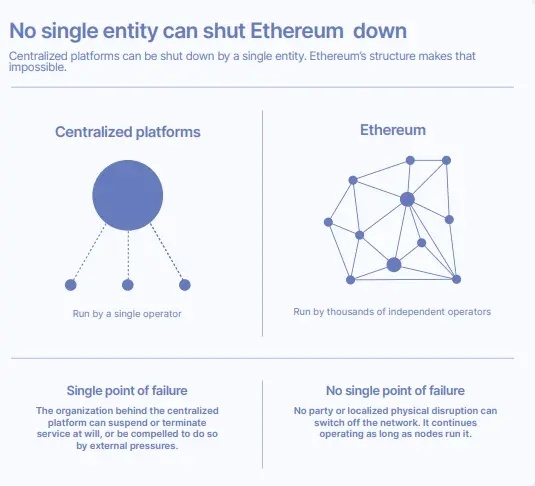
Ethereum is the safest, most resilient, and most decentralized blockchain network currently operating, structurally immune to single points of failure and unilateral influence. Unlike centralized banking platforms, cloud hosting services, and traditional payment networks, Ethereum cannot be unilaterally shut down or controlled by any individual, company, nation, or institution. Its resilience extends to physical interruptions like natural disasters.
The major power outages in Spain and Portugal in April 2025 paralyzed digital infrastructure across the region, whereas Ethereum has continued to run uninterrupted since its launch in 2015, surviving extreme market volatility, attack attempts, major protocol upgrades, physical interruptions, and drastic changes in the global regulatory environment.
Protocol governance design is the most direct framework for assessing whether a chain can be controlled or shut down. Networks optimized for transaction speed often concentrate validators to exchange for performance, increasing the risk of collusion and capture. Permissioned or consortium chains retain familiar governance models but reintroduce legal and administrative control points subject to regulatory or judicial intervention. Newer Layer 1s often combine limited operational history with highly concentrated token holdings, leading to higher governance uncertainty.
Ethereum's governance and consensus are based on weighted staked validator participation rather than operator or committee control, and it has withstood over a decade of testing in a public environment. Most other mainstream protocols have critical single-entity development dependencies: XRPL depends on Ripple, TRON depends on the TRON Foundation, BNB Smart Chain depends on Binance and the BNB Chain Foundation, and Canton depends on Digital Asset.
During the 2022 cross-chain bridge hack, Binance's CEO publicly instructed a pause on on-chain transactions, and BNB Smart Chain was subsequently intentionally halted for about 8 hours, demonstrating that a single individual could influence the network's transaction processing. No such intervention channel exists on Ethereum; no single team can unilaterally push changes, and protocol modifications require multi-team consensus across independent organizations.
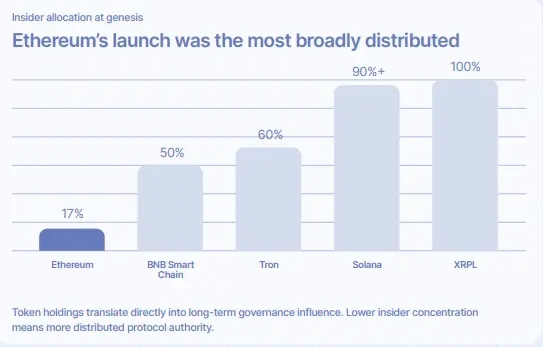
Genesis coin distribution concentration is another key factor shaping long-term governance landscapes.
Approximately 17% of Ethereum was allocated to insiders; BNB Smart Chain reserved 50% for the founding team and angel investors, with the rest publicly sold; Solana reportedly allocated over 90% to insiders; TRON gave 60% to the founding team and angel investors; and XRPL's entire initial supply went to the company and founders.
As of March 2026, Ethereum has over 900,000 validators, leading mainstream networks by orders of magnitude in quantity: Solana has over 800 validators, while BNB Smart Chain, XRPL, and TRON each have only dozens to around 100.
One fundamental reason for the large number of validators is the low barrier to entry, allowing effective participation with consumer-grade hardware. Censorship resistance thus stems from the dispersion of validator voting power, not just the number of nodes.
Regarding voting power and consensus, Ethereum's Proof of Stake mechanism allocates voting power based on staked amount. Finalization requires agreement from at least two-thirds of active staked amounts, following the Byzantine Fault Tolerance principle: even if up to one-third of participating stakes go offline, are compromised, or misbehave, the network continues to operate correctly.
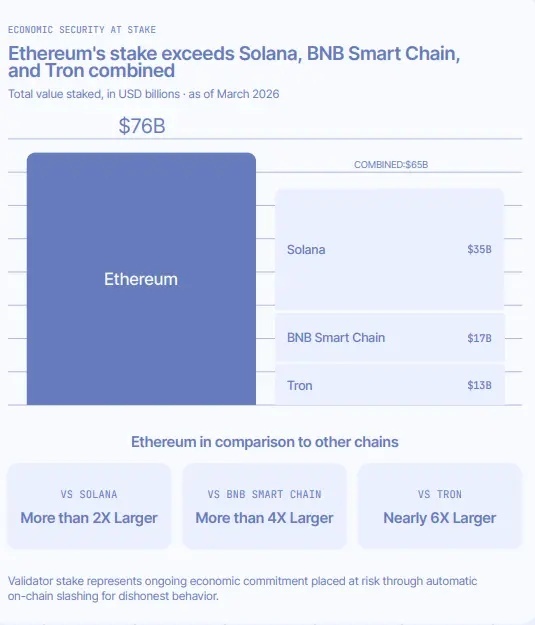
Validators collectively stake approximately $76 billion in ETH, capital that is explicitly at risk: failure to perform results in continuous minor deductions, while manipulating consensus triggers slashing. Penalties are automatically enforced by protocol rules, applying consistently across all jurisdictions without needing any administrative agency intervention.
Most other mainstream protocols, including Solana, lack this critical security mechanism of automatic punishment, and their economic staking scales are significantly lower: Solana, TRON, and BNB Smart Chain are protected by $35 billion, $13 billion, and $17 billion respectively. "Inactivity penalties" ensure that even if a large number of validators disappear, the network can still complete finality.
The distribution of network operations further strengthens resilience. Validators are distributed across continents, multiple jurisdictions, different energy systems, cloud providers, and client teams. Approximately 35% of validators are hosted on multiple cloud providers to avoid single points of failure, and no centralized registry concentrates control into a single entity or jurisdiction.
Even if a major country bans domestic participation in Ethereum, the network will continue to run uninterrupted through validators in other jurisdictions. This redundancy is a structural property of the system, not a policy that can be revoked.
Another dimension of Ethereum's resilience is so-called "trusted neutrality." The protocol applies the same rules to every participant, regardless of identity, nationality, or political stance. There are no management interfaces available for privileged parties to freeze accounts, roll back transactions, or deny service. There are no built-in admin keys, emergency stop switches, or protocol-level override functions.
Neutrality also requires that operation itself be visible: Ethereum's protocol, state, and operational behavior are observable by any participant, and any attempt to introduce opaque rules has nowhere to hide. Protocol upgrades only take effect when validators and node operators voluntarily run the new software; changes lacking broad community support simply do not activate.
For institutional users and governments, this means settlement, contractual obligations, and record states on Ethereum are not subject to discretionary intervention by any operator, providing finality and predictability for cross-border settlement, registry services, identity authentication, and financial instrument tokenization that traditional systems struggle to match.
The report also cites three typical attack paths summarized by OpenZeppelin, analyzing one by one why they fail on Ethereum.
First, acquiring sufficient economic stake: An attacker would need to control over $50.7 billion in ETH, the highest threshold among mainstream networks. Such a massive acquisition would be conspicuous in public markets, driving up the price of ETH and further increasing attack costs. Once the attack is launched, the stake would be automatically slashed. Ethereum slashes up to the entire stake of the attacker, unique among competitors; Solana lacks an automatic punishment mechanism, and TRON has no economic punishment at all.
Second, launching a supply chain attack on validator client software: This risk is sharpest when a single codebase dominates the network. Ethereum has at least five independent teams maintaining open-source clients at the execution and consensus layers, whereas BNB Smart Chain and TRON rely on a single codebase, meaning a severe vulnerability would simultaneously affect 100% of validators.
Third, colluding with a sufficient number of validators: Hijacking consensus requires controlling validators with at least one-third of the staked amount (two-thirds to manipulate finality). Ethereum's validators span individuals, institutional custodians, staking services, exchanges, and decentralized staking pools, with varying legal obligations, risk appetites, commercial motives, and political environments, making large-scale sustained collusion extremely difficult to organize and hide. Any discovered collusion similarly triggers catastrophic automatic slashing.
Comparative Analysis of Different Blockchains
What is the key difference between permissioned and permissionless chains?
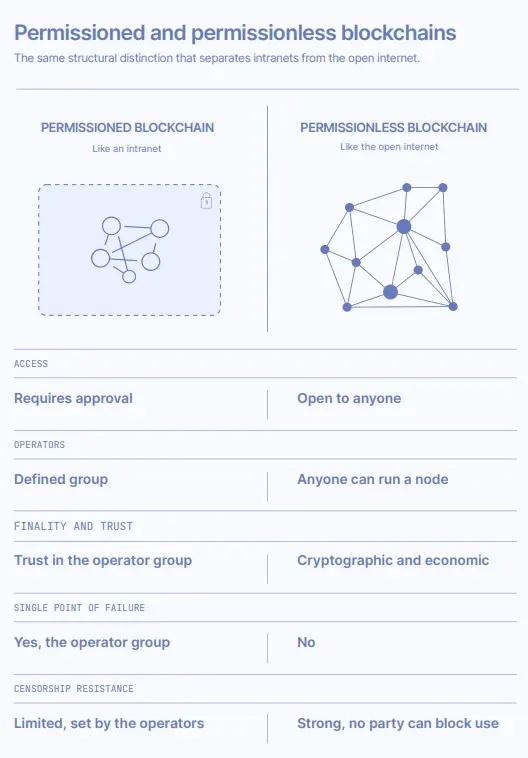
Permissioned and permissionless chains are often treated as a binary opposition, which is an oversimplification. They should be understood as the two ends of a spectrum, with each chain positioned somewhere on the spectrum based on its specific characteristics.
Blockchains near the permissionless end are open by default: anyone can read data, send transactions, become a validator or node operator, without applying to companies, governments, or committees, and there is no whitelist.
The system operates because a large number of independent participants are incentivized to follow shared rules and are automatically punished for misbehavior, not because a central authority grants access. Blockchains near the permissioned end are restricted by design: only approved participants can validate transactions, access may require identity verification or organizational membership, and governance decisions are made by a defined group. Since control is concentrated in known entities, transaction filtering or rule changes are easier to coordinate.
An intuitive analogy is the internet versus an intranet. The internet is open, allowing anyone to connect, publish content, and build applications, similar to a permissionless chain; an intranet is private, limited to internal organizational members, with controlled access determined by administrators, similar to a permissioned chain.
When governments and institutions evaluate blockchains, they should examine "where this chain sits on the spectrum" against specific deployment goals, rather than treating it as an abstract attribute.
For example, if the primary goal is to eliminate single points of failure, one must assess how many independent validators protect the network, how stakes are distributed among them, whether they are geographically and legally dispersed, and whether any single entity (company, government, or consortium) can unilaterally shut down or suspend the network. Additionally, is client software diverse enough that a bug in a single implementation won't crash the entire system? Permissioned chains concentrate validation in a known and limited group of operators by design; if this group is compromised, coerced, or ceases operations, the network fails.
How does the Ethereum blockchain differ from the Bitcoin blockchain?
Both Bitcoin and Ethereum are decentralized blockchain networks, but their design purposes differ. Bitcoin was born for peer-to-peer value transfer and is now widely understood as a digital currency asset or store of value, designed for simplicity, stability, and resistance to change. Ethereum is designed as a general-purpose programmable digital public infrastructure, similar to how the internet provides a shared foundation for information exchange.
Specific differences manifest in three areas.
Functionally, Bitcoin focuses on digital value transfer between participants, supporting only limited scripting capabilities. Ethereum was designed from the start for general programmability; its Turing-complete virtual machine allows arbitrary rules and logic to be embedded directly into financial or non-financial arrangements, supporting applications like stablecoins, payment systems, social protocols, certifications, and identity schemes, making it a shared platform rather than a single-purpose value exchange system.
In system design, Bitcoin uses the UTXO model, tracking discrete units of value flowing between users. Ethereum uses an account model, maintaining balances and application states, which is better suited for complex programmable logic.
In energy and security models, Bitcoin relies on Proof of Work for security, requiring continuous consumption of computational energy. Ethereum has transitioned to Proof of Stake, replacing continuous energy consumption with locked economic collateral, reducing electricity consumption by 99.98% and carbon footprint by approximately 99.99%, while maintaining network security.
How does Ethereum compare to other public chains?
Ethereum is widely used as digital public infrastructure because it prioritizes security, neutrality, and long-term reliability, with this neutrality supported by decentralization at every layer: validator participation, protocol governance, open-source development, and client diversity. No company, consortium, or nation controls transaction ordering, system upgrades, or network access.
Unmatched Resilience: Ethereum has run continuously without interruption since its launch in 2015; no smart contract platform can match this record.
Since its launch in 2020, Solana has experienced at least 7 major outages, with the longest lasting about 19 hours; the most recent outage of nearly 5 hours occurred in February 2024. Also launched in 2020, BNB Smart Chain was "paused" for at least 5 hours in 2022. Launched in 2012, the XRP Ledger has also had similar incidents, including an outage exceeding 1 hour in 2025.
Validator decentralization is by design. Ethereum's validators are geographically spread across continents and jurisdictions, partly due to lower barriers to entry: a standard consumer computer, client software, and 32 ETH are sufficient.
In contrast, operating validators on Solana and BNB Smart Chain requires enterprise-grade infrastructure far beyond the capabilities of ordinary participants, along with deep Linux operations expertise and near-perfect uptime, concentrating validation work in the hands of well-capitalized corporate operators.
Infrastructure and client diversity also lead. Ethereum nodes and validators use highly dispersed cloud providers and physical servers, with the community maintaining at least 5 open-source clients developed by different teams in different programming languages.
Solana has two main validator client implementations, but 92% of validators run on Agave, showing high concentration; BNB Smart Chain, TRON, and XRP Ledger rely entirely on a single client.
Economic security reaches a scale unmatched by others. As of March 2026, the Ethereum network has $76 billion in staked ETH, requiring over $50.7 billion to manipulate consensus.
At the same time, the staking scales for Solana, TRON, and BNB Smart Chain were $35 billion, $13 billion, and $17 billion respectively, with corresponding attack costs of $23.3 billion, $8.7 billion, and $11.3 billion. Furthermore, Solana, XRP Ledger, and TRON lack automatic slashing mechanisms; malicious validators do not face immediate automatic destruction of their stakes, and punishment relies on social coordination or even network restarts, significantly reducing deterrence.
For policymakers and institutions, the key is not introducing additional counterparty risk. On Ethereum, there is no operator that can change rules, restrict access, adjust monetary policy, reprioritize for commercial interests, or unilaterally shut down the network. The system's integrity does not depend on the solvency, goodwill, or strategic interests of any single entity.
This creates a structural difference from many other Layer 1s: The Solana Foundation directly shapes the validator ecosystem through staking matching, voting cost subsidies, and other delegation plans, making it a key counterparty in that ecosystem; Binance's substantive control over BNB Smart Chain has faced repeated criticism; Ripple controls approximately 42% of the total XRP supply, with control extending to validator selection and node whitelists.
The gap in genesis allocation is also evident: Ethereum allocated about 17% to insiders, BNB Smart Chain 50%, TRON 60%, Solana over 90%, and XRPL 100%.
Ethereum also enjoys self-reinforcing network effects not yet replicated by other Layer 1s. It is the most well-documented and tool-rich public chain. ERC-20 is the most supported token standard, and various ERC-based standards can be implemented permissionlessly and fee-free by any developer, custodian, or institution.
Building on Ethereum means directly adopting standards already used by thousands of institutions, rather than negotiating custom integrations from scratch with every counterparty. As of May 2026, the EVM tech stack is supported by approximately 11,000 developers, far surpassing Solana (~2,600), BNB Smart Chain (~837), TRON (~359), and Ripple (~272). Developer scale directly translates into depth in open-source tools, audited codebases, security research, and documentation.
The EVM itself is a computing engine, fundamentally no different from Microsoft .NET's virtual machine or the Java interpreter, and is now the de facto standard for smart contract execution across multiple chains.
Institutional adoption is also leading. This adoption has long gone beyond isolated pilots to cover live products, regulated funds, settlement infrastructure, and multi-year institutional projects:
Global banks like JPMorgan Chase, BNP Paribas, UBS, Deutsche Bank, and Standard Chartered are using Ethereum-based infrastructure for tokenized bonds, deposits, funds, and regulated settlement pilots.
Asset managers like BlackRock, Fidelity, Franklin Templeton, and Amundi are directly issuing tokenized money market funds, government securities, and investment products on Ethereum.
Custodians and market infrastructure providers like BNY Mellon and SWIFT support Ethereum-native assets and explore interoperability between traditional financial facilities and public chain settlement.
Payment networks like Visa, Mastercard, and PayPal run stablecoin settlement, vouchers, and programmable payment infrastructure on Ethereum.
Regulated trading and fintech platforms like Robinhood and Coinbase are building Ethereum Layer 2s for tokenized real-world assets, stablecoins, and on-chain capital markets.
The dominance in stablecoin and tokenized asset settlement is also clear. As of March 2026, Ethereum hosts $159 billion in stablecoins, Solana ~$15 billion, BNB Smart Chain ~$14 billion; tokenized real-world assets exceed $15.2 billion, three times the sum of BNB Smart Chain and Solana; DeFi TVL exceeds $56 billion, which is 8.1 times Solana's, 9.3 times BNB Smart Chain's, 13 times TRON's, and 1,142 times Ripple's. Combined with the 99.98% energy consumption reduction after transitioning to Proof of Stake, Ethereum also meets the environmental impact assessment requirements of the public sector.
How does Ethereum compare to permissioned chains?
The core argument for supporting permissionless public chains like Ethereum is that they provide functionalities unavailable in traditional solutions: they are the only solution allowing multiple parties to transact without relying on any party (or third party) for control.
Cross-border trade and settlement have historically required some form of shared infrastructure, previously provided by correspondent banks, clearinghouses, messaging networks, and custodial institutions. These systems operate well under conditions where participants share a legal framework, universally trust relevant institutions, and have stable relationships; they become unreliable when these conditions do not hold.
Global trade in 2026 is under pressure from supply chain restructuring, tightening regulations in various countries, and a more complex and fractured international environment. Parties previously relying on shared institutions for settlement increasingly doubt whether these institutions can provide truly neutral venues for all participants.
Any system with a clear governance structure will to some extent reflect the interests and constraints of its governors; this is an inherent attribute of controlled infrastructure.
Whether counterparties are willing to rely on a shared settlement facility depends on whether they believe rules will be applied consistently, access rights will not be revoked for reasons unrelated to the transaction, and no participant in the governance structure can unilaterally change the operating terms of others.
These requirements are difficult to meet solely through institutional design. Historical experience shows that the gap between designed neutrality and actual operational neutrality widens as stakes deepen and the scope of participants expands.
Ethereum has no governance body that can be pressured. Rules can only be changed through decentralized processes where no single party holds decisive control. Access rights cannot be revoked by any operator because there is no operator.
The result is a new settlement and collaboration layer: two parties, even if they have no prior relationship, apply different laws, distrust each other, and lack a common trusted intermediary, can still transact on it. In contrast, permissioned and consortium chains exchanged control and restricted access for neutral governance, cross-network interoperability, and long-term operational continuity. So far, no permissioned chain has achieved success close to that of public chains.
Permissioned chains do not constitute neutral infrastructure. Take Canton as an example. It is one of the most discussed permissioned platforms, backed by large institutions, aiming to create a "network of networks" to interconnect originally isolated systems in the financial market under frameworks of compliance, privacy, permission, and control.
But Canton is neither decentralized nor neutral: a small group of stakeholders controls access and sets rules. The Canton Foundation is jointly led by DTCC and Euroclear. Protocol changes require a two-thirds majority vote from super validators, and becoming a validator currently requires sponsorship. This is consortium governance, not decentralized governance. If these entities are pressured, they can change network rules.
Tempo, incubated by Stripe and Paradigm, claims to cater to various high-throughput, low-cost global transactions including machine payments, but its active validator set is currently license-managed by the Tempo team. At least for now, parties transacting on Tempo trust Stripe and Paradigm, not cryptographic guarantees.
Google Cloud's Universal Ledger (GCUL) is also a permissioned system. Adopting it effectively means letting a single commercial entity control the underlying infrastructure of financial settlement. The risk of these permissioned chains is rebuilding the old system while installing new power holders, pushing tech giants toward stronger dominance.
Permissioned chains require trust in a consortium. In permissioned ledgers, users ultimately must trust that consortium operators will keep honest books, adjudicate fairly, and enforce rules.
Canton adopts a delegated trust model, relying on trusted sync domain operators for transaction ordering and confirmation. Its whitepaper also acknowledges that in scenarios with highly trusted operators, sync domains can be implemented centrally, meaning participants are actually trusting the super validator consortium to act honestly.
Tempo and GCUL are similar. Ethereum replaces institutional trust with cryptographic verification and decentralized consensus, reducing reliance on intermediaries and single points of failure. Its trusted neutrality and open auditability are particularly important for cross-border scenarios where power, regulation, and enforcement are already dispersed across multiple jurisdictions.
Permissioned chains do not support substantive interoperability and composability. Assets, identities, and contracts issued on Ethereum can be used directly across wallets, platforms, and jurisdictions without custom integration; permissioned chains tend to become isolated systems, interacting with external networks requiring bilateral agreements and custom bridges.
Canton's applications only interoperate within the boundaries of their respective permission models. Institutions can effectively limit who can access or compose their applications.
Tempo has released an open standard MPP for AI Agent payments outside its mainnet, claiming compatibility with stablecoins, bank cards, Affirm, Klarna, and various payment methods. However, this interoperability relies at least partially on partnerships with private companies. Essentially, it is a few companies sitting down to agree on standards, little different from the status quo. Moreover, the addition of a group of established large institutions implies the exclusion of outsiders: any payment network, financial institution, or market participant not invited into the cooperative structure must first obtain permission, which precisely replicates the gatekeeping mechanism that permissionless infrastructure seeks to eliminate.
GCUL's deep integration with Google Analytics and AI tech stacks is a selling point for Google Cloud customers, but it also means composability outside the environment depends on interfaces controlled by Google. Institutions building on GCUL are composing within a walled garden.
Permissioned chains also restrict access to global liquidity. Public chains aggregate global liquidity; stablecoins, tokenized securities, and financial primitives on Ethereum can be immediately used by a wide range of market participants. Permissioned ledgers are constrained by liquidity by design; even if technically available, they often cannot achieve economic significance outside the initiating consortium.
Canton's liquidity is concentrated among a group of known, vetted permissioned ecosystem counterparties, with cross-deployment liquidity trending toward fragmentation rather than compounding growth.
Tempo's liquidity is similarly limited to its screened partners. Stablecoins issued on Tempo cannot immediately access global wallets, DeFi protocols, and institutional platforms like Ethereum-native assets.
GCUL, as a permissioned ledger, likely faces the same issues.
Technical portability and exit costs are also important considerations. Public chain infrastructure is built on open technical standards, and the cost of migrating applications and assets to compatible environments is low, favoring long-term exit flexibility and procurement elasticity.
Systems built on proprietary tech stacks may require significant redevelopment to migrate. Canton requires using Digital Asset's smart contract language, Daml, which cannot run on public EVM chains. Migrating away from Canton requires a complete rewrite rather than porting, creating switching costs at every level of tools, talent, and institutional knowledge.
Overall, neutrality, trust minimization, interoperability, and global participation are recognized key features for cross-institutional, cross-jurisdictional, long-cycle shared infrastructure.
Canton, Tempo, and GCUL might be suitable for connecting institutions that already share legal frameworks and established standards, but this definitionally excludes the vast majority of economic participants in the world.
Ethereum, however, is a shared, ownerless space where parties without existing trust, institutional membership, or common standards can transact on equal footing. In today's accelerating geopolitical fragmentation, neutral digital infrastructure不受 any centralized gatekeeper or consortium control is no longer a theoretical concept but an urgent practical need.
Impact on Economic and Financial Systems
How should central banks evaluate stablecoin issuance and settlement on Ethereum versus other networks?
When evaluating stablecoin issuance and settlement infrastructure, discussions usually revolve around monetary stability, legal settlement finality, system resilience, and cross-border interoperability. These are long-standing concerns of central banks regarding private money, payment system design, and financial infrastructure governance.
The report argues that structured evaluation along these dimensions clearly points to Ethereum as the most suitable settlement layer for currently systemically important stablecoins.
First, look at market adoption and explicit preferences of issuers.
As of March 2026, Ethereum hosts over $159 billion in stablecoins, while TRON, Solana, and BNB Smart Chain hold $89.1 billion, $15 billion, and $14 billion respectively. In tokenized real-world assets, Ethereum exceeds $15.2 billion, while Solana and BNB Smart Chain hold $2.1 billion and $3 billion respectively. In DeFi TVL, Ethereum exceeds $56 billion, with all other chains below $7 billion.
For central banks, this distribution is not just market statistics; it reflects the collective risk judgment of issuers operating under regulatory, legal, and reputational constraints. These issuers, already under regulatory scrutiny, have effectively conducted cross-platform due diligence and converged on Ethereum because it best meets their scaling requirements in operations, law, and reputation.
Second, look at settlement layer design.
Ethereum's settlement layer is protected by the largest staked capital among smart contract platforms (over $76 billion), with a highly diverse validator pool, nodes distributed globally, no single dependence on cloud providers, support for local hardware operation, and multiple teams maintaining production-grade clients in different languages.
These designs reduce dependence on any single party, enhance resilience in crisis scenarios, and compress the space for unilateral intervention. From the perspective of central banks and systemic risk, distributed validation is a mitigation mechanism for settlement layer operational risk: infrastructure relying on a few validators, operators, or legal systems may be efficient under normal conditions but exposes governance and intervention vulnerabilities during market stress or geopolitical tensions.
Recent failures of major service providers like AWS, Crowdstrike, Cloudflare, and Microsoft Azure have repeatedly impacted critical infrastructure. Ethereum's structure disperses operational and political dependencies.
Furthermore, Ethereum's architecture separates settlement verification from operations and access control: the base layer remains neutral, transparent, and auditable, while higher-layer applications can implement access restrictions, compliance requirements, and jurisdiction-specific controls without concentrating settlement power in a single entity.
Regarding finality, central banks look at legal and economic concepts rather than purely technical attributes. Ethereum provides economic finality under Proof of Stake. Flipping finalized blocks requires controlling massive stakes and suffering automatic slashing. Its economic finality is similar to existing payment systems: theoretically reversible, but practically excluded due to governance, cost, and reputational constraints.
Third, look at interoperability and composability.
Stablecoins are most valuable when used as universal settlement assets rather than isolated tools. Ethereum has the largest and most mature blockchain ecosystem. ERC-20 is the most widely supported token standard, and whitelisting, configuration, and compliance activation can still be done case-by-case as needed.
The thickness of the ecosystem is reflected in several layers:
In wallets, MetaMask alone has 143 million cumulative created accounts and about 30 million monthly active users. Almost all DeFi, NFT, or DAO projects integrate by default. Institutional smart contract wallets like Safe manage over $100 billion in corporate treasuries and funds. Hardware wallets like Ledger and Trezor natively support Ethereum and ERC-20.
In custody, Coinbase Custody, BitGo, Fidelity Digital Assets, Copper, etc., all provide regulated, insured Ethereum custody around the same address format and token standard. One ERC-20 asset can immediately access all these services, whereas assets on new or proprietary chains require separate custom integration with each custodian (if they are willing to do so).
In audit and security infrastructure, OpenZeppelin's open-source contract library is an industry-standard component. Professional audit firms like Trail of Bits, Consensys Diligence, and Certik have cumulatively reviewed thousands of Ethereum contracts.
This decade-long accumulation of security infrastructure depth substantially reduces the risk of any new deployment.
Permissioned or consortium ledgers might offer stronger local control but restrict interoperability and increase concentration risk, potentially recreating a fragmented settlement system rather than a unified digital currency layer. For stablecoins, especially in cross-border trade under geopolitical uncertainty, networks that can be unilaterally restricted undermine their core function.
Can Ethereum interoperate with financial institutions' existing infrastructure?
Ethereum's design embodies "separation of concerns" echoing existing financial market infrastructure: a neutral public settlement layer provides immutable finality and verifiability, while compliance, access control, data privacy, and qualification checks are executed at higher layers (applications, intermediaries, or Layer 2). Institutions retain compliance, operational control, and data protection while accessing Ethereum's settlement, liquidity, and programmability.
Real-World Asset (RWA) tokenization is a pathway connecting traditional finance with Ethereum, representing assets like bonds, funds, deposits, and collateral as digital assets on Ethereum. Tokenization allows these assets to settle near-real-time, transfer cross-border at lower cost without correspondent banking steps, and embed procedural rules for lifecycle events, compliance, and cash flows. Here, Ethereum does not replace existing systems but acts as a shared settlement and collaboration layer, operating parallel to traditional bookkeeping and custody frameworks.
Regulated institutions sometimes access Ethereum through modular integration models, including Layer 2 networks, permissioned execution environments, and hybrid architectures, placing compliance, disclosure, and operational control at appropriate layers while anchoring settlement on Ethereum's public base layer.
These models can enforce rules at the application or access layer, embed privacy while retaining compliance and audit capabilities, limit data visibility while still anchoring transactions on a publicly auditable settlement layer, and achieve scaling and cost efficiency without fragmenting liquidity.
An ecosystem comprising custodians, banks, middleware providers, and market infrastructure companies is connecting Ethereum with existing core banking, treasury, and post-trade systems. These intermediaries abstract away private key management, reporting, and reconciliation, allowing institutions to interact with Ethereum-based assets and protocols.
From an institutional perspective, accessing Ethereum is increasingly like accessing a new settlement track rather than a retail crypto system. It is an extension of existing infrastructure rather than a wholesale replacement, much like how the internet integrated into financial services through APIs, messaging layers, and standardized protocols.
Institutions' motivations for accessing Ethereum are usually not to replicate old systems but to reduce concentration risks in cross-border settlement, liquidity scheduling, and collaboration, especially under geopolitical pressure.
In this framework, Ethereum does not replace sovereign currencies, regulated intermediaries, or regulatory powers. Instead, it allows institutions and regulators to rely on a common public settlement layer, reducing dependence on any single operator, jurisdiction, or proprietary network, while keeping policy, compliance, and risk control at the institutional and application layers.
What is DeFi, and how does it differ from centralized financial institutions?
Traditional finance relies on institutions to endorse transactions, concentrating the power of fund flow in the hands of a few intermediaries. Since transactions, risk exposures, and internal processes are mostly opaque, trust is maintained through regulation, consumer protection, and traditional security frameworks, rather than transparency itself.
This concentration creates systemic fragility: the failure of a single institution can cascade through the entire financial system, as seen in Lehman Brothers in 2008 and FTX in 2022. Centralized gatekeeping mechanisms also exclude a large portion of the global population from basic financial services.
Decentralized Finance (DeFi) replaces intermediaries with smart contracts: automated execution programs deployed on the blockchain. Code is the rule and is publicly visible; anyone can inspect, audit, and verify it.
DeFi markets can therefore run continuously without centralized authorities capable of intercepting payments or restricting participation. Users directly control their own assets and can access global financial services with just an internet connection. Previously slow, opaque, and prone to human error processes have become automated, verifiable, and open code.
The report uses Morpho as an example. This is a decentralized lending protocol built on Ethereum, with a design philosophy of modularity and minimalism: the core is a streamlined and immutable smart contract serving as the base layer for lending markets.
Morpho does not bundle risk management, collateral decisions, and interest rate logic into an opaque whole. Instead, it separates these concerns, allowing users to create independent lending markets for any asset permissionlessly, selecting their own collateral and risk parameters.
This architecture significantly shrinks the attack surface of the core protocol while leaving flexibility for professional participants to continue building on top. As of March 15, 2026, the protocol's total locked value exceeded $7.3 billion.
What are representative cases of institutions and governments using Ethereum?
Ethereum has been used by large financial institutions and the public sector as settlement and collaboration infrastructure, especially in scenarios requiring cross-border, cross-entity interoperability, neutrality, and programmability. Adoption concentrates in several identifiable directions.
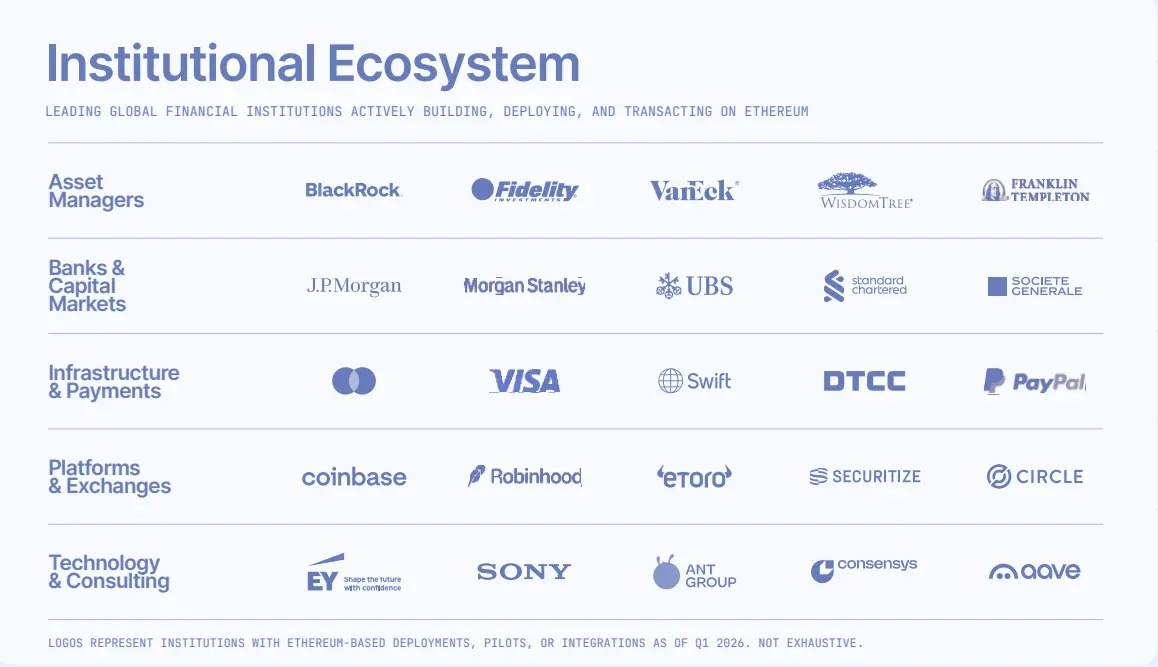
In tokenized assets, Ethereum hosts over $15.2 billion in real-world assets (as of March 2026).
Franklin Templeton's tokenized money market fund records share ownership on Ethereum, combining blockchain settlement with regulated fund management.
BlackRock launched the BUIDL tokenized fund on Ethereum, explicitly citing liquidity, interoperability, and maturity of institutional infrastructure as reasons for selection. JPMorgan Chase launched its first on-chain money market fund on Ethereum, currently managing over $100 million in assets.
Amundi, Europe's largest asset manager, issued tokenized shares of its Euro Money Market Fund on the Ethereum mainnet.
The U.S. Commodity Futures Trading Commission (CFTC) also announced the launch of a digital asset pilot program, allowing certain digital assets including ETH to be used as collateral in derivatives markets.
In these cases, Ethereum is not mimicking traditional capital market infrastructure but serving as a shared settlement and record layer that multiple intermediaries can simultaneously rely on.
In stablecoins, the $159 billion scale hosted on Ethereum is more than 10 times that of Solana ($15 billion) and BNB Smart Chain ($14 billion).
Circle issues USDC on Ethereum, used by financial institutions, payment service providers, and governments for treasury operations and cross-border transfers.
Fidelity launched its own stablecoin on Ethereum; BNP Paribas Forge issued the stablecoin CoinVertible on Ethereum.
Visa began supporting card issuers and acquirers to settle transactions via stablecoin trades on Ethereum. PayPal's stablecoin is also issued on Ethereum.
Large banks are increasingly adopting hybrid architectures, running proprietary or permissioned ledgers internally while using Ethereum as an external settlement anchor, employing it as a neutral reference layer to reduce the burden of bilateral infrastructure coordination and reconciliation.
JPMorgan Chase explicitly explores interoperability between its internal tokenized system and public chains including Ethereum through its Kinexys platform. BNY Mellon provides digital asset custody services supporting Ethereum-native assets, allowing institutional clients to hold and settle Ethereum assets within a regulated framework.
Institutions are also using Layer 2s on Ethereum. Layer 2s are secondary protocols built on Ethereum, suitable for achieving differentiated features through custom execution environments, integrated data layers, or specialized application designs.
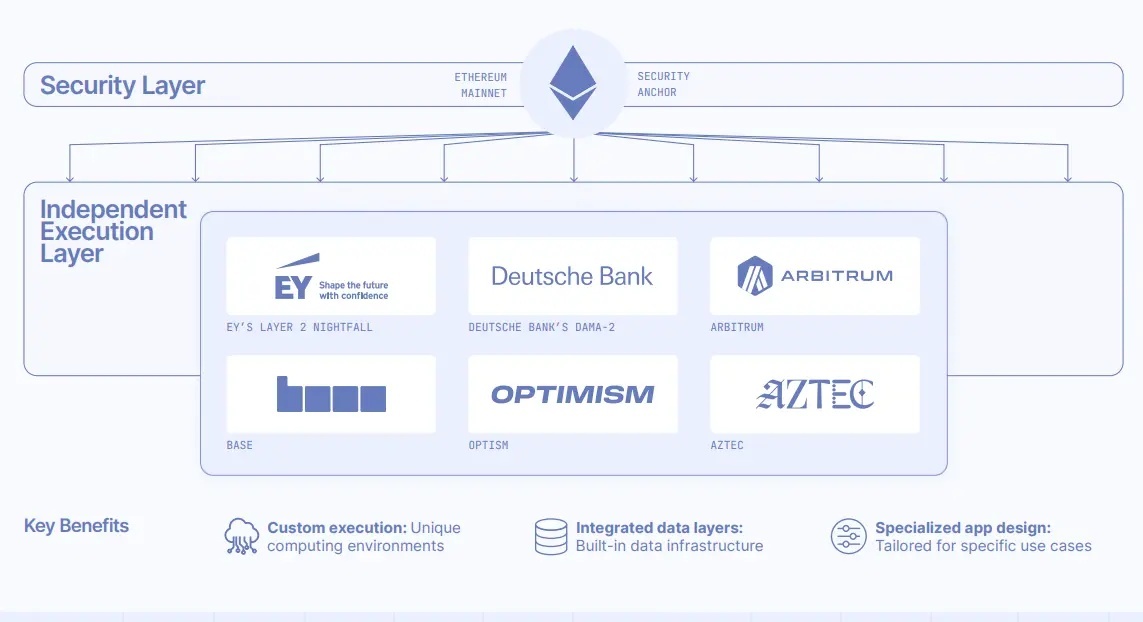
Ernst & Young's Nightfall and Deutsche Bank's DAMA-2 are both institution-built dedicated Layer 2s. Mature Layer 2s in the ecosystem also include Arbitrum, Aztec, ZKsync, Optimism, Base, Ink, Scroll, Unichain, and Linea.
Public sector projects typically keep sensitive data off-chain, using Ethereum to provide verifiable settlement or audit benchmarks.
The Indian government uses Ethereum-based technology to manage land records and caste certificates, combating fraud and ensuring public records are immutable.
Bhutan anchors its National Digital Identity (NDI) system on Ethereum, allowing citizens to autonomously control credentials without relying on a central database that could be breached.
The City of Buenos Aires launched a decentralized digital identity system, allowing users to own their identities and choose what data to share.
The European Investment Bank has issued digital bonds multiple times using Ethereum as a settlement and record layer. Issuance follows traditional legal documents and regulated intermediaries, with Ethereum used to coordinate issuance and settlement rather than replacing existing capital market laws.
UNICEF's CryptoFund uses Ethereum and its assets to receive, hold, and disburse funds, improving grant transparency and auditability while keeping beneficiary data off-chain.
Environmental and Social Considerations
How much energy does Ethereum consume?
After the completion of the Merge in September 2022 and the transition to Proof of Stake, Ethereum network electricity consumption dropped by 99.98%, and its carbon footprint decreased by approximately 99.99%.
Currently, the estimated annual electricity consumption of the entire global Ethereum network is approximately 0.0026 terawatt-hours (about 2,601 megawatt-hours), with an annual carbon footprint of about 870 tons of CO2 equivalent. Before the Merge, Ethereum under Proof of Work consumed about 21 terawatt-hours annually. The essence of this transition is a structural change in network security logic: shifting from consuming computational energy for security to using staked capital (ETH) for economic security.
A set of comparisons illustrates the magnitude of current energy consumption: Global data centers consume about 190 TWh, approximately 73,000 times that of Ethereum; the Bitcoin network consumes about 149 TWh, about 53,000 times; Google consumes about 19 TWh, about 7,300 times; Netflix consumes about 0.457 TWh, about 176 times; PayPal consumes about 0.26 TWh, about 100 times; Airbnb consumes about 0.02 TWh, about 8 times. Ethereum's energy consumption is several orders of magnitude lower than traditional digital infrastructure and Proof of Work systems.
How does Ethereum address problems brought by AI?
As AI systems develop, three fundamental governance challenges emerge.
First, today's cutting-edge AI infrastructure repeats the centralization of the rest of the internet: controlled by a few operators, setting their own rules, and subject to pressure from their respective jurisdictions. Millions of people's AI access could be cut off overnight without warning.
Second, as AI Agents generate realistic media and act autonomously, institutions must solve identity verification problems.
Third, policymakers need to consider how to verify the authenticity and integrity of digital content and machine-generated outputs. Ethereum can serve as a neutral verification layer, providing identity assurance, provenance tracing, and accountability support for these three issues.
In AI collaboration infrastructure, autonomous AI Agents currently lack standardized ways to identify themselves, prove historical records, pay for services, or allow third parties without existing relationships to independently verify their outputs.
Ethereum fills this gap through open standards implementable permissionlessly and fee-free by any developer or institution: ERC-8004 provides portable, censorship-resistant identifiers, standardized reputation interfaces, and hooks for independent output verification for AI Agents; x402 provides a payment standard for machine-to-machine commerce. Both standards are anchored on Ethereum, inheriting its core attributes: no single operator control, irrevocable access rights, and rules verifiable and auditable by anyone.
In identity verification, the proliferation of AI-generated content (deepfakes) and AI Agents has created a need to distinguish human from machine actors.
Ethereum provides a solid底层 for anchoring digital identities and content provenance, reusing open standards developed outside the blockchain ecosystem: W3C Verifiable Credentials (VC) and Decentralized Identifiers (DID) provide a framework for making and verifying identity claims. Ethereum's role is to act as a public, censorship-resistant registry for these identifiers and their issued credentials. The did:ethr method is one such implementation. Bhutan's National Digital Identity project anchors its identity system on Ethereum-based infrastructure.
Regarding content authenticity, creators can cryptographically sign content and timestamp it on an immutable ledger to prove the source and integrity of media.
Ethereum can anchor the cryptographic hash of digital content at a specific point in time. If the content is altered afterward, the hash will not match, making tampering detectable, while the content itself does not need to be put on-chain. This constitutes an auditable integrity record layer, helping to combat misinformation and AI fakes.
In AI Agent governance, as AI Agents begin trading and executing economically significant tasks, corresponding governance frameworks are needed.
ERC-8004 proposes a standardized framework for AI Agent identity, reputation, and verification, introducing a globally unique Agent identifier registry, portable reputation signals, and independent verification of high-risk outputs. These registries settle on Ethereum, inheriting the network's trusted neutrality and Proof of Stake economic security.
Additionally, Ethereum can serve as an important supplement to the AI tech stack, such as using zero-knowledge proofs to help users protect data or identity privacy, or using smart contract commitments to enforce compliance policies. AI is a powerful computing tool, while Ethereum provides the verification layer: a neutral, tamper-proof底层 for registering identities, certifying digital assets, and verifying the authenticity of information in the digital economy of the AI era.
What is post-quantum security, and how does Ethereum address it?
Post-quantum security refers to cryptographic systems that remain secure even if large-scale quantum computers have the capability to break current public-key cryptography. Modern digital systems, including public chains, online banking, and secure internet communications, largely rely on cryptographic schemes that could theoretically be weakened by sufficiently advanced quantum computers.
Quantum computers of this scale do not currently exist, but this risk is recognized as a long-term infrastructure issue.
Quantum resilience is not a problem unique to blockchains but a cross-industry digital infrastructure issue. Many institutions choose to postpone handling it until it becomes imminent. The Ethereum community's stance is that critical infrastructure should be hardened before the threat materializes, not after.
The potential threat of quantum computing to blockchains centers on digital signature security: sufficiently advanced quantum computers could break the elliptic curve cryptography currently used to authenticate user transactions and validator attestations.
Ethereum's response path involves proactive upgrades at the protocol level and a dedicated Post-Quantum Ethereum plan: by separating signature verification logic from settlement rules, the network can complete migration in phases as post-quantum cryptographic standards mature.
Ethereum's open governance model provides a channel for this adaptability. Once post-quantum signature schemes become necessary, they can be introduced through the EIP process and coordinated for adoption by network participants. Practical quantum systems capable of breaking elliptic curve cryptography at scale do not currently exist. The risk is prospective, but the Ethereum community chooses to plan and build for this now rather than waiting for a crisis.

JPMorgan Chase
USJPM

Deutsche Bank AG
USDB

Visa
USV

Tron
USTRON

BitMine Immersion Tech
USBMNR

Sharplink
USSBET
Grayscale Ethereum Staking ETF
USETHE

Robinhood
USHOOD

Solana
USHSDT

BLK
USBLK

688688
SH688688

09988
HK09988

89988
HK89988

BABA
USBABA

KBAB
USKBAB

BABO
USBABO

BABX
USBABX

HBBD
SGHBBD

BMNP
USBMNP

JPM-C
USJPM-C

JPM-D
USJPM-D

JPM-J
USJPM-J

JPM-K
USJPM-K

JPM-L
USJPM-L

JPM-M
USJPM-M
The copyright of this article belongs to the original author/organization.
The views expressed herein are solely those of the author and do not reflect the stance of the platform. The content is intended for investment reference purposes only and shall not be considered as investment advice. Please contact us if you have any questions or suggestions regarding the content services provided by the platform.