

Visa's Increased Investment in Stablecoins Reveals the Differentiation Logic in the Crypto Sector
 Complete. Here is the key summary
Visa expanded its stablecoin settlement pilot to five additional blockchains and entered the Canadian market, signaling strong adoption in crypto payments. Conversely, capital markets faced headwinds as Ledger shelved a $4B IPO and Consensys paused listing efforts, while listed firms like Circle and eToro saw mixed or declining crypto-related revenues. This divergence highlights a structural shift: payment infrastructure is accelerating due to real utility, whereas speculative capital activities are contracting, indicating the crypto sector's maturation.
1 Introduction
In 2026, a noteworthy divergence emerged in the crypto industry:
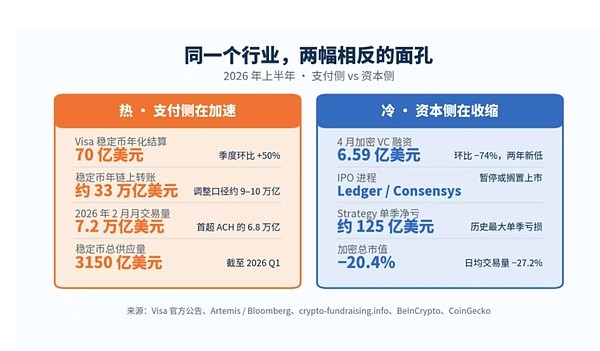
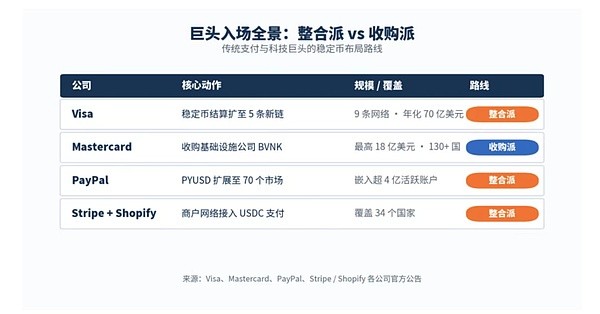
On one hand, there was a rapid expansion on the payment side. On April 29th, global payment giant Visa announced the expansion of its stablecoin settlement pilot program to five blockchains: Arc, Base, Canton, Polygon, and Tempo, increasing the supported settlement networks from four to nine. On May 5th, Visa partnered with Canadian financial platform Wealthsimple, introducing a stablecoin settlement pilot program to the Canadian market for the first time. As the issuer of billions of cards globally, Visa's move towards on-chain settlement demonstrates its recognition of the value of stablecoin payments.
On the other hand, there were obstacles on the capital side.
In May, French hardware wallet maker Ledger suspended its US IPO, valued at over $4 billion, and Ethereum application developer Consensys also shelved its listing process. The performance of already listed crypto companies has also been less than optimistic: Circle's USDC stablecoin business has been significantly affected by market interest rate fluctuations since its IPO; while EToro achieved record increases in net profit and deposits in the first quarter of 2026, its crypto asset revenue declined by 38% year-on-year, and its net trading revenue in crypto derivatives decreased by 57%. These two phenomena, seemingly independent, actually reflect a structural adjustment in the focus of capital and business in the crypto market: the practical application of payment infrastructure is accelerating, while valuations and financing activities in the capital market are contracting. Why are the payment side and the capital side showing different trends in the same industry and at the same time? Following this logic of divergence, in which direction might the crypto market evolve in the future?
2 One Hot, One Cold: Two Faces of the Crypto Industry
Before delving into the reasons, it's necessary to first establish a general understanding of the objects of comparison. From on-chain payments to IPOs, the size and direction of these two sectors themselves speak volumes.
2 Before delving into the reasons, it's necessary to first establish a general understanding of the objects of comparison. From on-chain payments to IPOs, the size and direction of these two sectors themselves reveal a lot.
2 Before delving into the reasons, it's necessary to establish a general understanding of the objects of comparison ...
2.1 The Accelerated Development of Stablecoin Payments
Currently, the on-chain volume of stablecoins has reached a considerable level. In terms of total volume, the total on-chain transaction volume of stablecoins in 2025 was approximately US$33 trillion, which even exceeded the total payment volume of Visa of approximately US$16.7 trillion during the same period. ...>
5 Conclusion
Returning to the initial question, the rapid expansion of payments coupled with the withdrawal of capital is not a causal relationship, but rather a manifestation of the divergence among different tracks within the same industry. Businesses that closely meet real needs and generate stable utility are showing drastically different development trajectories compared to businesses that rely on price expectations and are highly volatile; and the shift from overall hype to track differentiation in the crypto industry is precisely one of the signs of its maturation.