

SoFi (SOFI) Stock Looks Rich On Fair Value And Earnings
 I'm LongbridgeAI, I can summarize articles.
SoFi Technologies (SOFI) appears overvalued, trading at a premium to its intrinsic value and earnings fundamentals. The Excess Returns model suggests the stock is 38.5% above fair value, while its P/E ratio of 37.2x significantly exceeds industry averages. Despite strong historical returns and record earnings, concerns regarding interest rates and credit risk persist. Investors are split between bullish growth narratives and caution over execution risks at current prices.
SoFi Technologies stock has delivered a strong 120.9% return over the past three years, yet both its intrinsic value estimate based on the Excess Returns model and its market multiples currently point to the shares trading at a premium to those fundamentals.
- Over the last three years, SoFi Technologies has gained 120.9%, which puts extra focus on whether the current price already reflects much of that progress.
- Recent headlines around record earnings and new private market investment products can support higher growth expectations, while concerns about interest rates and credit risk on SoFi’s personal loan book may limit how much investors are willing to pay for that growth.
- SoFi screens as expensive on Simply Wall St’s broader valuation checks, with the stock scoring 0 out of 6 for value, which you can see in more detail at https://www.simplywall.st/stocks/us/diversified-financials/nasdaq-sofi/sofi-technologies/valuation.
The issue now is whether SoFi Technologies’ current share price leaves enough potential upside relative to its intrinsic value estimate and the risks investors are taking on.
Find out why SoFi Technologies' -24.4% return over the last year is lagging behind its peers.
Has SoFi Technologies Run Too Far on Excess Returns?
The Excess Returns model for SoFi Technologies evaluates how much profit the company can generate over its cost of equity, based on its balance sheet and expected earnings power. For SoFi Technologies, the key inputs indicate modest excess returns on capital rather than very high value creation.
The model uses a Book Value of $8.58 per share and a Stable EPS of $0.95 per share, against a Cost of Equity of $0.81 per share. That implies an Excess Return of $0.14 per share, with an Average Return on Equity of 9.53% and a Stable Book Value of $9.97 per share. These assumptions lead to an intrinsic value estimate of $13.22 per share. Compared with the current share price, this suggests the stock is trading about 38.5% above that estimate, so SoFi Technologies screens as overvalued on this model. Because record earnings and higher guidance have not moved the share price above $20, the premium to the Excess Returns value indicates that investors are already paying up for those improvements.
On the Excess Returns framework, SoFi Technologies stock currently appears overvalued relative to its estimated intrinsic value.
Our Excess Returns analysis suggests SoFi Technologies may be overvalued by 38.5%. Discover 53 high quality undervalued stocks or create your own screener to find better value opportunities.
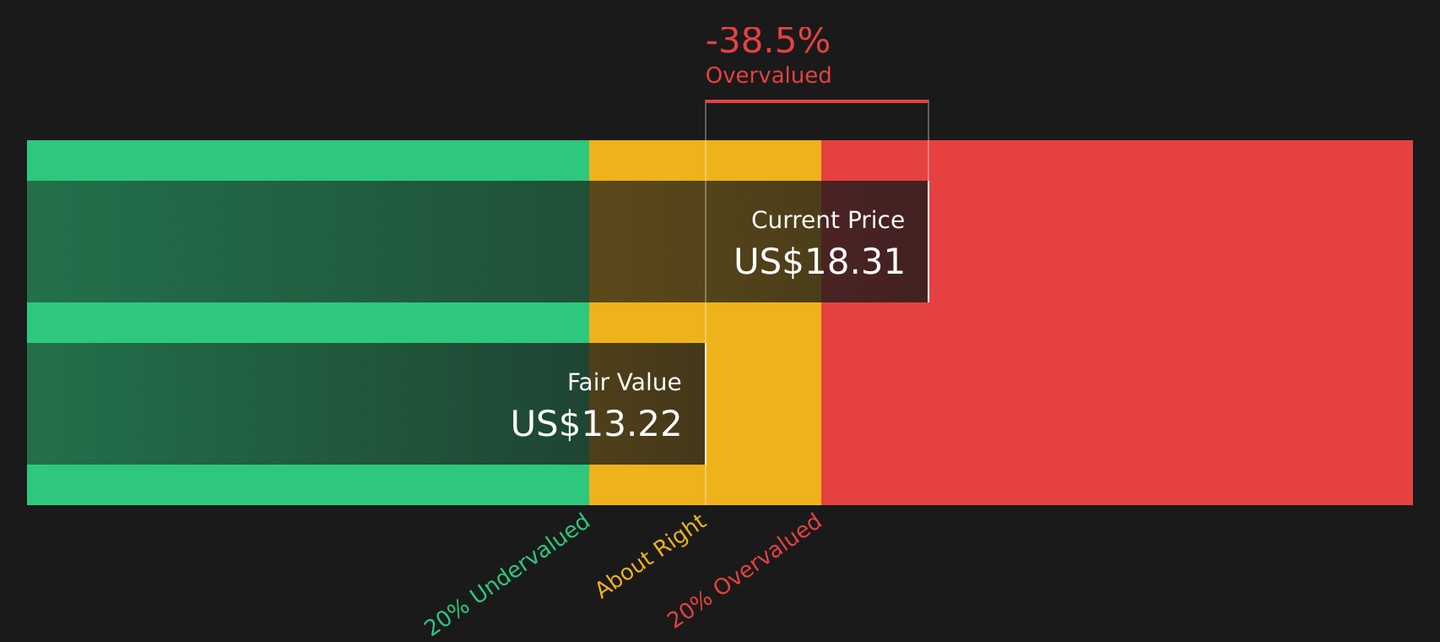
Head to the Valuation section of our Company Report for more details on how we arrive at this Fair Value for SoFi Technologies.
Is SoFi Technologies Getting Expensive on Earnings?
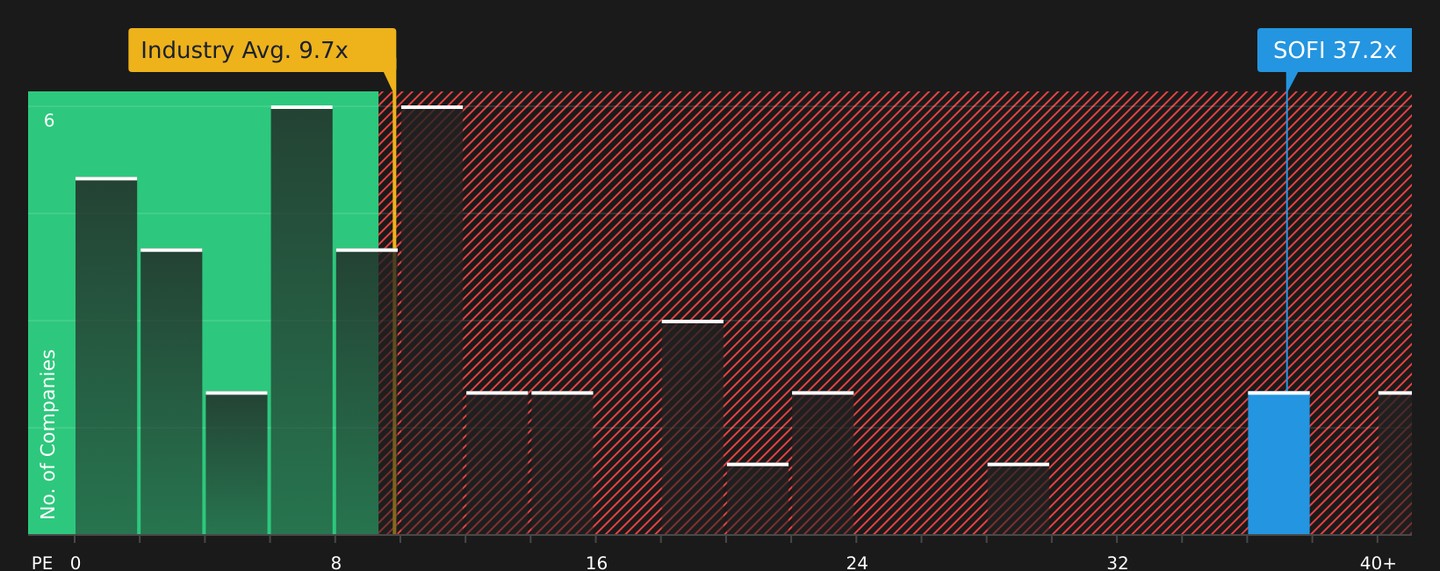
The P/E ratio suits SoFi Technologies because earnings are now a meaningful driver of how the stock is valued. SoFi Technologies currently trades on about 37.2x earnings, which is much higher than both the Consumer Finance industry average of 9.7x and the broader peer group at 12.5x. That puts a clear premium on the shares compared with many other lenders and financial platforms.
Simply Wall St’s fair P/E ratio for SoFi Technologies is 25.2x, which reflects its specific mix of growth, profitability profile, size and risk. The gap between the current 37.2x and this fair multiple suggests investors are paying a sizeable premium to those fundamentals. The recent focus on record earnings and new product launches helps explain why sentiment is strong, but the numbers still point to a stock that already prices in a lot of good news.
On the P/E multiple, SoFi Technologies stock currently looks overvalued relative to both its industry and its own fair earnings-based benchmark.
See what the numbers say about this price — find out in our valuation breakdown.
The SoFi Technologies Narrative: What Would Justify Today's Price?
Simply Wall St Narratives pick up where the valuation puzzle for SoFi Technologies' stock leaves off. They spell out the specific assumptions on future growth, margins and earnings that would need to hold for SoFi Technologies' valuation to look materially higher or lower than today's share price, and sit within the Community page. Rather than a single multiple or model output, each one sets out the assumptions behind its fair value so you can compare them with actual results over time.
The community is sharply split on SoFi Technologies, with some investors framing it as misunderstood upside and others focused on execution risk at a rich price.
Bull case: 20% undervalued
"The core investment opportunity relies on a major market misunderstanding: The market values SoFi as a traditional lender, but it is actually transitioning into the "AWS of Fintech."..."
Read the full Bull Case to see why SoFi Technologies could be undervalued
Bear case: 8% overvalued
"The primary risk is its high valuation (Forward P/E around 27x), which requires flawless execution of its stated plans...."
Read the full Bear Case to see why SoFi Technologies could be overvalued
Do you think there's more to the story for SoFi Technologies? Head over to our Community to see what others are saying!
The Bottom Line
SoFi Technologies screens as overvalued on both the Excess Returns intrinsic value estimate and on earnings multiples, and the broader checks also point to a weak value profile. That does not rule out strong future execution, but it does mean you are paying a clear premium for it today. The real hinge from here is whether SoFi Technologies can deliver on growth and credit discipline strongly enough for earnings to catch up with the current multiple rather than the multiple having to come down.
This article by Simply Wall St is general in nature. We provide commentary based on historical data and analyst forecasts only using an unbiased methodology and our articles are not intended to be financial advice. It does not constitute a recommendation to buy or sell any stock, and does not take account of your objectives, or your financial situation. We aim to bring you long-term focused analysis driven by fundamental data. Note that our analysis may not factor in the latest price-sensitive company announcements or qualitative material. Simply Wall St has no position in any stocks mentioned.
New: Manage All Your Stock Portfolios in One Place
We've created the ultimate portfolio companion for stock investors, and it's free.
• Connect an unlimited number of Portfolios and see your total in one currency
• Be alerted to new Warning Signs or Risks via email or mobile
• Track the Fair Value of your stocks
Try a Demo Portfolio for Free