

AUD/NZD, NZD/USD Forecast: Oil, Rates And Risk Appetite Back In Focus
 I'm LongbridgeAI, I can summarize articles.
AUD/NZD and NZD/USD forecasts highlight diverging drivers: AUD/NZD is influenced by rates, oil, and risk appetite, while NZD/USD remains tied to US Fed policy. Key upcoming events include Australian Q1 GDP and US job openings data. Technical analysis suggests buying dips for AUD/NZD above 1.2118, whereas NZD/USD faces resistance at .5920 with a preference for selling rallies.
- Last week's Kiwi breakout and AUD/NZD reversal delivered
- AUD/NZD remains driven by rates, oil and risk appetite
- NZD/USD still looks more Fed than RBNZ
- Australia's GDP report may reshape the Aussie outlook
- US job openings surge reinforces exceptionalism narrative
Looking Beyond The RBNZ
Both NZD/USD and AUD/NZD have moved largely as anticipated over the past week, with the Kiwi outperforming after the RBNZ's hawkish hold while AUD/NZD reversed sharply lower. With Australian GDP due later today and markets continuing to reassess the implications of elevated oil prices, strong US labour market data and shifting rate expectations, the focus now turns to where the next opportunities may lie.
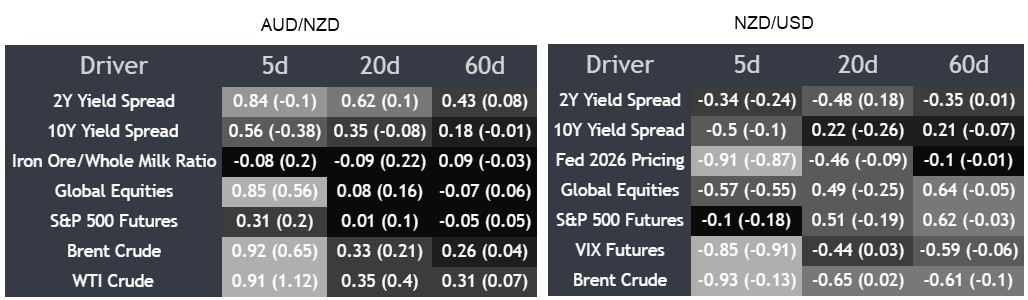
One of the more interesting developments over the past week has been the strength of the relationships emerging between both pairs and several key macro drivers.
Source: TradingView
Looking at the matrix above, AUD/NZD appears much more rates driven than NZD/USD right now, with the Aussie a higher beta play on broader risk appetite. The strength of the near-term relationship with crude oil also suggests Australia's standing as a net energy exporter has helped it rebound as oil prices have in recent days.
For NZD/USD, the picture looks very different. Despite the RBNZ's hawkish shift, the strongest relationships continue to sit with US variables, particularly Fed pricing, oil and volatility. That suggests the strength of the US economy and what it means for the future path of Fed policy continues to exert a greater influence on the pair than the prospect of additional RBNZ tightening. The recent rebound in crude prices and accompanying pullback in the Kiwi reinforces that point.
Reinforcing the US economic exceptionalism narrative, job openings recorded an unbelievable increase in April, leaving the US with more vacancies than available workers again. While the decline in hiring and quits offsets some of the signal, futures continue to price just 14 basis points of Fed hikes this year.
That's a very different backdrop to New Zealand where policymakers increasingly look prepared to hammer growth in the name of taming inflation. While the RBNZ's hawkish lurch helped spark the initial move higher in the Kiwi, the matrix suggests the pair continues to trade primarily as a US story.
New Risks, New Opportunities
While the relationships highlighted above help explain moves seen over the past week, several important event risks now loom that may determine whether they remain intact.
For AUD/NZD, the immediate focus is Australian Q1 GDP. While the headline will attract the attention, household consumption and productivity measures may prove more influential, especially following yesterday's larger-than-expected 4.75% increase in the minimum wage. With inflation pressures already elevated, any further signs of weak productivity growth may complicate the RBA's task.
For NZD/USD, the focus remains firmly offshore. With oil prices rebounding and recent US data reinforcing the economic exceptionalism narrative, the key question is whether markets will need to further adjust expectations for the future path of Fed policy.
AUD/NZD Reversal Complete?
Source: TradingView
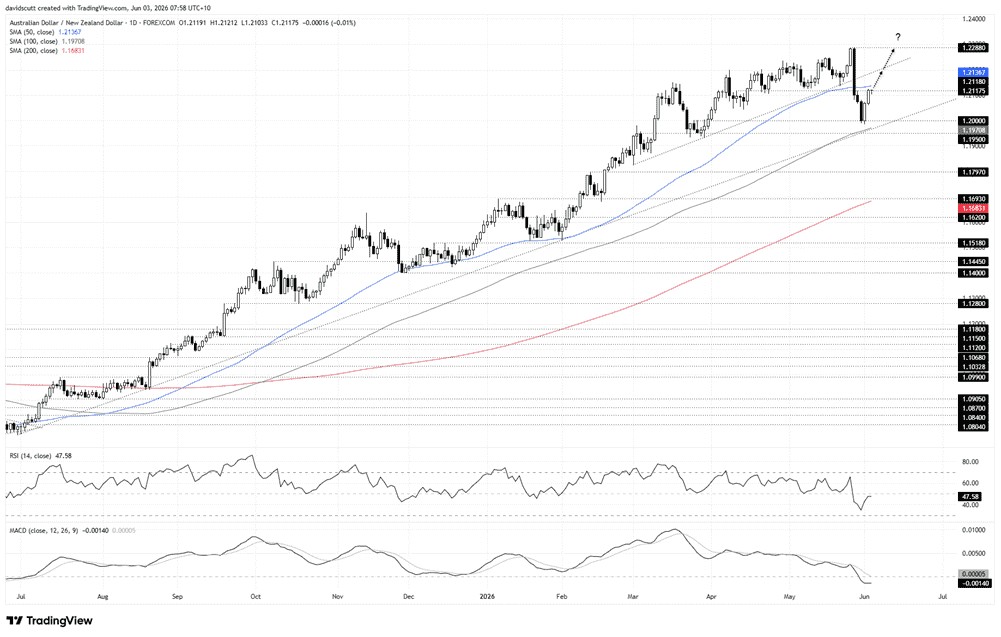
Reversal risk flagged for AUD/NZD played out nicely late last week, with the pair slicing through a support zone comprising the March 1 uptrend and 50-day moving average like a hot knife through butter, breaking beneath horizontal support at 1.2118 before stalling at 1.2000 support. Since then, we've seen a corrective bounce, coinciding with firm risk appetite and a sharp rebound in crude prices, leaving the cross back testing former support at 1.2118.
That level now looms as the one to watch for anyone contemplating fresh setups, providing a useful level for protection depending on how the price action evolves. While the oscillators marginally favour short setups over longs, with RSI (14) sitting just below 50 while MACD has flipped negative having already crossed the signal line from above, the preference remains to stick with the broader bullish trend, favouring buying dips and bullish breakouts.
As such, should we see the pair break above 1.2118 and hold there, longs could be established with a tight stop below, targeting the high of 1.2288 set last week. The 50-day moving average is an important level to monitor overhead, so if the pair shows hesitation around it, be prepared to jettison the position. Some residual resistance may also be encountered at 1.2200.
NZD/USD: Watching .5920
Source: TradingView
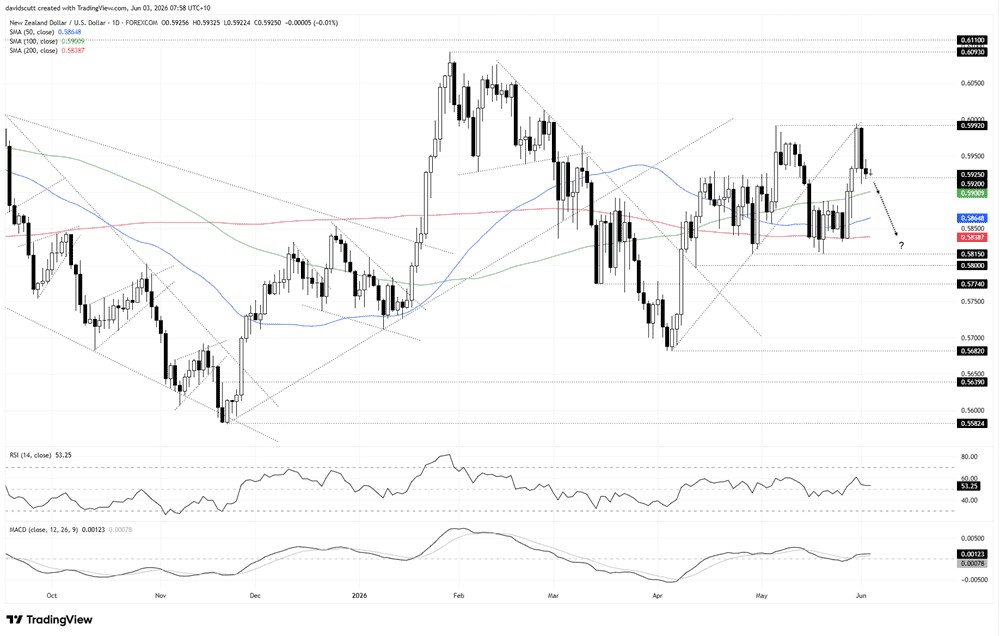
NZD/USD broke out strongly following the RBNZ's hawkish turn last week, seeing the pair smash through resistance at .5920 before the move stalled at .5992, the high set in early May. From there, the pair has now fully retraced the breakout, leaving it sitting just above former resistance at .5920.
The pair has already had multiple probes beneath the level only to be shoved back above, but it's notable how feeble the Kiwi's bounces have been so far. As such, despite the oscillators marginally favouring longs over shorts, the preference is to sell rallies and downside breaks.
Should the pair break beneath .5920 and hold there, shorts could be established with a tight stop above, targeting the 200-day moving average at .5839 initially. The 100-day moving average is a level of note in between, so any signs of hesitation around it should lead to a reassessment on whether to hold out for the target or cut and run.