

Global Capital Returns to Asia-Pacific Real Estate
 I'm LongbridgeAI, I can summarize articles.
Asia-Pacific commercial real estate investment surged 31.1% to $53.5 billion in Q2 2026, driven by international capital targeting Japan and Singapore. Hotel investments rose 55.2%, while cross-border flows hit $12.5 billion. Despite a quarterly dip from Q1 records, Knight Frank views this as normalization amid a selective recovery focused on high-quality assets with resilient income.
Asia-Pacific commercial real estate investment jumped by more than 30 percent in the second quarter of 2026, with international investors increasingly targeting major gateway markets such as Japan and Singapore. Hotels emerged as a particular bright spot as institutional capital returned selectively to the region.
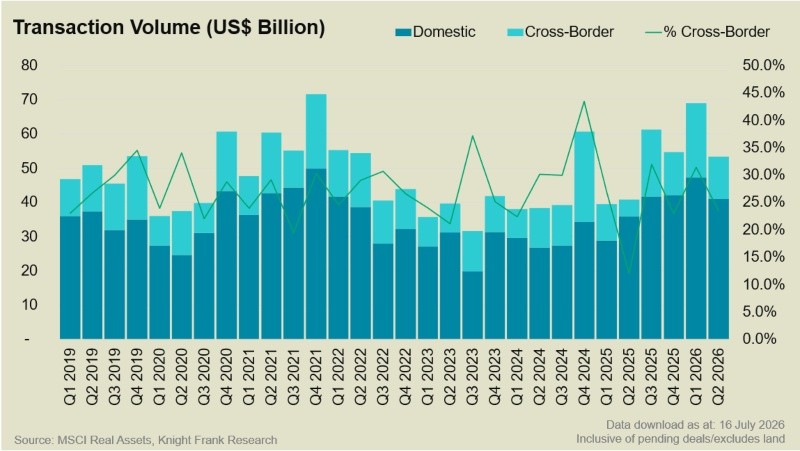
Commercial real estate investment across Asia-Pacific reached 53.5 billion dollar in the second quarter of 2026, an increase of 31.1 percent from a year earlier, according to the latest Asia-Pacific Capital Markets Insights report from Knight Frank.
Transaction volumes were also 16.1 percent above the five-year average for the second quarter, highlighting the continued recovery in the region's property investment markets.
Compared with the record first quarter, however, investment declined by 22.5 percent. Knight Frank views the slowdown as a normalisation following an exceptionally strong start to the year rather than a reversal of the broader recovery.
«Q2's pullback from Q1's record turnover is a moderation from an exceptional quarter, not a change in direction,» said Dan Dixon, Head of Capital Markets, Asia-Pacific at Knight Frank.
(Graphic: provided)
According to Dixon, institutional investors are increasingly returning to the market, but are deploying capital selectively, with a focus on assets offering resilient income streams and clear opportunities for value creation.
Cross-Border Capital Surges
One of the clearest signs of renewed investor appetite was the sharp increase in cross-border activity. International investment into Asia-Pacific reached 12.5 billion dollar during the quarter, accounting for 23.4 percent of total regional investment.
While this represented a decline of 42.2 percent from the particularly strong first quarter, cross-border investment was 156.8 percent higher than in the same period last year.
The figures suggest that international investors are becoming more willing to deploy capital in markets where pricing, liquidity and income fundamentals offer sufficient visibility, despite a more challenging interest-rate environment.
Japan remained the region's leading destination for international capital, attracting 5 billion dollar of cross-border investment – more than twice the amount recorded a year earlier.
Demand remained resilient despite softer overall transaction volumes and the Bank of Japan's interest rate increase to 1 percent in June. Knight Frank said the figures reinforced Japan's position as a core market for global investors due to its liquidity, scale and broad range of investment opportunities.
Singapore Attracts International Investors
Singapore ranked second, attracting 3 billion dollar in cross-border capital, more than three times the level recorded in the second quarter of 2025.
International investors accounted for 58.1 percent of the city-state's total real estate investment volume during the period.
A major contributor was IOI Properties Group's 1.9 billion dollar acquisition of Asia Square Tower 2 from CapitaLand Integrated Commercial Trust. The transaction highlighted continued demand for prime office properties in Singapore's central business district.
According to Knight Frank, stable recurring income and a constrained development pipeline continue to support international appetite for high-quality Singapore office assets.
Australia was the third-largest recipient of cross-border investment, attracting 1.9 billion dollar, an increase of 56.9 percent from a year earlier.
Hotels Emerge as a Bright Spot
Hospitality assets were among the strongest-performing segments across the region. Hotel investment reached 5.4 billion dollar in the second quarter, up 55.2 percent year-on-year.
Knight Frank attributed the increase to the continued tourism recovery, improving hotel operating performance and a limited supply of high-quality properties. Investors are also targeting refurbishment, repositioning and rebranding opportunities as a way of generating additional returns.
Among the larger transactions was CapitaLand Investment's 243.1 million dollar acquisition of Voco Seoul Myeongdong. In Australia, Wentworth Capital acquired two Sydney hotels for 269.2 million dollar.
Cross-border investment in Australian hotels alone increased almost fivefold to 674 million dollar.
A More Selective Recovery
Despite the strong headline numbers, Knight Frank expects the next phase of Asia-Pacific's real estate recovery to become increasingly selective.
«While Q2's results reinforce the underlying strength of Asia-Pacific's investment recovery, the path forward looks more uneven than the headline growth suggests,» said Christine Li, Head of Research, Asia-Pacific at Knight Frank.
Liquidity is increasingly concentrating around quality assets, transparent pricing and large-scale investment opportunities, according to Li. Prime offices, selected retail and logistics properties as well as tourism-linked hotels are expected to remain in focus.
With transaction volumes still above both year-earlier levels and the five-year quarterly average, Asia-Pacific enters the second half of 2026 with positive momentum. But rather than a broad-based investment boom, Knight Frank expects investors with the ability to identify quality assets and execute complex transactions to drive the next stage of the recovery.