

Building the foundation of digital quantum co-processors: HOLO MicroCloud Hologram FPGA Quantum Fourier Transform Layered IP Core Generator
 I'm LongbridgeAI, I can summarize articles.
MicroCloud Hologram (NASDAQ:HOLO) released a hierarchical IP core generator for implementing Quantum Fourier Transform (QFT) in FPGAs. This technology maps quantum gate operations to synthesizable VHDL modules, aiming to build a repeatable and scalable digital quantum coprocessor environment to accelerate quantum engineering applications such as Shor's algorithm, bridging theoretical algorithms with real quantum hardware
In the critical stage where quantum computing gradually transitions from theoretical research to engineering realization, how to efficiently simulate, verify, and accelerate quantum algorithms on existing classical hardware platforms has become a core issue of common concern for both industry and academia. From an overall architectural perspective, modern quantum computers are not a single form of computing device, but rather a hybrid computing system composed of classical computing systems and quantum coprocessors working in synergy. Classical computers are responsible for control, scheduling, preprocessing, and postprocessing, while quantum coprocessors are responsible for executing quantum state evolution and core quantum operators. Against the backdrop of current limitations in the scale and stability of real usable quantum hardware, FPGA-based digital quantum coprocessors have become an important bridge connecting theoretical algorithms and real quantum hardware.
In this context, MicroCloud Hologram (NASDAQ:HOLO) has proposed the engineering concept of digital quantum bits. Unlike physical quantum bits that rely on physical properties such as superposition and entanglement, digital quantum bits express the amplitude and phase evolution of wave functions through digital logic structures in FPGAs, with their operation strictly adhering to the mathematical description of quantum mechanics. MicroCloud Hologram has released a milestone technology—a hierarchical IP core generator for implementing quantum Fourier transforms in FPGAs. This technology revolves around one of the most critical fundamental operators in quantum computing—the Quantum Fourier Transform (QFT). Through this technological solution, quantum gate operations, state evolution, and measurement processes can be mapped as synthesizable VHDL modules, thereby constructing a repeatable, verifiable, and scalable quantum computing execution environment on FPGAs. Among numerous quantum algorithms, Shor's factoring algorithm is widely regarded as one of the most representative applications, with its core advantage stemming from the exponential acceleration capability of the quantum Fourier transform in the periodicity discovery process. However, the engineering implementation of the Shor algorithm heavily relies on the accuracy and scalability of the QFT. To this end, at the early stage of technology development, MicroCloud Hologram systematically estimated the computational complexity of various quantum operations that must be executed in the Shor algorithm, constructing a complexity assessment model aimed at engineering implementation from multiple dimensions, including gate count, phase rotation accuracy, quantum bit scale, and control logic complexity.
This assessment does not remain at a theoretical level but directly serves the design choices for the FPGA implementation path. Through complexity estimation, MicroCloud Hologram clarified the consumption trends of QFT modules on FPGA resources at different quantum bit scales, including the usage of lookup tables (LUTs), flip-flops (FFs), DSP units, and on-chip storage resources. This laid a quantitative foundation for the subsequent design of the hierarchical IP core generator, enabling the generator to achieve controllable trade-offs between performance, accuracy, and resource usage.
On this basis, MicroCloud Hologram proposed and implemented a multi-level VHDL description generator for the realization of quantum Fourier transforms. This generator is not a simple code template tool but a structured generation system with algorithmic understanding capabilities. Its core idea is to create a three-layer mapping of the mathematical structure of QFT, the quantum circuit structure, and the FPGA hardware structure, and to build automated generation logic on top of this At the top level, the generator takes quantum algorithm-level descriptions as input, capable of identifying the number of qubits required for the target Quantum Fourier Transform (QFT), the precision of rotation gates, and whether to enable approximate QFT and other algorithm parameters. This layer corresponds to the algorithm abstraction layer, primarily responsible for converting the mathematical definition of the quantum Fourier transform into an executable sequence of quantum gates.
In the middle layer, the generator maps the quantum gate sequence to logical structure modules, including controlled phase rotation modules, Hadamard modules, swap networks, and control paths. This layer is the key to the entire system, as it not only needs to ensure the logical correctness of the quantum circuit but must also fully consider the parallel characteristics, pipelined structure, and timing constraints of the FPGA. Through modular decomposition and parameterized design, the generator can support QFT implementations of varying scales and precision requirements within the same framework.
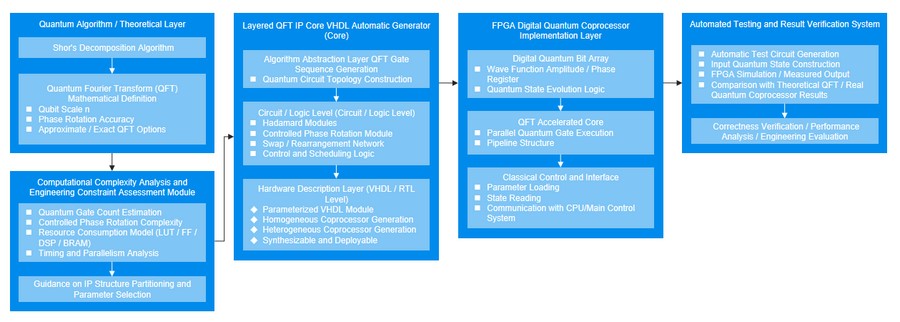
At the bottom layer, the generator automatically outputs synthesizable VHDL description files that adhere to strict hardware description specifications and can be directly used for FPGA synthesis, layout, routing, and timing analysis. Moreover, the generator supports the automatic generation of descriptions for homogeneous and heterogeneous coprocessors. In homogeneous mode, multiple quantum processing units adopt a unified structure, suitable for applications with strong regularity and clear scalability; in heterogeneous mode, different quantum processing units can adopt differentiated structural configurations to adapt to specific algorithm phases or resource constraints.
To ensure the correctness and reliability of the generated IP cores, MicroCloud Hologram (NASDAQ:HOLO) has integrated a set of automated test circuit generation mechanisms within this technology system. When outputting the QFT coprocessor description, the generator simultaneously generates corresponding test circuits and test vectors. These test circuits can run in an FPGA simulation environment to verify key quantum state evolution results and compare them with theoretical quantum Fourier transform results. This mechanism significantly lowers the threshold for quantum hardware validation, enabling researchers to conduct systematic studies of complex quantum algorithm execution processes without the need for real quantum computers.
From the perspective of enterprise engineering practice, this layered IP core generator significantly enhances the efficiency of converting quantum algorithms from theory to hardware. In traditional methods, any change in the scale of a quantum circuit could mean extensive manual VHDL modifications and revalidation, whereas this generator achieves one-time development and multi-scale reuse through parameterization and hierarchical design. This not only reduces R&D costs but also lays a universal foundation for supporting more quantum algorithm modules in the future.
From a broader industrial perspective, this technology provides critical infrastructure for building scalable quantum computing coprocessing platforms. Digital quantum coprocessors implemented via FPGA can serve as important components of quantum cloud platforms, quantum algorithm verification environments, and quantum hardware-software collaborative development platforms. Enterprises can leverage this technology to deploy quantum acceleration modules in existing data centers and embedded systems, thereby laying out the quantum computing application ecosystem in advance without relying on large-scale physical quantum hardware This technology is also of significant importance in education, scientific research, and standardization. Through the generation and verification of QFT IP cores, researchers can systematically study the behavioral characteristics of quantum algorithms under different hardware conditions, providing empirical data support for the architectural design of future real quantum computers. This progressive path from digital simulation to physical implementation is also considered a realistic choice for the engineering and industrialization of quantum computing.
The hierarchical IP core generator for the implementation of quantum Fourier transform in FPGA using MicroCloud Hologram is not only a single-point technological innovation but also a systematic solution aimed at the future quantum computing engineering system. By organically combining quantum mechanical descriptions, algorithm structures, and digital hardware design, it provides a solid foundation for enterprises to build controllable, scalable, and verifiable technological capabilities in the era of quantum computing. As this technology continues to evolve and application scenarios expand, its strategic value in the quantum computing industry chain will further emerge