

Picton Property Income Limited's (LON:PCTN) Has Been On A Rise But Financial Prospects Look Weak: Is The Stock Overpriced?
 I'm LongbridgeAI, I can summarize articles.
Picton Property Income (LON:PCTN) has seen an 18% rise in stock price over the last three months, but its financial prospects appear weak. The company's return on equity (ROE) stands at 7.8%, similar to the industry average, yet it has experienced a 22% decline in net income over five years. With a high payout ratio of 86%, it retains only 14% of profits, impacting earnings growth. Analysts expect slight improvement in earnings growth, but concerns remain about the company's ability to effectively utilize retained earnings for future growth.
Picton Property Income (LON:PCTN) has had a great run on the share market with its stock up by a significant 18% over the last three months. We, however wanted to have a closer look at its key financial indicators as the markets usually pay for long-term fundamentals, and in this case, they don't look very promising. In this article, we decided to focus on Picton Property Income's ROE.
ROE or return on equity is a useful tool to assess how effectively a company can generate returns on the investment it received from its shareholders. Simply put, it is used to assess the profitability of a company in relation to its equity capital.
We've found 21 US stocks that are forecast to pay a dividend yield of over 6% next year. See the full list for free.
How Do You Calculate Return On Equity?
The formula for ROE is:
Return on Equity = Net Profit (from continuing operations) ÷ Shareholders' Equity
So, based on the above formula, the ROE for Picton Property Income is:
7.8% = UK£41m ÷ UK£528m (Based on the trailing twelve months to September 2025).
The 'return' is the profit over the last twelve months. One way to conceptualize this is that for each £1 of shareholders' capital it has, the company made £0.08 in profit.
Check out our latest analysis for Picton Property Income
What Has ROE Got To Do With Earnings Growth?
We have already established that ROE serves as an efficient profit-generating gauge for a company's future earnings. We now need to evaluate how much profit the company reinvests or "retains" for future growth which then gives us an idea about the growth potential of the company. Assuming everything else remains unchanged, the higher the ROE and profit retention, the higher the growth rate of a company compared to companies that don't necessarily bear these characteristics.
A Side By Side comparison of Picton Property Income's Earnings Growth And 7.8% ROE
At first glance, Picton Property Income's ROE doesn't look very promising. Yet, a closer study shows that the company's ROE is similar to the industry average of 7.7%. But Picton Property Income saw a five year net income decline of 22% over the past five years. Remember, the company's ROE is a bit low to begin with. So that's what might be causing earnings growth to shrink.
However, when we compared Picton Property Income's growth with the industry we found that while the company's earnings have been shrinking, the industry has seen an earnings growth of 1.4% in the same period. This is quite worrisome.
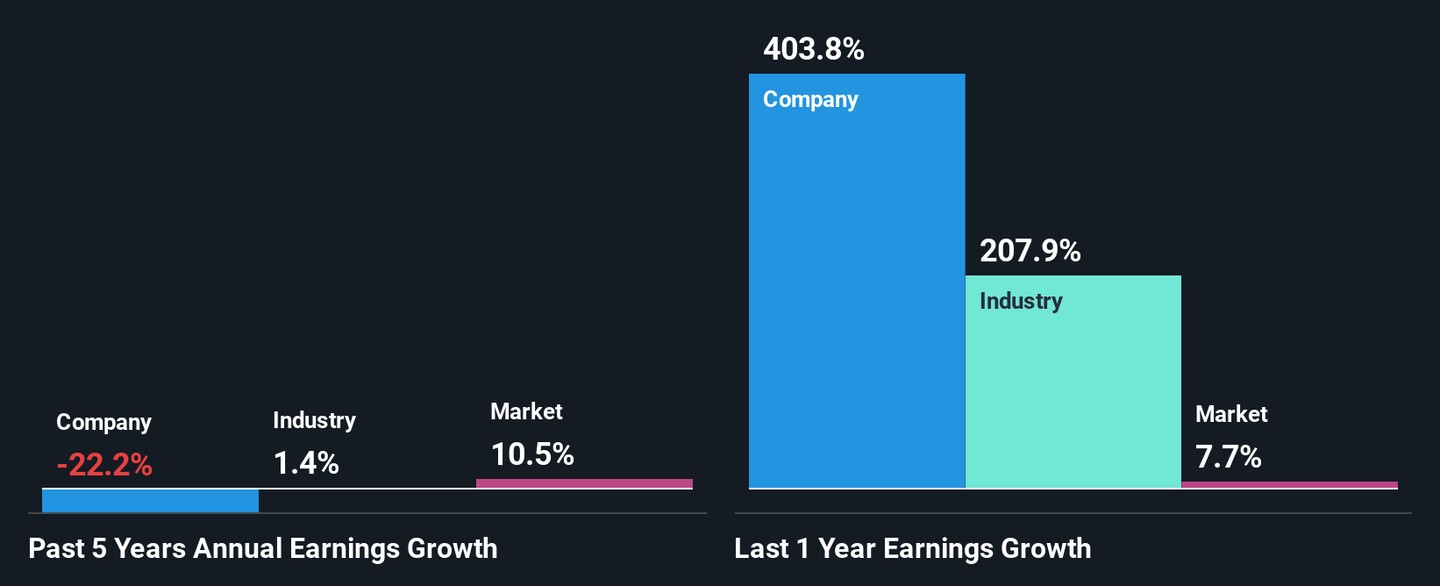
The basis for attaching value to a company is, to a great extent, tied to its earnings growth. What investors need to determine next is if the expected earnings growth, or the lack of it, is already built into the share price. This then helps them determine if the stock is placed for a bright or bleak future. Is Picton Property Income fairly valued compared to other companies? These 3 valuation measures might help you decide.
Is Picton Property Income Using Its Retained Earnings Effectively?
Picton Property Income has a very high three-year median payout ratio of 86%, implying that it retains only 14% of its profits. However, it's not unusual to see a REIT with such a high payout ratio mainly due to statutory requirements. Accordingly, this likely explains why its earnings have been shrinking.
Moreover, Picton Property Income has been paying dividends for at least ten years or more suggesting that management must have perceived that the shareholders prefer dividends over earnings growth.
Summary
On the whole, Picton Property Income's performance is quite a big let-down. The company has seen a lack of earnings growth as a result of retaining very little profits and whatever little it does retain, is being reinvested at a very low rate of return. Having said that, we studied the latest analyst forecasts, and found that analysts are expecting the company's earnings growth to improve slightly. This could offer some relief to the company's existing shareholders. Are these analysts expectations based on the broad expectations for the industry, or on the company's fundamentals? Click here to be taken to our analyst's forecasts page for the company.
New: Manage All Your Stock Portfolios in One Place
We've created the ultimate portfolio companion for stock investors, and it's free.
• Connect an unlimited number of Portfolios and see your total in one currency
• Be alerted to new Warning Signs or Risks via email or mobile
• Track the Fair Value of your stocks
Try a Demo Portfolio for Free