
Wall Street earns hefty commissions from SpaceX's initial public offering and large merger deals
 I'm LongbridgeAI, I can summarize articles.
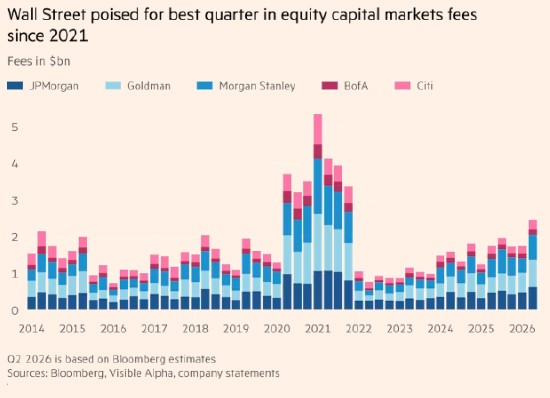
Driven by the SpaceX IPO and the recovery of large merger and acquisition transactions, the commissions from the investment banking businesses of the five major Wall Street investment banks are expected to increase by 27% year-on-year to USD 11.1 billion in the second quarter, reaching a new high since 2021. Among them, the equity capital markets business benefited from SpaceX underwriting fees of USD 2.5 billion, and the commissions from merger and acquisition activities also surged by 30% to over USD 4 billion. The market expects that the total net profit of these six leading banks in the second quarter will be approximately USD 44 billion, a year-on-year increase of 18%
Driven by the significant IPO of SpaceX and the revival of large-scale merger and acquisition transactions, major investment banks on Wall Street are set to announce their highest investment banking commission revenue in four and a half years this week.
Forecast data shows that the commission revenue from investment banking for the five leading U.S. investment banks—JP Morgan, Goldman Sachs, Morgan Stanley, Bank of America, and Citigroup—is expected to increase by 27% year-on-year in the second quarter.
The total commission scale may reach $11.1 billion, setting a new high since the peak of the industry in 2021.
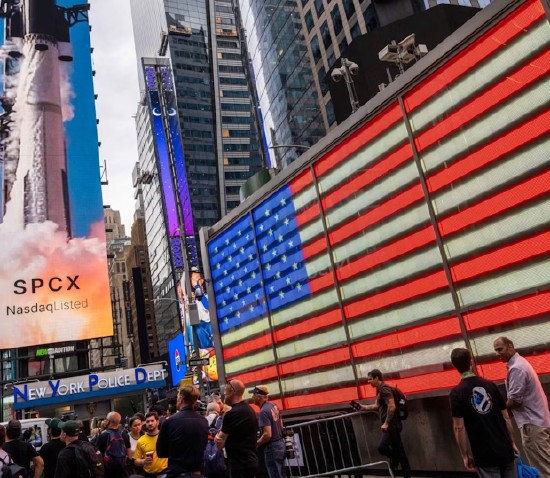
A significant portion of the commission increase comes from equity capital market activities, with the total revenue from this segment for the five major investment banks expected to reach $2.5 billion. The core driver is the $500 million underwriting commission brought by the SpaceX IPO project for 23 participating investment banks, which is also the highest underwriting fee for an IPO in history. Goldman Sachs and Morgan Stanley each earned $100 million from this transaction.
Brian Malberty, Chief Market Strategist at Zacks Investment Management, stated, "The SpaceX IPO transaction is massive, and we expect all participating underwriters to benefit significantly."
Bankers and analysts have pointed out that a number of large tech companies have completed their IPOs or are about to enter the capital market, including SpaceX, OpenAI, and Anthropic.
However, due to the impact of high interest rates, the IPO activities of small and medium-sized enterprises under private equity firms have been relatively quiet.
The merger and acquisition commission revenue for the five major investment banks is expected to surge by about 30% year-on-year, exceeding $4 billion; this is also the first time since 2021 that this segment's commissions have stabilized above the $4 billion mark for three consecutive quarters.
The revival of large merger and acquisition transactions valued at over $10 billion has brought substantial benefits to Wall Street investment banks. Morgan Stanley mentioned in a client report this week that the disclosed global merger and acquisition transaction volume in 2026 is expected to reach a historical high.
JP Morgan, Goldman Sachs, Morgan Stanley, Bank of America, Citigroup, and Wells Fargo are all scheduled to release their earnings reports on Tuesday, with Morgan Stanley postponing its disclosure to Wednesday. The market expects these six banks to report a combined net profit of approximately $44 billion in the second quarter, an increase of 18% year-on-year.
 The trading departments of various banks will also benefit from the increased volatility in the financial markets, providing clients with trading facilitation and financing services, with stock trading business growth being particularly remarkable.
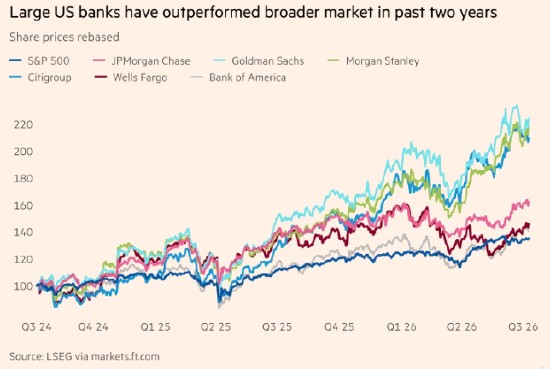
While the investment banking sector has achieved growth, credit business losses have remained at relatively moderate levels, supporting a rise in bank stocks. Over the past two years, the banking sector has outperformed the broader market. This has led the market to begin questioning how much further upside there is for bank stocks.
Sol Martinez, head of U.S. financial sector equity research at HSBC, stated: "The market's expectations have been raised. This quarter's performance should be good, but the market has already anticipated this, and stock price movements have reflected that."
Investors will also closely examine bank balance sheets for signs of pressure on U.S. consumers. Currently, in the face of import tariffs, the U.S.-Iran conflict, and rising oil prices, American consumers' ability to withstand risks appears relatively strong.
Martinez noted: "The real concern is if conflicts escalate again, oil prices rebound significantly, and inflation resurfaces; that is when economic growth will become worrisome."