

A Look At National Australia Bank’s Valuation As Credit Costs Rise And Capital Settings Turn More Cautious
 I'm LongbridgeAI, I can summarize articles.
National Australia Bank (ASX:NAB) anticipates first half credit impairment costs to reach A$706m, doubling previous levels due to uncertainties from the Iran war. The current share price is A$41.21, with a 1-year total shareholder return of 27.22%. However, recent trends show a 30-day return of -9.57%. The fair value is estimated at A$41.53, while a DCF model suggests A$40.67. Investors are advised to consider broader market opportunities and assess risks related to rising credit costs and profitability.
National Australia Bank (ASX:NAB) has warned that first half credit impairment costs are expected to reach A$706m, roughly double prior levels, as it responds to uncertainty linked to the Iran war.
See our latest analysis for National Australia Bank.
At a share price of A$41.21, National Australia Bank has seen a 1 year total shareholder return of 27.22% and a 5 year total shareholder return of 97.62%. However, the 30 day share price return of negative 9.57% and 7 day share price return of negative 7.79% suggest momentum has cooled following the credit impairment update, the revised software capitalisation approach and the capital raising via the dividend reinvestment plan.
If you are weighing bank risk and income, it can help to broaden your watchlist with other established names using our screener of 4 top founder-led companies
With credit costs rising, software expenses set to lift and fresh capital coming in via the dividend reinvestment plan, should you see A$41.21 as a reset that leaves upside on the table, or has the market already priced in what comes next?
Most Popular Narrative: 1% Undervalued
With National Australia Bank last closing at A$41.21 against a narrative fair value of A$41.53, the current price sits only slightly below what that widely followed view suggests, which puts more focus on the drivers behind that estimate than on any headline discount.
Ongoing digital transformation, focus on cost management, and productivity initiatives (including Citi integration, streamlined processes, and leveraging AI tools) are expected to structurally reduce the cost-to-income ratio over time, potentially boosting net margins and profitability.
Read the complete narrative.
The fair value hinges on a specific recipe: steady revenue expansion, firm profit margins, and a future earnings multiple above the broader bank group. Curious which exact assumptions sit underneath those headlines and how tightly they are wired into that A$41.53 figure? The full narrative lays out every step of that calculation in detail.
Result: Fair Value of A$41.53 (ABOUT RIGHT)
Have a read of the narrative in full and understand what's behind the forecasts.
However, there is still the risk that higher credit losses or a weaker cost to income outcome could unsettle the earnings path that underpins that A$41.53 narrative.
Find out about the key risks to this National Australia Bank narrative.
Another View: What The DCF Model Says
While the narrative fair value pegs National Australia Bank at about A$41.53, our DCF model points to a value of A$40.67, slightly below the current A$41.21 share price. That gap is small, but it raises a useful question for you: are the cash flow assumptions a bit too optimistic?
Look into how the SWS DCF model arrives at its fair value.
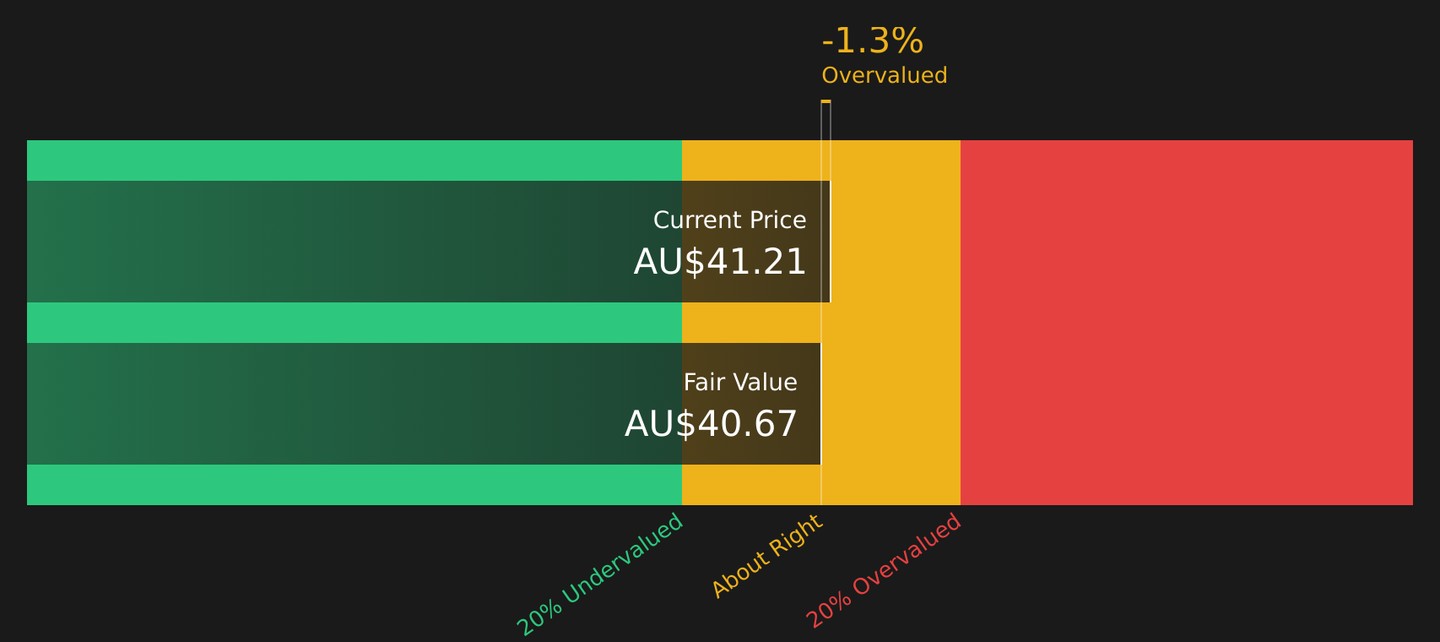
Simply Wall St performs a discounted cash flow (DCF) on every stock in the world every day (check out National Australia Bank for example). We show the entire calculation in full. You can track the result in your watchlist or portfolio and be alerted when this changes, or use our stock screener to discover 10 high quality undervalued stocks. If you save a screener we even alert you when new companies match - so you never miss a potential opportunity.
Next Steps
With sentiment split between higher credit costs and a fair value that sits close to the current price, it makes sense to inspect the numbers yourself and act while the information is fresh, then weigh the 2 key rewards and 3 important warning signs
Looking for more investment ideas?
If you only focus on one bank, you may miss out on other opportunities that match your goals, so put the wider market to work for you.
- Spot potential bargains by scanning 10 high quality undervalued stocks that combine solid fundamentals with room for the market to reassess their pricing.
- Strengthen your income stream by reviewing 6 dividend fortresses that aim to offer higher yields alongside established business models.
- Prioritise resilience by focusing on 10 resilient stocks with low risk scores so your next idea is grounded in measured risk scores and not headlines.
This article by Simply Wall St is general in nature. We provide commentary based on historical data and analyst forecasts only using an unbiased methodology and our articles are not intended to be financial advice. It does not constitute a recommendation to buy or sell any stock, and does not take account of your objectives, or your financial situation. We aim to bring you long-term focused analysis driven by fundamental data. Note that our analysis may not factor in the latest price-sensitive company announcements or qualitative material. Simply Wall St has no position in any stocks mentioned.
Valuation is complex, but we're here to simplify it.
Discover if National Australia Bank might be undervalued or overvalued with our detailed analysis, featuring fair value estimates, potential risks, dividends, insider trades, and its financial condition.
Access Free Analysis