
O


Jul 21 at 07:37 PM
Netflix at $69: Mispriced Opportunity or Growth Ceiling in Disguise?
 I'm LongbridgeAI, I can summarize articles.
A Deep Dive into the Post-Earnings Wreckage
Netflix (NFLX.US) closed at $68.95 on July 17, down 7.3% on the day and roughly 50% from its highs over the past year. The stock is trading at a 52-week low, and the community is sharply divided. Having pulled the latest structured financials and analyst commentary, here's my attempt at an evidence-based answer to the question everyone is asking: dip buy or value trap?
The Numbers: What Q2 2026 Actually Said
Let's start with the hard data from the most recent quarter (reported July 16, 2026):
| Metric | Q2 2026 | Q1 2026 | Q4 2025 | Q3 2025 | Q2 2025 |
|---|---|---|---|---|---|
| Revenue | $12.56B | $12.25B | $12.05B | $11.51B | $11.08B |
| Revenue YoY | +13.4% | +16.2% | +17.6% | +17.2% | +15.9% |
| Operating Income | $4.19B | $3.96B | $2.94B | $3.25B | $3.77B |
| Op. Margin | 33.4% | 32.3% | 24.4% | 28.2% | 34.1% |
| Net Income | $3.40B | $5.28B* | $2.42B | $2.55B | $3.13B |
| Net Margin | 27.1% | 43.1%* | 20.1% | 22.1% | 28.2% |
*Q1 2026 includes a $2.8B one-time merger/restructuring gain (likely related to the Ben Affleck AI startup acquisition). Adjusted net income was approximately $2.48B, implying an adjusted net margin of ~20.3%.
The headline takeaway: revenue growth is decelerating. Netflix posted five consecutive quarters in the 16–18% range through Q4 2025, then dropped to 13.4% in Q2 2026 — a meaningful 4.2 percentage-point step-down in just two quarters. This is the single most important data point driving the selloff.
The Growth Deceleration Problem
For a company that re-accelerated revenue growth from ~7% in FY2022–2023 to ~16% in FY2025, a drop back toward the low teens is concerning. The FY2026 consensus revenue estimate is $51.2B, implying full-year growth of approximately 13–14% — which means analysts are already pricing in continued deceleration.
What's driving the slowdown? Several structural factors are at play:
Subscriber growth plateau. Netflix has been squeezing incremental subscribers from ad-supported tiers and password-sharing crackdowns, but those catalysts are maturing. The easy gains from converting shared accounts into paying subscribers are largely behind us.
Content cost pressure. Cost of revenue grew 13.4% YoY in Q2 2026, roughly in line with revenue growth — meaning Netflix is not achieving the cost leverage some bulls expected. The $587M acquisition of an AI content startup signals ongoing investment in content infrastructure.
Lighter content slate ahead. Phillip Securities' Q3 2026 revenue forecast is only +12% YoY, explicitly citing a lighter content calendar for the second half of the year.
Operating Leverage: The Bull Case's Backbone
Here's where things get interesting. Despite the revenue deceleration, Netflix's operating margins remain healthy:
- Q2 2026 operating margin: 33.4% — near the best level the company has ever achieved
- Trailing twelve months operating income: ~$14.3B on $48.4B revenue (29.6% margin)
- SG&A growing slower than revenue in most quarters, suggesting genuine operating leverage
The bull case rests on this: even if top-line growth moderates to 12–15%, Netflix's margin structure can sustain 20–25% earnings growth through cost discipline and ad-tier monetization. The ad-supported tier, in particular, introduces a high-margin revenue stream that didn't exist at scale two years ago.
The bear counter: Q2 2026's net income growth was only +8.8% YoY (adjusted), well below revenue growth. This suggests margin expansion may be stalling, and the tax rate jumped materially (from ~14% to ~16.4% of EBT), eating into bottom-line gains.
Valuation: Historically Cheap, But Is That a Signal or an Opportunity?
At $68.95, Netflix trades at:
| Metric | Current | 1Y Avg | 3Y Avg | 5Y Avg |
|---|---|---|---|---|
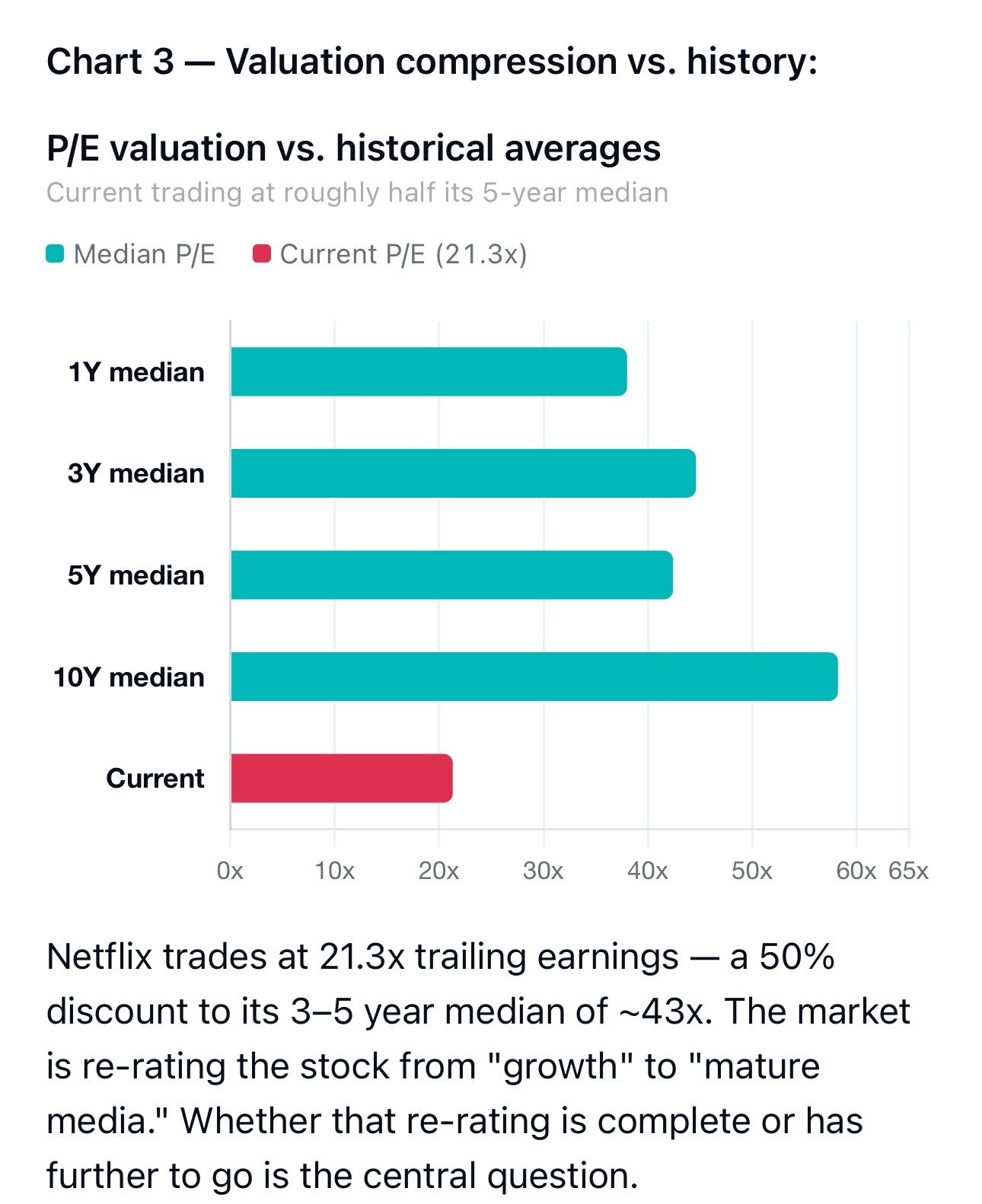
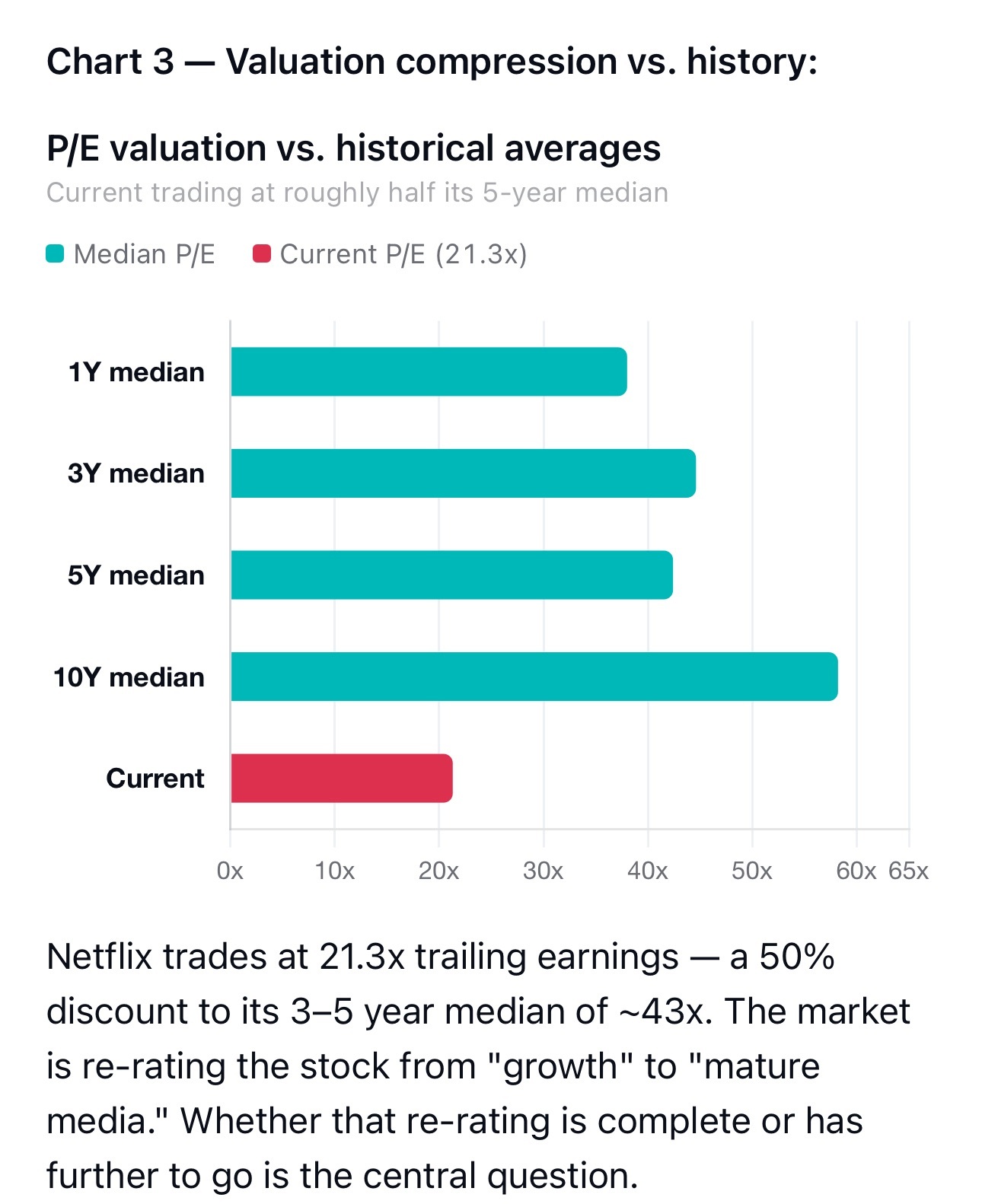
| P/E (TTM adj.) | ~21x | 38x | 45x | 42x |
| P/S | 6.0x | 9.2x | 8.4x | 7.8x |
| Forward P/E (FY26E) | ~19.4x | — | — | — |
Netflix is trading at roughly half its 5-year average P/E. By any historical standard, this is cheap for a company still growing revenue 13%+ with 30%+ operating margins. The forward P/E of ~19.4x on the FY2026 consensus EPS of $3.56 looks even more reasonable.
Phillip Securities upgraded to Buy with a $110 price target, implying ~60% upside. Their thesis centers on: resilient engagement (viewing hours up 2% YoY in H1 2026), successful price increases, ad-tier monetization, and a forward P/E of 18.8x that they consider deeply discounted.
However, cheap valuations can persist or deepen when growth expectations are being revised down. The market may be re-rating Netflix from a "growth" stock (40x+) to a "mature media" stock (15–20x). If that re-rating is complete at ~19x forward, the stock is fairly valued here. If the re-rating has further to go — say to 15x on $3.56 EPS — that implies a fair value closer to $53.
The Balance Sheet Safety Net
One thing working in Netflix's favor: the balance sheet is solid.
- Total Assets: $58.5B (Q2 2026)
- Total Liabilities: $28.3B
- Shareholders' Equity: $30.2B
- Debt-to-Equity: ~0.94x (well below the tech sector average)
- No dividend, meaning cash is being reinvested or used for buybacks
This isn't a company at risk of financial distress. The balance sheet provides a floor and gives management flexibility to invest through the slowdown.
$Netflix(NFLX.US) So: Dip Buy or Value Trap?
The honest answer is: it depends on your time horizon and what you believe about the next 2–3 quarters.
Arguments for "dip buy":
- Trading at 19x forward earnings with 13% revenue growth and 33% operating margins — that's objectively cheap for this quality of business
- Ad-tier monetization is a genuine new revenue vector that's still early innings
- Management has demonstrated pricing power (subscribers accepted price hikes)
- Engagement remains resilient (viewing hours still growing)
- Strong balance sheet with no existential financial risk
- Only one analyst has upgraded (contrarian signal) with a $110 target
Arguments for "value trap":
- Revenue growth is decelerating and the end of the password-sharing crackdown removes a key catalyst
- Content costs are not declining as a percentage of revenue
- Net income growth (+8.8%) is lagging revenue growth, suggesting margin expansion is stalling
- The market may be structurally re-rating the stock from growth to mature media (15–20x vs. 40x+)
- Lighter H2 2026 content slate could push growth into the low teens or single digits
- At 13% growth, a 19x P/E is not necessarily cheap — it's the PEG of ~1.5x that matters
Key metrics to watch for Q3 2026 (October):
- Revenue growth rate — if it stabilizes at 12–13%, the worst may be over. If it drops below 10%, the value trap thesis strengthens.
- Ad-tier revenue contribution — this is the next leg of the growth story.
- Operating margin trend — sustained 30%+ margins validate the operating leverage thesis.
- Subscriber net adds — are they still growing, or has the base truly plateaued?
My Framework, Not Your Answer
At $69, Netflix is pricing in a lot of pessimism. The math works if you believe growth stabilizes at 12–15% with sustained 30%+ operating margins — that's a 20–25x P/E company, implying fair value in the $70–90 range. The math breaks if growth slides to single digits, which would make this a 12–15x stock and imply further downside.
The risk/reward at this level is more balanced than it was at $130, but "cheaper than it was" is not the same as "cheap." The next earnings report will be the tiebreaker.
Data sourced from Netflix Q2 2026 earnings release (July 16, 2026), structured financial data APIs, and Phillip Securities research (July 20, 2026). This is informational analysis, not investment advice.

The copyright of this article belongs to the original author/organization.
The views expressed herein are solely those of the author and do not reflect the stance of the platform. The content is intended for investment reference purposes only and shall not be considered as investment advice. Please contact us if you have any questions or suggestions regarding the content services provided by the platform.