
Hong Kong Stock Market Derivatives Weekly Market Review 2026.7.27
 I'm LongbridgeAI, I can summarize articles.
Weekly Market Overview
The Hang Seng Index rose cumulatively by 1.63% last week, closing at 24,963.23 points, with a trend of rising first and then retreating throughout the week. On the news front, the situation in the Middle East escalated sharply, suppressing market risk appetite; Brent crude oil broke through $100 per barrel, and rising inflation expectations pushed up US Treasury yields, weighing on Hong Kong stock valuations. Additionally, with the Federal Reserve's July rate decision meeting approaching, market predictions for a rate hike probability surged from less than 12% to nearly 35% within a week, significantly increasing uncertainty.
Among component stocks, Lenovo Group stood out with a cumulative weekly rise of 13.63%; Intel's Q2 earnings showed its best growth in fifteen years, confirming a positive CPU cycle, and coupled with sustained strong demand for AI servers, the hardware sector's valuation accelerated its recovery. Zijin Mining rose 11.84%, driven by expectations of supply contraction in copper prices; Bank of China (Hong Kong) rose 10.22%, benefiting from improved HKD liquidity and rising rate hike expectations which favor bank net interest margins; Chalco rose 9.07%, with aluminum prices supported by new energy demand remaining high; Luoyang Molybdenum rose 8.59%, with copper and cobalt prices moving upward synchronously.
On the downside, NetEase led the decline with a drop of 7.45%, as markets worried that a slower pace in game license approvals would impact earnings; Tencent Holdings fell 5.85%, dragged down by pressure from major shareholder reductions and regulatory uncertainties; Nongfu Spring dropped 5.50%, with weak sentiment across the entire consumer sector; Sinopharm Group fell 4.15%, experiencing volatility due to expectations of centralized procurement policies in the pharmaceutical industry.
In overseas markets, the three major US indices showed divergent trends: the Nasdaq fell cumulatively by 2.13% for the week, the S&P 500 dropped 0.61%, and the Dow Jones dipped slightly by 0.38%. The Middle East conflict pushed up oil prices, and concerns about persistent inflation caused the 10-year US Treasury yield to briefly rise to 4.71%, a new high since January 2025, putting pressure on high-valuation growth stocks and leading the market to reprice the Fed's subsequent policy direction. In terms of sectors, energy stocks performed counter-trendly well driven by rising oil prices; Intel's impressive earnings briefly boosted sentiment, but Nvidia's comprehensive price hikes on GPU packages triggered downstream cost pressures, widening divergence within tech stocks.
The three major A-share indices all rose, forming a stark contrast with overseas markets: the Shanghai Composite Index accumulated a rise of 1.33%, the Shenzhen Component Index rose 0.49%, and the ChiNext Index rose 1.52%. On Tuesday, the ChiNext Index surged 7.05% in a single day, the Shenzhen Component Index jumped 4.81%, and the Shanghai Composite Index rose 1.79%, mainly catalyzed by the Shanghai 2026 World Artificial Intelligence Conference. National leaders attended the opening ceremony and delivered speeches, with a higher 规格 than last year. Hard technologies such as AI computing power, semiconductor equipment, and advanced packaging all surged. However, profit-taking emerged starting Wednesday, with the ChiNext Index falling 3.23% on Wednesday and another 2.65% on Friday, significantly narrowing the weekly gains.
2. Capital Flow of HSI Bull and Bear Certificates
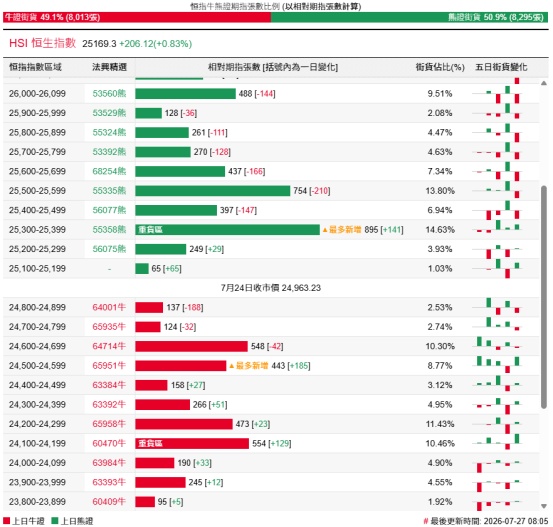
Over the past 5 days, the total net outflow of funds from HSI Bull Certificates was approximately 78.24 million HKD; while the total net inflow of funds into HSI Bear Certificates was approximately 46.03 million HKD.
Regarding street share distribution, HSI Bull Certificates accounted for about 49.1% of street shares, concentrated at recall prices between 24,100 and 24,900 points, equivalent to approximately 2,703 futures contracts; HSI Bear Certificates' street shares were concentrated at recall prices between 25,100 and 25,600 points, equivalent to approximately 2,360 futures contracts.
3. Weekly Capital Flow of Warrants
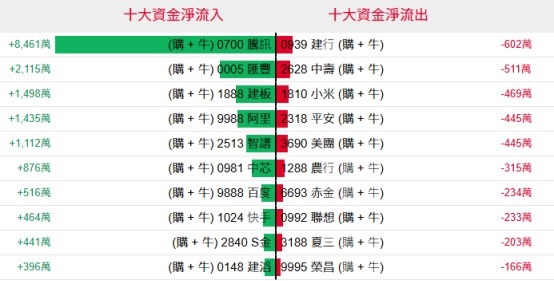
For long positions (Call warrants and Bull certificates), over the past 5 days, Tencent's long positions recorded a net inflow of approximately 84.61 million HKD, being the target with the most capital absorption; related long positions for HSBC Holdings and Kitakyushu Laminates also recorded net inflows of approximately 21.15 million and 14.98 million HKD respectively; while related long positions for Construction Bank, China Life, and Xiaomi Group recorded net outflows of approximately 6.02 million, 5.11 million, and 4.69 million HKD respectively.
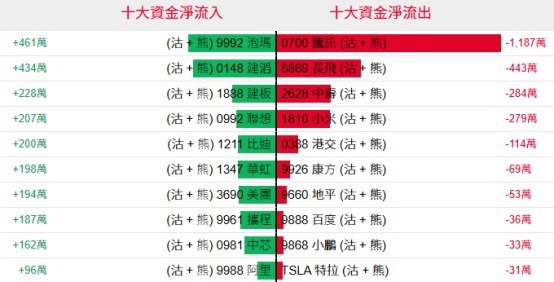
For short positions (Put warrants and Bear certificates), combined over the past 5 days, Pop Mart, Kitagawa Group, and Kitagawa Laminates related short positions recorded net inflows of approximately 4.61 million, 4.34 million, and 2.28 million HKD respectively; while Tencent, Yangtze Optical Fibre, and China Life related short positions recorded net outflows of approximately 11.87 million, 4.43 million, and 2.84 million HKD respectively.

XIAOMI-W
HK01810

Xiaomi Corporation
USXIACY

XIAOMI-WR
HK81810

Intel
USINTC

Direxion S&P 500 Bear 1X
USSPDN

KB LAMINATES
HK01888

FI2 CSOP HSI
HK07500

ISHARESHSI
HK03115

FL2 CSOP HSI
HK07200

Hang Seng Index
HKHSI

02600
HK02600

399006
SZ399006

02899
HK02899

09633
HK09633

00148
HK00148

399001
SZ399001

00005
HK00005

09999
HK09999

09899
HK09899

00700
HK00700

HXXD
SGHXXD

04335
HK04335

601600
SH601600

601899
SH601899

HSHD
SGHSHD

HSBC
USHSBC

NTES
USNTES

80700
HK80700

HTCD
SGHTCD

TCEHY
USTCEHY

TCTZF
USTCTZF
The copyright of this article belongs to the original author/organization.
The views expressed herein are solely those of the author and do not reflect the stance of the platform. The content is intended for investment reference purposes only and shall not be considered as investment advice. Please contact us if you have any questions or suggestions regarding the content services provided by the platform.