
O


Jul 31 at 02:42 AM
Part 1: Beginner’s Guide to Singapore Airlines (SIA) –
 I'm LongbridgeAI, I can summarize articles.
✈️ Understanding Earnings, Profits, and Why Changi Airport’s Expansion Could Benefit the Company
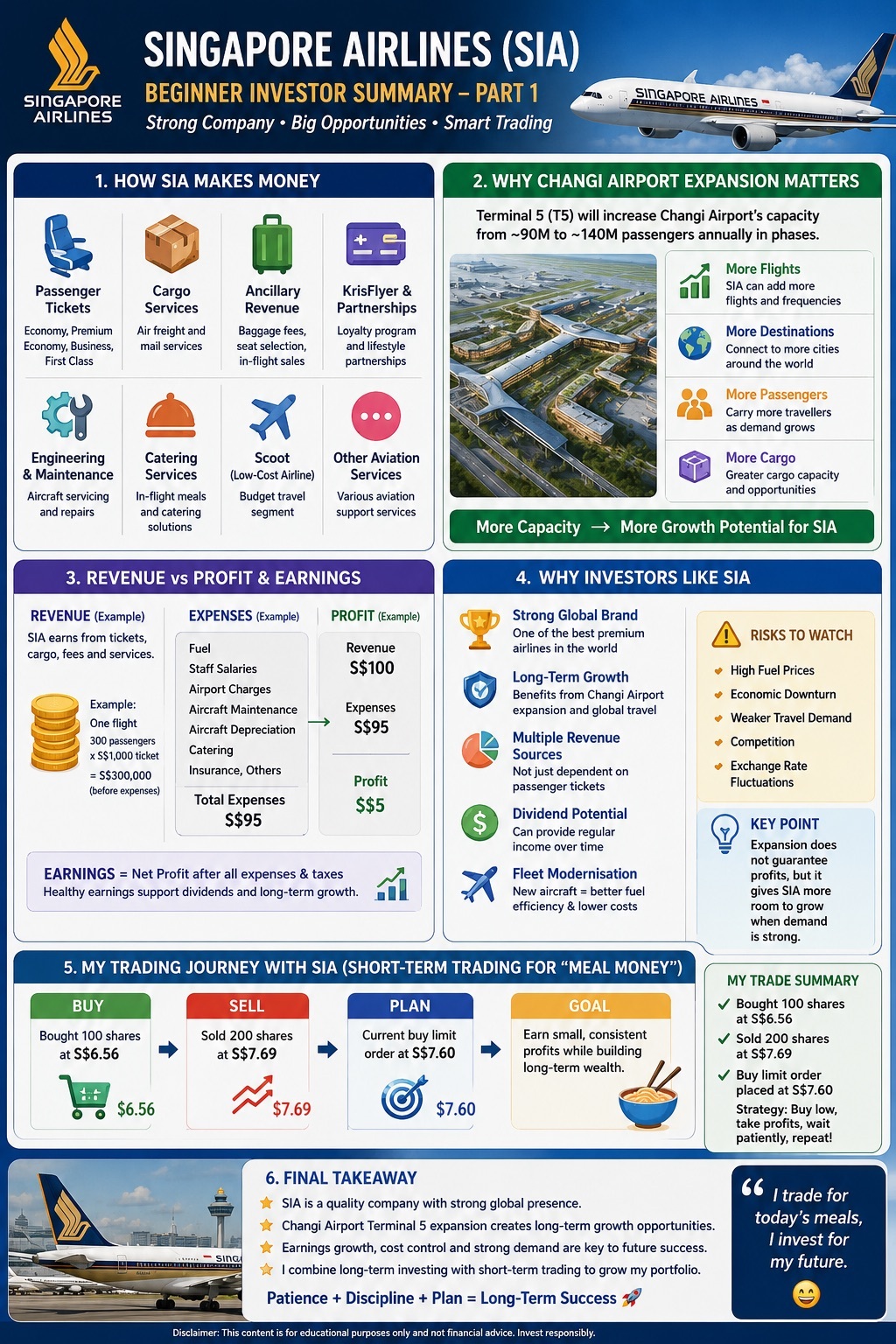
Singapore Airlines (SGX: C6L) is one of the world’s leading premium airlines and is also Singapore’s national carrier. As a beginner investor, one of the first things I learned was that an airline’s value is not just about today’s profits—it is also about its future growth. One of the biggest long-term growth projects for Singapore is the expansion of Changi Airport through the construction of Terminal 5, which could create more opportunities for Singapore Airlines over the next decade.
In this article, I will explain in simple terms how SIA earns money, what earnings and profits mean, why Changi Airport’s expansion matters, and why I have been trading SIA shares while investing for the long term.
🌍 What is Singapore Airlines?
Singapore Airlines is much more than an airline flying passengers around the world. The company operates:
- Singapore Airlines (full-service airline)
- Scoot (low-cost airline)
- Cargo services
- Engineering and maintenance services
- Catering and aviation-related businesses
This means SIA earns income from several different businesses instead of relying only on passenger tickets.
💰 How Does Singapore Airlines Make Money?
Every day, SIA operates hundreds of flights across Asia, Europe, Australia, and the United States.
Its main sources of revenue include:
✈️ Economy Class tickets
💺 Premium Economy tickets
👔 Business Class tickets
👑 First Class tickets
📦 Air cargo
💼 Excess baggage fees
🎫 KrisFlyer partnerships and other aviation services
For example, if one aircraft carries 300 passengers with an average ticket price of S$1,000, passenger revenue alone would be around S$300,000 before adding cargo and other services.
Multiply this by hundreds of daily flights and it is easy to understand why SIA generates billions of dollars in annual revenue.
📈 Revenue Is Different From Profit
Many beginners think high revenue automatically means high profit.
That is not always true.
Suppose SIA earns S$100.
Its expenses may include:
- Fuel
- Staff salaries
- Airport charges
- Aircraft maintenance
- Aircraft depreciation
- Catering
- Insurance
If expenses total S$95, the company only earns S$5 in profit.
This is why investors pay close attention to costs, especially fuel prices.
📊 What Are Earnings?
Earnings simply mean the company’s net profit after paying all operating expenses, taxes and financing costs.
For example:
Revenue:S$20 billion
Expenses:S$18 billion
Net earnings:S$2 billion
Growing earnings usually indicate that the company is operating efficiently and demand remains healthy.
✈️ Why Changi Airport’s Expansion Matters
One of the reasons I remain positive about SIA over the long term is Singapore’s investment in Changi Airport Terminal 5.
When completed, Terminal 5 will significantly increase the airport’s passenger capacity.
This creates opportunities for Singapore Airlines because the airline may be able to:
✅ Add more flights
✅ Open new destinations
✅ Increase flight frequencies
✅ Carry more passengers
✅ Expand cargo operations
As one of Changi Airport’s largest airlines, SIA is expected to benefit if global travel demand continues growing.
🌏 More Capacity Means More Growth Potential
Imagine SIA currently operates a certain number of flights every day.
If airport capacity increases and demand remains strong, SIA could gradually expand its network.
That means:
✈️ More aircraft flying
👨👩👧👦 More passengers
📦 More cargo
💰 Higher revenue potential
Although expansion alone does not guarantee higher profits, it gives SIA room to grow over the long term.
💼 Why Investors Watch Earnings Closely
Strong earnings can support:
- Dividend payments
- Fleet expansion
- New aircraft purchases
- Share buybacks (if announced)
- Long-term business growth
However, investors should also monitor:
- Fuel prices
- Economic conditions
- Travel demand
- Competition
- Exchange rates
These factors can all influence SIA’s future profitability.
📖 My Personal Trading Journey with SIA
Besides investing for the long term, I also enjoy doing short-term trades when I see opportunities.
One of my trades was buying 100 shares at S$6.56. As the company continued to recover and investor sentiment improved, I later sold 200 shares at S$7.69, locking in a gain.
After taking profits, I have now placed another buy limit order at S$7.60. If the market pulls back and my order is filled, I am happy to accumulate SIA shares again at a slightly lower price.
I do not try to predict every short-term movement. Instead, I buy when I believe the valuation is reasonable, take profits after a meaningful rise, and patiently wait for another opportunity.
I jokingly call these trades my “meal money” because the profits can help pay for my daily meals while I continue building my long-term investment portfolio.
🎯 My Trading Summary
📈 Bought 100 shares at S$6.56
💰 Sold 200 shares at S$7.69
📉 Current buy limit order placed at S$7.60
🍜 My goal is to earn small, consistent trading profits while still believing in SIA’s long-term growth story.
🎓 Beginner’s Summary
As a beginner investor, I believe Singapore Airlines has several attractive qualities:
- Strong global brand.
- One of the best premium airlines in the world.
- Benefits from Singapore’s position as an international aviation hub.
- Potential long-term growth from Changi Airport Terminal 5.
- Opportunity to grow passenger numbers, cargo operations and global routes.
- Regular dividend potential when earnings remain healthy.
At the same time, I understand that investing always carries risks. Fuel prices, economic slowdowns and weaker travel demand can all affect profits and the share price. That is why I combine long-term investing with disciplined trading, taking profits when prices rise and patiently waiting for attractive opportunities to buy again.
For me, SIA is both a quality long-term company and a stock that occasionally offers good short-term trading opportunities. By staying patient and following my plan, I hope to let both dividends and capital gains contribute to my investment journey.

The copyright of this article belongs to the original author/organization.
The views expressed herein are solely those of the author and do not reflect the stance of the platform. The content is intended for investment reference purposes only and shall not be considered as investment advice. Please contact us if you have any questions or suggestions regarding the content services provided by the platform.