

[Mou Zhou's Notes] Cheapness is not the reason for you to buy in (Week 31 of 2026 | Issue No. 281)
 I'm LongbridgeAI, I can summarize articles.
In 1992, the Shanghai and Shenzhen stock exchanges listed a strange type of stock: Class B shares. The same company, the same equity, the same dividends, yet two different prices. Class A shares were priced in RMB and sold only to domestic investors; Class B shares were priced in US dollars or HKD and sold only to foreign investors. Two groups of buyers, separated by a wall of foreign exchange controls, bought their own respective shares. The result was: identical rights for identical shares, with Class B shares trading at a long-term discount of 30% to 50% compared to Class A shares. It wasn't that the companies were worse off; it was simply because the pool of money able to buy Class B shares did not interoperate with the pool able to buy Class A shares. This discount persisted for nearly a decade until 2001, when regulators allowed domestic residents to use foreign exchange to buy Class B shares, connecting the two pools, after which the price gap began to converge.
Why tell this old story? Because this week, WeChat Moments was flooded with an image again: Hong Kong-listed semiconductors are significantly cheaper than their A-share counterparts, with SMIC's AH ratio at 2.29 and Hua Hong at 2.12, making "depression zones" and "bargain hunting" trending topics. But my lesson from the Class B shares is that price differences are determined by who can buy, not by value. A bargain you cannot access can remain cheap for many years.
I. Market Review: The Depression Zone Is Real, And So Are The Bargains
This week, Hong Kong and A-share semiconductors surged collectively again: Tianshu Zhixin rose 15%, GigaDevice rose 11.3%, ASMPT rose 10.8%, and Montage Technology rose 8.6%; while the Hang Seng Index itself dipped slightly by 0.3%, the Stock Connect information sector rose counter-trend by over 2%. The discount is also real: the Hang Seng AH Premium Index has been pressed to a five-year low, with SMIC and Hua Hong's H-shares still significantly cheaper relative to their A-shares.
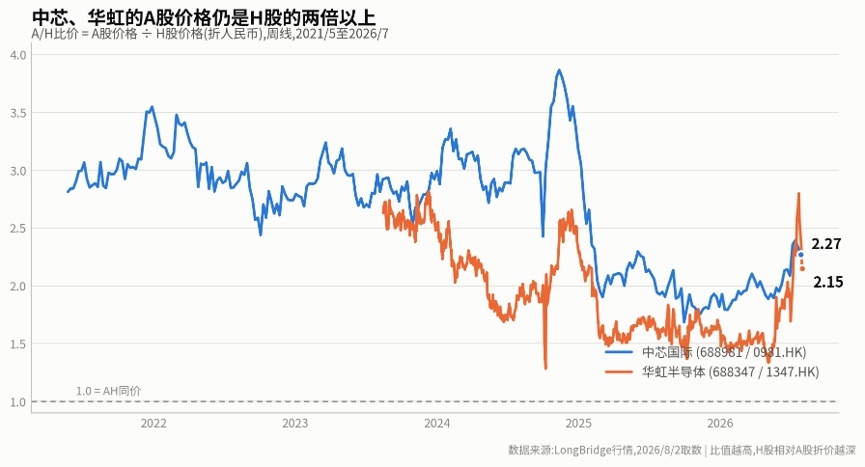
The tailwinds in fundamentals are no less true, following up on the previous two issues regarding memory chips: Samsung announced that "supply shortages will continue until 2028," Morgan Stanley expects memory prices to rise at least 25% quarter-over-quarter, and Goldman Sachs raised SanDisk's target price from $1,200 to $2,200. Major tech earnings reports have just validated the genuine demand for AI.
So here's the question: If the fundamentals are real and the bargains are real, why do I say this might just be noise for your US stock account? Because "cheap" is not a reason to buy; someone buying, and you being able to buy, is.
II. One Depression Zone, Three Fates
Any discounted depression zone has only three possible outcomes. First, it gets filled by arbitrage: if the money wanting to buy can get in, the price gap converges; this is called catching a mispriced bargain. Second, it becomes a value trap: there is a reason for the cheapness, and cheap things can stay cheap forever. Third, legal or liquidity isolation: if those who want to buy simply cannot get in, the discount is determined by institutional rules and can persist long-term; Class B shares are a living example.
There are only two criteria for judgment: Who is the marginal buyer? Can your money legally participate?
III. Who Is Filling The Pit: Northbound Capital, Not US Stocks
Let's look at the marginal buyers first. Over the past 12 months, Southbound capital net purchases hit a record 1.19 trillion HKD, approximately $152 billion USD; Southbound daily average turnover skyrocketed 84% year-on-year, increasing its share of total Hong Kong stock market turnover from 20% to 24%. Stock Connect has been clearly sweeping up semiconductor and AI hardware stocks these days.
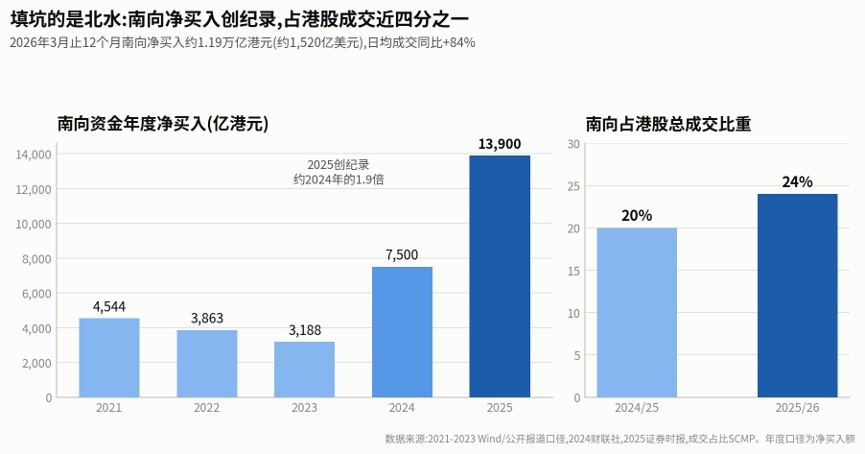
In other words, the AH premium has been pressed to a five-year low, and what pressed it down was RMB, not USD. The depression zone is indeed being filled, but this is a value regression priced in RMB. Southbound capital filling the pit does not mean US stock funds will follow suit: the eligibility requirements for these two pools of money are completely different.
IV. Even Dollars Can't Fill It In: That Sanctions Wall
The largest and most representative name in this depression zone is SMIC (Semiconductor Manufacturing International Corporation), which is on the US Treasury Department OFAC's NS-CMIC sanctions list. The rules are black and white: Americans are prohibited from buying or selling publicly traded securities of listed entities, as well as any derivative instruments providing exposure to such securities. On the Hua Hong side, the US also halted orders against it in April this year, with pressure coming through the trade channel. Translated into one sentence: You cannot arbitrage a price difference that you are legally prohibited from trading. This discount is not a mispricing caused by panic selling; it is a structural discount isolated by the sanctions wall, corresponding to the third fate.
Some might ask: Isn't foreign capital flowing back into China? Yes, global capital in 2026 is indeed removing the "uninvestable" label, but the flow is directed towards platforms within the wall like Tencent and Alibaba, bypassing the 晶圆厂 (wafer fabs) on the sanctions list. What foreign capital can buy is not in this semiconductor depression zone; what is in the depression zone, foreign capital cannot legally buy.
V. What This Means For Your Account
The conclusion is clean. What you want is the beta of AI and memory, not the adjective "cheap." To express exposure to memory industry prosperity, use the tickets you can actually buy: Micron, SK Hynix ADRs, and Hong Kong-listed names not on the sanctions list. Headlines like "Hong Kong and A-share semiconductors are surging wildly again, how big is the discount" are background noise for your US dollar account; just take a look.
Class B shares from over thirty years ago told us: identical rights for identical shares, yet prices could differ by half, simply because two groups of buyers were separated by a wall. Today's Hong Kong and A-share semiconductor depression zone is a new version of the same problem. Media loves to talk about bargains, but cheapness is never the reason; whether you can buy, and who is buying, is.
There is always a reason for being cheap, and always a reason for being expensive.
[Next Week Outlook]
For the memory sector, watch the final landing of Q3 DRAM contract prices; either Morgan Stanley's prediction of another 25% rise or the cooling camp will be wrong. For geopolitical risks, watch the expiration of the 60-day negotiation window between the US and Iran around August 16th, whether it will be renewed or lead to a showdown. The July Non-Farm Payrolls report on August 7th (Friday) is the most important macroeconomic data for next week.
[For specific operations and portfolio details, please visit the website]
This article represents personal views and probability assessments and does not constitute investment advice. Data sources: SCMP (Southbound capital and turnover ratio), OFAC and compliance interpretation (NS-CMIC list), Taipei Times (Hua Hong, 2026/4), Tonghuashun (this week's market data), Samsung/Morgan Stanley/Goldman Sachs (reporting 口径). AH ratio and premium index points are based on reporting 口径; please refer to the latest data at the time of writing. News images should be accompanied by screenshots of relevant reports with source attribution.

Samsung Electronics
USSSNGY

SMIC
HK00981

SMIC
SH688981

TENCENT
HK00700

TENCENT-R
HK80700

Tencent Holdings Limited
USTCTZF

Tencent
USTCEHY

Micron Tech
USMU

SK Hynix
USSKHY

SK Hynix - WI
USSKHYV

01347
HK01347

09903
HK09903

00522
HK00522

03986
HK03986

603986
SH603986

09988
HK09988

SNDK
USSNDK

07500
HK07500

07300
HK07300

07200
HK07200

HSMD
SGHSMD

HTCD
SGHTCD

688347
SH688347

89988
HK89988

HBBD
SGHBBD

BABA
USBABA
The copyright of this article belongs to the original author/organization.
The views expressed herein are solely those of the author and do not reflect the stance of the platform. The content is intended for investment reference purposes only and shall not be considered as investment advice. Please contact us if you have any questions or suggestions regarding the content services provided by the platform.