

Beginner guide to selling cash secured put options for Nvda why I waited
 I'm LongbridgeAI, I can summarize articles.
Beginner Guide to Selling Cash-Secured Put Options 🐶💰
Selling a cash-secured put means you agree to buy a stock at a chosen price while keeping enough cash in your account to purchase the shares if assigned. You receive an option premium upfront, which is your income for taking that obligation. Beginners should choose quality companies they are happy to own, pick strike prices below the current stock price, and avoid using borrowed money. If the stock stays above the strike price, the option may expire worthless and you keep the premium. If the stock falls below the strike price, you may buy the shares at that agreed price.
Why I Waited for NVDA to Fall Before Selling Cash-Secured Puts 🐶📉
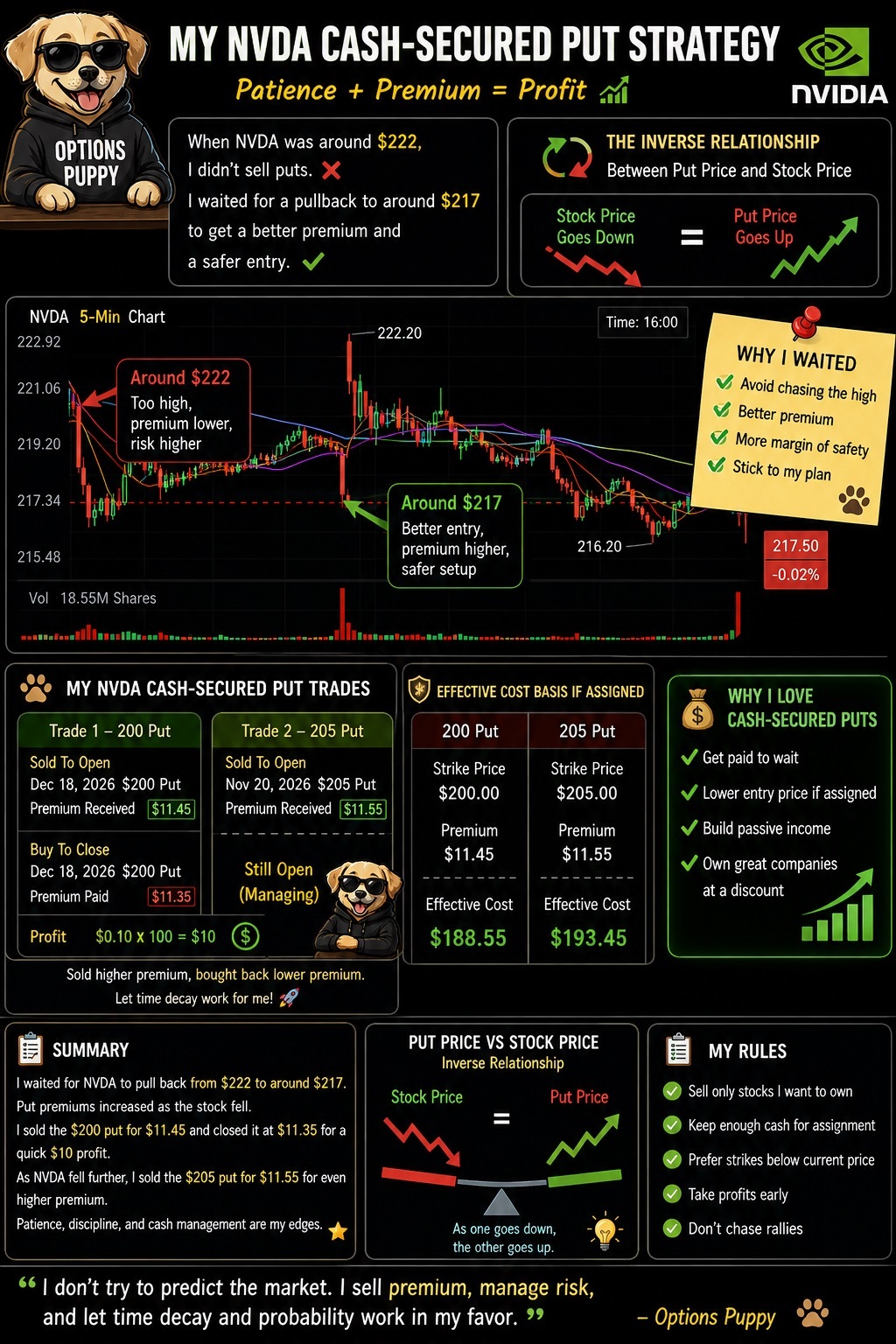
One of the biggest lessons I have learned from selling cash-secured puts is that patience is part of the strategy. Many traders feel they must enter a trade immediately when they see a stock moving, but I prefer to wait for a price level that gives me a better risk-reward setup. Recently, I was watching NVIDIA (NVDA) closely as it traded near $222, but I decided not to sell puts there. Instead, I waited until NVDA pulled back to around $217 before I started selling puts. That small difference in stock price changed the option premium, the margin of safety, and my comfort level significantly.
Waiting for a Better Entry 🕰️📊
When NVDA was around $222, the stock had already rallied strongly. Selling puts at that level would have meant taking assignment risk closer to the recent highs. I asked myself a simple question: “Am I willing to own NVDA if it suddenly drops?” At $222, my answer was less enthusiastic.
As the stock pulled back toward $217, I became much more interested. The five-minute chart showed weakness developing, short-term moving averages were rolling over, and price was moving away from the intraday highs. Instead of chasing the market, I let the market come to me. That is a habit I try to maintain in every options trade.
The Inverse Relationship Between Puts and Stock Price 🔄📉
A key concept in option selling is that put prices generally move inversely with the stock price.
- When the stock falls, put premiums tend to rise.
- When the stock rises, put premiums tend to fall.
This is exactly why I waited. As NVDA dropped from around $222 toward $217, the puts became more expensive, allowing me to collect a richer premium for taking the same type of obligation.
I like to think of it this way: when fear enters the market, option sellers get paid more. I do not enjoy seeing stocks fall, but I do appreciate when volatility increases because it improves the income potential of selling options.
My First Trade: Sell the $200 Put 🐶💰
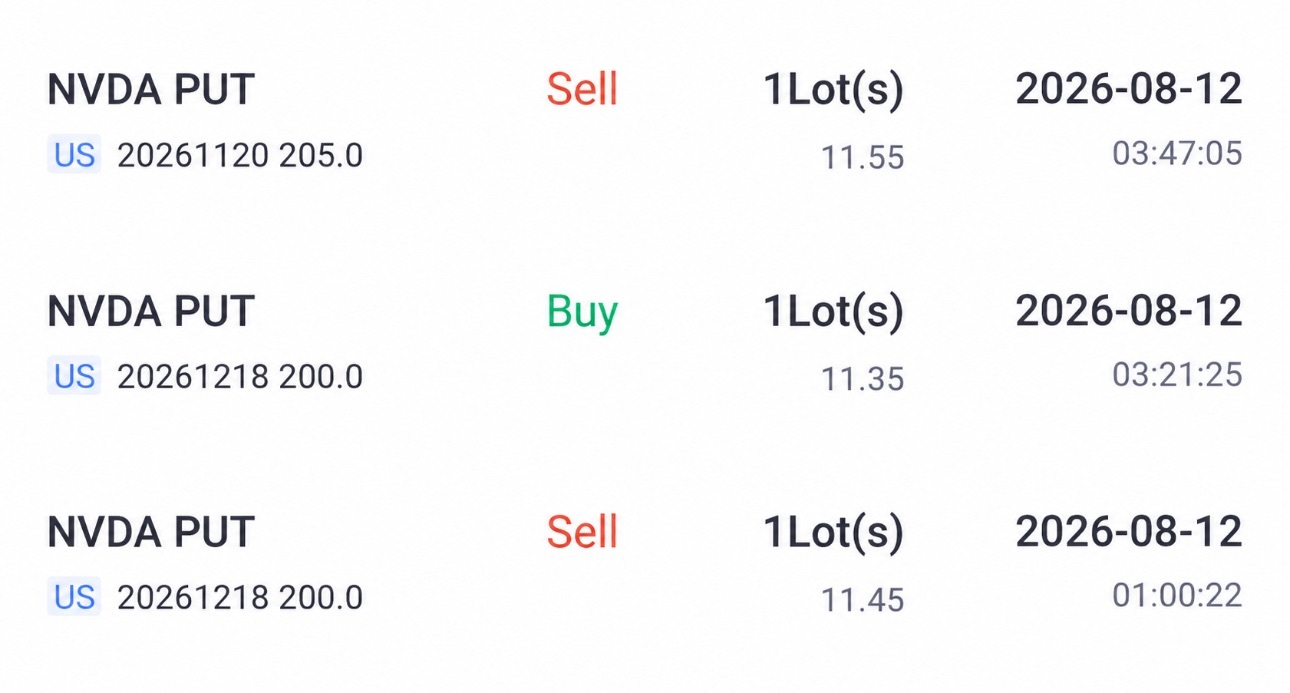
My first trade was selling the December 18, 2026 $200 put for $11.45.
Because one option contract represents 100 shares, the premium collected was:
- $11.45 × 100 = $1,145
By selling this put, I agreed that I could be required to buy 100 shares of NVDA at $200 if the option were assigned at expiration.
What attracted me to this trade was the distance between the stock price and the strike price. With NVDA near $217, the strike was about $17 below the market price, giving me a reasonable cushion.
Why I Chose the $200 Strike 🎯🛡️
I did not choose $200 randomly. I wanted a strike that provided a meaningful buffer while still paying a decent premium.
My thinking was:
- NVDA price: ~$217
- Strike price: $200
- Buffer: ~$17 per share
That buffer meant NVDA could fall roughly 7–8% before my strike would be reached. If assigned, my effective cost basis would be lower because of the premium received.
Effective cost basis
- Strike price: $200
- Premium received: $11.45
- Effective cost basis: $188.55
So although the contract said $200, my net purchase price would effectively be $188.55 if assignment occurred. I was comfortable owning NVDA at that level.
Buying Back Lower: The Power of Small Profits 💵📈
Shortly after selling the put, I bought it back for $11.35.
- Sold at: $11.45
- Bought back at: $11.35
- Profit: $0.10 per share
For one contract:
- $0.10 × 100 = $10 profit (before commissions)
Some people may think a $10 profit is too small, but I view option selling as a probability business. If I can repeatedly capture small profits while reducing risk exposure quickly, the gains can accumulate over many trades.
The important part was not the dollar amount; it was the discipline of selling higher and buying back lower.
“Sell High, Buy Low” for Option Sellers 🔁🐶
Stock investors often hear “buy low, sell high.” Option sellers operate differently. My goal is usually:
Sell the option at a high premium → Buy back the option at a lower premium.
For example:
- Sell put at 11.45
- Buy back at 11.35
- Difference captured: 0.10
Once I buy back the option, the obligation disappears. My capital becomes free again, and I can wait for the next opportunity instead of holding the position unnecessarily.
NVDA Fell Further, So I Sold Again 📉➡️💰
After I closed the first trade, NVDA weakened further. As the stock declined, put premiums increased again because of the inverse relationship between stock price and put price.
I then sold the November 20, 2026 $205 put for $11.55.
Notice what happened:
- The stock price was lower.
- The strike price was higher.
- Yet I received an even larger premium.
That is the advantage of waiting for weakness before initiating a put sale.
Comparing the Two Trades ⚖️📋
Trade | Strike | Premium |
First trade | $200 | $11.45 |
Second trade | $205 | $11.55 |
The second trade paid $10 more per contract than the first trade, even though the market was falling. This is a practical example of how option premiums respond to price movement and volatility.
Why I Was Comfortable with the $205 Put 🧠📉
Selling the $205 put does increase assignment risk compared with the $200 put, but I looked at the effective cost basis again.
- Strike: $205
- Premium: $11.55
- Effective cost basis: $193.45
Even though the strike was $5 higher, my net cost would be $193.45, which I still considered attractive for a company like NVDA.
I always ask myself: “If I wake up tomorrow and own 100 shares at this effective price, will I regret it?” If the answer is yes, I should not sell the put.
Cash-Secured Means Real Cash 💳🛡️
A true cash-secured put requires enough cash to buy the shares if assigned.
For the $205 put:
- $205 × 100 = $20,500 cash requirement.
I treat that cash as already committed. The premium is not free money; it is compensation for taking on the obligation to buy the stock.
This mindset prevents over-leverage and helps me sleep better during market volatility.
What the Chart Told Me 📈🔍
Looking at the intraday chart around the time of the trade, I noticed:
- Price struggling below short-term moving averages.
- Lower highs forming after the spike near $222.20.
- Increasing selling pressure into the close.
Those signals did not guarantee a decline, but they suggested that selling puts aggressively at the highs was less attractive than waiting for a pullback.
My Risk Management Rules 🚦🐶
I follow several simple rules:
- Sell only stocks I want to own.
- Keep enough cash for assignment.
- Prefer strikes below current market price.
- Take profits early when available.
- Do not chase rallies.
In this case, waiting from $222 to $217 allowed me to follow all five rules.
The Bigger Lesson 🌟📘
The most valuable part of this trade was not the premium collected. The real lesson was that patience improved the setup.
By waiting:
- I sold puts at richer premiums.
- I entered with a larger margin of safety.
- I avoided selling near the intraday high.
- I maintained emotional control.
Many traders focus only on predicting whether NVDA will go up or down tomorrow. I focus on getting paid appropriately for the risk I am taking.
My Final Thoughts 🐶💭
This NVDA trade reminded me why I enjoy selling cash-secured puts. I did not need to predict the exact bottom. I simply waited for a better price, sold premium when fear increased, bought back one position for a quick profit, and then sold another put at a higher premium as the stock weakened further.
- Sell high premium, buy back lower premium.
- Let time decay work for me.
- Use patience as an edge.
For me, that is the heart of the Options Puppy approach: stay patient, stay cash-secured, collect premium responsibly, and be willing to own great companies at prices that make sense.


The copyright of this article belongs to the original author/organization.
The views expressed herein are solely those of the author and do not reflect the stance of the platform. The content is intended for investment reference purposes only and shall not be considered as investment advice. Please contact us if you have any questions or suggestions regarding the content services provided by the platform.