
O


Aug 13 at 07:54 PM
🎬🐶 Beginner Guide: Why Netflix Rose After Replacing Its Homegrown Titus Solutions with Kueue
 I'm LongbridgeAI, I can summarize articles.
what happed
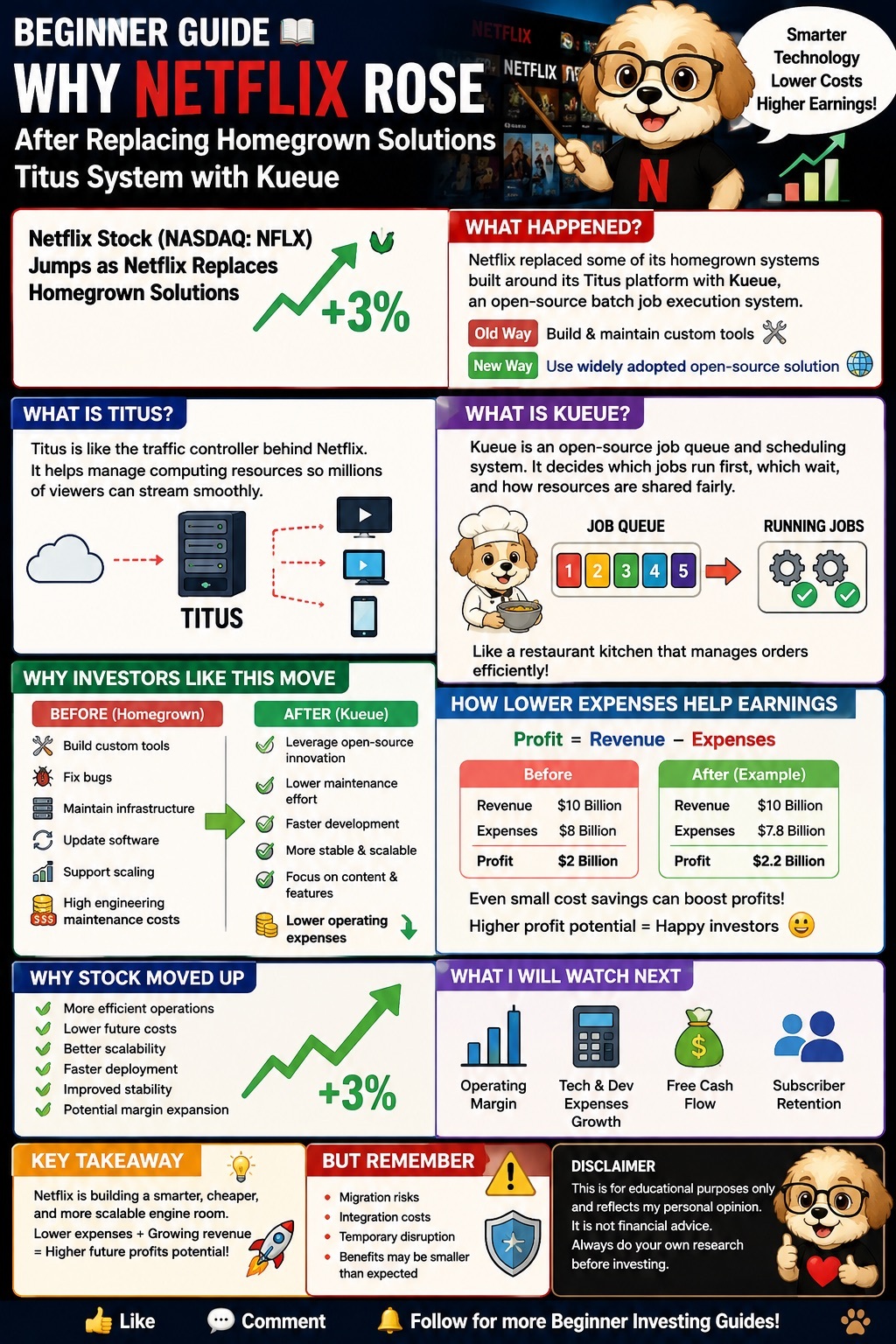
When I first read that Netflix stock jumped about 3% after announcing changes to its internal technology systems, I wondered: Why would a backend software change make investors excited? 🤔
As a beginner investor, it is easy to think stock prices move only when subscriber numbers increase. But technology companies like Netflix are different. Investors also watch cost savings, efficiency, scalability, and future profit margins. This Netflix story is a good example of that.
🍿 What happened?
Netflix has long used its own internal container platform called Titus to run many backend workloads. Over the years, Netflix also built several homegrown tools around Titus to manage batch jobs and scheduling.
Recently, Netflix started using Kueue, an open-source batch job execution system, for part of that workload instead of relying only on its homemade solutions.
In simple words:
- Old way: Build and maintain many custom internal tools 🛠️
- New way: Use a widely adopted open-source system 🌍
Investors liked this move because it suggests Netflix may become more efficient and cheaper to operate over time.

🧩 What is Titus?
Think of Titus as the traffic controller behind Netflix.
Whenever millions of people stream movies, browse recommendations, encode videos, or run analytics jobs, Netflix needs computing resources working smoothly in the background. Titus helps organize those resources.
For years, Netflix engineers also maintained extra internal software around Titus. Maintaining custom systems is powerful, but it can become expensive as the company grows.
🚀 What is Kueue?
Kueue is an open-source Kubernetes job queue and scheduling system.
That sounds technical, so here is the beginner version:
Imagine a restaurant kitchen. Orders arrive continuously. Kueue helps decide which jobs run first, which wait, and how resources are shared fairly so the kitchen does not become overloaded. 🍜👨🍳
Because many companies use open-source projects, improvements are often contributed by a larger community rather than funded entirely by one company.
💰 Why investors think this can save money
This is the part that matters most for beginners.
Before
Netflix had to:
- pay engineers to build custom tools,
- fix bugs,
- maintain infrastructure,
- update software,
- support scaling as traffic grows.
After
By adopting a mature open-source solution, Netflix may reduce:
- engineering maintenance costs,
- development time,
- operational complexity,
- duplicated internal tooling.
That does not mean Netflix pays nothing. It still needs engineers. But fewer resources may be required for maintaining custom infrastructure, allowing more focus on product features and content.
Investors often see that as a potential expense reduction. 📉💵
📊 Why lower expenses can help earnings
A simple beginner formula:
Profit = Revenue − Expenses
If revenue stays the same but expenses fall, profit rises.
Example:
- Revenue: $10 billion
- Expenses before: $8 billion
- Profit before: $2 billion
If technology efficiencies reduce expenses by even $200 million, profit becomes $2.2 billion. That is a 10% profit increase without adding a single new subscriber.
This is why Wall Street pays attention to infrastructure efficiency.
📈 Could this improve next quarter’s earnings?
Possibly, but beginners should understand timing.
Technology migrations usually take time. The benefits may appear gradually through:
- lower infrastructure spending,
- reduced maintenance effort,
- faster deployment of new services,
- fewer outages,
- better resource utilization.
So I would view this as a potential future earnings tailwind, not a guaranteed immediate jump in next quarter’s results.
⚡ Why the stock moved immediately
Stock prices often move based on expectations, not current earnings.
Investors may have thought:
- Netflix is becoming more efficient.
- Future operating margins could improve.
- Engineering productivity may increase.
- The company can scale faster as streaming demand grows.
Even a small change in expected future profit can move a large company’s stock price.
A 3% move does not prove earnings will surge. It shows investors became more optimistic about future profitability.
🛠️ Faster deployment matters too
The article mentioned Netflix can now deliver solutions more rapidly and with greater stability.
That matters because faster deployment can lead to:
- quicker feature releases,
- better recommendation systems,
- improved streaming reliability,
- faster experimentation.
If customers experience fewer problems, they are more likely to remain subscribers. Better retention can support future revenue growth. 📺❤️
🌱 Open source is not just about cost
Another beginner misconception is that open source only means “free.”
The bigger advantage is often innovation speed. Netflix can benefit from improvements developed by a broader community instead of building every feature itself.
That can reduce technical risk and shorten development cycles.
📺 My simple investment interpretation
If I were explaining this to a friend, I would say:
“Netflix found a cheaper and more scalable engine room for part of its streaming operation.”
The market is not celebrating a new movie release here; it is celebrating the possibility of higher future profit margins.
📉 Important beginner caution
I should not assume that every cost-saving announcement automatically makes a stock a buy.
A few risks remain:
- migration problems,
- unexpected integration costs,
- temporary disruption,
- security or reliability issues,
- benefits that are smaller than expected.
Professional investors will watch future earnings reports to see whether operating margins actually improve.
🔍 What I will watch in the next earnings report
As a beginner, I would focus on these numbers:
Operating margin
Is it rising?
Technology and development expense growth
Is it slowing?
Free cash flow
Is Netflix generating more cash?
Subscriber retention
Are users staying engaged?
If margins improve while revenue continues growing, the Kueue transition would look more meaningful.
🧠 Why Wall Street likes “scalable” businesses
Suppose Netflix adds 10 million more subscribers.
If the old system required hiring many more engineers and building more custom tools, costs might rise sharply.
If the new system scales more efficiently, Netflix can add customers with a smaller increase in cost. Investors love businesses where revenue can grow faster than expenses.
That is the real long-term story behind this announcement.
📚 Beginner takeaway in one minute
What changed?
Netflix replaced part of its homemade infrastructure tooling with the open-source Kueue system.
Why did the stock rise?
Investors believe this may improve efficiency and reduce future operating costs.
Does Netflix stop paying engineers?
No. But it may need fewer resources dedicated to maintaining custom infrastructure.
Will next quarter earnings definitely jump?
No. The benefits may appear gradually and are not guaranteed.
Why is this important?
Lower expenses plus stable or growing revenue can increase profit margins and free cash flow.
🐶 My final beginner summary
I see this Netflix announcement less as a “software update” and more as a business efficiency upgrade.
By moving part of its workload from custom Titus-related tooling to the open-source Kueue platform, Netflix may be able to:
- spend less on maintaining internal infrastructure 💰,
- deploy services faster ⚡,
- improve system stability 🛡️,
- scale more efficiently as streaming demand grows 🌍.
If those benefits show up in future financial results, Netflix could potentially report higher operating margins, stronger free cash flow, and better earnings growth over time. That is why many investors reacted positively.
For me as a beginner investor, the key lesson is this:
Stocks do not rise only because sales increase. Sometimes they rise because investors believe a company has found a smarter, cheaper, and more scalable way to run its business. 📈🐶
Disclaimer: This article is for educational purposes only and reflects my personal understanding and opinion. It is not financial advice. Always do your own research before investing.
👍 Like, 💬 comment, and 🔔 follow for more beginner-friendly investing articles in my “Options Puppy” style! 🐶📈

The copyright of this article belongs to the original author/organization.
The views expressed herein are solely those of the author and do not reflect the stance of the platform. The content is intended for investment reference purposes only and shall not be considered as investment advice. Please contact us if you have any questions or suggestions regarding the content services provided by the platform.