
C
1 day ago, 04:19 AM
NOK Options Seller Daily | Options Are on Discount: the Two Walls Between $12 and $10
 I'm LongbridgeAI, I can summarize articles.
$Nokia Oyj(NOK.US) news flow last week was messy: reports that it had closed its Hangzhou R&D unit and retrenched about 1,600 people, followed by talk of it "pulling back from China and pivoting to AI networking hardware". Optical-communications names swung back and forth all week, the share price was knocked about by the headlines, and it finished at US$10.76, up 1.9%.
The news is messy. But today we are not here to talk about news — we are here to talk about collecting rent.
Because the options board is showing a few signals that do not line up with the headlines.
1. The rent side: options got cheaper
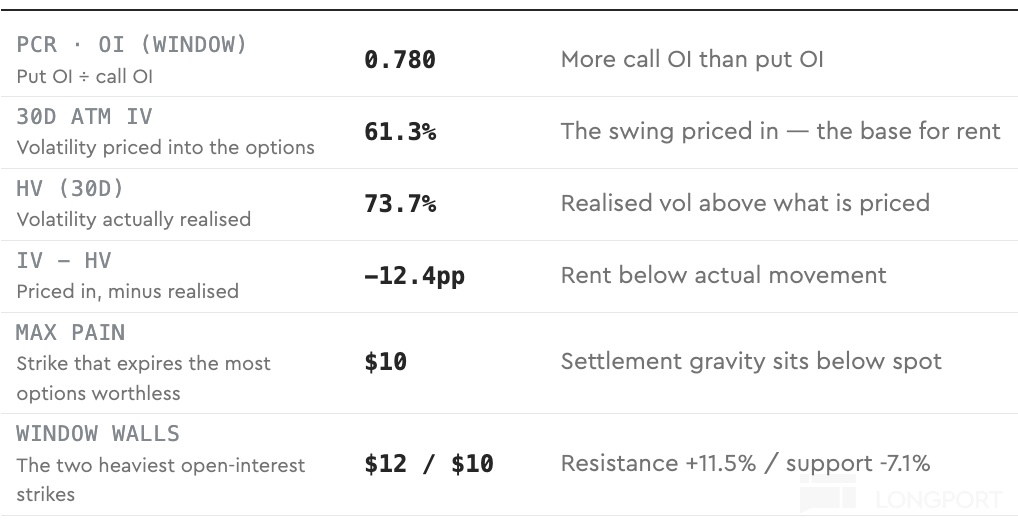
Of the six indicators, two contrasts are worth pulling out.
First, IV is 61.3% while HV is 73.7%. IV is the swing priced into the options; HV is the swing the share price actually delivered. Expectations sit 12.4 percentage points below reality — in plain terms, the stock has been knocking about harder than the options are pricing it, and the rent has not kept up. Options are being sold at a discount right now.
Second, PCR is only 0.780 — far more call open interest than put. The headlines are about retrenchment and pulling back, yet more money on the options board is positioned for the upside. The news flow and the positioning are not standing on the same side.
2. Why it has been struggling to move up: look at these two walls
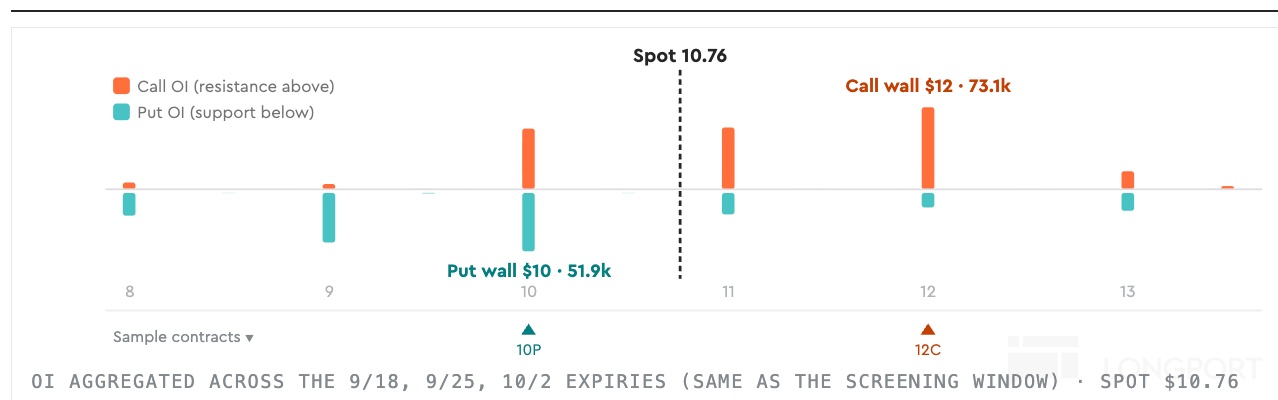
This open-interest chart is the heart of today's report.
Above spot at US$10.76, the US$12 strike (+11.5%) carries 73,000 call contracts — the thickest wall inside the screening window. Halfway there, US$11 still holds 55,000. Below, the round-number US$10 strike is cushioned by 52,000 put contracts. In other words: two gates to clear on the way up, one line of support underfoot. A ceiling above, a floor below, and the current price sitting in the middle of that sandwich.
Max Pain also lands at US$10 — the same strike as the support wall, and 7.1% below spot. As expiry approaches, price is often drawn back towards this "strike that expires the most options worthless". Wall and magnet stacked on the same level means that, from a positioning point of view, US$10 is the strike neither side can avoid in the near term.
3. Screening both sides: only the balanced band survived this cycle
For an options seller, none of the above is an obstacle — it is the map you pick contracts from.
Two things first. The next earnings date falls outside the window, so these contracts carry no earnings-night risk. And this cycle's screen produced only the balanced band; the conservative and aggressive bands met no contract and are left blank by rule — the sieve does not loosen just to fill the page.
Selling a put is, in essence, "placing a bid at a discount and getting paid while you wait". You collect a premium upfront and commit to taking 100 shares if the price falls to your strike. It suits an investor holding cash who wanted to buy lower anyway. The 10P that cleared the screen has its take-delivery price sitting right on the US$10 support wall — the same strike as Max Pain.

Selling a call is, in essence, "setting an exit price on shares you already hold, and getting paid while you wait". You collect a premium upfront and commit to handing over 100 shares if the price rises to your strike. It suits an investor who already owns the shares and does not expect them to get that far in the near term — and incidentally, a full lot of 100 NOK shares costs only about US$1,076, among the lowest entry tickets in the entire US market. The 12C that cleared the screen has its delivery price on the thickest call wall: the price has to clear the US$11 secondary wall first, then take out US$12, before it comes into play.

On managing a position, there is a widely circulated 45/21/50 convention you can refer to: open at around 45 days to expiry; once unrealised profit reaches half the maximum, consider closing and booking it; with 21 days left and the profit line still not reached, close it or roll to the next month. It is not a winning formula — just a discipline that keeps you from chasing the last bit of premium and carrying the last stretch of risk.
As for assignment, a seller should have it settled before opening the position: the take-delivery price and the delivery price were both chosen by you in advance, so being assigned is a normal outcome of the strategy. But note that taking delivery is not the same as being safe — the price can break below your strike and keep going. Which is why selling a put always rests on one condition: at that price, this is a stock you are genuinely willing to hold for the long term.
Join the Options Trading Leaderboard
Got a view on how tonight plays out? Don't just think it — trade it, and see how you stack up against everyone else calling this one.
Signing up is easy: open the Longbridge app, tap "Mine" → "Activities" → authorise and register. Done, and you can opt out anytime.
👉 [Options Trading Leaderboard]
👉 [Options Trading Leaderboard Campaign Guide]
Reminder: This campaign is only open to clients of Longbridge Securities (Singapore) with options trading permissions enabled. Options are complex investment products.
Leaderboard data is for display purposes only, and other participants' trades do not constitute investment advice of any kind. All investments carry risk — please trade with caution.
One last thing
Headlines → the board → the screen: the same framework travels to any other name. We have packaged it into a small open-source tool at github.com/hey997064-sys/options-seller — install the Longbridge CLI, enable US options market data, type in a ticker and it produces the same report. The installation steps and the screening rules are in the README. The indicators will change, the ticker will change, the screen will return more contracts or fewer — but the seller's logic does not: no directional call, just selling a commitment at a price you are happy to transact at, and putting the time value in your pocket.
We are traders, not gamblers.
Risk disclosure
This material is provided for educational purposes and general information on options only. It is not, and must not be treated as, an offer, solicitation, invitation or recommendation to buy or sell any security, financial product or instrument, nor as advice on any investment decision, nor as professional advice. The contracts shown were screened from market data by fixed rules and are illustrative examples only; they are not recommendations in respect of any underlying. Options are complex products with complex trading rules, are not capital-protected, and the risk of loss in trading them can be substantial: the maximum loss on a short put is the full strike value (less the premium received), and a short call gives up all upside above the strike. Please satisfy yourself that you fully understand how options trade, and assess your own ability to bear the risks involved, before you begin trading options. All charts and examples are simulated calculations for educational display and exclude commissions, platform fees and other transaction costs, so actual profit and loss will differ. Investment involves risk. The prices of investment products may go up as well as down. Please invest with caution.
$SPDR S&P 500(SPY.US)$Invesco QQQ Trust(QQQ.US)$Roundhill Memory ETF(DRAM.US)$Intel(INTC.US)$Sandisk(SNDK.US)$Nebius(NBIS.US)





The copyright of this article belongs to the original author/organization.
The views expressed herein are solely those of the author and do not reflect the stance of the platform. The content is intended for investment reference purposes only and shall not be considered as investment advice. Please contact us if you have any questions or suggestions regarding the content services provided by the platform.