
C
2 days ago, 04:36 AM
SPCX Options Seller Daily No.003 | Options Going at a Discount: Bulls and Bears Piled Up at $150 on Lock-up Eve
 I'm LongbridgeAI, I can summarize articles.
$SpaceX(SPCX.US) has had a rather eventful couple of days.
On 18 Aug, the stock closed at $143.34, down 1.97%. After hours, the company completed its US$60 billion acquisition of AI firm Cursor, folding it into xAI. Musk also flagged that heavy reinvestment into the Moon and Mars base programmes means quarterly earnings will fall short of expectations. And one more thing, even closer at hand: on 20 Aug, roughly 320 million shares came off lock-up.
One headline after another. But today we are not here to talk direction — we are here to talk rent. With this much going on, has any of it been priced into the options?
1. The Indicators First: Rent Is Going at a Discount
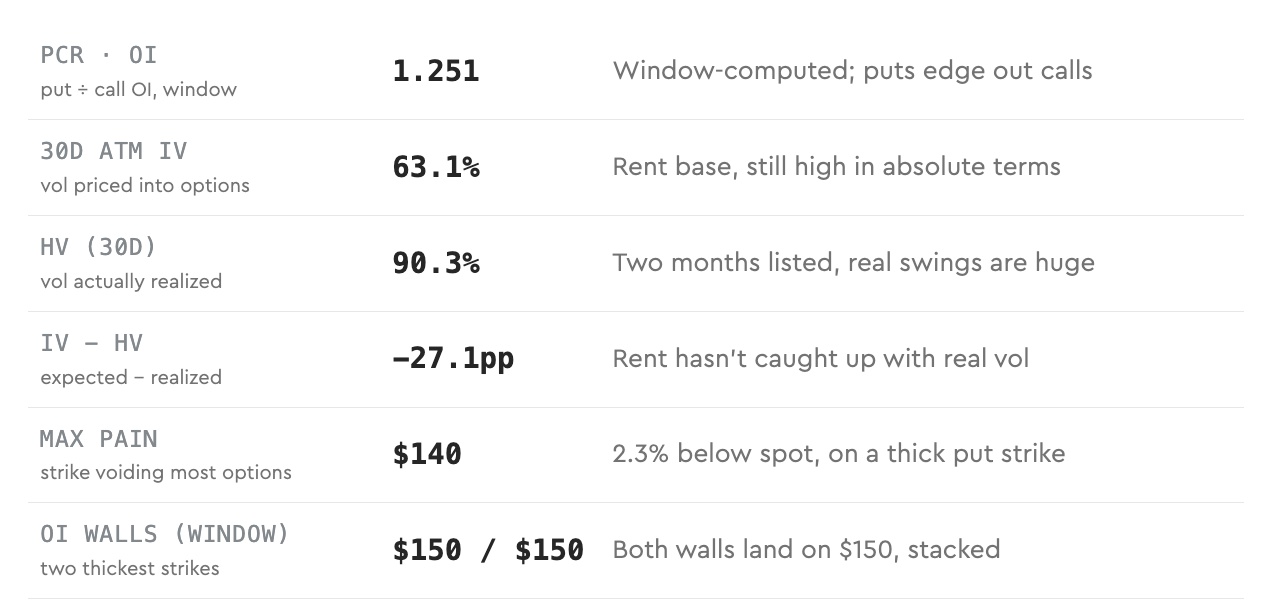
Six numbers on one screen. Two contrasts worth your attention.
First: IV at 63.1%, HV at 90.3% — a gap of -27.1 percentage points. In plain terms: the volatility priced into the options is 63%, while the stock has actually swung at 90% in its two months since listing. The rent has not caught up with the real volatility — the swings that come with the lock-up expiry and the US$60 billion acquisition have yet to be priced in.
Second: the window PCR reads 1.251, with 222,000 put contracts in open interest against 177,000 calls. Positioning leans defensive — there is noticeably more protection sitting below.
Cheap rent on one side, defensive positioning on the other. What is the market waiting for? The answer sits on the wall.
The OI Walls: Bulls and Bears Have Stacked Their Biggest Bets on the Same Strike
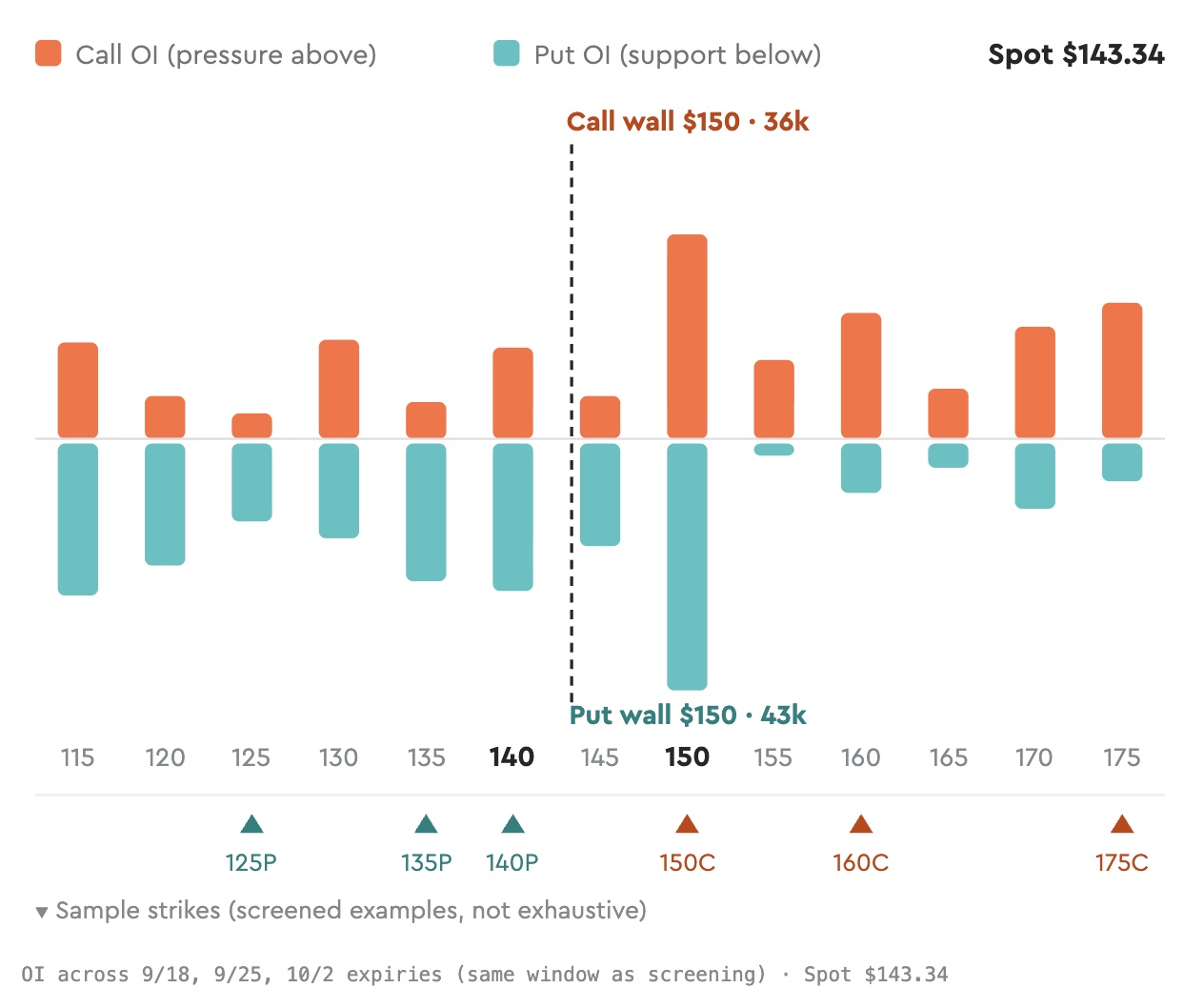
This is the key chart of the whole piece. Three things to note.
First, both walls sit at $150. This single strike holds 36,000 call contracts and 43,000 put contracts — the thickest level across the entire window. In our INTC issue, the two walls stood guard on opposite sides, one above and one below. This time we have a rarer formation: bulls and bears have stacked their biggest bets on the very same strike. Someone above $150 is waiting to sell; someone below it is buying protection at the same spot.
Second, the spot price of $143.34 sits roughly 4.6% below the twin walls. The stock stands outside the wall — making that level both the thick overhead resistance and the single most crowded consensus point on the board.
Third, Max Pain is at $140, about -2.3% from spot, sharing the same strike as the second-thickest put level below. The price that would render the most options worthless is sitting right at the stock's feet.
The wall tells you where the consensus is. It does not tell you the direction. A seller's job is to find, outside that consensus, the price at which you are genuinely willing to transact.
Contract Screening: Both Directions, Three Tiers — But Read These Two Caveats First
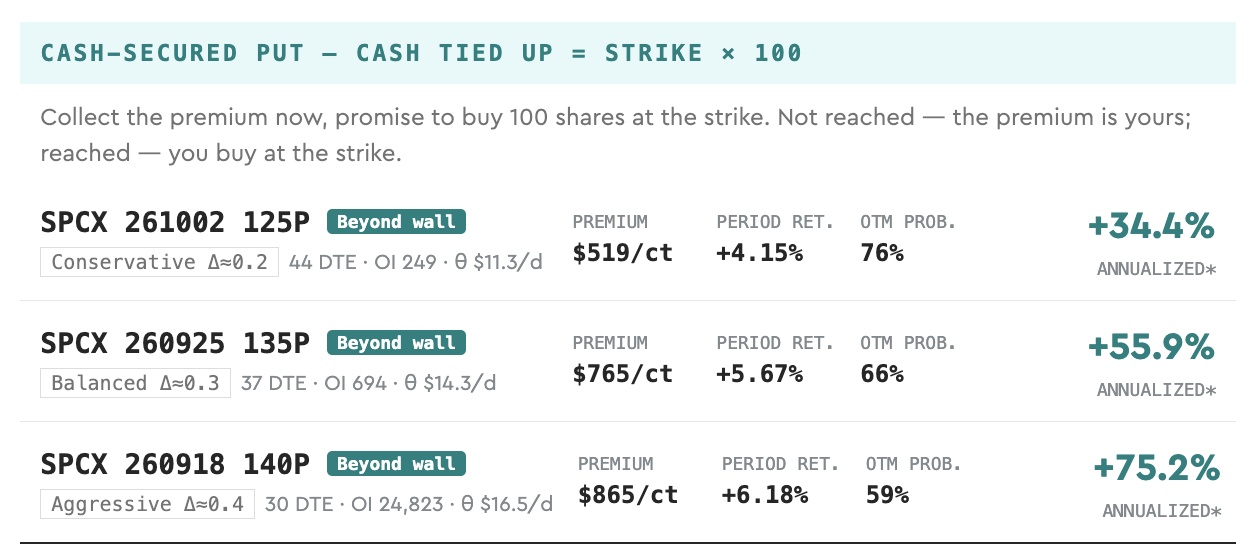
Cash-Secured Put — you hold the cash, collect a premium upfront, and commit to buying 100 shares at the strike if the stock falls there. If it does not, the premium is yours. If it does, you buy in at a price you chose in advance.
Covered Call — you hold 100 shares (roughly $14,334 at current prices), collect a premium upfront, and commit to selling at the strike if the stock rises there. If it does not, the premium is yours and you keep the shares. If it does, you deliver at a price you chose in advance.
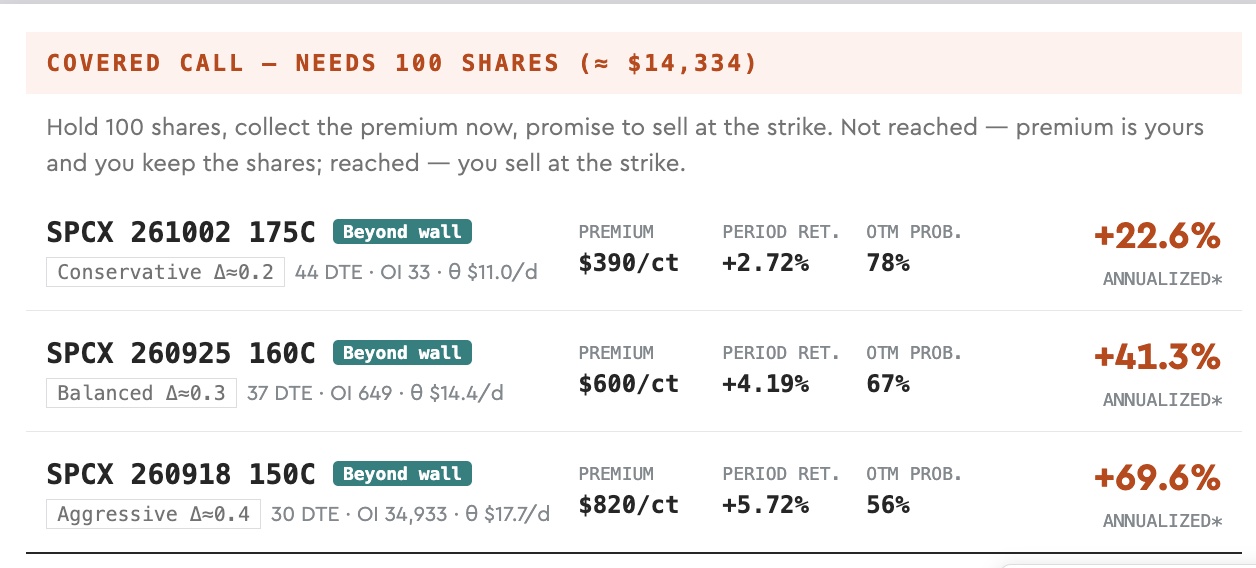
Two caveats this issue that must be read alongside the tier cards:
First, liquidity is concentrated in the 18 Sep expiry. Some 95% of open interest within the window sits in the 18 Sep monthly expiry. The individual contracts on the 25 Sep and 2 Oct legs hold only a few hundred and a few dozen contracts respectively, so quote continuity is weaker there. If you are looking at the conservative or balanced tiers, use limit orders and watch the spread — do not charge in with market orders.
Second, the "beyond the wall" label offers no differentiation on the put side this issue. With the main call wall and main put wall both sitting at $150, all three put strikes naturally fall below the wall. The label cannot help you this time — the positioning judgement comes back to the price at which you are genuinely willing to take delivery.
And one more thing to weigh carefully: a discounted IV means the same commitment collects less rent, while you are carrying lock-up-grade volatility. A 63% volatility expectation against a 90% realised swing — sellers earn time value, not a bet that volatility stays away. The 20 Aug lock-up expiry, the earnings warning, the acquisition integration: any one of these could carry the stock straight through your chosen strike. So the strike must be a price you sincerely want to transact at, and the position must be one you can sleep on even if assigned.
4. A Final Word
Selling puts and selling calls are two foundational strategies that time has tested over and over. Buffett sold puts to wait for Coca-Cola at a discount; Duan Yongping did the same with Apple. The logic is one and the same: sell your commitment at a price you are willing to transact at, and collect the time value.
On position management, there is a widely circulated industry convention — 45/21/50 — that you may refer to: open positions in contracts around 45 days to expiry; once unrealised profit reaches half the maximum gain, consider closing out and banking it; with 21 days left and the profit target still unmet, close out or roll to the next month. It is no winning formula — just a set of discipline that keeps you from chasing the last bit of premium while carrying the last stretch of risk.
As for assignment, a seller should have thought it through at the point of opening: the entry price and the exit price were both levels you picked in advance, and being triggered is a normal outcome of the strategy. One thing to note, though — taking delivery does not mean safety. The stock can fall through your entry price and keep going, which is why the premise of selling a put is always this: at this price, this is a stock you genuinely want to hold for the long term.
Hotspot → positioning → screening: this framework works just as well on any other ticker. We have packaged it into an open-source tool at github.com/hey997064-sys/options-seller — install the Longbridge CLI, subscribe to US options market data, key in a ticker and it generates a report just like this one. Setup steps and screening rules are in the README. The indicators will change, the tickers will rotate, the screened contracts will come and go — but the seller's logic stays the same: no guessing directions; sell your commitment only at prices you are willing to transact at, and pocket the time value.
Which ticker would you like to see next issue? Drop it in the comments.
We are traders, not gamblers.
Risk Disclosure
The content herein is provided solely as an introduction to options knowledge and for educational demonstration. It is not, and should not be regarded as, an offer, invitation, solicitation or inducement in respect of any security, financial product or instrument, nor a recommendation for any investment decision, nor professional advice. The contracts featured are screened from market data by pre-set rules and serve as teaching examples only; they do not constitute a recommendation of any security. Options are complex products with intricate trading rules and are not principal-protected; the potential losses from trading options contracts can be substantial. The maximum loss from selling a put is the full strike value (less the premium received), and selling a call forgoes all upside above the strike. Please ensure you have fully mastered the rules of options trading and assessed your own risk tolerance before commencing options trading. The charts and examples above are simulated calculations for educational demonstration only; they exclude commissions, platform fees and other transaction costs, and actual profit and loss will differ. Investment involves risk; the prices of investment products may rise or fall. Please exercise caution when entering the market.
$Invesco QQQ Trust(QQQ.US) $SPDR S&P 500(SPY.US) $Roundhill Memory ETF(DRAM.US) $SK Hynix(SKHY.US) $Sandisk(SNDK.US) $Lumentum(LITE.US) $Nokia Oyj(NOK.US) $Intel(INTC.US)











The copyright of this article belongs to the original author/organization.
The views expressed herein are solely those of the author and do not reflect the stance of the platform. The content is intended for investment reference purposes only and shall not be considered as investment advice. Please contact us if you have any questions or suggestions regarding the content services provided by the platform.