
O

Aug 20 at 03:40 AM
📈 Beginner’s Guide to why Moderna flys : Why Can a Stock Rise Because of a Catalyst?
 I'm LongbridgeAI, I can summarize articles.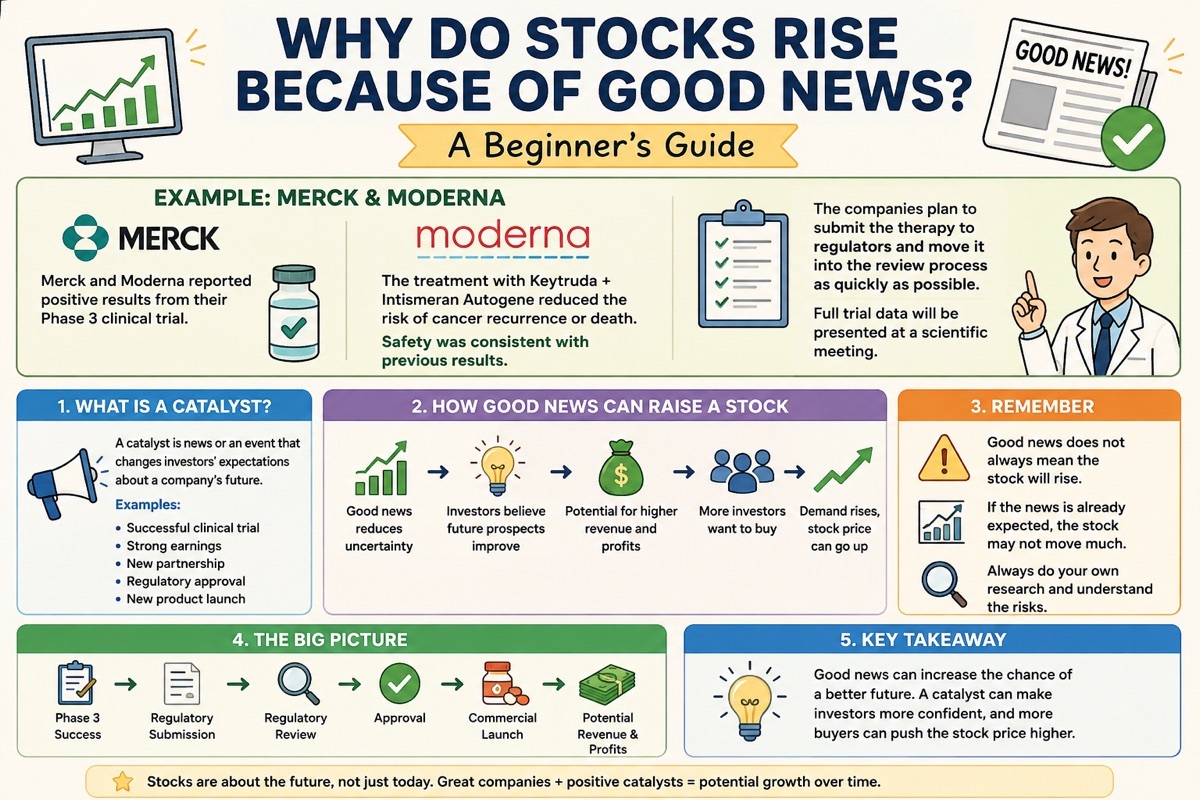
A catalyst is an event or piece of news that can change how investors think about a company’s future.
Think of it simply:
Good news → better expectations → more buyers → potentially higher stock price
The recent news involving Merck & Co. and Moderna is a good example of how a catalyst can affect a stock.
🧬 1. What was the catalyst?
Merck and Moderna announced positive results from their Phase 3 INTerpath-001 clinical trial.
The trial tested intismeran autogene, an individualized neoantigen therapy, together with Keytruda, in patients with completely resected stage IIB-IV melanoma.
$Moderna(MRNA.US)
The important news for investors was that the trial met its primary endpoint of recurrence-free survival.
In simple English:
👉 Patients receiving the combination treatment had a substantially lower risk of their cancer returning or dying compared with the standard adjuvant treatment.
For a pharmaceutical company, this can be extremely important news.
🚀 2. Why can this make a stock rise?
Before the announcement, investors had uncertainty.
They might have been thinking:
“Will this treatment actually work?”
A successful Phase 3 result provides important evidence that the treatment can work in the intended patient population.
So investors may start thinking:
Successful trial⬇️Potential regulatory submission⬇️Potential approval⬇️Potential commercial launch⬇️Potential new revenue⬇️Potentially higher future earnings
The stock price can rise because investors are pricing in the possibility of better future business performance.
💰 3. Stocks are about the future
This is one of the most important lessons for a beginner.
The stock market isn’t only asking:
“How much money did the company make today?”
It is also asking:
“How much money could this company make in the future?”
Imagine Moderna has a new cancer treatment that could eventually generate billions of dollars in revenue.
Even if the treatment generates $0 in sales today, investors may still value the company more highly because the probability of future revenue has increased.
That’s why a stock can jump immediately after important news.
🧪 4. Why is Phase 3 such an important catalyst?
Drug development generally happens through several stages.
Phase 1 📝
Researchers primarily look at safety and how the treatment behaves in people.
Phase 2 🔬
Researchers gather more evidence about safety, dosage and whether the treatment appears to work.
Phase 3 🎓
The treatment is tested in a much larger population to determine whether it provides meaningful benefits compared with existing treatment.
Therefore, a successful Phase 3 trial can be a major milestone.
However:
⚠️ Phase 3 success does NOT automatically mean the drug is approved.
The companies still need to submit their data and go through the regulatory process.
📜 5. The next catalyst: Regulatory submission
This is another important part of the announcement.
Merck and Moderna said they plan to engage with regulatory authorities regarding submission filings for the combination therapy.
For investors, this creates another potential catalyst.
The sequence could look like this:
Phase 3 success ✅⬇️Regulatory submission 📄⬇️Regulatory review 🔍⬇️Potential approval ✅⬇️Commercialisation 💰
Each stage can potentially create new information for investors.
📈 6. Why could Moderna benefit?
For Moderna, investors may see this as evidence that its mRNA technology could have applications beyond COVID-19 vaccines.
That can potentially change the company’s long-term story.
Instead of investors thinking only about existing products, they may start thinking about:
🧬 Cancer treatments🧬 Personalized medicine🧬 Future mRNA therapies🧬 Additional clinical programs🧬 Potential future revenue
If investors believe the probability of successful commercialization has increased, they may be willing to pay more for the stock.
💊 7. Why could Merck benefit?
Merck’s Keytruda is already an important cancer treatment.
The positive trial result involves using intismeran autogene in combination with Keytruda.
Therefore, investors may see potential for Keytruda to participate in another important treatment combination.
That can potentially strengthen the long-term value of Merck’s oncology business.
🧠 8. But here’s the BIG beginner lesson
Good news doesn’t automatically mean the stock will rise.
Why?
Because the stock market cares about expectations.
Imagine:
Investors expect a company to earn $5.00 per share.
The company announces:
Actual earnings = $5.20
That sounds great!
But imagine investors were expecting $5.50.
The stock could still fall.
Why?
Because the result was better than last year but worse than expected.
This is called the difference between:
📊 Actual results vs. Market expectations
🔥 9. A catalyst can also be “better than expected”
For example:
Company A
Expected: Phase 3 succeedsActual: Phase 3 succeeds
➡️ Good news, but perhaps already priced into the stock.
Company B
Expected: Phase 3 has modest resultsActual: Phase 3 dramatically exceeds expectations
➡️ Potentially much stronger catalyst.
This is why stocks sometimes explode higher after news.
The market is constantly asking:
“Is this better or worse than what we already expected?”
⚠️ 10. Don’t chase the stock just because of the headline
This is where I would be careful as a beginner investor.
If I see:
“Company announces successful clinical trial!”
I wouldn’t immediately think:
“BUY!”
Instead, I would ask:
1️⃣ How important is the news?
Does it actually change the company’s future?
2️⃣ Was it better than expected?
Or did investors already expect success?
3️⃣ How big could the market be?
Could this treatment eventually generate meaningful revenue?
4️⃣ What happens next?
Regulatory submission? Approval? Commercial launch?
5️⃣ Has the stock already jumped 30%, 50% or 100%?
If so, some of the good news may already be reflected in the price.
🐶 My Simple Catalyst Formula
I like to simplify it like this:
CATALYST ➡️ Does it change the company’s future? ➡️ Can it increase revenue? ➡️ Can it increase future profits/cash flow? ➡️ Is the news better than expected? ➡️ Is the current valuation still reasonable?
If the answers are mostly YES, investors may have a reason to value the company more highly.
📌 Final takeaway
A stock doesn’t rise simply because the news is “good.”
It rises when the news can make investors believe:
“This company may be worth more in the future than I previously thought.”
The Merck/Moderna Phase 3 result is a good example.
Positive clinical result 🧬→ reduces uncertainty→ increases confidence in the treatment→ creates potential regulatory opportunity→ creates potential future commercial revenue→ potentially increases the company’s future value→ investors may buy the stock→ stock price can rise 📈
But remember: clinical success is not guaranteed approval, and approval is not guaranteed commercial success.
Disclaimer: This is for educational purposes only and is not financial advice. A catalyst can cause a stock to rise, but it can also be followed by profit-taking, volatility or a decline if the market believes the news was already priced in.



The copyright of this article belongs to the original author/organization.
The views expressed herein are solely those of the author and do not reflect the stance of the platform. The content is intended for investment reference purposes only and shall not be considered as investment advice. Please contact us if you have any questions or suggestions regarding the content services provided by the platform.