

Beginner guide Why the Cybercab rollout is a structural revenue story for Tesla
 I'm LongbridgeAI, I can summarize articles.
Why the Cybercab rollout is a structural revenue story for Tesla — not just another car launch
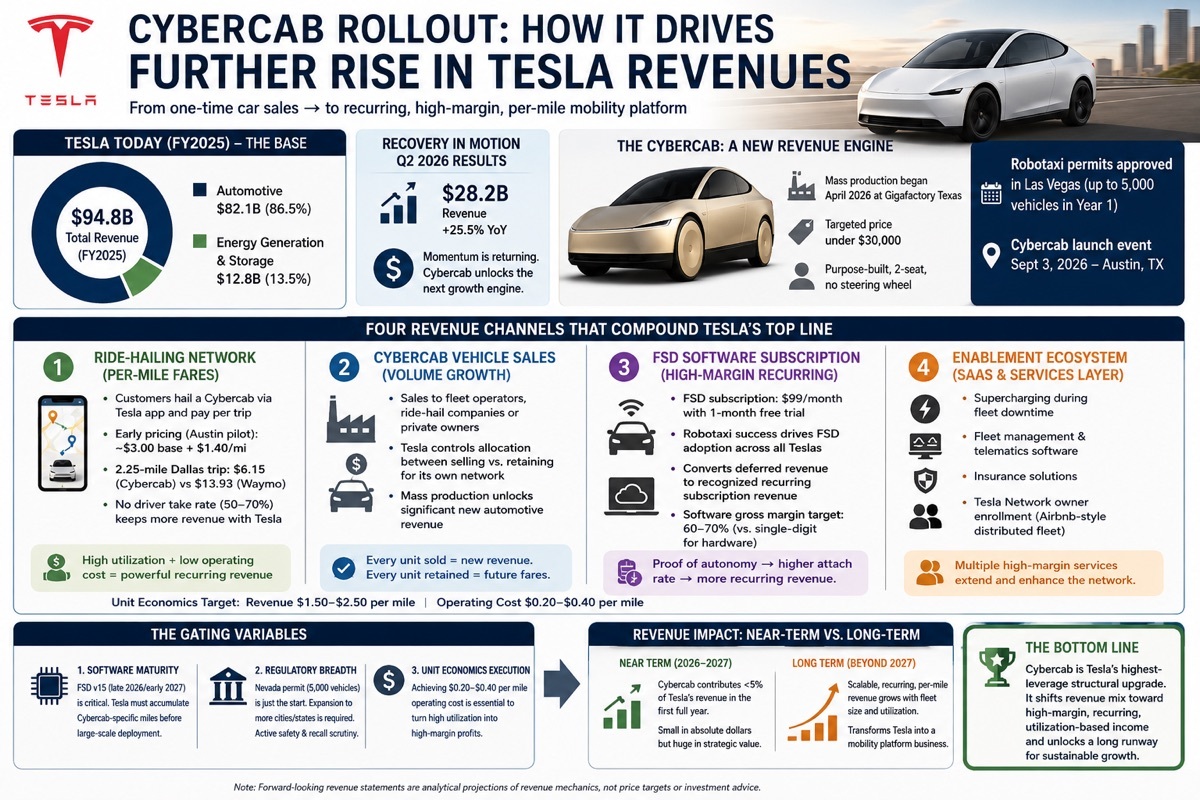
The platform question first. To see what the robotaxi move actually does to Tesla's top line, you have to start with the base it is building on. In FY2025 Teslagenerated $94.8B in revenue, down ~2.9% year over year — its first contraction after years of high growth — and the latest full-year segment split shows why: Automotive still accounted for ~86.5% of sales ($82.1B) while Energy Generation & Storage contributed ~13.5% ($12.8B).Longbridge Data +1 That is a hardware-dependent, cyclical, price-sensitized revenue engine hitting capacity and competition limits. Q2 2026 signals the recovery — total revenue of $28.2B, up 25.5% YoY — but the engine is the point of reference for sizing the robotaxi opportunity.Longbridge Data
That context matters because the Cybercab program is fundamentally different in kind from every prior Tesla product line. It is not primarily a device you sell once; it is a recurring-revenue, per-mile mobility business that, if it scales, changes the type of revenue Tesla earns. Nevada's August 21 decision to clear robotaxi permits in Las Vegas for Tesla, Uber and Waymo — allowing Tesla up to 5,000 autonomous vehicles in year one — plus the confirmed September 3 Cybercab launch event in Austin and the employee/test rides already underway, converts what was a prototype narrative into a regulated commercial deployment.longbridge.com +1 This is the gateway through which every dollar below flows.
Channel one — the ride-hailing network: recurring per-mile fares
The principal new revenue stream is the Tesla Network robotaxi fare. The model is ride-hailing per mile rather than vehicle sale: customers hail a Cybercab through the Tesla app and pay per trip.optimusk.blog Because the fleet is vertically integrated — Tesla manufactures the vehicle, operates the network, and runs the autonomy software — the take rate that legacy platforms give to human drivers (~50–70% of gross bookings) is removed from the cost side entirely,inkl and early consumer pricing data shows the pricing power: Tesla's Austin pilot has run at roughly $3.00 base plus $1.40 per mile, comparable to or below incumbent rideshare, with a completed 2.25-mile unsupervised Dallas trip costing $6.15 versus $13.93 for the same route from Waymo.teslarobotaxi.com +1
The unit economics are the entire thesis. Tesla's long-stated target is an internal operating cost near $0.20–$0.40 per mile at scale — far below the ~$1.50–$2.50 per mile that human-driven rideshare carries as a full cost — with revenue per mile initially in the $1.50–$2.50 range.optimusk.blog +2 Even a modest fleet can therefore generate large recurring revenue. If a Cybercab operates roughly 20 hours a day at ~$1.50/mile, per-vehicle annual revenue can plausibly run into the tens of thousands of dollars — the recurring stream, not the one-time sale, is the real economics.optimusk.blog A fleet of 5,000 vehicles in Las Vegas alone, at even conservative utilization, represents a new, high-margin annuity line growing on top of the hardware base.
Channel two — Cybercab vehicle sales: volume that redeploys the factory
The second stream is more conventional but still incremental: sales of the Cybercab itself. Mass production began at Gigafactory Texas in April 2026 at a targeted price below $30,000 — a purpose-built, two-seat, steering-wheel-free vehicle that effectively resets the low end of Tesla's vehicle lineup.Pressfarm +1 Every unit delivered to fleet operators, ride-hail companies, or private owners is a new automotive-sales dollar. Critically, Tesla controls the allocation between selling units and retaining them in its own fare-collecting fleet,The so the program can dynamically choose between upfront cash from sales and the recurring fare cash flow from retention — both of which feed revenue.
Channel three — FSD software subscription and deferred revenue
The rollout is inseparable from the Full Self-Driving (FSD) monetization layer because robotaxi operation is the proof that FSD works. Tesla transitioned from perpetual software sales to a $99/month FSD subscription with one-month free trials to drive adoption.X Each success milestone in the Cybercab network validates the software, raises attach rates across the installed base, and converts the option that every Tesla on the road carries into recurring subscription revenue — plus the recognition of previously deferred FSD revenue. This is where the margin inflection is largest: software carries SaaS-like gross margins in the 60–70% range that Tesla targets, versus single-digit margins typical of new vehicle hardware.Builder +1
Channel four — the enablement layer
Around the core network sits an ecosystem of recurring revenue: charging at Superchargers during fleet downtime, fleet management/telematics software, insurance, and future "Tesla Network" owner enrollment, where individuals contribute under-utilized vehicles to earn income — an Airbnb-style distributed fleet model that extends the network without Tesla bearing all the capex.optimusk.blog +1None of these are large today, but they are the infrastructure on which a per-mile business compounds.
Why this is transformational even though it is small at first
It is essential to size the near term honestly. At 125,000 Cybercabs a year sold at under $30,000, vehicle-sale revenue lands under ~$3.8B — roughly 4% of Tesla's $94.8B FY2025 base — and even an aggressive fare-collection case stays below ~5% in the first full year.The +1 The robots' absolute contribution to revenue in 2026–2027 will be a rounding error against the existing business. What the program changes is not the magnitude of 2026 revenue but its trajectory and quality: it pivots Tesla's revenue mix toward high-margin, recurring, utilization-based income, away from a margin—compressed hardware cycle.
The gating variables to watch
None of this happens automatically. Three gates determine whether the channels convert into real revenue. First, software maturity: the fleet's expansion depends on FSD v15, expected late 2026 or early 2027, and Tesla has said it must accumulate Cybercab-specific chassis miles before large-scale deployment — so scale is backend-weighted.longbridge.com +2 Second, regulatory breadth: Nevada's 5,000-vehicle year-one permit is single-state; every additional market requires its own clearance, and Tesla faces an active 2026 recall backdrop in China.longbridge.com Third, unit economics execution: whether operating cost truly approaches the $0.20–$0.40/mile target determines whether high utilization converts into margin rather than simply into high-volume, low-margin rides.optimusk.blog
Bottom line: The Cybercab program is Tesla's mechanism for turning a mature, hardware-driven revenue base into a recurring, software-margined mobility platform. In 2026 it adds little to the topline relative to FY2025's $94.8B base — the likely first-year contribution is well under 5% — but it is the highest-leverage structural revenue upgrade Tesla has left, and its value lies in diversification, margin quality, and the per-mile recurrence it introduces rather than near-term absolute dollars. The rollout facts to track are FSD v15 timing, expansion of permitted cities beyond Las Vegas and Austin, and whether sustained public-ride data holds down the cost-per-mile curve



The copyright of this article belongs to the original author/organization.
The views expressed herein are solely those of the author and do not reflect the stance of the platform. The content is intended for investment reference purposes only and shall not be considered as investment advice. Please contact us if you have any questions or suggestions regarding the content services provided by the platform.