
O

Sep 22 at 04:50 AM
Beginner guide 🚀🐶 Options Puppy: Why I’m Bullish on SpaceX — And the Catalysts That Could Push It
 I'm LongbridgeAI, I can summarize articles.
My view: I think SpaceX has several potential catalysts beyond the Nasdaq-100 rebalancing. The important thing for me is that SpaceX is no longer just a rocket-launch company. It is increasingly becoming a combination of Starlink internet + mobile connectivity + AI infrastructure + launch services + space technology.
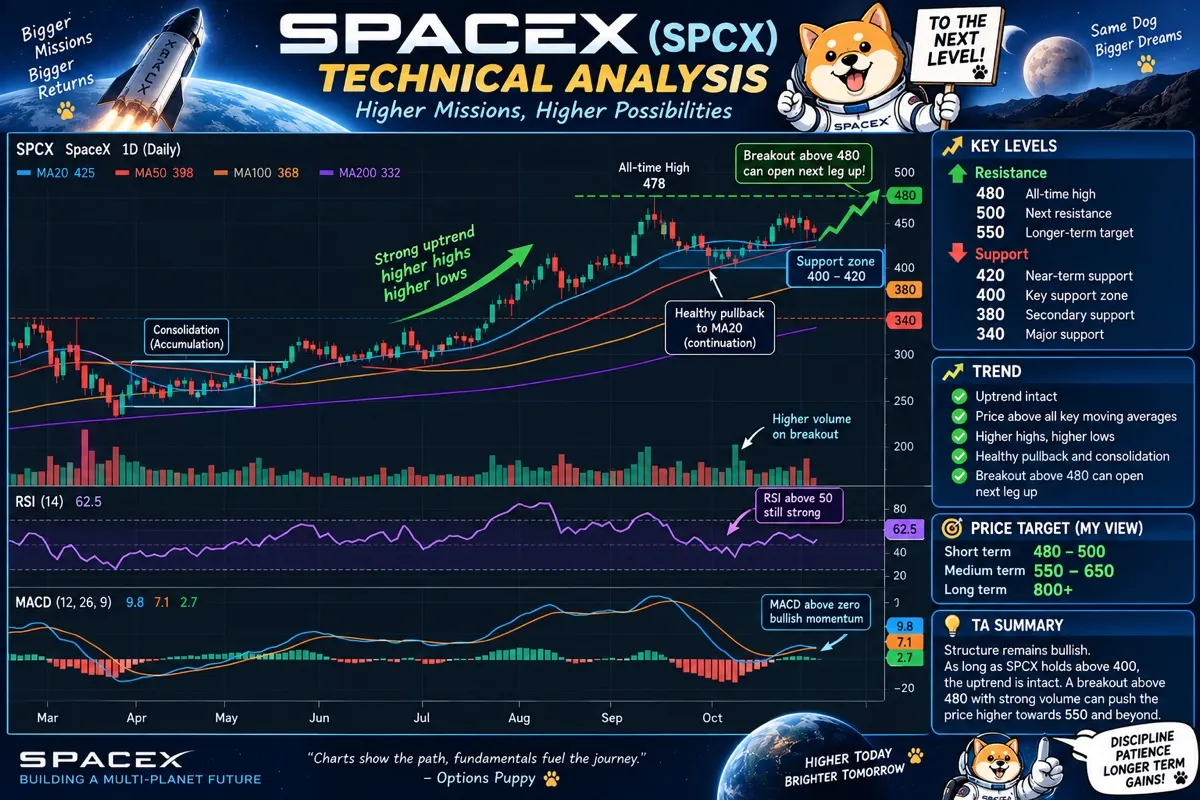
That gives me multiple possible engines for future growth. At the same time, I would not ignore valuation risk because the market is already assigning SpaceX very high expectations.
🔥 1. The Nasdaq-100 catalyst is only the beginning
The first catalyst is the one shown in the screenshot.
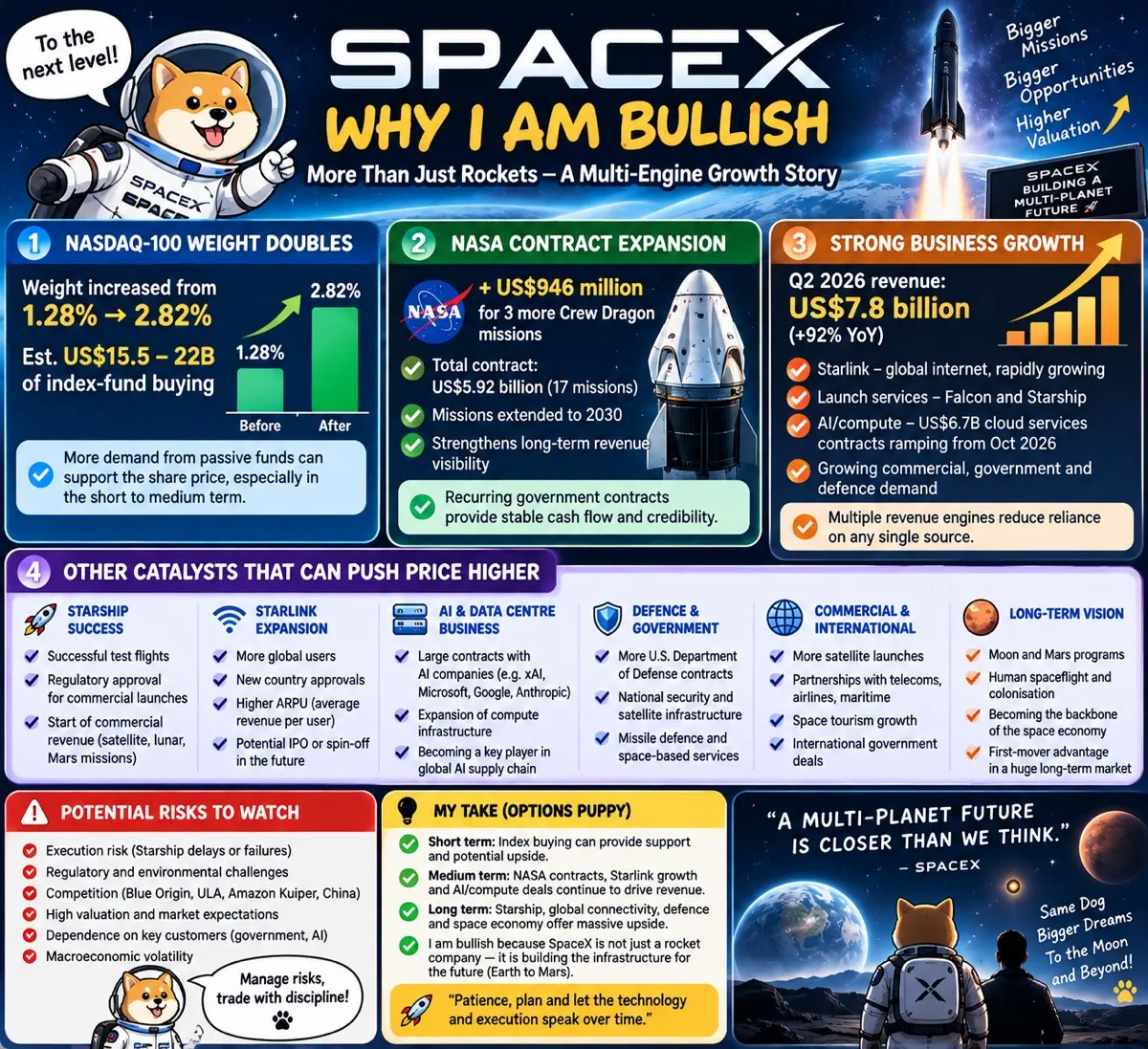
SpaceX’s Nasdaq-100 weighting increased from approximately 1.28% to 2.82% following the September 2026 rebalance. Bloomberg confirmed the 2.82% weighting.
For me, this is important because index-tracking funds have to adjust their holdings when the index composition and weights change.
That creates a potential mechanical demand catalyst.
But I would separate this from the fundamental story.
The Nasdaq-100 rebalance itself doesn’t suddenly make SpaceX more profitable. Instead, it can create additional demand and improve market liquidity and visibility.
🐶 Options Puppy lesson:Sometimes a stock can rise because of a fundamental catalyst. Sometimes it can rise because of forced or mechanical buying. When both happen together, I pay attention.
🚀 2. Starship could become the biggest catalyst
This is the catalyst I am watching most closely.
SpaceX was targeting a September 22, 2026 Starship test that could attempt the vehicle’s first orbital flight, with plans to deploy the first batch of Starlink V3 satellites. Reuters reported that the mission is designed to test major parts of the reusable system, including launch, stage separation, boostback and splashdown.
Why does this matter?
Because Starship isn’t simply another rocket.
The long-term thesis is about dramatically lowering the cost of putting things into orbit.
If SpaceX can eventually demonstrate reliable, highly reusable Starship operations, it could potentially launch much larger payloads at a much lower cost per unit.
That could benefit several SpaceX businesses simultaneously:
🚀 Starlink satellite deployment🤖 AI/compute satellites🌐 communications infrastructure🛰️ government missions🌙 lunar missions📡 future space infrastructure
So I see Starship as a platform catalyst, rather than just a single launch catalyst.
A successful test could strengthen investor confidence in the company’s long-term plans.
🌐 3. Starlink V3 could accelerate the growth story
Another major catalyst is the next generation of Starlink satellites.
SpaceX said it planned to launch at least 1,000 next-generation V3 Starlink satellites within a year. Its first-half 2026 revenue reached US$7.8 billion, nearly double the previous year’s level, while Starlink revenue increased 66%.
This is important because Starlink is already the company’s major revenue engine.
The more satellites SpaceX can deploy, the more capacity it can potentially provide.
That creates opportunities to grow:
- Consumer broadband
- Enterprise connectivity
- Aviation
- Maritime
- Government services
- Mobile connectivity
The company reported approximately 12 million Starlink subscribers at the end of the quarter.
For me, the exciting part is that Starlink can become a recurring-revenue business.
Rocket launches are generally transactional.
Internet subscriptions are recurring.
That difference matters.
📱 4. Starlink entering the mobile market could be enormous
This is another catalyst I don’t think investors should ignore.
SpaceX has been moving beyond satellite broadband toward mobile connectivity.
SpaceX acquired wireless spectrum from EchoStar, and management has said it intends to build terrestrial infrastructure and develop Starlink into a broader mobile service. Reuters reported that SpaceX expects to compete for customers currently served by the major U.S. wireless carriers.
Imagine the potential market.
Instead of Starlink being something people buy because they live in a rural location, it could eventually become part of a much broader communications ecosystem.
📱 Phone🌐 Internet🛰️ Satellite✈️ Aviation🚢 Maritime🏢 Enterprise
That creates a much larger addressable market.
Of course, execution will be difficult. Traditional telecom companies already have huge networks and customer bases, so this is not guaranteed.
But from an investor perspective, I see optionality.
🤖 5. AI could become SpaceX’s second major growth engine
This is probably the most interesting part of the SpaceX story after Starlink.
According to Reuters, SpaceX’s AI revenue surged roughly 250% year over year in the latest reported quarter. The company also invested heavily in AI compute infrastructure.
This changes how I think about SpaceX.
Previously:
SpaceX = rockets + Starlink
Now I think about:
SpaceX = rockets + Starlink + AI infrastructure
That is a much bigger story.
The company has also discussed deploying AI-related computing capacity and potentially using satellites as part of future infrastructure.
If AI demand continues to grow and SpaceX successfully monetizes its AI investments, investors could start valuing SpaceX partly as an AI infrastructure company, rather than simply an aerospace company.
That could potentially expand the valuation framework.
💰 6. Revenue growth could be another major catalyst
SpaceX reported quarterly revenue of approximately US$7.8 billion, compared with US$4.1 billion a year earlier.
That’s an enormous growth rate.
Management also said it expected to reach approximately a US$100 billion annualized revenue run-rate by December 2026.
If SpaceX continues to deliver strong revenue growth, the market could become increasingly focused on earnings and cash generation rather than simply the company’s technology story.
This is an important transition.
A company can receive a high valuation because investors believe in its future.
But eventually, the market wants to see:
Revenue → margins → cash flow → earnings.
If SpaceX demonstrates that progression, it could provide another fundamental catalyst.
🛰️ 7. NASA contracts provide additional visibility
NASA recently awarded SpaceX three additional crew missions, bringing the company’s total Commercial Crew missions to 17.
This isn’t as exciting as Starship or AI, but I like it because government contracts can provide relatively visible demand.
SpaceX is also involved in NASA’s broader communications ambitions.
NASA selected SpaceX’s Starlink laser communications technology for Artemis III to help transmit high-bandwidth imagery and video from Orion.
That demonstrates another potential use for Starlink technology.
Instead of simply selling internet access, SpaceX can potentially sell space communications infrastructure.
🌙 8. Lunar and government missions could become another growth market
If Starship becomes operational at scale, SpaceX could potentially participate in a much larger number of government and commercial space missions.
That includes:
🌙 Lunar infrastructure🛰️ National-security satellites🚀 Commercial launches🤖 Space-based AI infrastructure📡 Communications networks
The current space industry is already facing strong demand for launch capacity. A recent Wall Street Journal report described a developing shortage of rocket-launch capacity as demand for satellite deployment increases.
That potentially gives SpaceX a valuable position if it can continue expanding launch capacity while competitors struggle with schedules and reliability.
📈 9. More institutional ownership could support the stock
The Nasdaq-100 inclusion is important for another reason.
It can put SpaceX in front of a much larger group of institutional investors and index funds.
As SpaceX becomes more established as a publicly traded company, more institutions may be able to analyse and own it.
That can potentially improve:
Liquidity → analyst coverage → institutional participation → market visibility.
I would not automatically assume this means the stock must rise.
But it can change the investor base and potentially increase demand over time.
💎 10. A future Starlink or SpaceX strategic transaction could be huge
Another potential catalyst would be a major corporate transaction involving Starlink or another SpaceX division.
For example, if management eventually separates, monetizes or otherwise creates a distinct valuation for a major SpaceX business, investors could get more visibility into how much each business is worth.
This is especially interesting because Starlink itself could potentially be valued as a major standalone connectivity business.
For now, however, I would treat this as potential optionality, not something I would assume will happen.
🐶 My Options Puppy catalyst checklist
If I were watching SpaceX, these are the catalysts I would put on my checklist:
🚀 Near-term
1. Starship orbital test resultsA successful milestone could improve confidence in the Starship program.
2. Nasdaq-100 buying flowsThe 2.82% weighting creates a major index-related demand change.
3. Starlink V3 deploymentMore satellites could increase network capacity and support subscriber growth.
🌐 Medium-term
4. Starlink subscriber growthMore users can increase recurring revenue.
5. Mobile service expansionSpaceX could move from satellite internet toward a much broader communications platform.
6. AI revenue growthIf AI becomes a meaningful contributor to revenue and profitability, the investment story could change significantly.
🌙 Long-term
7. Starship becoming fully reusable
8. Lunar missions
9. Government and defence contracts
10. Space-based AI infrastructure
⚠️ But I would watch the valuation
This is where Options Puppy needs to be careful.
A fantastic company can still have a disappointing stock price if investors have already priced in too much future growth.
Reuters reported that SpaceX’s valuation was around US$1.75 trillion following its public-market debut, while the company is simultaneously investing heavily in AI and other expansion projects.
Capital expenditure has also become enormous.
So my bullish thesis is not:
“SpaceX will definitely keep going up.”
My thesis is:
If SpaceX keeps delivering strong Starlink growth, successfully advances Starship, monetizes AI, expands mobile connectivity and continues growing revenue, investors may have more reasons to assign a higher valuation to the company.
That is a very different statement.
🐶🚀 Options Puppy Conclusion
For me, the Nasdaq-100 rebalance is the immediate catalyst, but it is not the reason I find SpaceX interesting.
The bigger story is the potential combination of:
🚀 Starship🌐 Starlink📱 Mobile connectivity🤖 AI infrastructure🛰️ Government contracts🌙 Lunar missions
The most important catalyst I am watching is Starship progress, because successful reusable Starship operations could potentially unlock growth across several other SpaceX businesses at the same time.
Then I watch Starlink V3 deployment, subscriber growth, AI revenue, mobile expansion and revenue growth.
$SpaceX(SPCX.US) 🐶 My Options Puppy mindset: I don’t want to chase simply because a stock is going up. I want to understand what catalyst is driving the move, whether that catalyst can continue, and whether the valuation already reflects the good news.
For SpaceX, there are currently multiple potential catalysts rather than just one. That is what makes the story particularly interesting to me.


The copyright of this article belongs to the original author/organization.
The views expressed herein are solely those of the author and do not reflect the stance of the platform. The content is intended for investment reference purposes only and shall not be considered as investment advice. Please contact us if you have any questions or suggestions regarding the content services provided by the platform.