

The Return of DC: AI Is Reopening the War Edison Lost
 I'm LongbridgeAI, I can summarize articles.
In 1893, the lights came on at the Chicago World’s Fair.
They were powered by Westinghouse Electric’s alternating-current system, which won the contract with a bid of $399,000. General Electric lost with a bid of $554,000—and behind its proposal stood the direct-current system Edison had championed for years.
Textbooks have long settled the outcome of this “War of the Currents”: AC won, and DC lost.
More than a century later, NVIDIA is changing the yardstick for computing power.
In the past, people mainly asked how many tokens a system could generate per second. Now there is another question: How many tokens can it generate per megawatt of electricity?
Ian Buck, NVIDIA’s vice president of hyperscale and high-performance computing, put it plainly:“In AI factories, power is the constraint. Every watt counts.”
And one of NVIDIA’s answers is to bring direct current back.
Why Edison Lost
Early DC power had one major limitation: there was no practical, economical way to change its voltage.
Edison’s Pearl Street Station, completed in 1882, could supply electricity only to a relatively small surrounding area. The farther electricity travelled, the more energy was lost along the way. Covering an entire city would have required additional generating stations at frequent intervals.
AC offered another solution. Its voltage could be raised before long-distance transmission and lowered again near the customer. Higher voltage means less current is needed to deliver the same amount of power. Lower current, in turn, means thinner wires and lower transmission losses.
In 1896, AC power generated at Niagara Falls was transmitted dozens of kilometres to Buffalo. AC had won the power grid, and even General Electric eventually adopted the technology.

In Edison’s time, DC was constrained by distance. AC could be stepped up for long-distance transmission and stepped down again near the city.
The Same Problem, Inside a Rack
But DC never disappeared. Chips have always run on direct current.
For decades, data centres delivered AC power to each rack, where power modules converted it into 54V DC for the chips.
That architecture worked for years because ordinary racks generally consumed only a few kilowatts.
Then AI arrived.
NVIDIA’s GB200 NVL72 rack draws about 120 kilowatts. The Kyber design shown at GTC 2025 could reach 600 kilowatts, while NVIDIA’s longer-term roadmap points towards one megawatt.
A steel cabinet roughly two metres tall was beginning to consume as much electricity as a small factory.
That created a problem. Delivering one megawatt at 54 volts requires more than 18,000 amps of current.
According to NVIDIA’s calculations, that could require roughly 200 kilograms of copper busbars. Space is an even bigger problem. At megawatt scale, stacking enough conventional power modules could occupy as much as 64 rack units—more than the full height of a standard rack—leaving no room for the GPUs they are supposed to power.
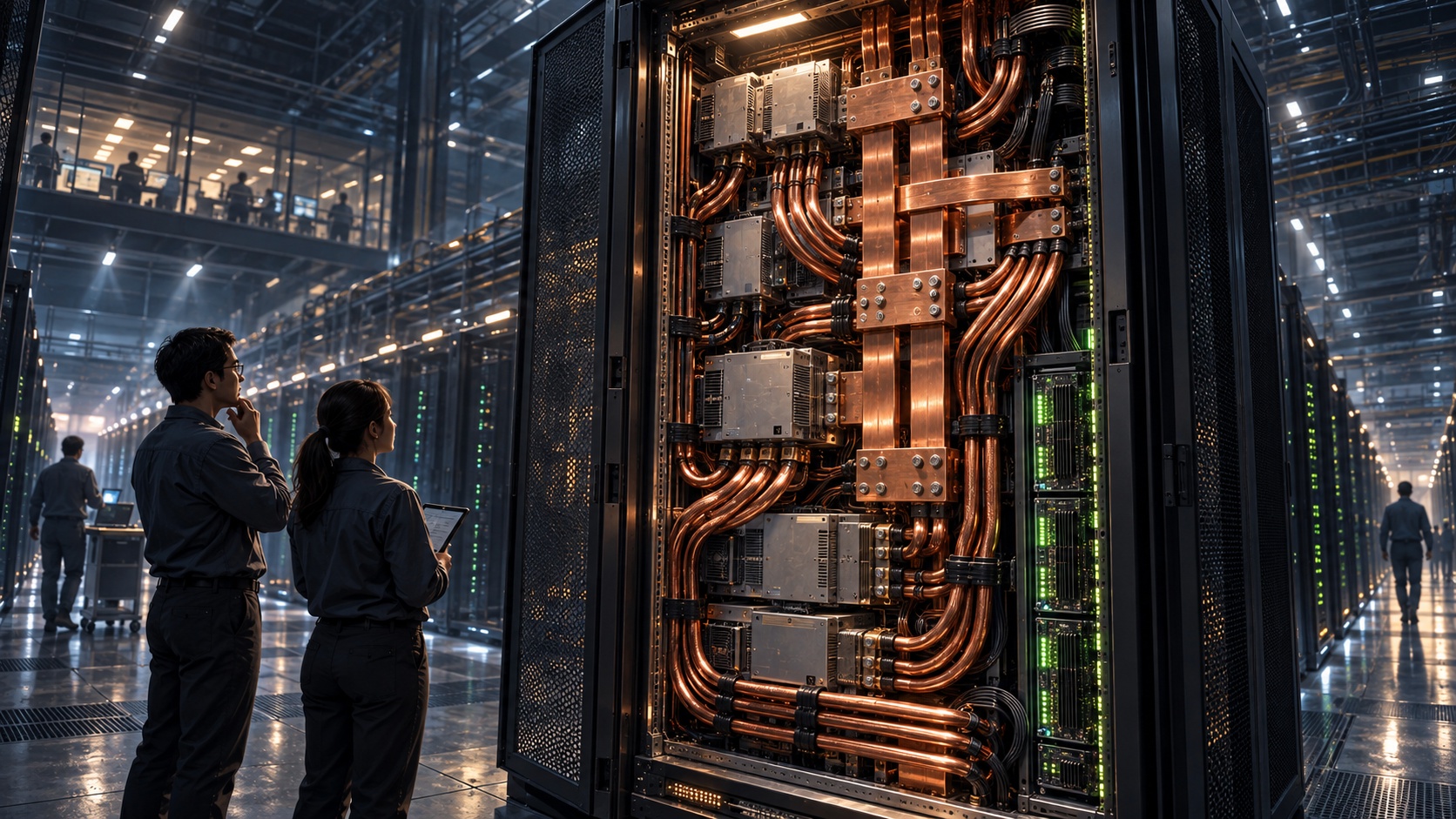
At megawatt-scale power, continuing to use 54V DC means copper busbars and power modules begin to crowd out the GPUs.
Low voltage, enormous current and thick copper: it is the same equation Edison encountered at Pearl Street, only with different variables.
Edison was solving for distance. Beyond a certain point, the copper required to carry electricity another mile became uneconomical. Today’s engineers are solving for space. Once the copper becomes thick enough, there is no longer room for the GPUs inside a 64U rack.
This time, AC is not the opponent. The problem is that 54V can no longer carry this much power efficiently. The battlefield has shrunk from an entire city to a single rack.
Why DC Can Make a Comeback
Instead of putting even more copper inside the rack, NVIDIA has redesigned the final section of the power path.
Its proposed architecture uses 800V DC. AC power is converted centrally into 800V DC at the edge of the data hall, sent directly towards the rack, and stepped down again only when it reaches the GPUs.
Raising the voltage from 54V to 800V reduces the current required to carry the same amount of power to roughly one-fifteenth. With less current, the busbars can be thinner and more of the power equipment can be moved outside the compute rack.
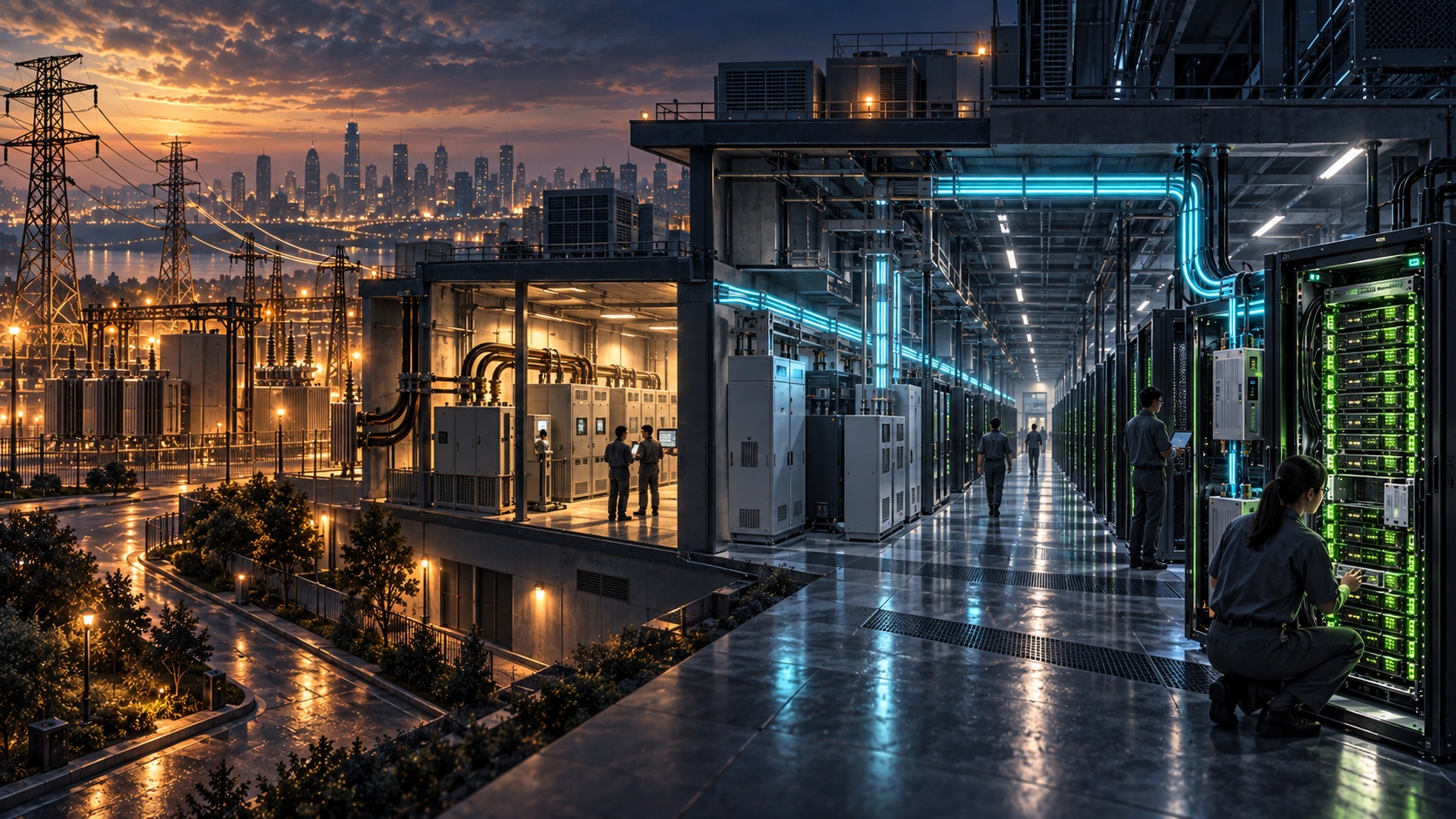
AC still carries electricity to the data-centre site. Inside the facility, it is converted into 800V DC and then stepped down again near the GPU.
According to NVIDIA, compared with traditional 415V AC distribution, an 800V DC architecture can transmit 85% more power through conductors of the same size, reduce copper use by 45%, and improve end-to-end power efficiency by up to about 5%.
But that raises another question: if DC voltage can now be changed, why could Edison not do the same thing?
The answer is power semiconductors.
Changing DC voltage requires a continuous current to be switched into rapid pulses, adjusted and then reconstructed at a different voltage. The mechanical technology of Edison’s era could not do this practically.
Thyristors arrived later, followed by power transistors and, more recently, silicon-carbide and gallium-nitride devices. Each generation has made high-power DC conversion smaller, faster and more efficient.
What Edison lacked was not a thicker copper wire, but an entire system of power-electronics technology that had yet to be invented.
NVIDIA did not invent direct current or these components. What it has done is combine mature power-electronics technologies into a reference architecture designed for AI data halls, encouraging power, distribution and semiconductor suppliers to develop products around the same direction.
NVIDIA is involved because electricity is no longer merely a cost item. It has become a ceiling on AI-factory output.
On its August 2026 earnings call, NVIDIA estimated that the revenue opportunity associated with each gigawatt of AI infrastructure had increased from roughly $18 billion in the Hopper era to about $40 billion in the Vera Rubin era.
If the power architecture cannot keep up, even the most powerful GPUs cannot be deployed at scale.
But the story does not end there. It is also where the market begins following the current downstream.
What the Market Is Looking For
Where does the value appear along this supply chain?
An 800V architecture changes more than a single cable. It affects almost every piece of equipment through which the electricity passes.
Power entering the site travels through transformers, switchgear and backup power systems. Inside the data hall, it passes through rectifiers, busbars, circuit breakers and connectors. Near the GPU, power semiconductors and inductors step the voltage down again and keep the current stable.
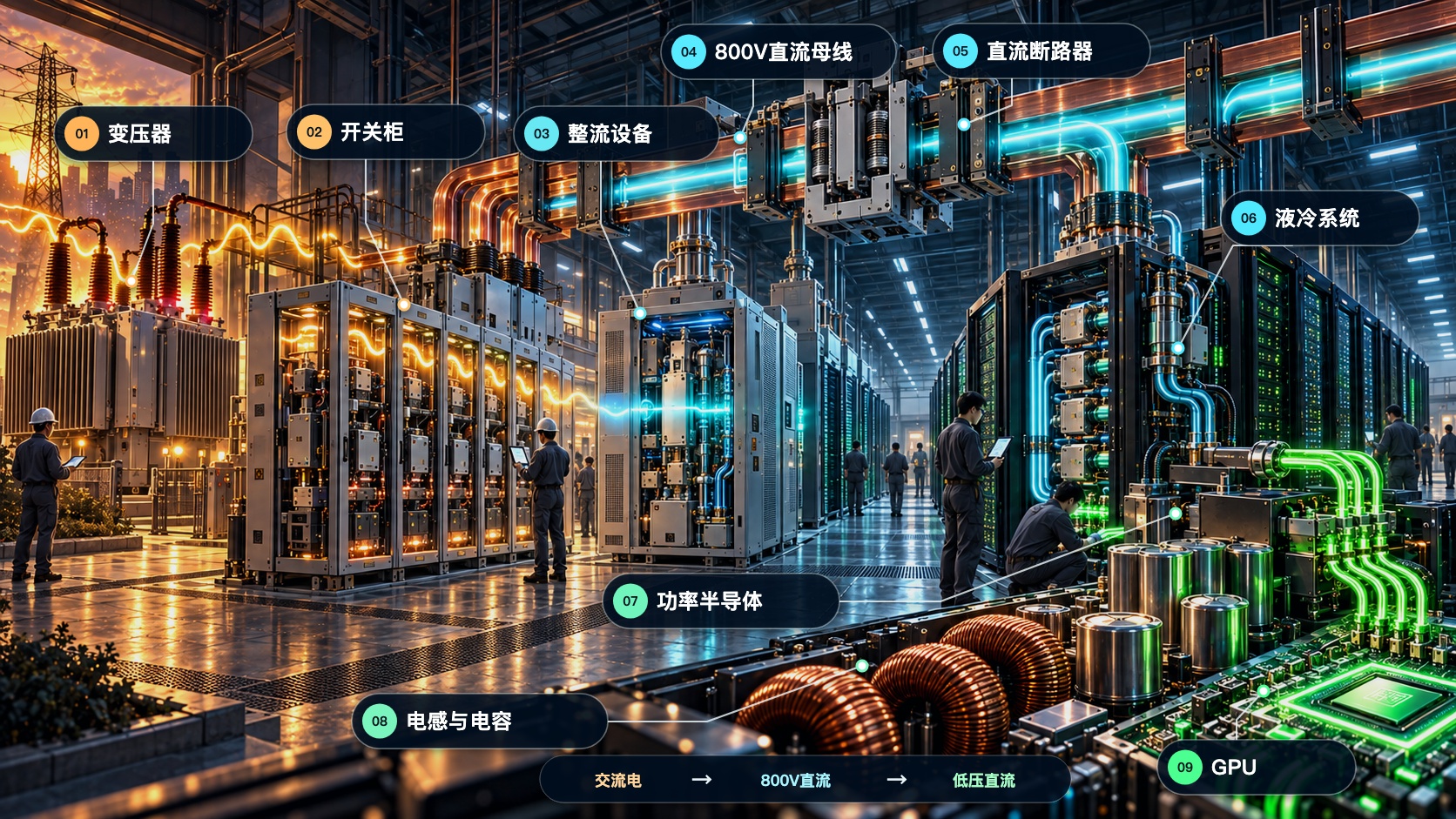
From the site entrance to the GPU, electricity passes through transformers, switchgear, rectifiers, busbars, breakers and rack-level power supplies. Power devices, inductors and capacitors then handle the final conversion. As rack power rises, this equipment may require higher specifications and carry more content value.
Eaton has provided one useful comparison. The company estimates that its equipment content amounts to approximately $1.5 million per megawatt in a typical cloud data centre.
In an AI data centre, that rises to roughly $3 million per megawatt—or about $3.4 million when the liquid-cooling business added through Eaton’s acquisition of Boyd is included.
For each megawatt of capacity built, an AI data centre can therefore require more than twice as much power and cooling equipment as a conventional cloud data centre.
The smaller components are multiplying as well.
Inductors help stabilise the current immediately before it reaches the GPU. As chip power rises, more power-delivery circuits are required. Some next-generation AI racks could contain thousands of inductors.
That is what the market is trying to identify:
The launch event gives you the names. The current tells you where the value is.
Wherever more than 10,000 amps are flowing, the busbars, breakers, power supplies and inductors along that path could all get redesigned—and repriced.
However, this architecture is not expected to reach full-scale deployment until 2027. Whether the power grid can supply enough electricity, and which suppliers might be displaced by the new architecture, remain open questions.
Sources: NVIDIA technical blog, “800 VDC Architecture” (May 20, 2025); NVIDIA’s official recap of the AI Infra Summit (September 15, 2026); NVIDIA’s Q2 FY2027 earnings call (August 26, 2026); accounts of the “War of the Currents” from the U.S. Department of Energy and History.com; GE Reports on the evolution of DC power technology (August 26, 2018); NVIDIA’s published specifications for the GB200 and Kyber rack systems, together with technical coverage of GTC 2025; and remarks by Eaton CEO Paulo Ruiz at Morgan Stanley’s Laguna Conference in September 2026. This article is for educational purposes only and does not constitute investment advice.
$NVIDIA(NVDA.US) $Eaton(ETN.US) $Vertiv(VRT.US) $Texas Instruments(TXN.US) $STMicroelectronics NV(STM.US) $Navitas Semiconductor(NVTS.US) $Monolithic Power(MPWR.US) $Infineon Technologies(IFNNY.US)


The copyright of this article belongs to the original author/organization.
The views expressed herein are solely those of the author and do not reflect the stance of the platform. The content is intended for investment reference purposes only and shall not be considered as investment advice. Please contact us if you have any questions or suggestions regarding the content services provided by the platform.