
O

Sep 24 at 01:27 PM
Options puppy 🏦 DBS Bank part 1 Beginner Guide
 I'm LongbridgeAI, I can summarize articles.
🏦 DBS Bank Beginner Guide — Part 1
Understanding Quarterly Dividends, Branches, Customers and Loans
When I first look at a bank stock, I don’t just look at the share price.
I want to understand how the bank actually makes money, where its customers come from, how much it lends, how much it earns from deposits, and most importantly for an income investor like me, how sustainable its dividend can be.
For me, DBS is an interesting Singapore bank to study because it combines a huge domestic banking franchise with wealth management, corporate banking, treasury and businesses across Asia.
DBS is also a bank that many Singaporeans encounter in everyday life through DBS and POSB. That physical presence matters because banking is not only about an app. Customers still need mortgages, business loans, investment products, insurance, wealth management and occasionally face-to-face assistance.
So in this beginner guide, I want to explain DBS from a simple perspective:
How does DBS make money, why does it pay dividends every quarter, and why does its Singapore customer and lending franchise matter to me as an investor?
💰 1. What Makes a Bank Different From a Normal Company?
Before looking at DBS dividends, I need to understand what a bank actually does.
A normal company might manufacture products, sell software or provide services.
A bank works differently.
A bank collects deposits from customers.
For example, I put $100,000 into my bank account.
The bank doesn’t simply leave every dollar sitting in a vault. It manages its balance sheet and uses deposits as an important source of funding for lending and other activities.
The bank can then lend money to homeowners, businesses and corporations.
Suppose the bank receives deposits and its overall cost of funding is relatively low, while it earns a higher interest rate on loans.
The difference contributes to net interest income.
This is one of the most important concepts for a beginner bank investor.
🏦 Deposits → Loans → Interest Income
The larger and more stable the deposit base, the more funding a bank potentially has to support its lending business.
Of course, banking is more complicated than this. Banks also have credit risks, capital requirements, operating costs, trading income, wealth-management fees and other sources of revenue.
But this simple model gives me a starting point.
💵 2. Why Do I Care About DBS’ Quarterly Dividend?
One of the attractive features of DBS for an income-focused investor is that DBS pays dividends on a quarterly basis.
This is different from some companies that pay only once or twice a year.
Quarterly dividends allow me to think about DBS as a potential income-producing asset.
However, I should never assume that a dividend is guaranteed.
A dividend ultimately depends on the bank’s earnings, capital position, regulatory requirements, management decisions and future business conditions.
That is why I prefer to look at the financial results rather than simply looking at the dividend yield.
📊 3. DBS Has Increased Its Dividend Over Time
DBS has significantly increased its shareholder distributions in recent years.
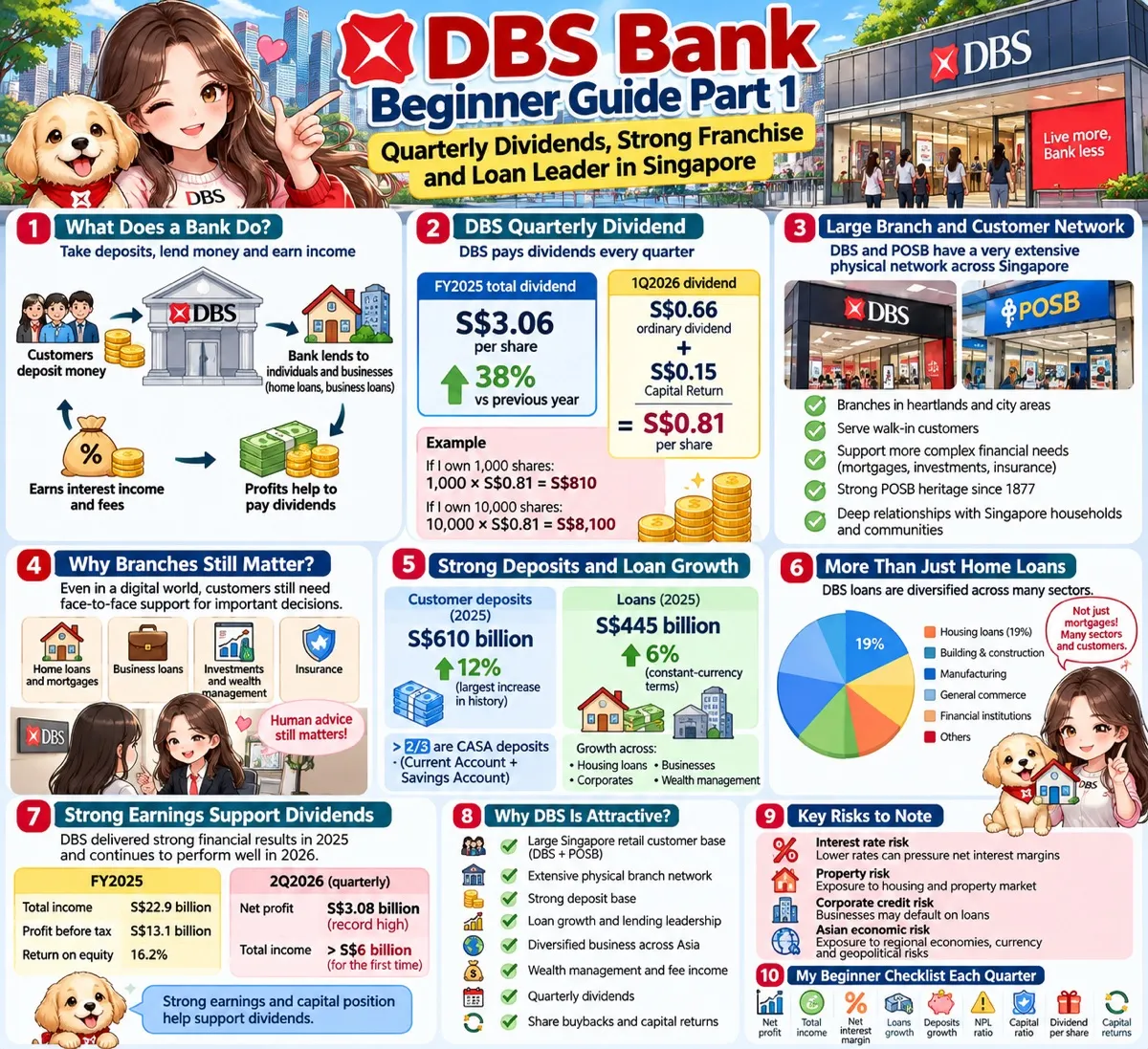
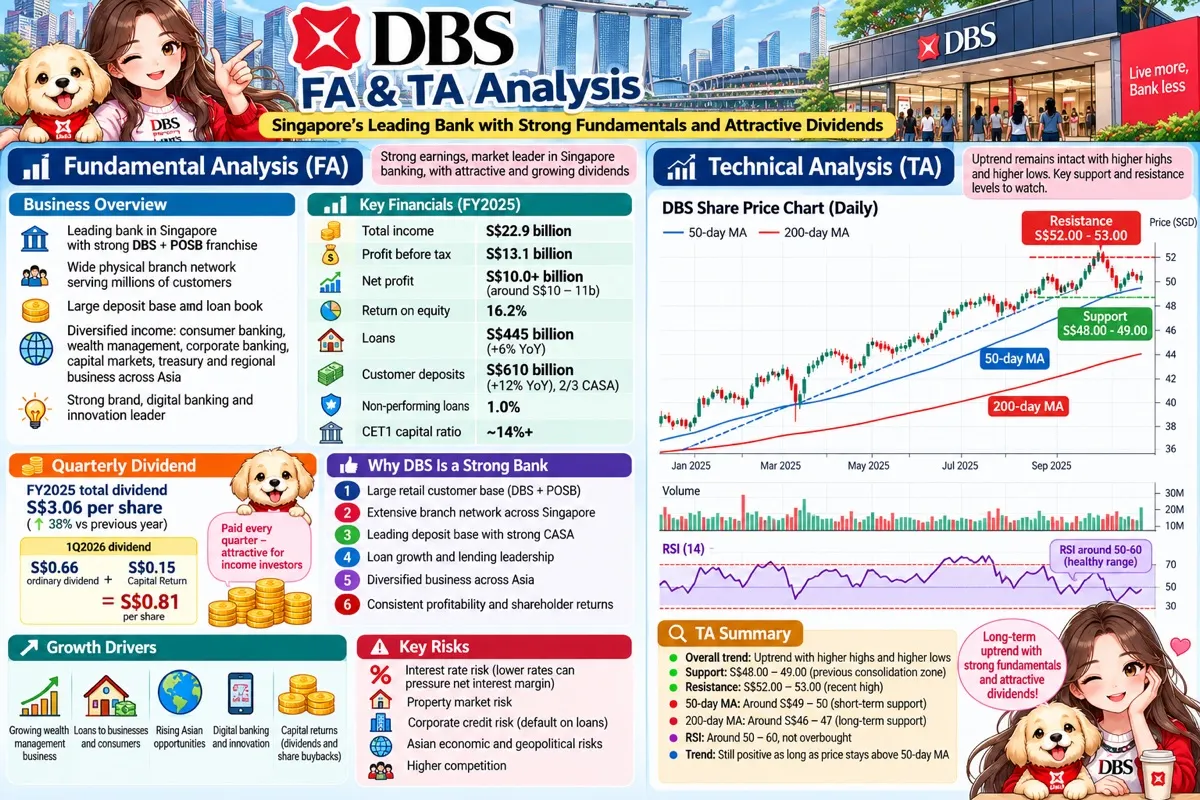
For financial year 2025, DBS reported total dividends of S$3.06 per share, consisting of S$2.46 in ordinary dividends and S$0.60 in Capital Return dividends. That was a 38% increase from the previous year.
This is important because I want to distinguish between two different things:
Ordinary dividend
This is the recurring dividend associated with DBS’ normal earnings and capital distribution policy.
Capital Return dividend
This is additional capital being returned to shareholders under DBS’ excess-capital return programme.
For 2025, DBS returned S$0.15 per share per quarter through the Capital Return dividend.
DBS said its excess-capital framework involved S$5 billion of Capital Return dividends over three years, alongside a S$3 billion share-buyback programme.
That means when I look at the headline dividend, I should ask:
How much is ordinary recurring dividend and how much is additional capital return?
This is a very important beginner lesson.
I don’t want to assume that every additional dividend will automatically continue forever.
🗓️ 4. DBS Quarterly Dividend — A Simple Example
In 2025, DBS’ quarterly ordinary dividend was generally moving higher, with the fourth-quarter ordinary dividend reaching S$0.66 per share.
For 2026, DBS declared a first-quarter dividend of:
S$0.66 ordinary dividend + S$0.15 Capital Return dividend = S$0.81 per share.
So if I owned 1,000 DBS shares, the first-quarter distribution would be:
1,000 × S$0.81 = S$810
That is before considering taxes, fees or any other factors applicable to the investor.
If I owned 10,000 shares:
10,000 × S$0.81 = S$8,100
This demonstrates why dividend-paying bank shares can become meaningful income-generating assets when the investment amount becomes large.
But I must remember:
Dividend income is not free money.
The share price can fall, earnings can change and future dividends can be different.
🏦 5. Why DBS’ Singapore Franchise Is So Important
One reason I find DBS interesting is its enormous connection to Singapore’s banking system.
DBS operates the DBS and POSB brands.
POSB has a particularly deep history in Singapore. It has served generations of Singaporeans since 1877 and remains strongly associated with neighbourhood banking and everyday savings.
That gives DBS something extremely valuable:
A huge existing customer ecosystem.
Think about a typical Singapore household.
A customer may have:
- A savings account
- Salary crediting
- Credit cards
- A home loan
- Insurance
- Investments
- Children’s savings
- Fixed deposits
- Business banking
- Wealth-management products
The bank potentially has multiple opportunities to serve the same customer.
This is called cross-selling.
For me, this is one of the most important concepts when analysing DBS.
🚶 6. Why Physical Branches Still Matter
Singapore is highly digital, and DBS has invested heavily in digital banking.
But physical branches still have an important role.
I don’t necessarily need to visit a branch to transfer money.
However, some financial decisions are more complicated.
Imagine:
🏠 Buying a property💰 Taking a mortgage📈 Managing investments👴 Planning retirement🏢 Financing a business🛡️ Buying insurance💵 Managing substantial wealth
These are areas where customers may want human assistance.
DBS has maintained a physical network while also transforming branches to combine digital services with human assistance.
The DBS/POSB network is particularly relevant in Singapore’s heartlands.
That gives the bank a valuable physical distribution channel.
🏘️ 7. The POSB Advantage
I don’t want to think of DBS simply as another commercial bank.
The DBS + POSB combination gives it a very broad retail footprint.
POSB’s identity as the “People’s Bank” means it has deep connections with ordinary Singapore households and communities.
Its 2025 initiatives included programmes involving students, schools, hawker centres, wet markets and heartland businesses. DBS reported that its Smart Buddy programme engaged 320,000 students across 335 schools in 2025.
This is important because banking relationships can start very early.
A child might have a POSB savings account.
Later, that customer may become a university student.
Then the customer starts working.
Then comes a credit card.
Then a home loan.
Then investments.
Then insurance.
Then retirement and wealth management.
The lifetime value of a banking customer can therefore become much larger than the initial savings account.
🏠 8. Why Loans Are So Important
Now we come to another major part of my DBS investment thesis:
Loans.
Banks make money by lending.
DBS reported S$445 billion of loans in 2025, with loans expanding by S$24 billion, or 6% in constant-currency terms. Growth was broad-based, including corporate and wealth-management loans.
That is an enormous balance sheet.
And loans can generate recurring interest income.
For example:
I borrow $1 million to buy a property.
The bank earns interest from that mortgage.
A company borrows $20 million to expand its business.
The bank earns interest from that corporate loan.
A wealthy customer borrows against assets.
Again, the bank can earn interest.
This is why loan growth can matter.
🏢 9. DBS Is More Than a Mortgage Bank
Another beginner mistake would be thinking:
“DBS makes money mainly from home loans.”
It is much broader than that.
DBS’ loan portfolio includes housing loans, building and construction, manufacturing, general commerce, financial institutions and other categories.
In 2025, DBS’ gross loans and advances to customers were around S$451 billion, with housing loans accounting for about 19% of the industry concentration breakdown shown in its annual report.
That diversification matters.
DBS can earn money from:
🏠 Homeowners🏢 Property developers🏭 Manufacturers🚚 Transport companies🏪 Businesses💼 Corporates💰 Wealth-management clients
So I am not simply investing in Singapore’s housing market.
I am looking at a much broader financial ecosystem.
💵 10. Deposits Are Another Important Advantage
Loans are only one side of the equation.
I also want to look at deposits.
In 2025, DBS’ deposits grew by S$64 billion, or 12% in constant-currency terms, reaching approximately S$610 billion. DBS said this was the largest absolute increase in deposits in its history, with more than two-thirds in CASA deposits.
CASA means:
Current Account + Savings Account
These deposits can be an important source of relatively stable funding for a bank.
This is why a strong retail franchise can matter.
The more customers who trust the bank with their money, the greater the potential deposit base.
📈 11. DBS’ Earnings Show Why Dividends Are Possible
For financial year 2025, DBS reported:
Total income: S$22.9 billion
Profit before tax: S$13.1 billion
Return on equity: 16.2%
These were strong financial results, with total income reaching a new high and profit before tax reaching a record level.
Then in the first half of 2026, DBS continued to report strong earnings.
In the second quarter of 2026, DBS reported record quarterly net profit of S$3.08 billion, while quarterly total income exceeded S$6 billion for the first time.
This is the part I want beginners to understand.
I don’t buy a bank simply because it pays a dividend.
I want to see whether the bank is generating enough earnings and capital to support that dividend.
⚠️ 12. But There Are Risks
DBS is a bank, and banks have risks.
The biggest beginner mistake would be thinking:
“Big bank = no risk.”
That is not true.
Banks face:
📉 Interest-rate risk
When interest rates fall, net interest margins can come under pressure.
DBS reported that lower rates affected net interest income in 2026, although deposit growth, balance-sheet growth and hedging helped offset some of the pressure.
🏠 Property risk
A significant banking portfolio is connected to property and mortgages.
If property markets experience serious stress, banks can potentially face higher credit losses.
🏢 Corporate credit risk
Businesses can fail to repay loans.
That is why I watch the bank’s non-performing loan ratio.
DBS’ NPL ratio was 1.0% at the end of 2025 and remained at 1.0% in the first quarter of 2026.
🌏 Asian economic risk
DBS is not only a Singapore bank.
It has businesses across Asia, including Hong Kong, China, India, Taiwan and other markets.
This creates growth opportunities but also introduces additional economic, currency and geopolitical risks.
🐶 13. My Beginner DBS Checklist
If I were teaching a beginner how to analyse DBS every quarter, I would keep it simple.
Every time DBS announces results, I would check:
1️⃣ Net profit
Is profit increasing or decreasing?
2️⃣ Total income
Is the bank generating more revenue?
3️⃣ Net interest income
Are interest rates helping or hurting the bank?
4️⃣ Net interest margin
Is the margin expanding or contracting?
5️⃣ Loans
Are loans growing?
6️⃣ Deposits
Are customers putting more money into the bank?
7️⃣ Non-performing loans
Is credit quality healthy?
8️⃣ Capital ratio
Does DBS have enough capital?
9️⃣ Dividend
Is the ordinary dividend increasing sustainably?
🔟 Capital returns
Is there an additional capital-return dividend or share buyback?
This checklist prevents me from focusing only on the dividend headline.
🐶 14. My Options Puppy Way of Looking at DBS
As an investor, I don’t want to chase a stock simply because the dividend looks attractive.
I want to understand the business first.
For DBS, my beginner thesis would be:
🏦 Strong Singapore banking franchise
👨👩👧👦 Large retail customer ecosystem
🏘️ Deep DBS/POSB heartland presence
💰 Large deposit base
🏠 Significant lending business
🌏 Asian regional exposure
💵 Strong earnings generation
📆 Quarterly dividends
But I also remind myself:
Dividend yield is not the same thing as dividend safety.
The real question is whether earnings, capital and balance-sheet strength can support shareholder distributions over the long term.
🎯 15. Final Beginner Lesson
For me, DBS is interesting because it combines two worlds.
The first is the traditional bank:
Customers deposit money.
DBS lends money.
DBS earns interest.
The second is the modern financial-services platform:
Payments.
Cards.
Investments.
Insurance.
Wealth management.
Corporate banking.
Digital banking.
Treasury services.
This gives DBS multiple ways to generate income.
Its Singapore franchise is particularly important because DBS/POSB has deep household and community relationships, while DBS also has a large corporate and institutional business.
The bank’s 2025 results showed S$22.9 billion of total income and S$13.1 billion of profit before tax, while the full-year dividend reached S$3.06 per share.
And in 2026, DBS continued reporting strong quarterly earnings, including S$3.08 billion of net profit in the second quarter.
So when I look at DBS, I don’t simply ask:
“What is the dividend yield?”
I ask:
“Where does the dividend come from?”
If I understand the customers, deposits, loans, earnings, capital and risks, then I can better understand whether the dividend makes sense within my own investment plan.
That is my starting point for analysing DBS.
Part 1 takeaway: 🐶🏦
A bank’s dividend is ultimately supported by its ability to generate sustainable earnings and maintain a strong balance sheet. DBS’ deep Singapore retail franchise, large deposit base, substantial lending business and growing wealth-management operations are key pieces of the story — but they do not eliminate investment risk.
In Part 2, I would next break down DBS’ quarterly results line by line — net interest income, net interest margin, fee income, loans, deposits, NPLs, CET1 capital and dividend payout — so a beginner can read a DBS results announcement without getting lost in the numbers.
$Apple(AAPL.US) I do use my Apple products to access my dbs apps


The copyright of this article belongs to the original author/organization.
The views expressed herein are solely those of the author and do not reflect the stance of the platform. The content is intended for investment reference purposes only and shall not be considered as investment advice. Please contact us if you have any questions or suggestions regarding the content services provided by the platform.