
O

10 hours ago
🏦 DBS Bank Beginner Guide — Part 2
 I'm LongbridgeAI, I can summarize articles.
🏦 DBS Bank Beginner Guide — Part 2
How I Read DBS Quarterly Results Before Looking at the Dividend
In Part 1, I explained why DBS interests me as a Singapore bank investor.
I looked at its DBS/POSB franchise, large customer base, deposits, loans, wealth-management business and quarterly dividends.
But now I want to go one step further.
How do I actually read DBS’ quarterly results?
For me, I don’t start with the share price.
I don’t start with the dividend yield either.
I start with the business numbers.
My simple rule is:
🐶 First understand how the bank makes money. Then check whether the earnings are strong enough to support the dividend.
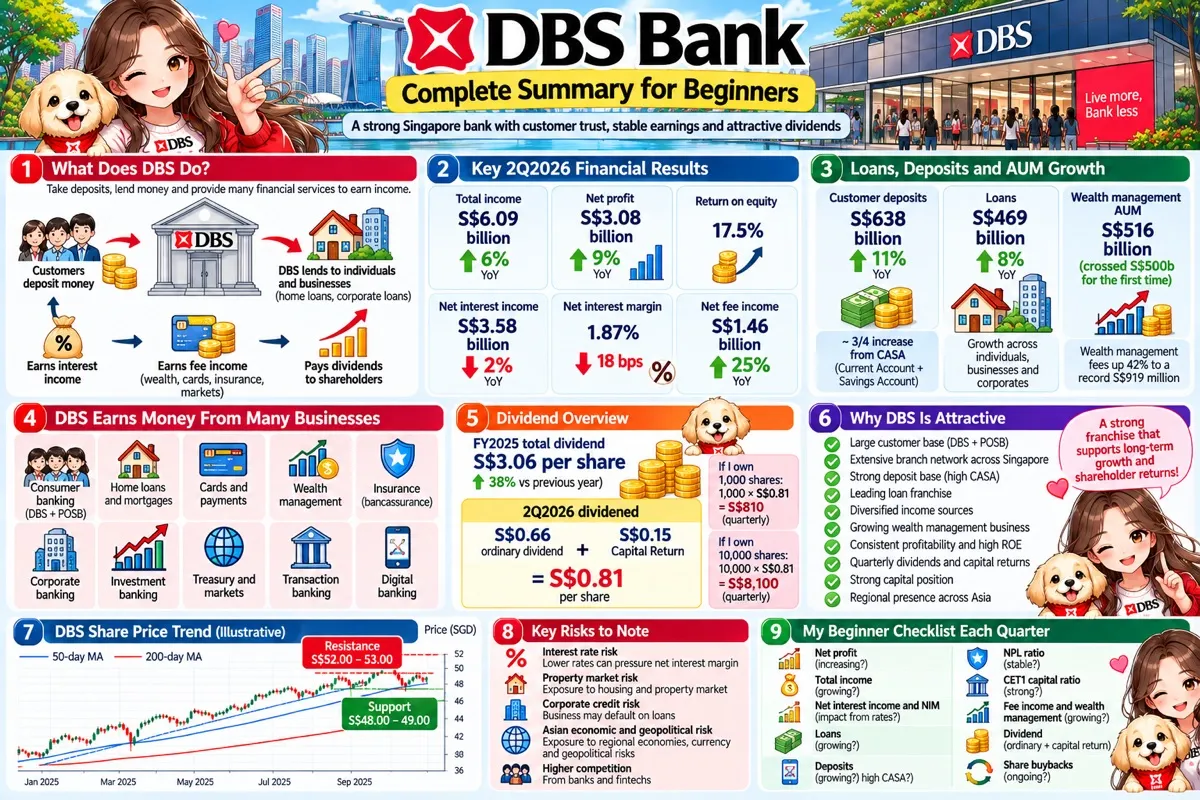
DBS’ latest available results provide a good example. In the second quarter of 2026, DBS reported record quarterly net profit of S$3.08 billion, up 9% year-on-year, while total income reached a record S$6.09 billion.
That gives me plenty of numbers to study.
💰 1. First, I Look at Total Income
The first number I want to understand is total income.
Why?
Because before DBS can pay dividends, it needs to generate income from its banking activities.
In 2Q2026, DBS generated S$6.09 billion of total income, up 6% from the same quarter a year earlier.
This is important because the growth did not simply come from charging more interest on loans.
In fact, the opposite happened in one important area.
Net interest income declined 2% to S$3.58 billion, while net interest margin fell to 1.87%.
So how did total income still increase?
This leads me to the second part of my analysis.
📉 2. Net Interest Income — The Traditional Bank Engine
A bank traditionally makes a large portion of its money from interest.
I deposit money.
The bank uses deposits and other funding sources to support its balance sheet.
It lends money to customers.
The interest earned on assets minus the interest paid on funding contributes to net interest income.
This is why interest rates are so important to bank investors.
When rates are high, banks can potentially earn attractive spreads.
But when rates fall, the economics can become more challenging.
DBS’ 2Q2026 results showed exactly this.
Net interest income declined 2% year-on-year, and net interest margin fell 18 basis points to 1.87%.
So I don’t simply look at DBS’ huge profit and say:
“Everything is perfect.”
I ask:
“Are lower interest rates putting pressure on the traditional banking engine?”
The answer is yes.
But there is another important part of the story.
🛡️ 3. DBS Has Other Engines Besides Interest Income
This is where DBS becomes more interesting to me.
The bank isn’t dependent only on lending money and collecting interest.
It also generates income from:
💰 Wealth management💳 Cards and payments🏦 Transaction banking📈 Investment banking💵 Treasury customer sales📊 Markets trading🛡️ Insurance and bancassurance💼 Corporate banking
In 2Q2026, DBS’ net fee income increased 25% to S$1.46 billion. Wealth-management fees increased 42% to a record S$919 million.
That is a very important number for me.
It tells me that when interest income is under pressure, DBS has another source of growth.
💎 4. Wealth Management Is Becoming More Important
One area I pay particular attention to is wealth management.
Singapore is a major wealth-management centre in Asia.
DBS has built a substantial wealth-management business serving affluent customers across Singapore and the region.
In 2Q2026, DBS’ wealth-management assets under management reached S$516 billion, crossing S$500 billion for the first time.
This matters because wealthy customers can generate multiple sources of revenue.
For example, a customer might have:
🏦 Deposits📈 Investments💵 Brokerage activity🛡️ Insurance💳 Credit cards🏠 Property financing💰 Wealth-management products
The bank doesn’t have to depend on just one product.
That is why I like to think about DBS as a financial ecosystem, rather than simply a mortgage bank.
🏠 5. Next, I Check Loan Growth
After looking at income, I check the balance sheet.
The first number I look at is loans.
Why?
Because lending is still one of the core functions of a bank.
In 2Q2026, DBS’ loans increased 8% year-on-year in constant-currency terms to approximately S$469 billion.
That’s substantial growth.
The growth was broad-based, with large corporate lending playing an important role.
For me, loan growth is useful because it tells me whether customers and businesses are demanding financing.
But I don’t automatically celebrate loan growth.
There is a second question:
Are those loans good quality?
Giving out more loans is not necessarily good if too many customers eventually cannot repay them.
That brings me to one of my favourite bank-investing numbers.
⚠️ 6. I Always Check the NPL Ratio
NPL means:
Non-Performing Loan.
In simple language, it is a loan where repayment problems have become serious enough to be classified as non-performing under the bank’s rules.
For me, this is one of the most important risk indicators.
DBS’ NPL ratio was 1.0% in 2Q2026, remaining stable.
So my simple checklist becomes:
Loans growing? ✅
NPL ratio stable? ✅
That gives me more confidence in the quality of the loan growth than simply looking at the headline loan number.
But I still need to watch it every quarter.
💵 7. Then I Look at Deposits
Now I look at the other side of the balance sheet.
Deposits.
Deposits are incredibly important to banks because they are a major source of funding.
DBS’ deposits increased 11% year-on-year in constant-currency terms to approximately S$638 billion in 2Q2026.
That is even larger than the loan book.
And something else catches my attention.
About three-quarters of the deposit increase came from CASA balances.
CASA means:
Current Account + Savings Account.
For me, a large CASA franchise is valuable because it represents a deep relationship with customers.
This connects directly back to Part 1.
The physical DBS/POSB network and digital ecosystem can help the bank maintain relationships with households and businesses.
🏦 8. Why Deposits Matter to My Dividend Thinking
Suppose DBS has:
S$638 billion of deposits
and
S$469 billion of loans.
That doesn’t mean DBS simply takes every dollar of deposits and lends it out.
Banks need to maintain liquidity and regulatory buffers, and they invest in other assets as well.
But the numbers demonstrate the enormous scale of the balance sheet.
In 2025, DBS had already grown deposits to S$610 billion and loans to about S$445 billion.
So by 2Q2026, both sides of the balance sheet had continued to expand.
For me, this is one of the reasons DBS can remain a major banking franchise in Singapore and Asia.
📈 9. Then I Check Net Profit
Now I arrive at the number most people immediately look at:
Net profit.
In 2Q2026, DBS reported a record S$3.08 billion net profit, up 9% year-on-year.
For the first half of 2026, net profit reached S$6.01 billion, up 5% year-on-year.
That tells me the bank was still growing profits despite lower interest rates.
This is important.
The traditional interest-income engine was facing pressure.
But wealth management, fee income, treasury customer sales, markets trading and balance-sheet growth helped offset some of that pressure.
📊 10. I Also Watch Return on Equity
Another important number for banks is:
ROE — Return on Equity.
Very simply, ROE tells me how effectively the bank is generating profit relative to shareholders’ equity.
DBS reported 17.5% ROE for the first half of 2026.
That is a useful profitability measure because I don’t want a bank to grow simply by accumulating more capital without generating attractive returns on that capital.
I want to see:
Capital → Business → Profit → Shareholder returns
That is the cycle I am studying.
🛡️ 11. Capital Is Extremely Important
This is where a beginner needs to be careful.
A bank cannot simply distribute every dollar of profit to shareholders.
It needs capital.
Capital provides a cushion against losses and supports the bank’s ability to conduct business.
One number I watch is the CET1 ratio.
CET1 stands for Common Equity Tier 1 capital.
DBS reported a CET1 ratio of 16.6% under transitional arrangements at the end of 2Q2026, with a fully phased-in pro-forma ratio of 14.6%.
This gives me another piece of the dividend puzzle.
The question isn’t just:
“How much profit did DBS make?”
It is:
“After considering capital requirements and future business needs, how much can DBS reasonably return to shareholders?”
💰 12. Now I Look at the Dividend
Only after studying all those numbers do I look at the dividend.
For 2Q2026, DBS declared:
Ordinary dividend
S$0.66 per share
Capital Return dividend
S$0.15 per share
Total
S$0.81 per share
The first-half 2026 total was therefore S$1.62 per share.
This is where I need to make an important distinction.
The S$0.66 ordinary dividend is different from the S$0.15 Capital Return dividend.
I don’t automatically assume the extra S$0.15 is a permanent part of DBS’ ordinary dividend.
DBS had announced its intention to continue Capital Return dividends of S$0.15 per share per quarter for financial years 2026 and 2027, subject to unforeseen circumstances.
So I treat that as additional capital return, not exactly the same thing as recurring ordinary earnings.
🧮 13. My Simple Dividend Calculation
Suppose I own:
1,000 DBS shares
and the quarterly total dividend is:
S$0.81 per share
Then:
1,000 × S$0.81 = S$810
If four quarters were paid at the same level:
S$810 × 4 = S$3,240
That would be the annualised cash distribution.
But there is a big word here:
“Annualised.”
It doesn’t mean future dividends are guaranteed.
It simply means:
If the same quarterly amount continued for four quarters, the arithmetic would be S$3.24 per share.
That’s an important distinction.
🐶 14. My DBS Quarterly Scorecard
Instead of trying to predict everything, I prefer a simple checklist.
Every quarter I look at:
💰 Earnings
Is net profit growing?
🏦 Total income
Is the overall business generating more income?
📉 NIM
Are lower interest rates squeezing margins?
🏠 Loans
Is lending growing?
💵 Deposits
Are customers bringing more money into the bank?
⚠️ NPL
Are bad loans increasing?
📈 Fee income
Is wealth management and transaction activity growing?
🛡️ CET1
Does DBS remain strongly capitalised?
💵 Dividend
Is the ordinary dividend supported by earnings and capital?
🔄 Capital return
Is additional capital being returned through dividends or buybacks?
This gives me a much better picture than simply looking at the dividend yield.
🌏 15. Why I Don’t Want to Look at DBS Only as a Singapore Bank
Singapore is DBS’ home market.
But DBS has substantial regional operations.
Its institutional and wealth-management businesses connect it with customers across Asia.
That gives the bank additional growth opportunities.
However, it also introduces additional risks.
Different countries have different:
🌏 Economic cycles💱 Currencies🏦 Banking regulations🏢 Property markets📈 Interest rates⚠️ Credit risks
So when I analyse DBS, I think:
Singapore foundation + Asian expansion.
That is more accurate than thinking of DBS as only a local branch bank.
📉 16. What Happens If Interest Rates Keep Falling?
This is one of the questions I would ask as a DBS investor.
Lower rates can put pressure on the bank’s net interest margin.
We can already see this in the 2026 numbers.
DBS’ 2Q2026 net interest margin was 1.87%, down from the previous year.
However, DBS has been using hedging and balance-sheet management to reduce some of the sensitivity.
Its 2025 annual report explained that fixed-rate assets had been increased substantially to help manage the impact of falling rates.
At the same time, deposit growth, wealth management and fee income provide additional sources of earnings.
So I don’t ask:
“Will falling rates be good or bad?”
I ask:
“How much of the impact can DBS offset through other parts of its business?”
That is a much better investing question.
🧠 17. The Biggest Beginner Mistake
The biggest mistake I can make with a dividend bank is:
Looking only at dividend yield.
Imagine a stock pays a very high dividend.
That sounds attractive.
But if profits are falling rapidly, bad loans are increasing and capital is weakening, the dividend may become harder to sustain.
That’s why my analysis goes in this order:
Business → Income → Loans → Deposits → Credit quality → Capital → Profit → Dividend
Not:
Dividend yield → Buy
This distinction is extremely important.
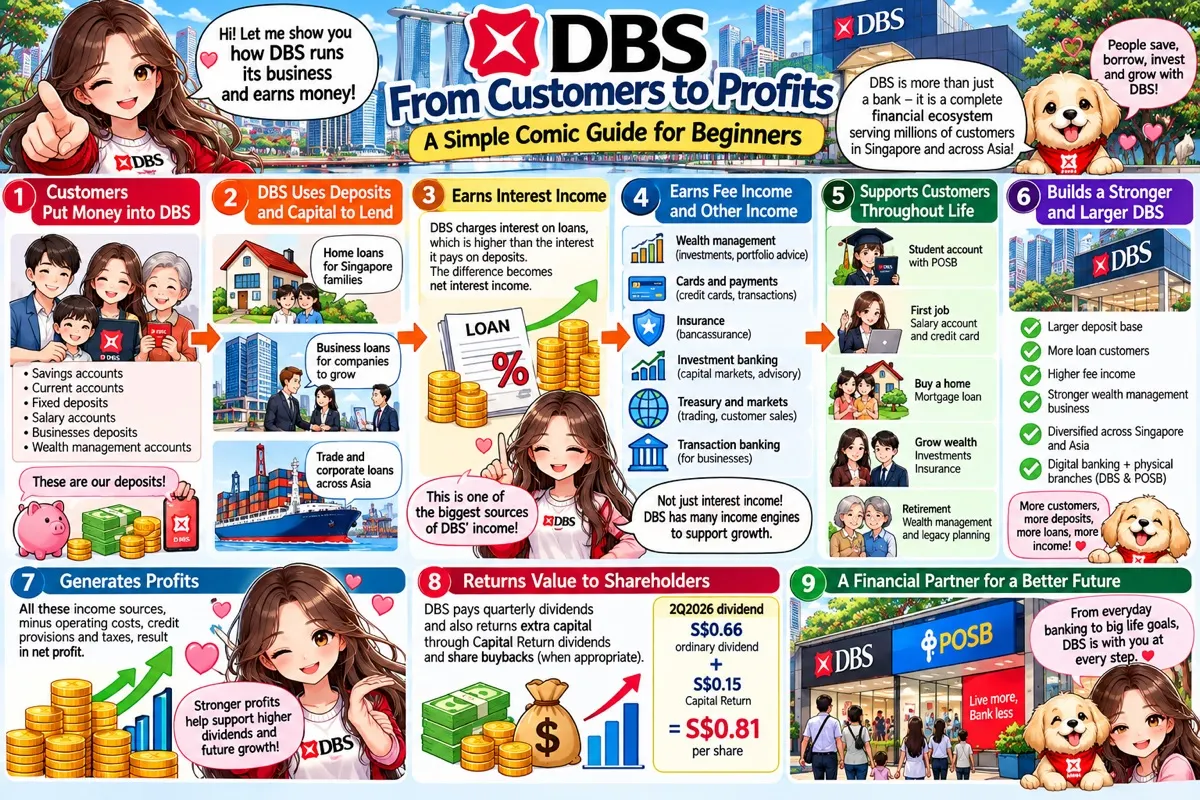
🐶 18. My Options Puppy DBS Framework
For my own beginner framework, I simplify DBS into three layers.
🏦 Layer 1 — The Franchise
I ask:
Do customers continue using DBS/POSB?
The answer can be seen through deposits, transaction activity, wealth-management relationships and other customer metrics.
💰 Layer 2 — The Earnings Engine
I ask:
Where does the money come from?
Interest income.
Fee income.
Wealth management.
Treasury.
Markets.
Corporate banking.
💵 Layer 3 — Shareholder Returns
Finally I ask:
After supporting the business and maintaining capital, how much can DBS return to shareholders?
That’s where dividends and share buybacks come in.
🎯 Part 2 Final Takeaway
For me, DBS is not simply:
“A bank that pays quarterly dividends.”
It is a large financial franchise with several earnings engines.
The latest 2Q2026 numbers show the picture clearly:
🏦 S$469 billion loans
💵 S$638 billion deposits
📈 S$6.09 billion quarterly total income
💰 S$3.08 billion quarterly net profit
💎 S$516 billion wealth-management AUM
⚠️ 1.0% NPL ratio
🛡️ 16.6% reported CET1 ratio
💵 S$0.81 total dividend per share for 2Q2026
The interesting part for me is that DBS managed to grow total income and profit even while lower interest rates pressured net interest income.
That tells me I need to watch more than just interest rates.
I need to watch wealth management, fee income, deposits, loans, trading, credit quality and capital.
And that is exactly what I will look at in the next quarterly report.
🐶 My simple DBS rule:
Don’t buy a bank just because it pays a dividend. Understand how the bank earns the money that eventually becomes the dividend.
In Part 3, I would take this one step further and build a DBS dividend-investing calculator for beginners — showing how many DBS shares I would need for S$100, S$500, S$1,000 and S$2,000 of quarterly dividend income, while also explaining dividend yield, payout, ex-dividend dates and the difference between ordinary dividends and capital returns.
i do other stocks too like ETFs Qyld
$Global X Nasdaq 100 Covered Call ETF(QYLD.US)


The copyright of this article belongs to the original author/organization.
The views expressed herein are solely those of the author and do not reflect the stance of the platform. The content is intended for investment reference purposes only and shall not be considered as investment advice. Please contact us if you have any questions or suggestions regarding the content services provided by the platform.