

📈 My Market Outlook for Tuesday, 13 October 2026: Bank Earnings, Inflation, AI Stocks and Why I Buy
 I'm LongbridgeAI, I can summarize articles.
📈 My Market Outlook for Tuesday, 13 October 2026: Bank Earnings, Inflation, AI Stocks and Why I Buy KWEB
🇺🇸 1. My Overall Market View: Good News Does Not Always Mean Higher Stock Prices
I think the US stock market will be influenced by several important events this week, especially bank earnings, inflation data, major technology developments and Federal Reserve expectations.
For me, the most important question is not simply whether companies report good results. I want to understand whether their results are better than what the market has already priced in.
Sometimes, a company can report higher revenue and stronger profits but still see its share price fall. This happens because investors may have expected even better results. On the other hand, a company with disappointing earnings may see its shares rise if the results are not as bad as feared.
This is why I believe investors need to look beyond the headlines. I want to examine earnings quality, forward guidance, valuation, market positioning and price action before deciding whether to buy, sell or wait.
My approach is to remain flexible. If the market rallies strongly, I will not automatically assume that the rally can continue. If the market falls, I will not immediately assume that every decline is a buying opportunity.
I want to understand what is driving the move before committing my capital.
🏦 2. US Bank Earnings: JPMorgan, Citi, Goldman Sachs and Wells Fargo
One of the biggest events on my radar is the earnings season for major US banks, including JPMorgan Chase, Citigroup, Goldman Sachs and Wells Fargo.
Banks are important because their results provide clues about the health of the wider economy. They lend money to households and businesses, facilitate financial transactions and participate in capital markets. Their performance can tell us something about consumer demand, corporate activity and credit conditions.
However, I do not want to look only at headline earnings per share. I want to examine several important indicators.
First, net interest income. Banks earn interest from loans and other assets while paying interest on deposits and borrowings. The difference is an important source of income. Higher interest rates may help banks earn more on certain loans, but they may also have to pay depositors more to retain their money. Therefore, higher interest rates are not automatically positive for every bank.
Second, loan growth. If businesses and consumers continue borrowing, it may indicate that economic activity remains healthy. However, rapid loan growth is not always good if lending standards weaken or borrowers become less able to repay their debts.
Third, credit losses. I will watch whether banks need to set aside more money for loans that may not be repaid. Rising credit-loss provisions could indicate that some households or businesses are struggling financially.
Fourth, investment banking and trading revenue. Goldman Sachs and other major financial institutions can benefit when clients participate actively in mergers, acquisitions, bond issuance and stock-market trading. Strong market activity may support earnings, although these revenue streams can be volatile.
For me, management’s comments about the next few quarters may be just as important as the reported numbers. Past earnings show what has already happened, while guidance provides clues about what management expects next.
📊 3. Why Good Bank Earnings Can Still Lead to Falling Share Prices
I believe investors should be careful about assuming that good earnings automatically mean higher share prices.
Imagine that a bank reports a 15% increase in profits. At first glance, this looks excellent. However, suppose analysts and investors were expecting a 20% increase. The results may disappoint the market even though the bank is still growing.
Another possibility is that the bank reports strong profits because trading revenue was unusually high. Investors may question whether those profits can be repeated in future quarters.
There is also the issue of valuation. If bank shares have already rallied significantly before earnings, investors may have purchased them in anticipation of excellent results. Once the announcement arrives, some traders may sell to lock in profits.
I will therefore watch three things together: the reported numbers, management’s forward guidance and the share-price reaction.
If a bank beats expectations and its shares continue rising after the market opens, that may indicate that buyers remain confident. If it beats expectations but immediately falls, I will investigate whether the guidance, profit quality or valuation explains the reaction.
Neither reaction guarantees what happens next. A sharp initial move can reverse, and a weak opening does not necessarily mean a stock will remain weak throughout the session.
🍎 4. Apple’s “Welcome Home” Event: Can Technology News Support Market Sentiment?
Another event highlighted in my calendar is Apple’s “Welcome Home” event, scheduled for 1 a.m. Singapore time on Wednesday, 14 October, according to the calendar shown in the post.
I will watch for announcements that could influence expectations for Apple’s products, services and broader technology strategy.
For a company such as Apple, product announcements can affect investor sentiment because the market is always trying to estimate future revenue, profit margins and demand. Exciting announcements may attract attention, but the financial impact depends on whether consumers actually purchase the products and whether those sales improve profitability.
I also want to consider Apple’s influence on the broader technology sector. Large technology companies account for a substantial portion of major US stock indexes. Their share-price movements can influence the Nasdaq and S&P 500.
However, I would not buy a technology stock purely because a product event generates excitement online. I want to know whether the announcement changes the company’s long-term earnings outlook or merely creates short-term enthusiasm.
For traders, the important distinction is between a genuine improvement in business expectations and a temporary sentiment-driven rally.
📉 5. Inflation Data: Why the September CPI Report Matters
The calendar highlights the September Consumer Price Index, or CPI, scheduled for Wednesday, 14 October, at 8:30 p.m. Singapore time.
Inflation matters because it influences purchasing power, business costs and expectations for Federal Reserve interest-rate policy.
If inflation remains stubbornly high, the Federal Reserve may have less room to cut interest rates. This could put pressure on some growth stocks, particularly companies whose valuations depend heavily on profits expected many years into the future.
If inflation slows more than expected, investors may become more optimistic about the possibility of easier monetary policy. Lower interest-rate expectations can support some technology stocks and other interest-rate-sensitive investments.
However, I will not assume that a lower CPI reading automatically guarantees a market rally.
Investors also examine core inflation, which excludes food and energy prices, as well as housing-related costs and services inflation. The details matter because one favourable headline number may not represent a broad improvement in inflation.
I also want to distinguish between the actual inflation reading and the market’s expectations. A CPI reading that looks high in isolation could still be considered positive if investors had expected something worse.
The market reaction will depend on how the report changes expectations for future interest rates, bond yields and corporate earnings.
💵 6. Treasury Yields and the Federal Reserve: Why Bonds Matter to Stocks
I believe bond yields deserve close attention during this period.
US Treasury yields influence borrowing costs throughout the economy. They also provide investors with an alternative to stocks. When Treasury yields rise significantly, some investors may demand a higher expected return before buying equities.
Growth stocks can be particularly sensitive to changes in yields because a large part of their perceived value may come from future earnings.
For example, investors may be willing to pay a high valuation for a company expected to grow rapidly over the next decade. If interest rates rise, those future earnings may become less valuable when discounted back to today’s dollars.
Banks can respond differently depending on the direction of interest rates, deposit costs, the shape of the yield curve and the composition of their assets and liabilities. This is another reason I will avoid making a blanket assumption that higher rates are good or bad for every financial stock.
I will also watch comments from Federal Reserve officials and developments surrounding monetary policy. The key question is whether policymakers sound more concerned about inflation or economic weakness.
A change in that balance could affect expectations for future interest rates and influence both stocks and bonds.
🏭 7. TSMC Earnings: An Important Test for the AI Trade
The calendar also highlights TSMC’s third-quarter results and earnings call on Thursday, 15 October.
TSMC is important because it manufactures advanced semiconductors used in many computing, smartphone and artificial-intelligence applications.
I want to watch for commentary on demand for advanced chips, production capacity, capital expenditure and the outlook for AI-related orders.
The AI investment theme has attracted considerable attention. Companies across the technology industry are spending money on data centres, specialised processors and computing infrastructure. If TSMC reports strong demand and provides an encouraging outlook, investors may interpret this as evidence that semiconductor demand remains healthy.
However, there are risks.
Technology companies may eventually slow their spending if they cannot generate sufficient returns from their AI investments. Semiconductor businesses also face competition, manufacturing challenges, geopolitical risks and fluctuations in customer demand.
I will therefore distinguish between strong current results and a sustainable long-term growth outlook.
I also want to remember that expectations can become very high during popular investment themes. Even excellent results may fail to push share prices higher if investors have already priced in an extremely optimistic future.
🇨🇳 8. Why I Buy KWEB: Looking for Value in Chinese Internet Companies
One position I am interested in is KWEB, the KraneShares CSI China Internet ETF. I bought KWEB at approximately US$24.03, viewing it as a way to gain exposure to Chinese internet businesses at a price I considered attractive.
My reason for buying KWEB is different from simply chasing a stock that is going up. I am looking for potential value in a sector that can experience significant changes in investor sentiment.
KWEB provides exposure to a collection of Chinese internet-related companies. Depending on the ETF’s holdings, these businesses can include e-commerce platforms, online services, gaming, digital entertainment and other internet-related activities.
These are businesses that may benefit from the long-term development of China’s digital economy. Consumers continue to use online platforms to shop, communicate, make payments and access digital services. Companies in these industries may also explore artificial intelligence to improve customer experiences, advertising, recommendations and operational efficiency.
However, I recognise that potential growth does not automatically make an investment attractive. The price I pay matters.
My approach is to look for a reasonable entry price rather than buying simply because the market is excited about Chinese technology stocks. If investors are excessively pessimistic and prices already reflect substantial concerns, there may be an opportunity for patient investors, provided the underlying businesses remain fundamentally sound.
That is the value-oriented idea behind my KWEB position.
📉 Why I Am Interested in Buying During Weakness
Chinese internet stocks can experience substantial volatility. Investor sentiment can be affected by economic growth, consumer spending, government regulation, US-China relations, geopolitical developments and concerns about competition.
When sentiment becomes negative, the market may sell off an entire sector, even though individual companies have different financial strengths and business prospects.
I see this as a reason to investigate opportunities rather than automatically reject the whole sector.
If KWEB falls because investors are temporarily reducing risk across the market, I want to understand whether the decline creates a more attractive valuation.
However, I must also recognise that some price declines reflect genuine deterioration in fundamentals. A falling share price is not proof that an investment is undervalued.
I will therefore monitor Chinese consumer demand, company earnings, policy developments and the financial health of the businesses represented in the ETF.
My intention is not to predict the exact bottom. It is to build exposure at a price that offers a reasonable balance between potential upside and downside risk.
🛒 What Could Drive KWEB Higher?
There are several potential catalysts that I will watch.
First, improving consumer confidence. If Chinese households become more willing to spend, e-commerce platforms and other consumer-facing internet companies could benefit.
Second, better corporate earnings. If companies demonstrate stronger revenue growth, healthier margins and disciplined spending, investors may become more willing to assign higher valuations to the sector.
Third, supportive government policies. Measures that improve business confidence, encourage consumption or support economic activity could improve sentiment. However, policy announcements do not guarantee that corporate profits will increase.
Fourth, artificial intelligence. Some Chinese internet businesses are investing in AI and related digital services. If these investments generate additional revenue, improve efficiency or strengthen competitive advantages, they could support longer-term earnings growth.
Fifth, valuation recovery. If investor concerns ease, the market may become willing to pay higher multiples for Chinese internet companies. This could support KWEB even before every business reports a dramatic improvement in earnings.
These are potential catalysts, not guaranteed outcomes. I want to see evidence that sentiment is improving alongside business fundamentals.
⚠️ Why KWEB Is Not a Risk-Free Bargain
I do not want to treat KWEB as a guaranteed recovery trade.
Chinese internet businesses face regulatory uncertainty, competition, economic challenges and geopolitical risks. US-listed Chinese companies may also be affected by investor concerns about listing structures, auditing requirements and US-China relations.
Furthermore, an ETF spreads exposure across multiple companies, but it does not eliminate the risks affecting the overall sector or country.
If the Chinese economy weakens further, consumer spending disappoints or regulations adversely affect major holdings, KWEB could decline substantially.
My position at approximately US$24.03 is therefore based on a value-oriented thesis, not a belief that the ETF cannot fall further.
I need to remain disciplined about position sizing and avoid committing too much capital simply because the price appears cheaper than before.
🎯 My KWEB Trading Plan
I previously identified the US$25 area as an important support region and US$30 as a resistance area in my trading analysis. These are reference levels from my earlier setup, not guaranteed levels that will continue to hold.
I will reassess them against current price action rather than assume they remain valid indefinitely.
If KWEB stabilises around support, buying pressure improves and the broader market becomes more supportive, I may become more confident in the possibility of a recovery.
If KWEB breaks below support decisively, I will reassess whether the move reflects temporary selling or a deterioration in the investment thesis.
I also do not want to use every available dollar to average down. Keeping cash gives me flexibility if the market becomes more attractive later.
For me, KWEB is a way to seek value in Chinese internet businesses while accepting that the recovery may take time. I am prepared to be patient, but patience must be supported by a clear investment thesis and sensible risk management.
🏦 9. Bank Earnings, BlackRock and Morgan Stanley: Following the Money
The calendar lists Bank of America, Morgan Stanley and BlackRock among the companies reporting on Wednesday, 14 October.
I will pay attention to these companies because their results provide different perspectives on the financial industry.
Bank of America can provide clues about deposit trends, lending conditions and consumer financial health. Morgan Stanley’s results may offer insights into trading, investment banking and wealth management. BlackRock’s results can help investors understand asset flows, market movements and demand for investment products.
Together, these results may provide a broader picture of investor confidence and financial activity.
For example, strong trading revenue could indicate active markets, but it does not necessarily mean that long-term investor confidence is improving. Similarly, asset managers may benefit from rising markets because assets under management increase in value, even when new client inflows are relatively modest.
I will look for evidence that business activity is genuinely improving rather than relying on a single headline figure.
🎯 10. My Trading Strategy: Avoid Chasing the First Move
With so many events happening within a few days, I expect the possibility of increased volatility. However, volatility does not automatically mean that every stock will move in the same direction.
My first rule is to avoid chasing a large premarket rally simply because the headlines look positive.
Premarket trading can be thin, and prices may change quickly when regular US trading begins. The opening move can reflect overnight positioning, news reactions and liquidity conditions rather than a lasting change in fundamentals.
I want to watch whether the stock holds its gains after the opening bell, whether trading volume confirms the move and whether the broader market supports the direction.
My second rule is to avoid assuming that every sell-off is manipulation. Market makers and other participants manage risk and provide liquidity, but a decline can also reflect genuine selling, changing expectations, valuation concerns or large investors reducing exposure.
My third rule is to protect my capital. I would rather miss the first part of a rally than enter a trade without a clear reason.
If a stock breaks above resistance and holds the level, I may become more interested. If it breaks support and cannot recover, I will reassess whether the original investment thesis remains valid.
🐶 11. Selling Cash-Secured Puts: Premium Is Income, but Risk Still Matters
For my options strategy, I may consider cash-secured puts on stocks that I genuinely want to own at lower prices.
The attraction is that I receive an option premium in exchange for accepting the obligation to buy shares at the strike price if assigned. If the option expires out of the money, I generally keep the premium. If the stock falls below the strike price, I may be assigned shares at a price above the prevailing market price.
The danger is that a stock can fall much further than the premium received.
Suppose I sell a cash-secured put with a strike price of US$100 and receive US$3 per share in premium. Ignoring fees and other costs, my effective purchase price if assigned is US$97 per share. If the stock subsequently falls to US$80, I would face a substantial unrealised loss despite receiving the premium.
That is why I want to choose strikes based on valuation, support levels, volatility and my willingness to own the underlying shares.
A high premium is not automatically a good trade because it may reflect substantial downside risk.
During earnings season, I would be especially cautious about selling puts immediately before a major announcement. A large overnight price gap can overwhelm the premium collected.
I also need to distinguish between a genuinely cash-secured position and one that uses leverage or insufficient collateral. Capital management matters just as much as selecting the strike price.
⚠️ 12. The Risks I Am Watching This Week
There are several risks that could change my market outlook.
First, inflation could surprise to the upside, leading investors to reassess interest-rate expectations.
Second, banks could report higher credit-loss provisions or provide cautious guidance about the economy.
Third, technology companies could deliver strong results but signal that future growth is slowing.
Fourth, Treasury yields could rise sharply, putting pressure on valuations across interest-rate-sensitive sectors.
Fifth, markets could experience profit-taking after a strong rally, especially if investors have positioned themselves aggressively ahead of earnings.
Sixth, Chinese internet stocks could face renewed selling if economic data disappoints or geopolitical and regulatory concerns intensify. This would be particularly relevant to my KWEB position.
Finally, unexpected geopolitical developments or economic news could overwhelm the scheduled events in the calendar.
I cannot predict which risk will dominate. Instead, I want to identify what the market is responding to and adjust my positions accordingly.
📝 13. My Final Market Take for Tuesday, 13 October
My view is that this week will be an important test of whether the US market can justify its valuations through solid earnings, credible guidance and a manageable inflation outlook.
I will focus on bank earnings first because they provide useful information about lending, credit quality and economic conditions. I will then watch Apple’s event, the September CPI report and TSMC’s earnings for clues about technology demand and investor expectations.
At the same time, I will continue monitoring KWEB because I see potential value in Chinese internet businesses at attractive prices. My purchase at approximately US$24.03 reflects my willingness to look beyond short-term pessimism and consider the longer-term potential of e-commerce, digital services and AI-related opportunities.
However, I will not confuse a low share price with a guaranteed bargain. I need to monitor the fundamentals, understand the risks and preserve enough cash to respond if conditions change.
I do not believe I need to trade every headline. There will always be another opportunity, but capital lost through an impulsive trade is difficult to recover.
My strategy is to remain patient, watch the reaction after the US market opens and avoid confusing a positive headline with a guaranteed price increase.
For me, the most important question this week is simple: Are earnings genuinely improving faster than the market expects, and can I find good businesses at prices that offer an attractive balance between risk and reward?
That is the difference I want to understand before committing more capital.
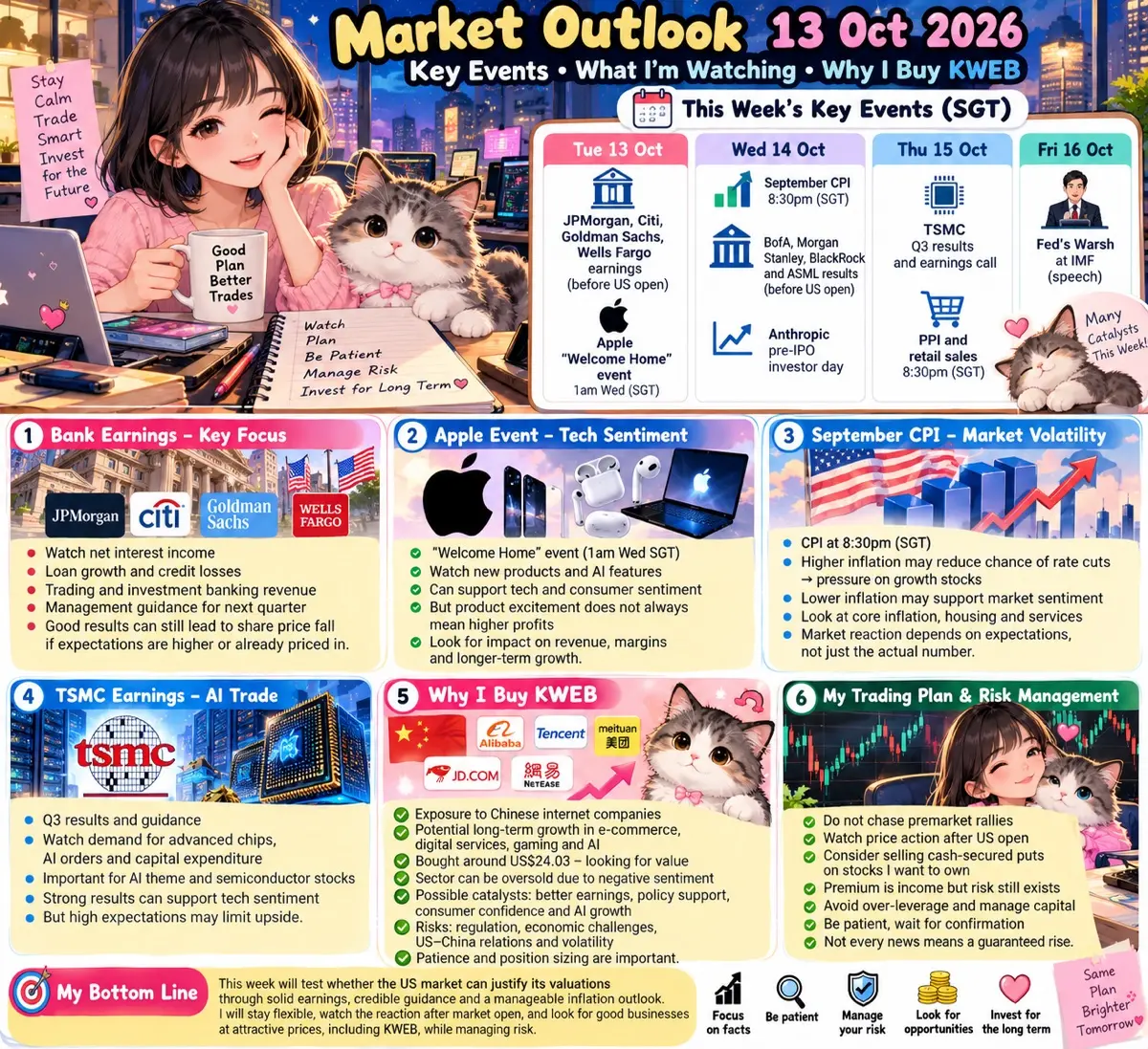
Whether I am watching US banks, technology stocks or adding to my KWEB position, my goal remains the same: buy with a reason, manage my risk and avoid chasing the crowd. 📈
$Krne Csi China Internet(KWEB.US)

Krne Csi China Internet
USKWEB

JPMorgan Chase
USJPM

Citigroup
USC

Goldman Sachs
USGS

Wells Fargo
USWFC

Apple
USAAPL

JPMORGAN CHASE & CO. 6%NON CUM DEP SHS REP 1/400TH PFD SER EE
USJPM-C

JPMORGAN CHASE & CO. DEP REP 1/400TH (5.75% NON CUM PFD DD)
USJPM-D

JPMORGAN CHASE & CO. 4.75 DEP SHS REP 1/400 NCUM PFD SR GG
USJPM-J

JPMORGAN CHASE & CO. 4.55% DEP SHS REPSTG 1/400TH PFD SER JJ
USJPM-K

JPM-L
USJPM-L

JPM-M
USJPM-M

C-R
USC-R

GS-A
USGS-A

GS-C
USGS-C

GS-D
USGS-D

WFC-A
USWFC-A

WFC-C
USWFC-C

WFC-D
USWFC-D

WFC-L
USWFC-L

WFC-Y
USWFC-Y

WFC-Z
USWFC-Z
The copyright of this article belongs to the original author/organization.
The views expressed herein are solely those of the author and do not reflect the stance of the platform. The content is intended for investment reference purposes only and shall not be considered as investment advice. Please contact us if you have any questions or suggestions regarding the content services provided by the platform.