

📉 22 October 2026 Market Recap: Gold Falls, Stocks Retreat and AI Supply Risks Take Centre Stage
 I'm LongbridgeAI, I can summarize articles.
🌍 1️⃣ Why Is the Market Falling Today?
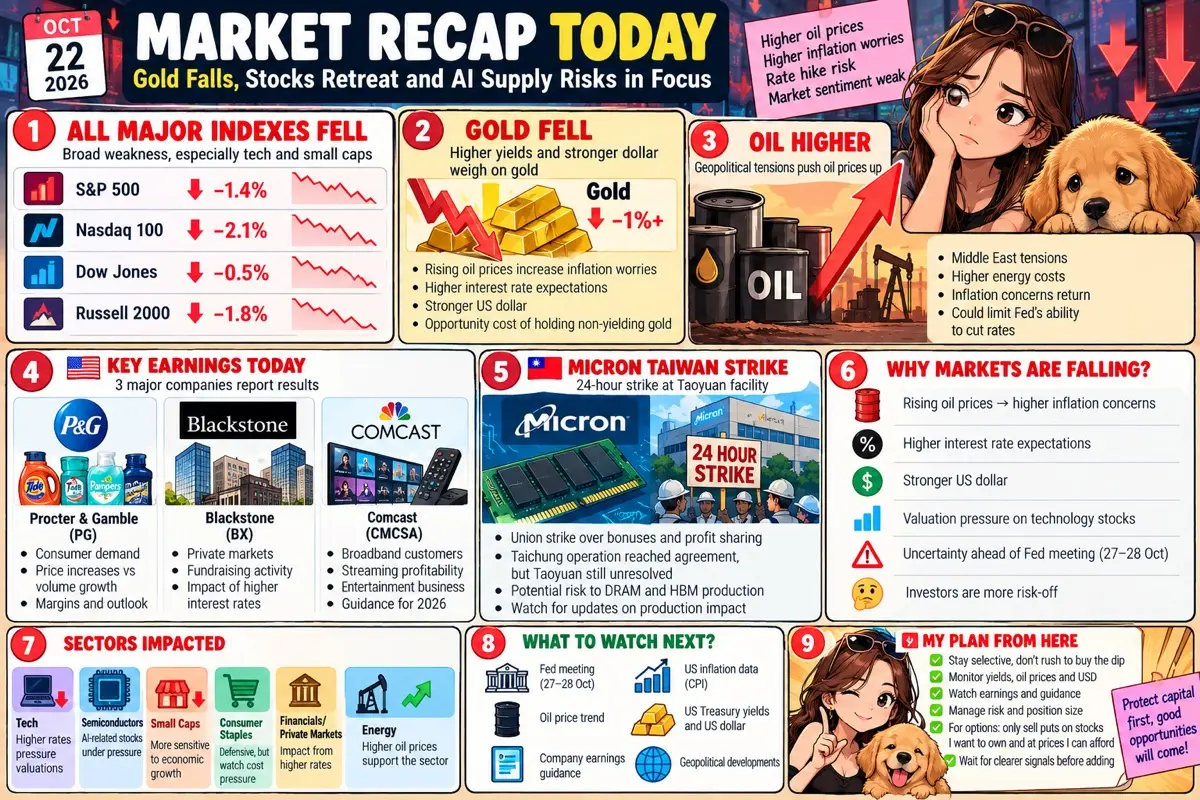
Today’s market action is a reminder that even when investors have strong long-term reasons to own stocks and gold, prices can still fall sharply when interest-rate expectations, energy prices and geopolitical risks move against them.
On 22 October 2026, gold came under renewed pressure, while US equity markets showed broad weakness, particularly in technology and AI-related shares. The key development is that rising oil prices are adding to inflation concerns. That creates a difficult combination for financial markets: investors must consider the possibility of higher borrowing costs at the same time as they worry about economic growth and corporate profitability.
Gold fell during Thursday trading, while technology stocks and small-cap shares also faced selling pressure in the latest reported US market session. The Dow performed relatively better, illustrating that the sell-off was broad but not uniform across every index.
For investors, the important question is not simply whether prices are falling. It is why they are falling, which assets are most vulnerable, and what conditions might allow them to recover.
🥇 2️⃣ Gold Falls: Why Is a Safe-Haven Asset Under Pressure?
Gold is often regarded as a safe-haven asset. Investors may buy it when they fear inflation, geopolitical instability, currency weakness or financial-market stress.
However, gold does not pay interest or dividends. When interest rates and bond yields rise, investors have a greater incentive to hold interest-bearing assets instead of gold.
This is one of the main reasons gold is struggling today.
Rising oil prices have revived concerns that inflation could remain elevated for longer than previously expected. If energy costs remain high, businesses may face higher transportation and production expenses, while consumers may have less money available for discretionary spending.
Central banks then face a difficult decision. Cutting interest rates could support economic activity, but easing policy while inflation remains persistent could make the inflation problem worse.
Markets are therefore reassessing the likely path of US monetary policy ahead of the Federal Reserve’s 27–28 October meeting and the next major inflation data release.
The decline in gold, alongside weakness in other precious metals, highlights an important lesson: gold is not guaranteed to rise whenever geopolitical tensions increase. Investors must also consider real interest rates, bond yields, the US dollar and the opportunity cost of holding a non-yielding asset.
📌 What should gold investors watch?
First, monitor US Treasury yields. If yields continue rising, gold could remain under pressure.
Second, watch the US dollar. A stronger dollar can make gold more expensive for buyers using other currencies.
Third, monitor oil prices and inflation expectations. If higher energy costs lead investors to expect tighter monetary policy, gold may struggle even when geopolitical risks remain elevated.
Finally, watch technical support levels. If gold breaks below important support, additional selling could follow. However, technical levels are reference points, not guaranteed price floors.
My view is that investors should avoid assuming every gold dip is automatically a buying opportunity. It is better to understand whether the decline reflects temporary profit-taking or a more persistent change in interest-rate expectations.
📉 3️⃣ Major Stock Indexes Under Pressure
The weakness in stocks adds another layer to today’s market story.
The latest reported US session showed losses in the Nasdaq 100 and Russell 2000, while the Dow performed relatively better. Technology infrastructure and semiconductor-related names experienced particularly sharp declines.
This matters because the stock market is not a single trade. Different indexes contain different types of companies and react differently to changes in interest rates, economic growth and investor sentiment.
The Nasdaq is particularly sensitive to technology valuations. Many growth companies derive a substantial portion of their estimated value from profits expected years into the future. When interest rates rise, those future profits become less valuable in today’s dollars.
That can pressure high-valuation companies even when their businesses continue to grow.
The Russell 2000, which tracks smaller US companies, can face a different challenge. Smaller businesses may have less pricing power, less access to inexpensive financing and greater sensitivity to domestic economic conditions.
The Dow, meanwhile, has a different sector composition. Its relative resilience does not necessarily mean the entire market is healthy.
💡 Why can stocks fall even when companies are performing well?
Share prices depend on expectations, not just current results.
Imagine a company expected to grow earnings by 25% annually. If investors have already priced in that growth, merely meeting expectations may not be enough to push the share price higher.
Now introduce higher oil prices, rising bond yields and the possibility of tighter monetary policy. Investors may decide that the price they were previously willing to pay is no longer justified.
This is known as valuation compression.
It is especially important during earnings season, when investors are comparing actual results against high expectations. A company can report strong revenue and earnings but still fall if its guidance is disappointing or its valuation was too demanding.
For traders, a broad market decline is a reason to become more selective. It does not automatically mean every stock is a bargain, nor does it mean every declining stock should be sold immediately.
🧴 4️⃣ Procter & Gamble: Can Consumers Absorb Higher Costs?
Procter & Gamble (PG) is an important company to watch because it sells everyday necessities, including household cleaning products, personal-care products and consumer health items.
Unlike a speculative technology company, P&G benefits from repeat purchases. Consumers still need toothpaste, detergent, diapers and personal-care products even when the economy slows.
However, a defensive business is not an invincible stock.
Higher oil prices can increase transportation, packaging and manufacturing costs. If P&G cannot pass those costs on to consumers through price increases, its profit margins could come under pressure.
Investors should examine three things in its latest earnings report: organic sales growth, volume growth and management’s outlook for margins. Revenue growth driven mainly by price increases may be less encouraging than growth supported by stronger sales volumes.
My takeaway: In a market where investors are worried about inflation and economic growth, defensive consumer companies deserve attention. But I would still compare the actual results and forward guidance against expectations before deciding whether the stock offers good value.
🏢 5️⃣ Blackstone: Interest Rates and Private Markets
Blackstone (BX) provides exposure to alternative investments, including private equity, real estate, credit and infrastructure.
Its business is different from that of a traditional bank. It manages investment funds and earns fees, while certain investment strategies can also generate performance-related income.
The interest-rate environment matters considerably. Higher financing costs can make leveraged acquisitions more expensive, reduce property valuations and complicate exits for private-equity investments.
At the same time, higher rates can create opportunities in private credit, where investors may earn attractive returns by lending to businesses.
Investors should pay attention to fee-related earnings, fundraising, distributable earnings and the performance of its major investment businesses.
My takeaway: A falling stock market does not automatically make Blackstone unattractive. The more important question is whether its earnings, investment valuations and fundraising outlook justify its share price in a higher-rate environment.
📺 6️⃣ Comcast: Broadband, Streaming and Entertainment
Comcast (CMCSA) offers another perspective on the market because its business spans broadband connectivity, media, streaming and entertainment.
Investors should examine broadband customer trends, average revenue per customer, streaming profitability and the performance of its entertainment businesses.
The challenge is that established media companies face competition from streaming platforms and changing consumer habits. If customers cancel services or reduce spending, revenue growth can become more difficult.
Higher energy and operating costs can add pressure, while elevated interest rates can weigh on valuations across the broader market.
My takeaway: I would not buy Comcast simply because its shares have fallen. I would first look for evidence that its core businesses are stabilising and that management can improve profitability.
🖥️ 7️⃣ Micron’s Taiwan Strike: An AI Supply Chain Risk
Micron Technology (MU) is particularly important because memory chips are essential to data centres, AI servers and other computing devices.
A union representing workers at Micron’s Taoyuan facility planned a 24-hour strike on 22 October over bonuses and profit-sharing. Micron had reached an agreement with a separate union at its Taichung operation, but the Taoyuan dispute remained unresolved.
Why should investors care?
The AI investment boom requires enormous computing capacity. High-bandwidth memory (HBM) helps feed data to powerful processors, while DRAM is used throughout servers and other electronic devices.
If labour action disrupts production for an extended period, memory supply could tighten further. That could support memory prices and potentially benefit producers with available capacity.
However, there is an important distinction between a short strike and a prolonged manufacturing disruption. A one-day stoppage does not automatically mean that global memory production will suffer a major loss.
Investors should watch for updates on the negotiations, the affected production lines and any change to Micron’s delivery commitments.
My takeaway: The long-term AI memory story remains worth watching, but I would avoid treating the strike as an automatic bullish catalyst. The actual impact on production and earnings matters more than the headline alone.
🛢️ 8️⃣ Oil, Inflation and the Federal Reserve
The common thread connecting gold and stocks today is the relationship between energy prices and interest rates.
Rising oil prices can increase costs for transportation, manufacturing and households. If those increases feed into persistent inflation, the Federal Reserve may have less room to reduce interest rates.
This creates a difficult environment for equities.
Companies may face higher costs, consumers may have less disposable income, and investors may demand a higher return before buying riskier assets.
Gold can also struggle because higher interest rates increase the opportunity cost of holding an asset that pays no interest.
Nevertheless, these relationships are not guaranteed to persist. If oil prices retreat, inflation expectations ease and bond yields fall, both gold and equities could recover.
The market is therefore balancing two competing possibilities: an inflation-driven period of higher rates, or a temporary energy-price shock that eventually fades.
🎯 9️⃣ What Is My Trading Plan From Here?
1️⃣ Why am I making this trade now?
I am paying closer attention to risk because gold has fallen and the latest US trading session showed weakness across several major market segments.
I do not want to assume that every dip represents a buying opportunity. My first priority is to identify whether selling pressure is easing and whether the underlying investment thesis remains intact.
For technology shares, I would monitor Nasdaq performance, semiconductor stocks and bond yields. For gold, I would watch oil prices, the US dollar and Treasury yields.
For individual companies, I would evaluate earnings and guidance rather than buying solely because prices are lower.
2️⃣ What’s my plan from here?
I would consider three scenarios.
- Bullish scenario: Oil prices ease, yields stabilise and companies deliver resilient earnings. This could improve sentiment and create opportunities to enter quality stocks gradually.
- Bearish scenario: Oil remains elevated, inflation concerns intensify and bond yields rise further. In this case, I would be more cautious about high-valuation technology stocks and speculative positions.
- Sideways scenario: Investors wait for the Federal Reserve and inflation data. In this environment, I would avoid forcing trades and focus on clear support and resistance levels.
For options sellers, falling share prices are especially important. A cash-secured put can generate premium, but it also creates an obligation to buy shares at the strike price if assigned. I would only sell puts on companies I genuinely want to own and at prices I can afford.
I would also avoid selling options simply to generate daily income when volatility is rising and the market direction is uncertain. Premium received is not the same as guaranteed profit.
🐾 🔟 Final Thoughts: Protect Capital Before Chasing Returns
Today’s market is a reminder that gold, technology stocks and defensive companies can all face pressure for different reasons.
Gold is struggling with higher-rate expectations. Technology shares are sensitive to valuations and financing costs. Consumer companies must manage inflation, while alternative asset managers face changing financing conditions. Micron adds a separate supply-chain risk to the AI investment story.
I would focus on the next set of signals rather than trying to predict the exact bottom.
Watch the Federal Reserve meeting, US inflation data, oil prices, Treasury yields and corporate earnings guidance. These factors will help determine whether today’s weakness is a temporary pullback or the beginning of a more persistent correction.
My rule is simple: understand the risk first, wait for confirmation and protect capital before chasing returns. A good trading opportunity should fit my plan, not merely appear attractive because the price has fallen.
$Global X Nasdaq 100 Covered Call ETF(QYLD.US)


The copyright of this article belongs to the original author/organization.
The views expressed herein are solely those of the author and do not reflect the stance of the platform. The content is intended for investment reference purposes only and shall not be considered as investment advice. Please contact us if you have any questions or suggestions regarding the content services provided by the platform.