

🐶 Options Puppy: Grab Wheel Strategy – Part 2
 I'm LongbridgeAI, I can summarize articles.
Managing My Covered Call and Planning My Next Premium
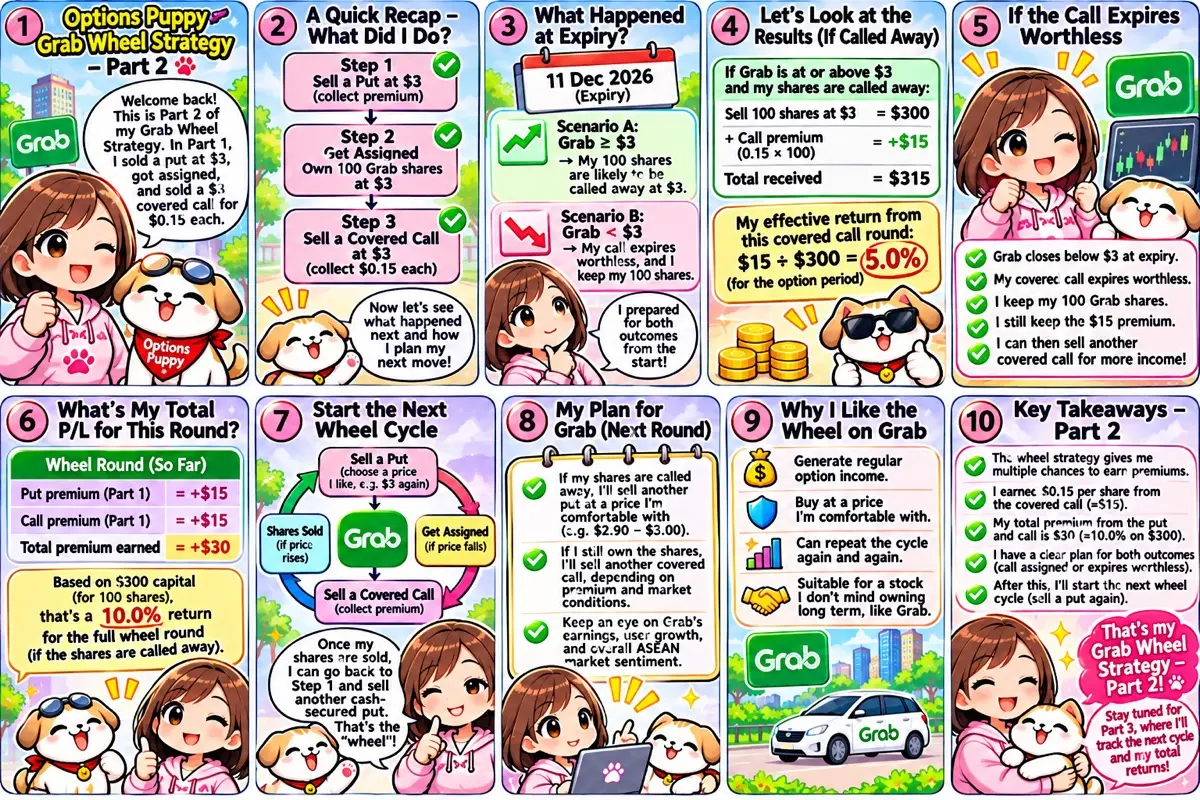
🐶 My take: The wheel strategy does not end when I get assigned shares. In fact, that is when the next opportunity begins. I now own 100 Grab shares, and I am using covered calls to collect additional premiums.
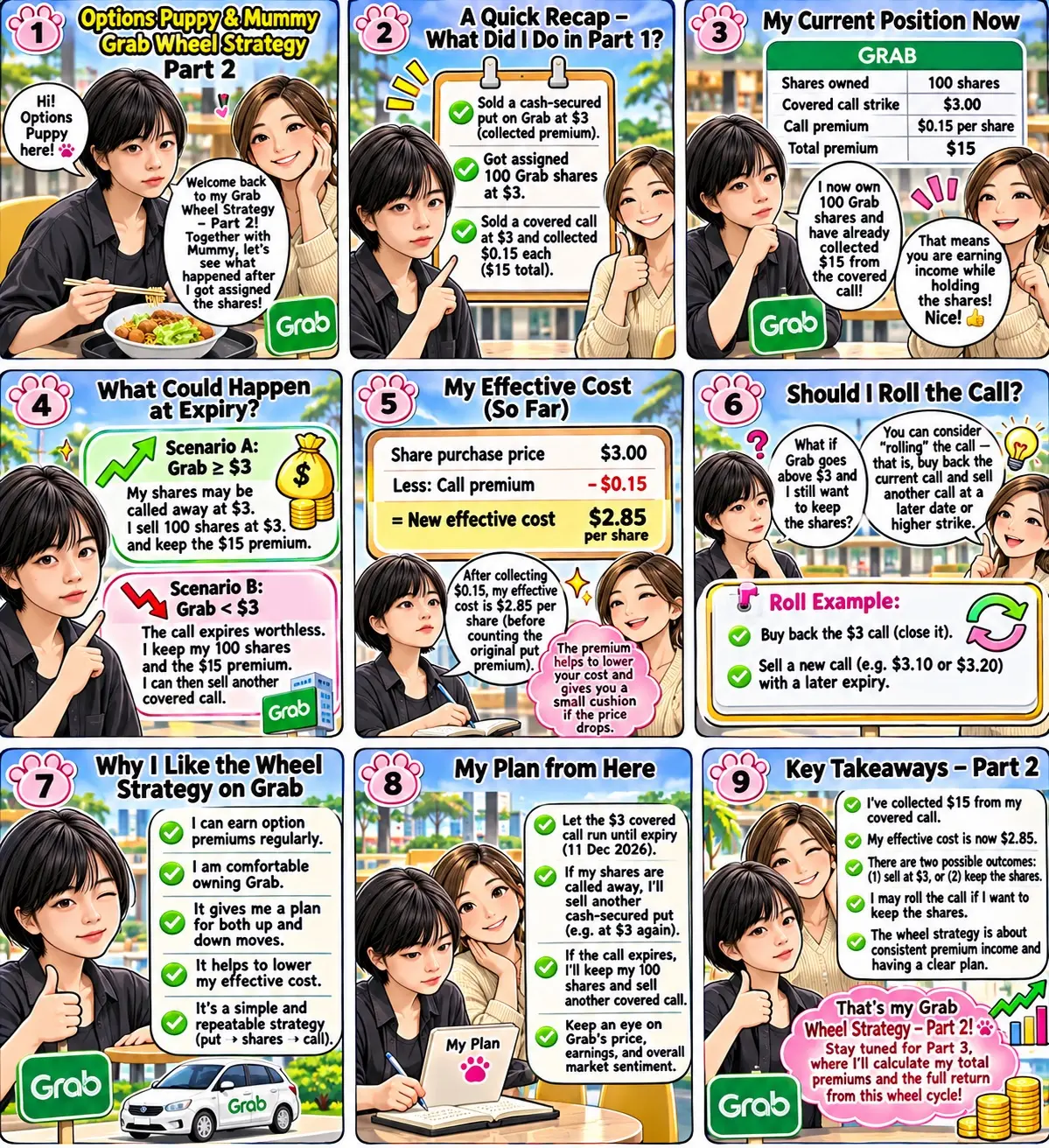
In Part 1, I explained how I sold a cash-secured put at $3 and eventually got assigned. I was prepared to own Grab at that price.
After assignment, I sold another option: a $3 covered call, collecting $0.15 per share.
Let’s look at how I manage the next stage.
1️⃣ Why am I making this trade now?
I don’t want my 100 Grab shares to sit idle while waiting for the share price to move.
By selling a covered call, I receive premium in exchange for agreeing to sell my shares at the $3 strike price if the option is exercised.
My trade details:
- Stock: Grab (GRAB)
- Shares owned: 100
- Covered call strike: $3
- Premium: $0.15 per share
- Total premium: $15
- Expiration: 11 December 2026
I chose the $3 strike because it was the price at which I was originally comfortable buying Grab.
However, there is an important trade-off. If Grab rises substantially above $3, I may have to sell my shares at $3 and miss out on further upside.
I must be comfortable with that possibility before selling the call.
2️⃣ How much premium have I collected?
Let’s calculate the second leg.
100 shares × $0.15 = $15.
That means I have collected another $15 from selling my covered call.
The premium also reduces my effective share cost.
Calculation | Amount |
Original share purchase price | $3.00 |
Covered call premium | -$0.15 |
Effective cost before put premium | $2.85 |
Effective cost for 100 shares | $285 |
This is only a partial cost calculation. I must also include the original put premium, transaction fees and any other costs to calculate my actual overall return.
The important lesson is that premiums can gradually reduce my effective cost basis.
3️⃣ What if Grab rises above $3?
This is where I need to understand the risk of selling covered calls.
Suppose Grab trades at $3.50 when my call expires.
My $3 covered call is in the money. If exercised, I may have to sell my 100 shares at $3.
I receive $300 from selling the shares and keep the $15 call premium.
I would also account for the original put premium when calculating my total profit or loss.
The downside is that I do not participate in the additional $0.50 share-price gain above the strike.
This is why I should only sell covered calls at prices where I am genuinely comfortable exiting.
4️⃣ What if Grab falls below $3?
Now imagine Grab falls to $2.80.
My covered call could expire worthless, allowing me to keep my 100 shares and the $15 premium.
I can then consider selling another covered call.
However, I must remember that the shares have declined by $0.20 from my $3 assignment price.
The $15 premium provides only partial protection. It does not eliminate the risk of a falling share price.
If Grab continues falling, the loss on my shares can become much larger than the premiums collected.
This is why I need to monitor the underlying company, not just the options premiums.
5️⃣ Should I roll my covered call?
Another technique available to options sellers is rolling.
Rolling means buying back my existing call and selling another call, usually with a different expiration date or strike price.
For example, if Grab rises above $3 and I still want to keep my shares, I could consider buying back the existing call and selling a later-dated call at a higher strike.
But rolling is not free money.
I may have to pay more to close the existing contract than I receive from selling the replacement contract.
I need to compare the debit or credit, new strike, expiration and potential opportunity cost.
Sometimes accepting assignment is perfectly reasonable. I don’t need to defend every position.
6️⃣ What is my plan from here?
My plan is to monitor the December 11, 2026 expiration.
There are three things I want to watch:
- Grab’s share price relative to the $3 strike.
- The option’s remaining time value and premium.
- Grab’s business performance and overall market sentiment.
If my shares are called away, I can return to selling cash-secured puts at a price where I am comfortable buying again.
If the call expires worthless, I still own my shares and can evaluate another covered call.
I will not automatically sell another option just because I can. I want the premium to justify the risk.
7️⃣ My Options Puppy lesson
🐶 The wheel strategy is about patience and having a plan.
I start by selling puts. If assigned, I own shares. Then I sell covered calls. If my shares are called away, I can start the process again.
My objective is not to win every single trade or predict every market movement.
I want to build a disciplined process where I understand my entry price, exit price, premium received and downside risk.
Part 1 was about getting assigned. Part 2 is about managing my shares and collecting covered call premiums.
Stay tuned for Part 3, where I will calculate the complete wheel cycle and examine whether the premiums have made the trade worthwhile.
This is my personal trading journal, not financial advice. Options involve risks, and premiums do not guarantee profits.
$Grab(GRAB.US)
The copyright of this article belongs to the original author/organization.
The views expressed herein are solely those of the author and do not reflect the stance of the platform. The content is intended for investment reference purposes only and shall not be considered as investment advice. Please contact us if you have any questions or suggestions regarding the content services provided by the platform.