

How to achieve trend-following strategy from the recent strong performance of the Hong Kong stock market
 I'm LongbridgeAI, I can summarize articles.
“ Use the technical logic on small cycles to enter trades based on the trend logic of the main battlefield, but never the other way around.”

Today, high-dividend concept stocks in the Hong Kong market rose across the board, leading the $Hang Seng Index HSI.HK$ and the HSCEI to rise by 2.3% and 2.41%, respectively, both hitting new highs since mid-August 2023. The Hang Seng Tech Index rose slightly by 0.38%, showing relatively weaker performance. The three major Hong Kong stock indices have cumulatively risen over 20% from their lows, all entering technical bull markets.
$Hong Kong Exchanges and Clearing hk00388$ surged 7.61%, leading the blue-chip gains.
It has always been known that, in terms of preferred investment strategies, whether value investing or mean-reversion swing trading, both are counter-trend strategies.
Therefore, except for value investing, which can "lie flat" when portfolio companies follow major trends, relying solely on mean-reversion swing strategies can easily miss out on big trend opportunities.
Hence, the focus of investment advancement in the first half of this year has been to address this shortcoming—learning and practicing robust swing strategies that can ride major trends.
Previously, the self-developed robust strategy involved participating whenever stability after strength was observed, without further classification or filtering, resulting in low win rates and payoff ratios.
After studying the classification method from the 20-year trading veteran "Shanghai Twelve" (沪上十二少), it became clear that the truly worthwhile robust trends are those with big rises and small pullbacks.
In other words, to achieve trend-following in swing trading, one must actively participate in strong trends with big rises and small pullbacks after proper risk control.
01—Trend-Following in Swing Strategies
Trend-following has long been considered the best path to big profits in investment/speculation markets. Identifying trends isn’t particularly hard; the toughest part is finding the right entry point after recognizing the trend.
This is the key to building a trend-following trading system. As Shanghai Twelve puts it, for technical traders,
The principle for constructing a trend-following trading system is:Use the technical logic on small cycles to enter trades based on the trend logic of the main battlefield, but never the other way around.
This week, I’ve been carefully reflecting on and internalizing this principle.
As Shanghai Twelve said: Swings and consolidations are the only two components of all major trends. Most of the time, trends manifest as a sequence of swing + consolidation + swing + consolidation...
Thus, the trend-following swing strategy used by Shanghai Twelve is about capturing big swings within major trends, enduring small pullbacks but not major ones.
In other words, enter when the main battlefield trend reverses and shows big rises with small pullbacks. Hold until the trendline on the main battlefield is broken.
From this, we can see that the technical logic on small cycles is the stabilization pattern after big rises and small pullbacks,
while the trend logic of the main battlefield is "the trend remains until it doesn’t."
02—How to Follow the Trend in Strong Tech Stock Performances
The recent strength of the Hong Kong market is undeniable. Today, let’s take a few tech stocks in the current strong Hong Kong market as examples to see how Shanghai Twelve’s swing strategy achieves trend-following.
1. Hang Seng Index
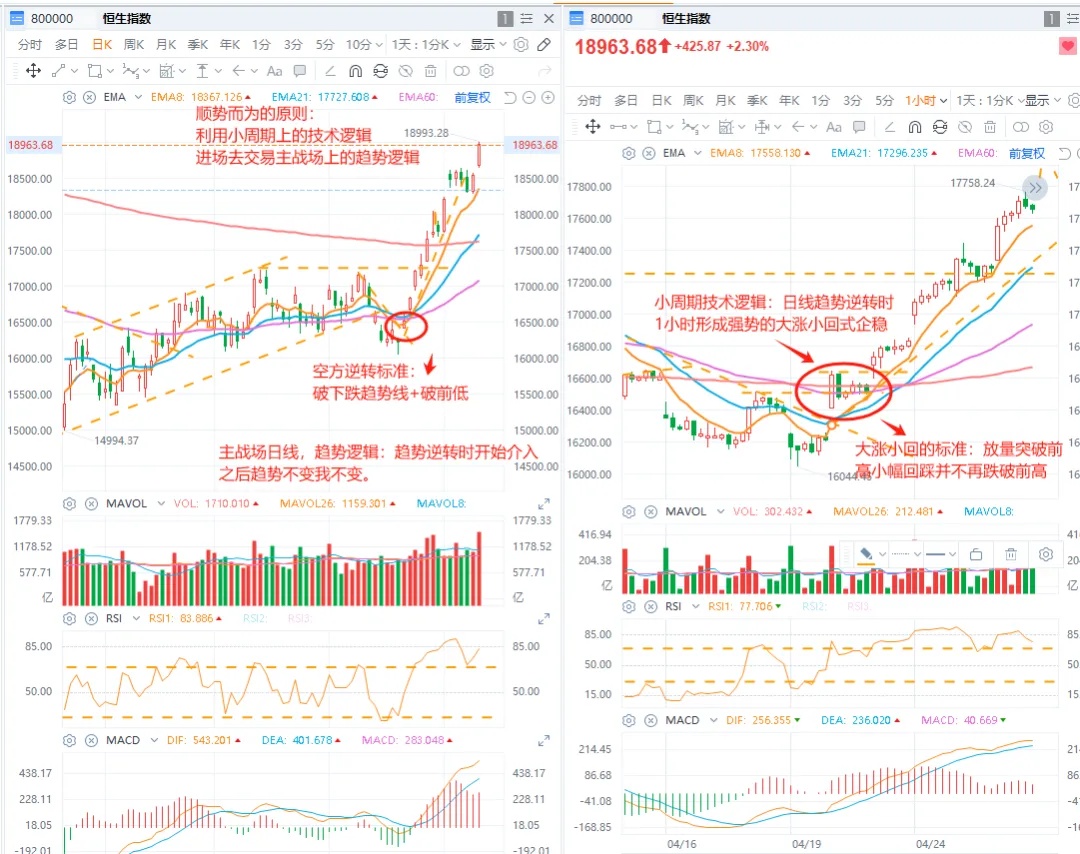
From the perspective of Shanghai Twelve’s trend-following trading system principle,
before the Hang Seng Index’s recent strong rally, the trend logic was to confirm a reversal on the main battlefield (daily chart) and then use the technical logic (big rises with small pullbacks) on the small cycle (1-hour chart) to enter. After that, "the trend remains until it doesn’t."
It’s also evident that the small cycle has maintained a step-like pattern of big rises and small pullbacks.
In other words, in strong trends, every pullback with big rises and small pullbacks can be an opportunity to add or enter. However, the risk-reward ratio may diminish as the rally progresses.
Decisions to enter should be based on personal risk control and judgment of further upside potential.
Generally, the first three big rises with small pullbacks after a major trend reversal carry relatively lower risk.
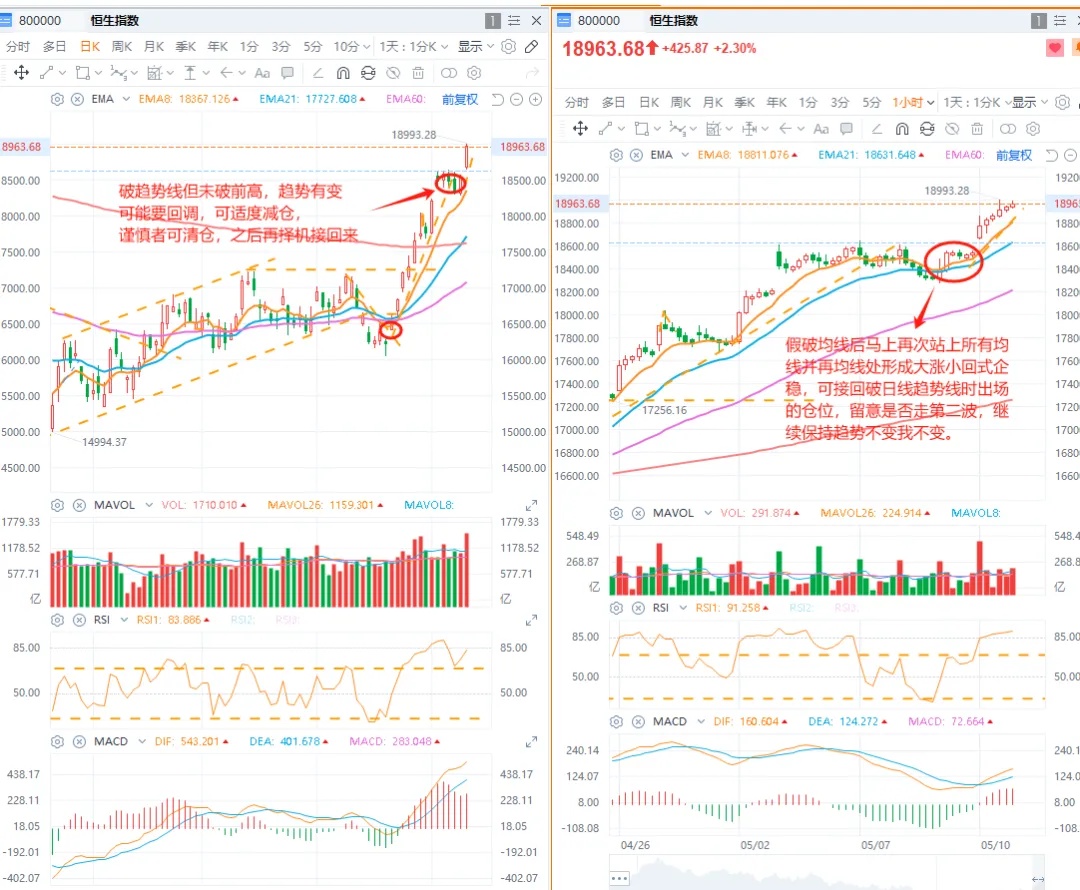
Wednesday’s pullback broke the daily fast-rising trendline, potentially signaling a major correction. Swing traders might reduce or exit positions here,
and re-enter if the trend confirms strength later—for example, when Thursday’s rebound above all moving averages showed stabilization with big rises and small pullbacks.
Trend traders, however, might hold through potential pullbacks until a true trend reversal.
This is the difference between swing and trend trading: swing traders lock in profits when major pullbacks loom, while trend traders endure for bigger gains.
2. Tencent Holdings
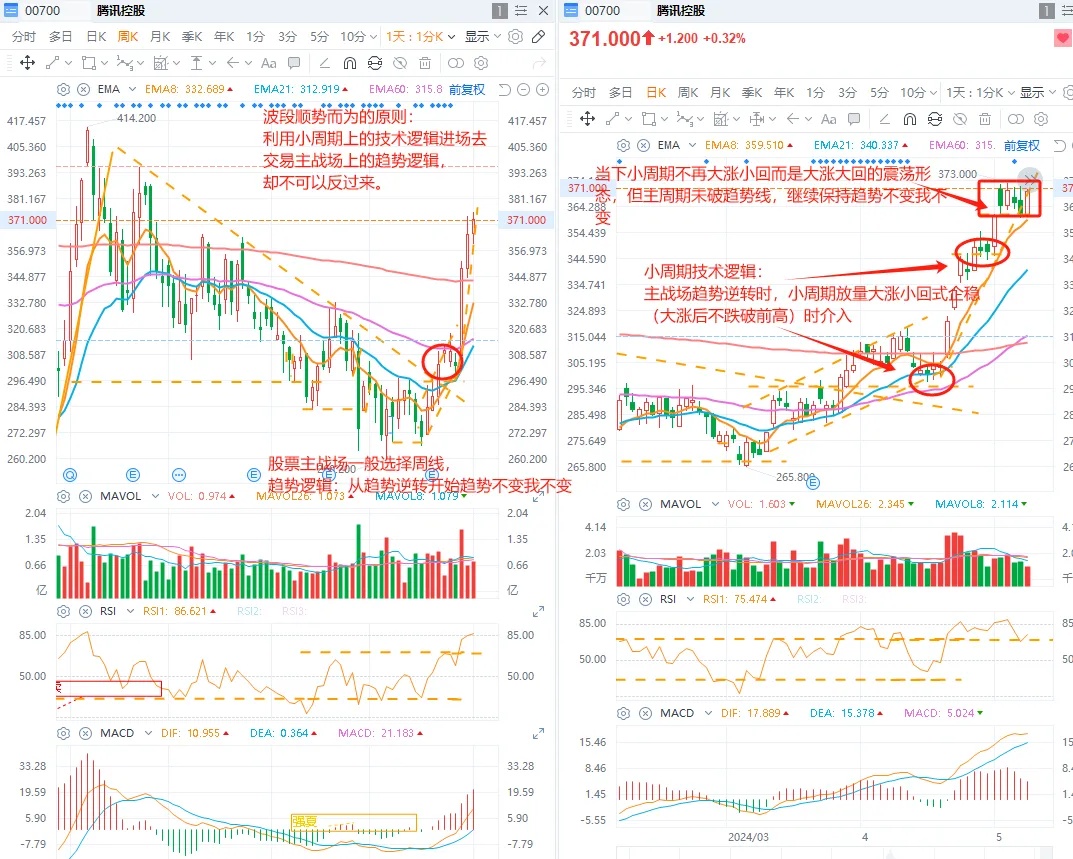
As seen in the chart, $Tencent Holdings hk00700$’s current rally began with big rises and small pullbacks after a weekly downtrend reversal.
Similarly, use the technical logic (big rises with small pullbacks) on the small cycle (daily chart) to enter trades based on the trend logic ("the trend remains until it doesn’t" from the reversal) of the main battlefield (weekly chart).
Currently, Tencent’s daily chart shows volatile swings with big rises and pullbacks, but it remains above the weekly trendline, so the weekly trend remains intact.
From these two cases, it’s clear that to follow the trend, one must first identify the main battlefield and then align with its trend.
Patience is key to wait for the technical logic (big rises with small pullbacks) on the small cycle before participating in the main battlefield’s trend.
The above is just my personal reflection and analysis of the trend-following principle in swing trading. It may not be correct or suitable for everyone, so please consider it rationally.
I hope my sharing helps. See you in the next article.
Disclaimer: This article shares my trading system philosophy and investment logic, not investment advice. Any mentioned stocks are not recommendations. The market carries risks; invest cautiously and rationally!


The copyright of this article belongs to the original author/organization.
The views expressed herein are solely those of the author and do not reflect the stance of the platform. The content is intended for investment reference purposes only and shall not be considered as investment advice. Please contact us if you have any questions or suggestions regarding the content services provided by the platform.