
2024 Week 39 Weekly Report
 I'm LongbridgeAI, I can summarize articles.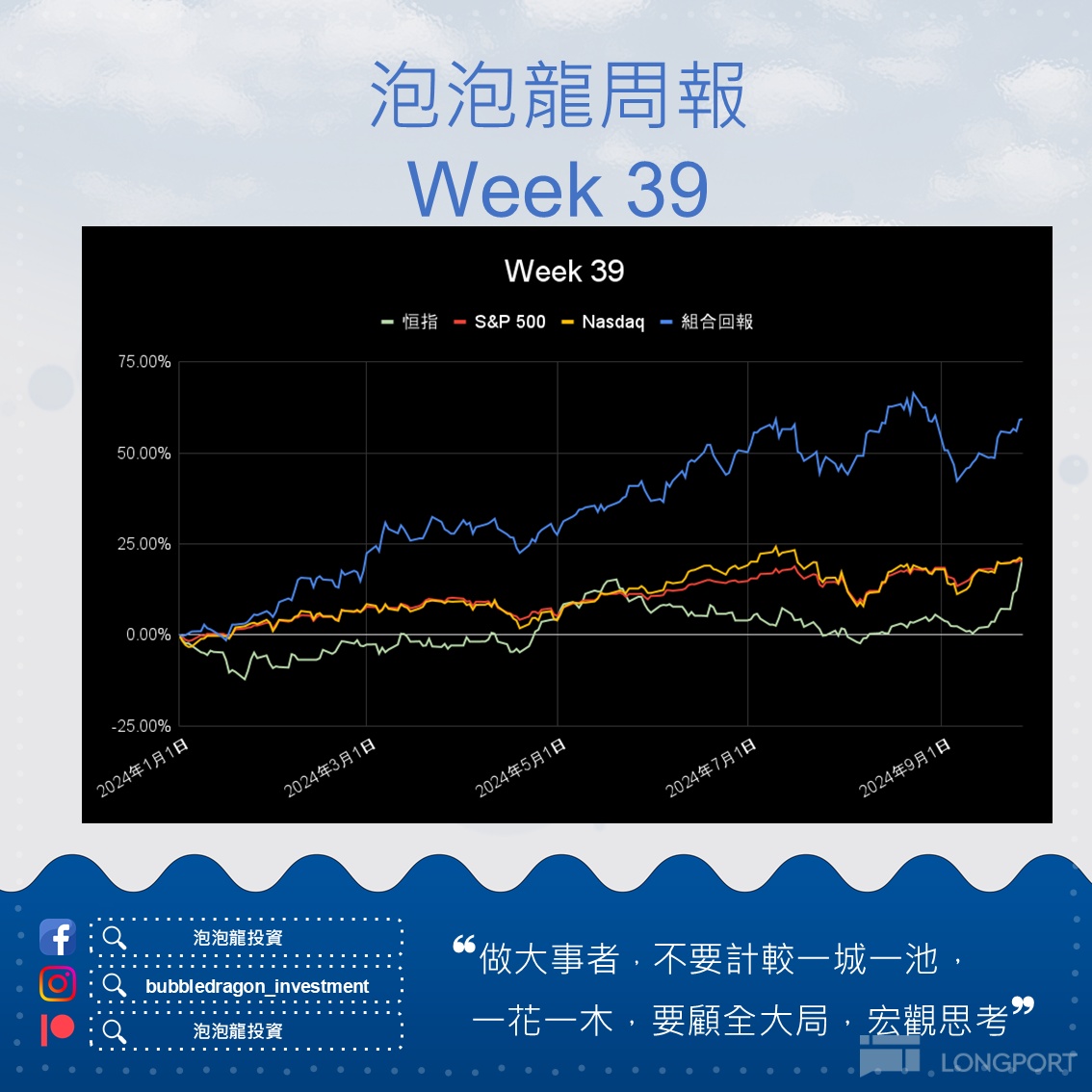
Portfolio NAV at the beginning of the year: HKD 2,307,716
Latest portfolio NAV: HKD 3,676,972
YTD return: 59.3%
Hang Seng Index YTD return: 21.03%
S&P 500 YTD return: 20.3%
Nasdaq YTD return: 20.7%
Portfolio
The portfolio's return continued to rise slowly this week, reaching 59.3%, moving steadily toward the goal of getting rich slowly. There weren't many operations in the portfolio this week—basically, it was fully invested, with only minor adjustments. I felt comfortable holding the positions without much need for active trading. A detailed analysis and review of the portfolio's individual stocks will be shared with everyone on Patreon.
Market Overview
Regarding the U.S. stock market, as I previously predicted, volatility has decreased, creating a comfortable period of steady growth. This is characteristic of U.S. stocks—once major risks are ruled out, funds gradually flow in.
The U.S. market has been relatively calm recently, and the PCE data released on the 27th was in line with expectations, hovering around 2.7%. As long as the PCE doesn’t deviate too much, it won’t have a significant impact on the market. Instead, people are paying more attention to the monthly non-farm payroll data, which serves as evidence of whether the U.S. economy is achieving a soft landing.
However, although the U.S. market has been relatively calm, individual stocks are clearly showing signs of upward fatigue. For example, semiconductor stocks rose early in the week but then sharply retreated, with Friday’s drop erasing most of the gains from earlier in the week—almost making the entire week’s effort pointless.
It’s estimated that without any clear catalysts, the U.S. market will continue this pattern, digesting high valuations while waiting for the next wave.
As for the Hong Kong market, this week was truly spectacular—a week that should absolutely go down in history! Friday’s trading volume exceeded HKD 440 billion, setting a new record for the highest single-day turnover in history. Witnessing this firsthand is truly an honor. The only regret is that it happened when the Hang Seng Index was around 20,000 points, not 30,000 or 40,000, which is somewhat lamentable.
With such trading volume, the Hong Kong market cannot be underestimated. The reason for this surge is the sudden introduction of a series of policy measures from mainland China. What’s different this time is that many of these policies directly target the stock market, such as allowing loans for stock purchases, requiring dividends, and improving market capitalization management—all of which should help valuations.
Judging whether the market has bottomed out involves several layers, including the so-called "policy bottom," "market bottom," and "economic bottom." Given the scale of these policy measures, we can confidently say the policy bottom has been reached. However, whether the Hang Seng Index can rise further and sustain its gains depends on the economic bottom—simply put, corporate earnings must bottom out and recover. Even if valuations don’t increase, stock prices should still rise if earnings improve.
Right now, the policies have just been introduced, and the economy is definitely not at its bottom yet—it will take time for the effects to trickle down to the real economy, usually a few months. Therefore, economic data in the coming months will be extremely important! If this attempt fails like in 2023, I believe a recovery won’t be possible for several years.
That said, the government’s policies have already helped lift valuations. For example, a company that previously had a P/E ratio of 5 might now command 8 due to policy support and expectations of higher buybacks and dividends—that alone could drive a 60% increase! This is one of the main reasons for the recent sharp rally. And if the economy eventually recovers and corporate earnings rise, even at a P/E of 8, stock prices could climb further depending on EPS growth.
However, for now, the Hong Kong market is driven by liquidity—something I’ve always emphasized as the hardest to predict and trade. Liquidity-driven markets can surge rapidly but also crash just as fast if funds dry up. The Hang Seng Index rose from 16,000 to nearly 21,000 in just a few weeks, but it could also drop 1,000 points in a few days. I wouldn’t be surprised to see extreme volatility.
Personally, I’m not pessimistic in the short term. With such massive liquidity, a sharp decline is unlikely anytime soon. Any dip would be a buying opportunity because the rally has been so rapid that many buyers likely haven’t had enough time to build positions. This latent demand should provide short-term support for the market.
A detailed review of the portfolio’s holdings is shared in the Patreon member area:
The above represents personal opinions and does not constitute investment advice.
$MEITUAN(03690.HK) $BABA-W(09988.HK) $Tesla(TSLA.US) $NVIDIA(NVDA.US) $Taiwan Semiconductor(TSM.US) $HKEX(00388.HK)
The copyright of this article belongs to the original author/organization.
The views expressed herein are solely those of the author and do not reflect the stance of the platform. The content is intended for investment reference purposes only and shall not be considered as investment advice. Please contact us if you have any questions or suggestions regarding the content services provided by the platform.