


Why do inverse ETFs not follow the returns of related assets?

As one of the active exchange-traded products (ETP) in the Hong Kong market, leveraged and inverse products (referred to as "leveraged inverse products") are a type of exchange-traded product (ETP) that can provide leverage effects compared to traditional ETFs, amplifying index returns or hedging against index declines.
However, sometimes investors may find on trading platforms that the price returns of leveraged and inverse products displayed do not equal the specific multiple returns of their related indices.
In fact, when comparing the performance of leveraged inverse products and related indices, there are two points to pay attention to: one is that the comparison should be limited to "daily" returns; the other is that when looking at daily returns, the performance of the leveraged inverse product's net asset value (NAV) should be compared to the index level, rather than the "market price" of the leveraged inverse product.
If investors overlook these two points when buying and selling leveraged inverse products, they may encounter situations where the product performance deviates from the specific multiple returns of the related index. Next, we will further elaborate on these two points to help investors better analyze the performance of leveraged and inverse products and choose suitable trading tools.
1. Leveraged inverse products are "daily" products
When comparing the performance of leveraged inverse products and the price performance of related indices, we must first ensure that we are comparing daily returns. After all, the investment objective of leveraged inverse products is to provide investment returns that closely align with the daily performance of the index at a maximum of two times (2x) or negative two times (-2x) before deducting fees and expenses, and they do not seek to achieve investment objectives over periods longer than one day. Here, "daily" refers to the period from the close of the relevant market on a specific trading day to the close of the relevant market on the next trading day for index leveraged returns or product performance.
If the period exceeds one day, the period returns of leveraged inverse products will be affected by compounding effects, deviating from the specific multiple returns of the index during the same period.
If it is less than one trading day, there will be same-day investment risks. This is because the leverage multiple of leveraged inverse products will change with market trends on trading days, but the frequency of product rebalancing is daily, meaning that it will not be rebalanced until the end of the trading day, leading to returns within the trading day that may be more or less than the leveraged or inverse returns of the related index.
2. Daily returns should compare NAV and index levels
When evaluating the daily performance of leveraged inverse products, investors may fall into a misconception by directly comparing the easily accessible "market price" returns on trading platforms with the specific multiple performance of related indices, resulting in a deviation or significant difference between the two.
Specifically, the difference between the "market price" returns of leveraged inverse products and the specific multiple performance of related indices mainly has two layers:
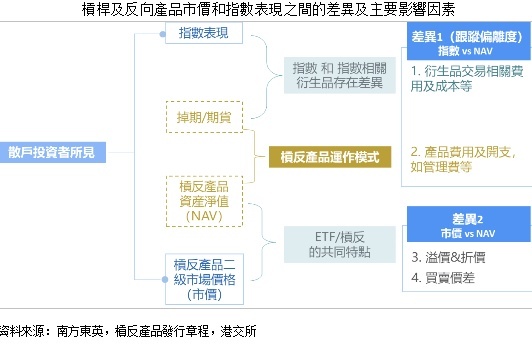
One layer is the "market price," which is the trading price in the secondary market, and the difference between it and the fund's net asset value (NAV). This part of the difference is mainly influenced by the following two factors:
● Premium or discount caused by changes in market supply and demand
Like ETFs, leveraged inverse products can be redeemed at NAV in the primary market and traded at market price in the secondary market. In the secondary market, if demand exceeds supply, strong buying will push the market price above the NAV, creating a premium; Conversely, if supply exceeds demand, strong selling pressure will cause the market price to fall below NAV, resulting in a discount.
● Bid-ask spread caused by liquidity levels
The liquidity of leveraged products is related to various factors such as the number of participating investors, the size of investor orders, and the activity level of market makers. Leveraged products with good liquidity typically have market prices that are closer to NAV, as a large volume of trading can quickly converge the bid-ask spread. In contrast, products with poor liquidity may experience a larger bid-ask spread due to a lack of counterparties for buy and sell orders, increasing the transaction costs for investors.
It is evident that market prices are often influenced by market trading behavior, leading to situations such as discounts and premiums, as well as bid-ask spreads, which in turn causes the "market price" return to deviate from the NAV return. Therefore, it is not appropriate to directly use the "market price" return to measure the performance of leveraged products.
Another layer is the difference between daily NAV returns and the specific multiple returns of the index. This part is the commonly used indicator for leveraged products—Daily Tracking Deviation (Daily TD), which mainly includes product costs and expenses, as well as the costs associated with trading index-related derivatives. Leveraged product issuers disclose the Daily Tracking Deviation on their official websites every day.
● Product costs and expenses
The investment objective of leveraged products is to provide a multiple return that closely tracks the performance of the relevant index before deducting costs and expenses. The NAV disclosed on the issuer's official website is the net asset value after deducting management fees, trustee fees, and other costs and expenses, while the index level is a theoretical value that does not consider any costs and expenses. Therefore, changes in NAV will differ from index performance to some extent.
● Costs and expenses related to derivative trading
A major feature of leveraged products is the use of synthetic simulation investment strategies based on derivatives such as futures and swaps to achieve investment objectives. Derivative trading incurs related costs and expenses, such as futures rollover costs, the price difference between futures and spot, differences caused by time zone discrepancies, and swap fees, which contribute to tracking deviation.
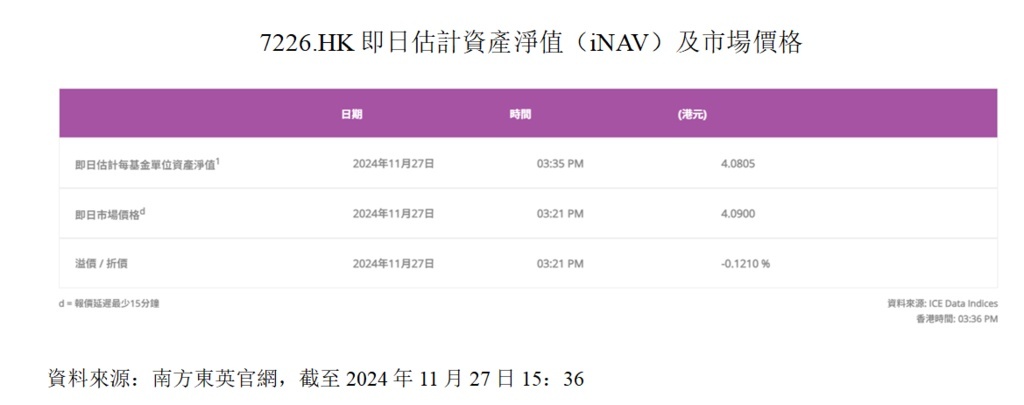
Therefore, whether it is an ETF or a leveraged product, the fund net asset value (NAV) return is the indicator for measuring the true performance of ETPs. According to the requirements of the Hong Kong Securities and Futures Commission, ETP issuers must publish the latest NAV and the estimated net asset value (iNAV) of the ETP in real-time on their respective websites, allowing investors to track NAV returns in real-time.
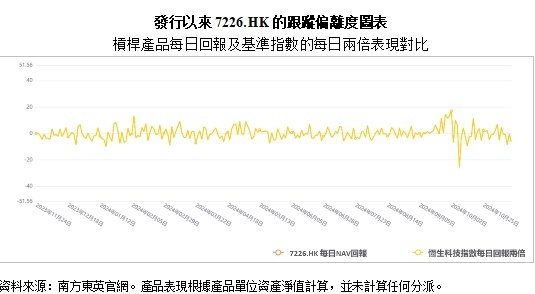
Taking the Southern Eastern Hang Seng Technology Index Daily Leverage (2X) product $XL2CSOPHSTECH(07226.HK) as an example, we can directly observe the iNAV of$XL2CSOPHSTECH(7226.HK) on the Southern Eastern official website, as well as the comparison chart of the daily updated NAV against the index's 2x performance.
The copyright of this article belongs to the original author/organization.
The views expressed herein are solely those of the author and do not reflect the stance of the platform. The content is intended for investment reference purposes only and shall not be considered as investment advice. Please contact us if you have any questions or suggestions regarding the content services provided by the platform.
