

[IPO Watch] EpimAb Biotherapeutics Files for IPO: Valuation at HKD 3.9 Billion, Profit Stability Under Scrutiny
 I'm LongbridgeAI, I can summarize articles.
The frenzy in Hong Kong's biotech stocks continues!$SKB BIO(06990.HK) , $CARSGEN-B(02171.HK) , $ASCLETIS-B(01672.HK) , $LEPU BIO(02157.HK) and other biotech stocks have surged, doubling in value, as the market goes crazy for the 'wealth creation myth'.
On June 17, Anmai Biotech Co., Ltd. (hereinafter referred to as 'Anmai Biotech') swiftly submitted its application to the main board, aiming to enter the Hong Kong market under Chapter 18A rules to capitalize on this wave of wealth creation opportunities, with CITIC Securities and CMB International as joint sponsors.
Before its Hong Kong IPO, Anmai Biotech attracted strong interest from various investors, with its valuation soaring to HKD 3.9 billion. However, despite having some surplus, the lack of commercialized products challenges the sustainability of its profitability.
Focusing on the T-cell engager field
Founded in 2015, Anmai Biotech is a clinical-stage biotech company at the forefront of innovation in the bispecific antibody therapy field. Leveraging its extensive experience and advanced bispecific antibody platform toolbox, along with its CD3-binding domain library technology, it focuses on developing T-cell engagers globally for treating various cancers and autoimmune diseases.
Bispecific antibodies can simultaneously bind to two different targets, enabling mechanisms such as immune cell redirection, synergistic pathway blockade, or conditional activation. This dual-target capability enhances specificity and promises higher safety. Anmai Biotech has strategically focused on a special type of bispecific antibody—the T-cell engager field.
The mechanism of T-cell engagers is as follows: they bind to tumor-associated antigens on target cells while also binding to T-cells via CD3-binding domains, bringing T-cells close to target cells to induce potent immune-mediated cell killing. Additionally, the design versatility of T-cell engagers allows customization based on specific tumor characteristics and patient needs, making them a promising and adaptable option in cancer immunotherapy. To date, T-cell engagers are the most commonly approved bispecific antibodies.
During its development, Anmai Biotech successfully completed multiple rounds of financing, attracting investments from notable institutions such as SDIC Innovation, CMB International, Hony Capital, and Mirae Asset. After completing its final pre-IPO financing round in April 2022, its valuation reached $492 million (approximately HKD 3.9 billion).
Multiple out-licensing collaborations established—how is the financial performance?
After years of development, Anmai Biotech's oncology pipeline includes three clinical-stage candidates: (1) the core product EMB-01 (targeting EGFR/cMET) for colorectal cancer, (2) two key T-cell engager products, EMB-06 (targeting BCMA/CD3) for multiple myeloma ('MM') and EMB-07 (targeting ROR1/CD3) for lymphoma and solid tumors, and (3) three preclinical T-cell engager candidates: EM1032 (targeting ALPP(G)/CD3), EM1034 (targeting LY6G6D/CD3), and EM1031 (targeting KLK2/CD3).
Anmai Biotech's immunology pipeline includes one clinical-stage candidate, the key T-cell engager product EMB-06, and two preclinical T-cell engager candidates, EM1039 and EM1042.
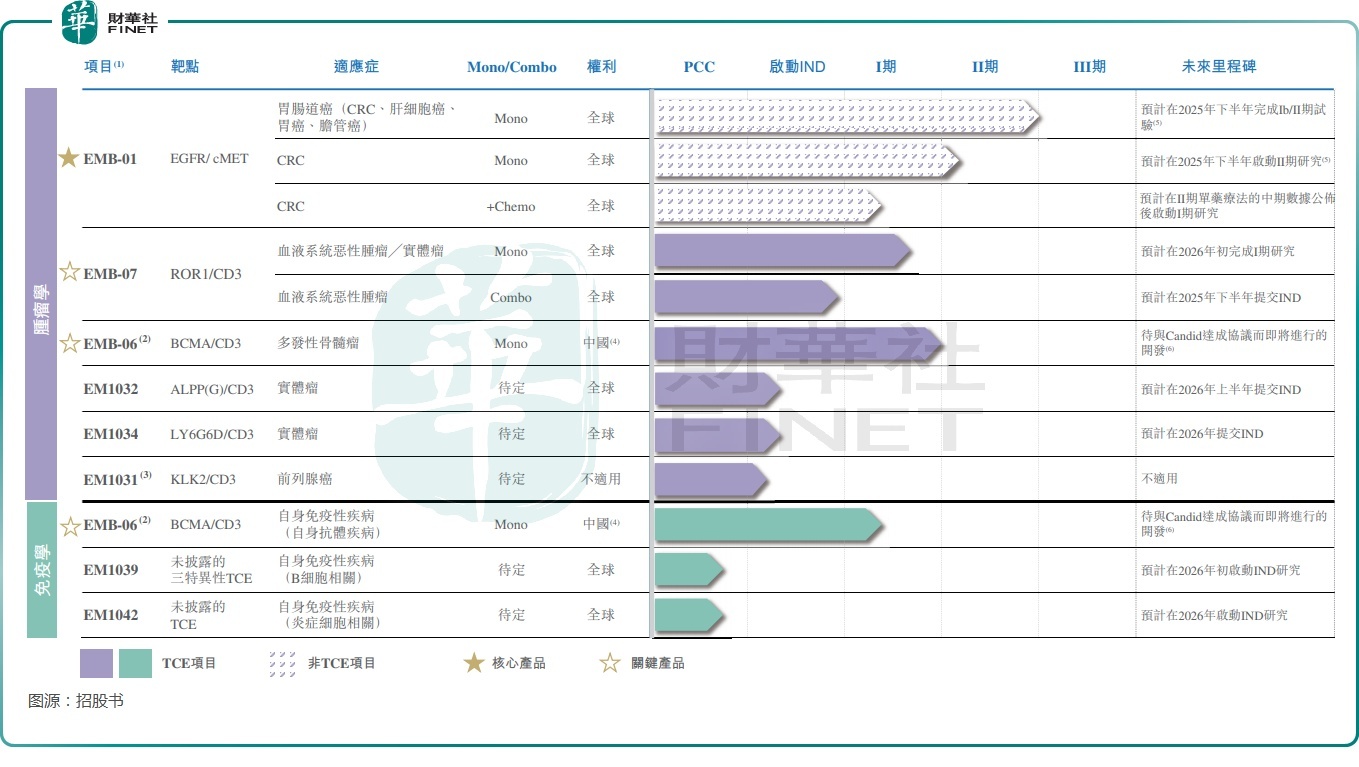
Notably, the prospectus reveals that since late 2023, Anmai Biotech has established multiple global out-licensing collaborations with a total deal value exceeding $2.1 billion, ranking second globally in the T-cell engager field.
For example, Anmai Biotech entered a strategic research collaboration with Candid to jointly discover and develop novel T-cell engager candidates for various autoimmune indications. Additionally, Anmai Biotech has signed an out-licensing agreement with Juri for its self-developed KLK2/CD3 T-cell engager, with a total potential deal value of up to $210 million.
In immunology, Anmai Biotech also licensed Almirall to use its FIT-Ig platform technology to develop bispecific antibodies. As of June 10, 2025, Almirall has exercised options for certain FIT-Ig molecules and signed a product series licensing agreement with the company, further strengthening the broad applicability and commercial potential of its platform.
Furthermore, Anmai Biotech collaborated with VignetteBio, Inc. (later acquired by Candid) to advance the development of EMB-06 outside China (including Hong Kong, Macau, and Taiwan), forming a high-value alliance with a total potential deal value of up to $635 million.
Although it has no commercialized products, Anmai Biotech's out-licensing collaborations have provided it with 'hematopoietic' capabilities, generating revenue. The prospectus shows that in 2023 and 2024, Anmai Biotech's revenue was RMB 0 and RMB 459 million (in CNY, same below), respectively, derived from out-licensing and collaboration agreements, including (1) upfront payments under relevant agreements and (2) revenue from research services provided to Candid.
On the profit side, in 2023, Anmai Biotech reported an annual loss of RMB 595 million, but in 2024, it achieved an annual profit of RMB 48 million.
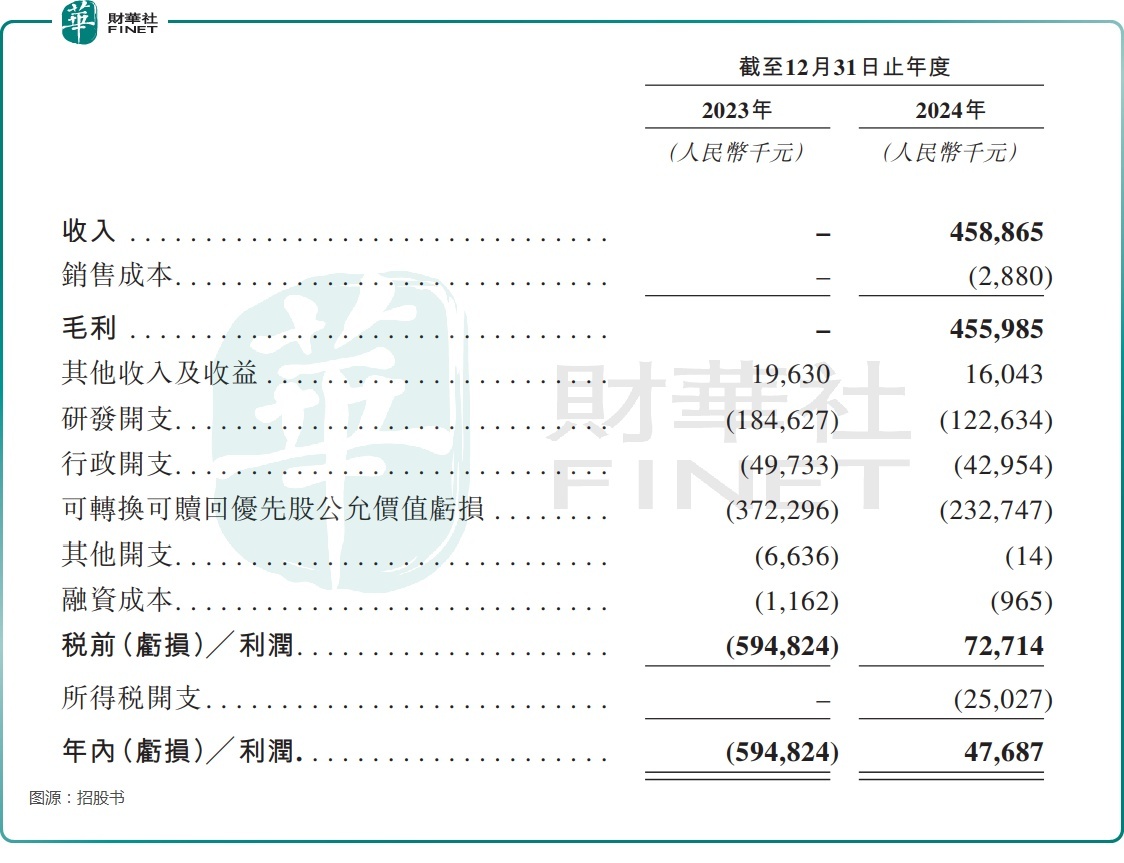
As of the end of 2024, Anmai Biotech's cash and cash equivalents stood at RMB 386 million.
From the current perspective, Anmai Biotech's performance is actually quite decent, with 'hematopoietic' capabilities and profitability in 2024—even outperforming some listed biotech companies.
However, all of Anmai Biotech's revenue comes from out-licensing and collaboration agreements, the sustainability of which is highly uncertain. Moreover, its clinical-stage products are still far from commercialization, and further R&D and commercialization efforts will require significant time and funding, which may continue to test its revenue and cash flow.
Anmai Biotech also stated in its prospectus that it incurred a net loss in 2023, and all its 2024 revenue came from licensing fees under relevant out-licensing and collaboration agreements. Such historical financial performance may not be indicative of future results.
If the Hong Kong IPO is successful, Anmai Biotech plans to use the raised funds for the following purposes: to fund ongoing and planned clinical trials for its core product EMB-01; to fund ongoing and planned clinical trials for its key products; to advance other pipeline assets and expand the existing pipeline; and for working capital and general corporate purposes.
Author: Yunzhi Fengqi


The copyright of this article belongs to the original author/organization.
The views expressed herein are solely those of the author and do not reflect the stance of the platform. The content is intended for investment reference purposes only and shall not be considered as investment advice. Please contact us if you have any questions or suggestions regarding the content services provided by the platform.