

Winners and losers in the Pop Mart capital game - Golden Eagle International clears inventory at low prices, Tencent hesitates and misses the investment
 I'm LongbridgeAI, I can summarize articles.
The previous article detailed all the financing details in Pop Mart's history, and today's article will analyze the investment returns of Pop Mart's pre-IPO investors.
Compared to the financing statistics in the previous article, the statistics in this article are much more challenging. This is because Pop Mart's several rounds of additional share issuance financing were relatively clear and straightforward, while the buying and selling of existing shares outside of additional issuances were far more complex. Including investors who held shares through secondary market purchases, Pop Mart had over 20 shareholders before its IPO.
Due to considerations of complexity and accuracy, a small number of investors' statistics were not included.
First, the data and conclusions:
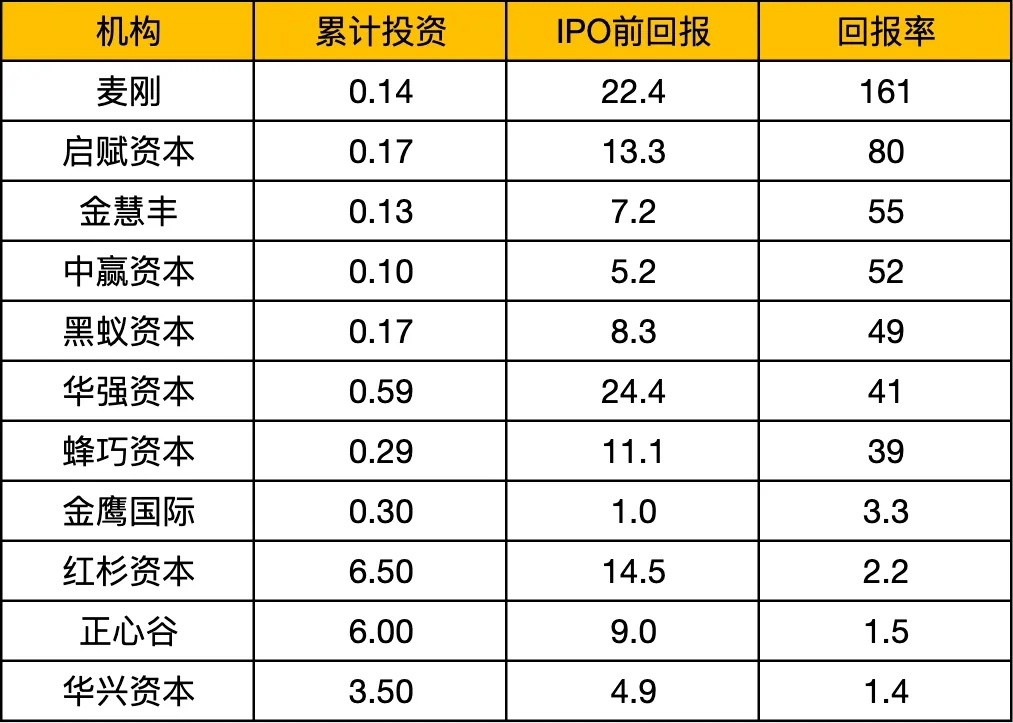
From the chart above, all 11 investors listed made decent profits from Pop Mart. From this perspective, these shareholders were all winners in Pop Mart's capital game.
If we were to name the biggest winner, it would be no doubt Mai Gang. As Pop Mart's first investor, if we calculate based on his initial investment of RMB 2 million in 2012, Mai Gang made roughly 1,000 times his investment before the IPO. Based on the current stock price, his return would be at least 5,000 times.
Although all investors made money, there were clearly some who were disappointed, such as Golden Eagle International, which was likely very regretful.
In 2014, during Pop Mart's Series B financing, Golden Eagle International invested RMB 20 million at a valuation of RMB 100 million, acquiring a 20% stake. In 2015, during the Series C round, it invested another RMB 10 million at a valuation of RMB 336 million, increasing its stake to nearly 21%.
In addition, Golden Eagle International also established a joint venture with Pop Mart, opening 10 to 20 official Pop Mart stores in provinces like Jiangsu.
Logically, as an investor in offline department stores, Golden Eagle not only invested heavily to become Pop Mart's second-largest shareholder but also collaborated with Pop Mart to operate a dozen offline stores. It should have been deeply optimistic about Pop Mart and held onto its shares for a long time.
However, in a dramatic turn of events, in 2017, Golden Eagle International sold nearly half of its stake at a valuation of RMB 430 million, cashing out RMB 35 million. In 2019, the year before Pop Mart's IPO, it sold its remaining shares at a valuation of RMB 1 billion, cashing out RMB 95 million.
At its peak, Golden Eagle held a 21% stake. If it had held onto these shares until the IPO, it would have owned roughly 200 million shares, worth approximately RMB 7 billion, with a return of nearly RMB 7 billion—a 200-fold return. Unfortunately, it sold early at a low price, resulting in a total return of only RMB 100 million, a mere 3.3-fold return.
Looking at Pop Mart's growth and valuation today, it's no exaggeration to say that Golden Eagle International missed out on Pop Mart, just like Richard Li missed out on Tencent back in the day.
According to online sources, the investment in Pop Mart was made by Golden Eagle International's professional manager Su Kai. The actual controller of Golden Eagle didn't fully understand Pop Mart, and the decision to exit was made by the controller. Presumably, Golden Eagle now deeply regrets this investment exit.
Another company that didn't invest in Pop Mart—while not necessarily disappointed—was at least regretful: Tencent. Before Pop Mart's IPO, Tencent had almost finalized its investment share. However, because Tencent wanted veto power, Wang Ning refused. While Tencent hesitated, Sequoia Capital, Huaxing Capital, and ZhenFund quickly stepped in to finalize the investment, leaving Tencent out of the picture...
Given Tencent's style, when it invests in a company it believes in, its stake is usually substantial, and it holds for a long time. If Tencent had entered, its return on this deal would likely have been in the tens of billions. What a shame... quite regrettable.
After summarizing the data and results, let's delve into the investment and exit journeys of these institutions in detail.
First, institutions that entered through Pop Mart's additional share issuance financing:
1. Mai Gang:
Mai Gang is an unavoidable figure among Pop Mart's investors. His investment in Pop Mart cemented his status in the venture capital circle. In 2012, during Pop Mart's first round of financing, Mai Gang invested RMB 2 million at a valuation of RMB 12.5 million, acquiring a 16% stake.
In 2013, during Pop Mart's second round of financing, Mai Gang sold a 4% stake to Mochi Mountain Ventures at a valuation of RMB 100 million, cashing out RMB 4 million.
In 2018, Mai Gang sold Pop Mart shares at a valuation of RMB 1 billion, cashing out RMB 10.17 million. That same year, Future Innovation, managed by Mai Gang, bought RMB 11.87 million worth of Pop Mart shares at a valuation of RMB 800 million.
In 2019, Mai Gang cashed out RMB 4.4 million. In March 2020, he sold shares to Vision Plus Capital at a valuation of USD 2.36 billion, cashing out USD 10 million.
In total, Mai Gang and Future Innovation invested RMB 13.87 million in Pop Mart, cashed out roughly RMB 80 million before the IPO, and still held 62.69 million shares before the IPO. At the IPO price of HKD 38.5, the stake was worth HKD 2.41 billion.
Cumulative investment: RMB 13.87 million. Cash-out + remaining stake value: ~RMB 2.25 billion. At the IPO, Mai Gang's return was 160-fold.
2. Qifu Capital:
Qifu Capital was another key investor in Pop Mart and the second investor after Mai Gang. Tu Zheng, who handled this deal for Qifu Capital, left in 2018 to establish Fengqiao Capital and later invested in Pop Mart.
In 2013, during the Series A round, Qifu Capital invested RMB 6 million at a valuation of RMB 80 million, acquiring a 7.5% stake.
In 2014, during the Series B round, Qifu Capital bought a 5.6% stake from Mai Gang and Wang Ning at a valuation of RMB 100 million, spending RMB 5.6 million.
In 2015, during the Series C round, Qifu Capital invested RMB 5 million at a valuation of RMB 336 million, increasing its stake to 11.85%.
In 2017, Qifu Capital sold shares at a valuation of RMB 500 million, cashing out RMB 17.58 million.
In 2019, it sold shares at a valuation of RMB 1 billion, cashing out RMB 31.18 million.
In 2019, it sold shares to Sequoia at a valuation of RMB 7.5 billion, cashing out RMB 15 million.
In total, Qifu Capital invested RMB 16.6 million in Pop Mart, cashed out RMB 63.76 million before the IPO, and held 37.03 million shares before the IPO. At the IPO price of HKD 38.5, the stake was worth ~RMB 1.28 billion.
Cumulative investment: RMB 16.6 million. Cash-out + remaining stake value: ~RMB 1.35 billion. At the IPO, Qifu Capital's return was ~80-fold.
Note: Mochi Mountain Ventures, an early investor in Pop Mart, was managed by Qifu Capital but later became independent. Here, Mochi Mountain and Qifu Capital's investments and returns are combined.
3. Golden Eagle International
Golden Eagle International operates many department stores in Jiangsu. It was not only Pop Mart's largest external investor in its early days but also established a joint venture with Pop Mart to manage offline operations in several provinces, including Jiangsu. The investment was led by Golden Eagle's then-CEO Su Kai, who later left to join Sequoia Capital and facilitated Sequoia's investment in Pop Mart.
In 2014, during the Series B round, Golden Eagle invested RMB 19.9 million at a valuation of RMB 100 million, acquiring a 19.9% stake.
In 2015, during the Series C round, it invested another RMB 10 million at a valuation of RMB 336 million, increasing its stake to 20.74%.
In 2017, Golden Eagle sold ~8% of its stake to Wang Ning and Pop Mart's management at a valuation of RMB 430 million, cashing out RMB 35.36 million.
In 2019, it sold its remaining shares at a valuation of RMB 1 billion, cashing out RMB 94.59 million.
In total, Golden Eagle invested RMB 29.9 million and cashed out RMB 130 million, a 3.4-fold return.
4. Jinhui Feng
In 2015, during the Series C round, it invested RMB 8 million at a valuation of RMB 336 million, acquiring a 2.38% stake.
In 2016, during the Series D round, it invested RMB 5 million at a valuation of RMB 400 million, increasing its stake to 3.25%.
In 2019, it cashed out RMB 1.53 million at a valuation of RMB 1 billion.
In 2019, it cashed out USD 14.04 million at a valuation of USD 1.33 billion.
In 2020, it cashed out USD 12.5 million at a valuation of USD 2.36 billion.
In total, Jinhui Feng invested RMB 13 million in Pop Mart, cashed out ~RMB 190 million before the IPO, and held 15.45 million shares before the IPO. At the IPO price of HKD 38.5, the stake was worth ~RMB 540 million.
Cumulative investment: RMB 13 million. Cash-out + remaining stake value: ~RMB 730 million. At the IPO, Jinhui Feng's return was ~55-fold.
5. Huaqiang Investment
According to a previous 36kr article, Huaqiang Investment was an LP of Qifu Capital. When Pop Mart faced financing difficulties, Qifu Capital introduced Huaqiang Investment to invest in Pop Mart.
In 2016, during the Series D round, Huaqiang invested RMB 10 million at a valuation of RMB 400 million, acquiring a 2.5% stake.
In 2017, it spent RMB 9.15 million to buy Pop Mart shares at a valuation of RMB 500 million, increasing its stake to 4.14%.
In 2018, during the Series E round, it invested RMB 40 million to subscribe to new shares at a valuation of RMB 740 million, increasing its stake to 9.32%.
In 2019, it sold part of its stake at a valuation of RMB 1 billion, cashing out RMB 4.66 million.
In 2019, it sold part of its stake to Sequoia at a valuation of USD 2 billion, cashing out USD 80 million.
In total, Huaqiang Investment invested RMB 59.15 million in Pop Mart, cashed out ~RMB 560 million before the IPO, and held 56.09 million shares before the IPO. At the IPO price of HKD 38.5, the stake was worth ~RMB 1.94 billion.
Cumulative investment: RMB 59.15 million. Cash-out + remaining stake value: ~RMB 2.5 billion. At the IPO, Huaqiang Investment's return was ~40-fold.
6. Zhongying Investment
In 2016, during the Series D round, it invested RMB 10 million at a valuation of RMB 400 million, acquiring a 2.5% stake.
In 2019, it sold part of its stake at a valuation of RMB 1 billion, cashing out RMB 1.09 million.
In 2019, it sold part of its stake to Wang Ning at a valuation of USD 1.3 billion, cashing out USD 13.34 million.
In total, Zhongying Investment invested RMB 10 million in Pop Mart, cashed out ~RMB 95 million before the IPO, and held 12.45 million shares before the IPO. At the IPO price of HKD 38.5, the stake was worth ~RMB 430 million.
Cumulative investment: RMB 10 million. Cash-out + remaining stake value: ~RMB 530 million. At the IPO, Zhongying Investment's return was ~52-fold.
The above institutions entered as shareholders through Pop Mart's new share issuance.
Next, institutions that entered through secondary market transactions:
1. Sequoia Capital
After Su Kai, former CEO of Golden Eagle International, left, he joined Sequoia Capital and facilitated a meeting between Neil Shen and Wang Ning. Sequoia decisively bought shares at a high price a year before the IPO, becoming the second-largest shareholder after Wang Ning.
In 2019, Sequoia bought USD 80 million worth of shares from Huaqiang Investment at a valuation of USD 2 billion.
In 2019, it bought RMB 94 million worth of shares from other institutions at a valuation of RMB 7.5 billion.
Before the IPO, Sequoia held 60.61 million shares, a 4.87% stake, making it the second-largest shareholder after Wang Ning. At the IPO price of HKD 38.5, the stake was worth ~RMB 2.1 billion. Total investment cost: ~RMB 650 million. Return: 2.2-fold.
2. ZhenFund
In 2020, ZhenFund bought new and existing shares at a valuation of USD 2.36 billion, spending USD 87.5 million in total for a 3.43% stake.
Before the IPO, it held 42.75 million shares. At the IPO price of HKD 38.5, the stake was worth ~RMB 1.5 billion. Total investment cost: ~RMB 600 million. Return: 1.5-fold.
3. Huaxing Capital
In 2020, Huaxing Capital bought shares at a valuation of USD 2.363 billion, spending USD 49.5 million in total for a 1.94% stake.
Before the IPO, it held 24.18 million shares. At the IPO price of HKD 38.5, the stake was worth ~RMB 840 million. Total investment cost: ~RMB 350 million. Return: 1.4-fold.
4. Fengqiao Capital
In 2018, Tu Zheng left Qifu Capital to establish Fengqiao Capital and later invested in Pop Mart.
In 2019, Fengqiao bought RMB 28.5 million worth of shares at a valuation of RMB 1 billion, acquiring a 2.85% stake.
Before the IPO, it held 32.91 million shares. At the IPO price of HKD 38.5, the stake was worth ~RMB 1.14 billion. Total investment cost: RMB 28.5 million. Return: ~40-fold.
5. Black Ant Capital
In 2018, during the Series E round, it spent RMB 12 million to buy shares at a valuation of RMB 800 million, acquiring a 1.5% stake.
It also participated in Pop Mart's management partnership Tianjin Paqu, but the exact investment cost is unclear (estimated at ~RMB 5 million).
In 2019, it sold shares to Sequoia at a valuation of RMB 7.5 billion, cashing out RMB 22.5 million.
Before the IPO, it held 21.63 million shares. At the IPO price of HKD 38.5, the stake was worth ~RMB 830 million. Including the cash-out of RMB 22.5 million, the total was ~RMB 850 million. Total investment cost: ~RMB 17 million. Return: ~50-fold.
The above covers the investment and return data of Pop Mart's core pre-IPO shareholders. There are a few other major shareholders, but due to the complexity of secondary market transactions and frequent internal changes, their statistics are omitted here.$POP MART(09992.HK) $TENCENT(00700.HK)




The copyright of this article belongs to the original author/organization.
The views expressed herein are solely those of the author and do not reflect the stance of the platform. The content is intended for investment reference purposes only and shall not be considered as investment advice. Please contact us if you have any questions or suggestions regarding the content services provided by the platform.