

如果拼多多的现金淹没过脖子,你怕吗?
 I'm LongbridgeAI, I can summarize articles.
Hello everyone, I'm Jack.
I'm doing something foolish: writing about all the S&P 500 component companies in order of their founding.
Steve Jobs once said: "In the end, everything comes down to taste."
Taste is the ability to recognize excellence. In the world of investing, this taste first points to the ability to understand business models. As Buffett emphasizes, evaluating a company must begin with its business model. Only by truly "seeing" can one perceive what excellence is, and taste can form standards through insight.
Buffett's method is extremely simple: turn every page. He once read thousands of pages of the "Moody's Manual" twice, leaving no corner untouched. When Munger was surprised by his familiarity with a small California company, the answer remained—he had already "turned that page."
Therefore, we choose to start with the S&P 500. Turning every page is the first step in building taste.
This is a marathon about "value" and an upgrade in cognition.
I recommend following first, then reading. Let's dive deep together.
So far, I've reintroduced you to:
-Main Text-
Summary: When a company's market cap drops to the point where, in a few years, the cash on its books could buy the entire company, should you be greedy or fearful? Pinduoduo, the outlier of the internet world, is testing the faith of all value investors with an almost cruel silence.
If we compare a company to a room, market cap is the ceiling, and cash is the water constantly filling the room.
In most companies, the water level is usually maintained at ankle height—healthy and safe. For companies like Apple, when the water reaches the knees, Cook quickly grabs a ladle (buybacks) to scoop the water out and distribute it to shareholders, afraid that people will think capital utilization is low.
But Pinduoduo (PDD) is an exception.
As of Q3 2025, the company's market cap is about $166.3 billion. The cash and equivalents on its books are $59.5 billion (over 400 billion RMB), rising at a terrifying rate ($5.5 billion increase from Q2 to Q3). The water has already submerged the knees and is approaching the waist.
At its current profit rate—nearly 30 billion RMB in net profit per quarter ($4.119 billion in Q3 2025), with no dividends, no buybacks, and minimal capital expenditures—in just a few years (maybe less than five), the water in this room will submerge the neck.
This is an extremely rare sight in business history: a tech giant in its prime, clearly owning a money-printing machine, yet locking the door tight, letting cash pile up inside like a mountain, turning a blind eye to shareholders knocking on the door with bowls for dividends.
Will Pinduoduo become the fattest "cigar butt" in Buffett's eyes (out of respect for its dazzling performance, it should be called the "Ultra-Luxury Cigar Big Butt"), or is it an "infinite game" set up by Huang Zheng?
01
The Ultimate "Tyrant": Who Is Pinduoduo's God?
If Pinduoduo's cash submerges your neck, are you scared?
Original by JackNong Gui Zhuang YaoDecember 10, 2025, 16:28 Shanghai 28 people
Hello everyone, I'm Jack.
I'm doing something foolish: writing about the long-lived companies in the S&P 500 in order of their founding.
Time is the most merciless judge and the fairest coronator in the business world.
From 18th-century canals and flour mills to 19th-century railroads and steel, to 20th-century consumer goods and oil, and finally to 21st-century Silicon Valley chips. This isn't just a list of the S&P 500; it's a living history of capitalist evolution.
What we're looking for are the business secrets of those that have survived wars and depressions, truly possessing "antifragile" genes. Cutting through the fog of finance, we'll touch the pulse of industry, seeing how they've built moats against time over a century of storms.
This is a marathon about "value" and an upgrade in cognition. I recommend following first, then reading. Pick up this scalpel for dissecting business, and let's start with the oldest stories—now, let's go.
So far, I've reintroduced you to:
【3】McKesson 1833【4】John Deere 1837
-Main Text-
Summary: When a company's market cap drops to the point where, in a few years, the cash on its books could buy the entire company, should you be greedy or fearful? Pinduoduo, the outlier of the internet world, is testing the faith of all value investors with an almost cruel silence.
If we compare a company to a room, market cap is the ceiling, and cash is the water constantly filling the room.
In most companies, the water level is usually maintained at ankle height—healthy and safe. For companies like Apple, when the water reaches the knees, Cook quickly grabs a ladle (buybacks) to scoop the water out and distribute it to shareholders, afraid that people will think capital utilization is low.
But Pinduoduo (PDD) is an exception.
As of Q3 2025, the company's market cap is about $166.3 billion. The cash and equivalents on its books are $59.5 billion (over 400 billion RMB), rising at a terrifying rate ($5.5 billion increase from Q2 to Q3). The water has already submerged the knees and is approaching the waist.
At its current profit rate—nearly 30 billion RMB in net profit per quarter ($4.119 billion in Q3 2025), with no dividends, no buybacks, and minimal capital expenditures—in just a few years (maybe less than five), the water in this room will submerge the neck.
This is an extremely rare sight in business history: a tech giant in its prime, clearly owning a money-printing machine, yet locking the door tight, letting cash pile up inside like a mountain, turning a blind eye to shareholders knocking on the door with bowls for dividends.
Will Pinduoduo become the fattest "cigar butt" in Buffett's eyes (out of respect for its dazzling performance, it should be called the "Ultra-Luxury Cigar Big Butt"), or is it an "infinite game" set up by Huang Zheng?
01
The Ultimate "Tyrant": Who Is Pinduoduo's God?
To understand where Pinduoduo's cash flow comes from, you must first understand its soul.
Many ask me: Is Pinduoduo a consumer-oriented company?
My answer: It's not consumer-oriented; it's "consumer-dictated."
In Amazon's flywheel, Bezos still balances merchants and users. But in Pinduoduo's algorithm, the scale is completely tilted.
Pinduoduo's business logic is essentially a "tax and redistribution based on traffic allocation rights."
It doesn't own the goods, doesn't handle delivery (domestic main site), it controls one thing: the display space on the screen. It tells merchants: "I have 800 million users who want cheap stuff. Want traffic? Simple—offer the lowest price online. Whoever's cheapest gets the C-spot."
To please consumers, Pinduoduo invented the merchant-terrifying "refund-only" policy. It's ethically controversial but a nuclear weapon in efficiency. It drastically lowers consumer decision costs—dare to buy on Pinduoduo because you're not afraid of being scammed; the platform will blindly side with consumers.
This creates a bizarre ecosystem: merchants on Pinduoduo live like players in a battle royale game, all racing to the bottom on price, shrinking the "toxic circle." Only the fiercest, most cost-controlled merchants survive.
So when you see Q3 earnings with revenue growth slowing to 9% but net margins still at a high 27% (could've been higher), don't be surprised. It's because it's collecting "tolls," while the costs of building the road (logistics), making the cars (production), and even after-sales (refund-only) are borne by merchants. Pinduoduo then reinvests the collected money to enhance consumer experience, maintaining the ecosystem. The more people use this road, the more tolls it can collect, and the better the road can be maintained and expanded.
Sound like taxation?
Pinduoduo's ecosystem essentially squeezes out unnecessary middlemen and inefficiencies in the supply chain through extreme internal competition. With higher platform efficiency (lower costs than competitors), it achieves "goods finding people." Merchants may grumble, but how many actually quit?
Part of the ad revenue is returned to consumers—that's the "billion subsidies, trillion support" we see.
That's why its cash flow is so good—it's extremely stingy with itself (rented offices, computers), extremely harsh on merchants (fines at the drop of a hat), and extremely indulgent with consumers (refund-only, no-reason returns, negative experience compensation).
02
The Silent Reservoir: What Does It Want?
Let's return to the "water level" question.
The market is extremely pessimistic now. In December 2025, Pinduoduo's market cap is $166.3 billion (~1.2 trillion RMB). Excluding liabilities like merchant payments, the free cash truly belonging to shareholders may be close to $35-40 billion.
This means the market's enterprise value is just over $120 billion.
Even if we assume zero growth, this company can stably generate $12-15 billion in real cash annually.
Ex-cash P/E is in the single digits.
In value investing textbooks, this is "deep value." In reality, it's "uncertainty discount."
Pinduoduo's management is the most secretive and "coldest" among China's internet giants.
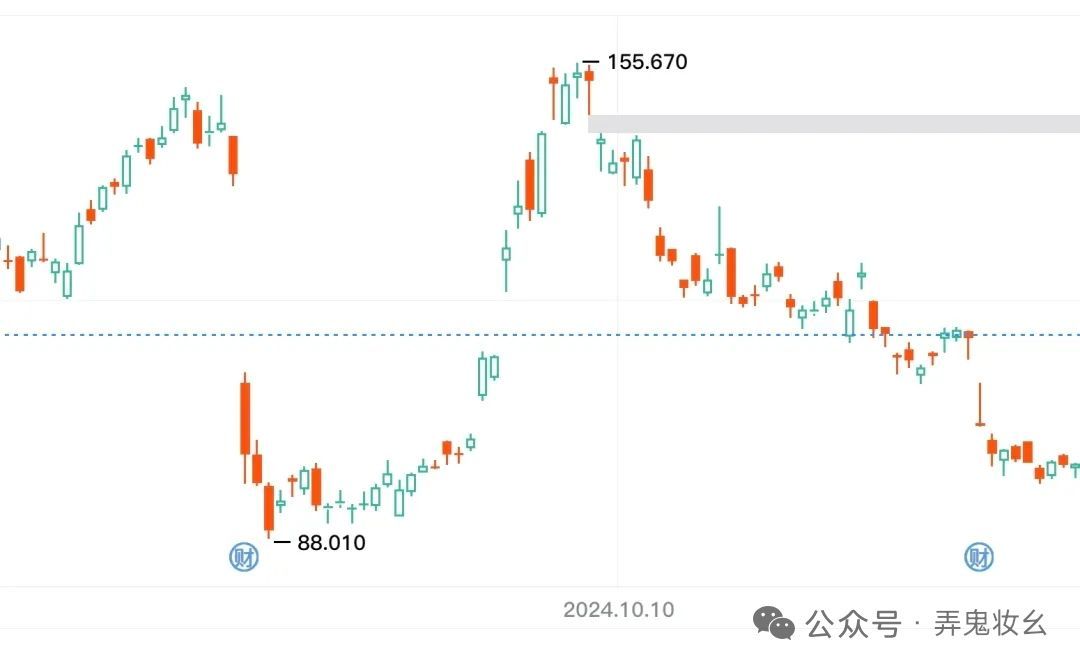
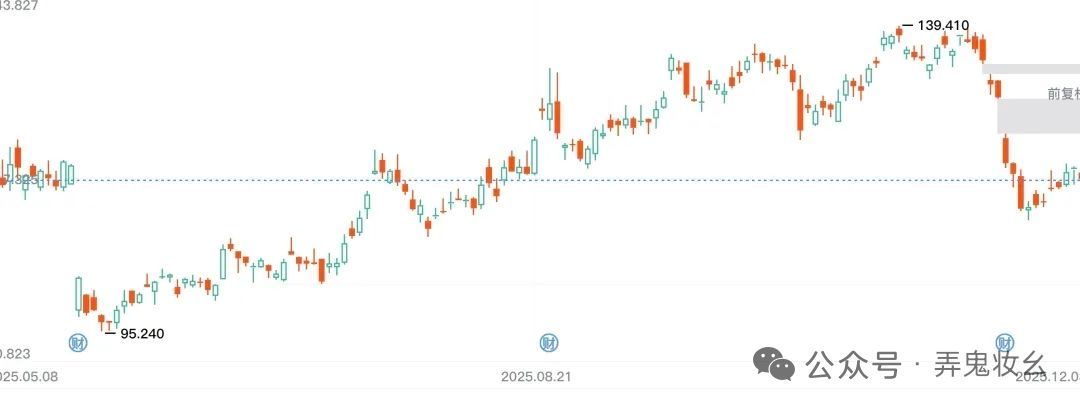
Better earnings, lower stock prices. Especially on earnings call days.
Every quarter, the most familiar part is the risk warnings:
"Growth slowdown is inevitable"
"Profit levels are unsustainable"
"This quarter's record profits don't represent the future."
At first, this caused stock crashes—last year, it fell 45% at one point. After a few rounds, investors became desensitized: pre-market pop on earnings, slight dip during the call as a courtesy.
As shown:
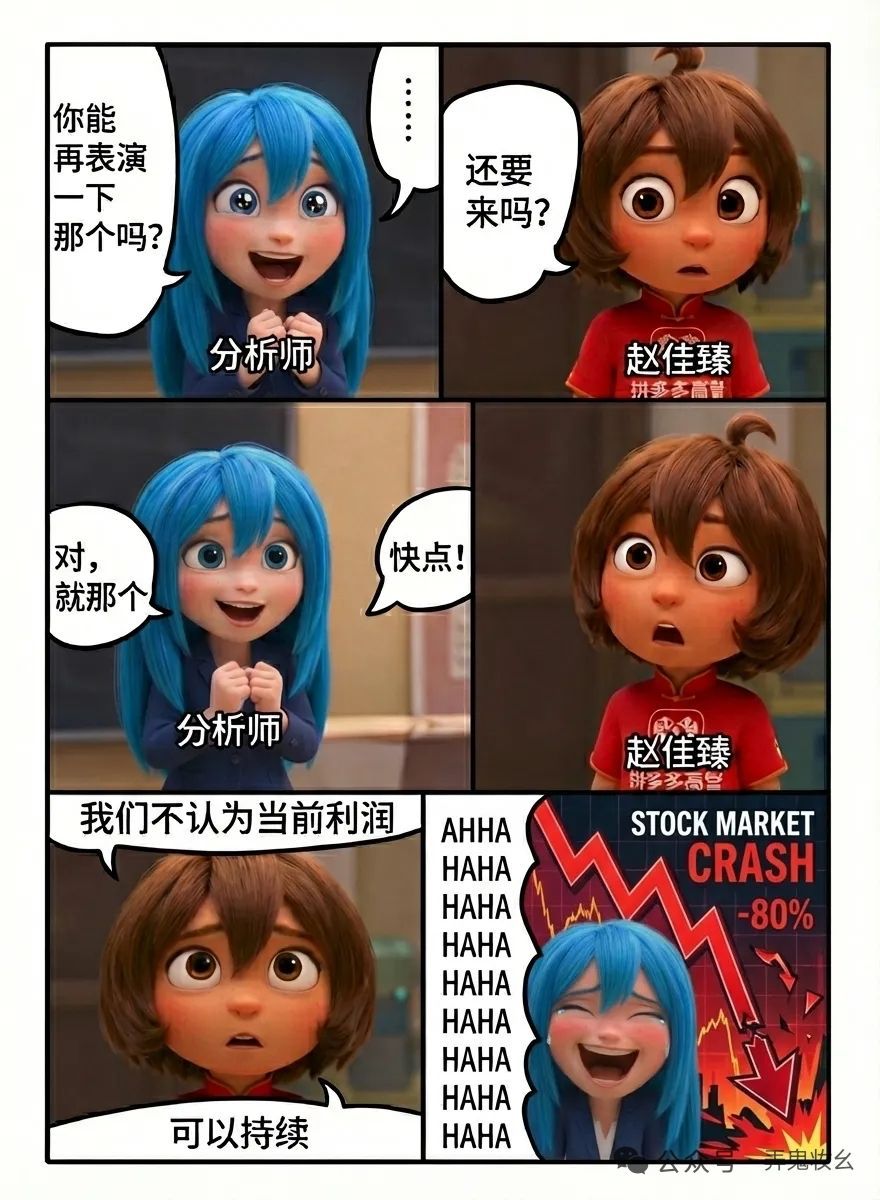
Wrong image,,,
Correct image:
What are they waiting for?
Two possibilities:
Script A: The pessimist's stockpile. Management believes geopolitics (Temu's tariff risks) and domestic competition (Douyin e-commerce's fierce growth) will make the future tough. This cash is winter coats, war provisions. If so, the low valuation is justified, expecting profit crashes ahead.
Script B: The strategist's ambush. Huang Zheng's team never thinks short-term. Influenced by Duan Yongping, they believe in "daring to be last." They hoard cash because today's low stock price isn't low enough to make "going private" or "big buybacks" better than "new ventures." Or they're brewing something big—maybe agri-chain transformation, maybe global supply chain reshaping.
Remember, Berkshire Hathaway doesn't pay dividends. Buffett keeps cash because he thinks it compounds better with him than with shareholders.
Pinduoduo's management clearly thinks: Money is more useful in their hands than yours.
03
Temu: The Veiled Second Growth Curve
Many still debate whether Temu makes money overseas.
2025 Q3 earnings reveal a fact: Transaction Services revenue has surpassed ad revenue. Temu's volume is so huge it's reshaping the group's income structure. Note: Temu's merchant fees include cross-border logistics, warehousing, fulfillment—hard costs. Compared to ads' fat margins, this segment's margins are thin, possibly negative (management won't say).
But as 2025 欧美 tightens "de minimis" exemptions, Temu's "direct-from-China tax-free free-shipping" story changes.
If tariff perks vanish, Temu must warehouse and tax in the US like Amazon. Can it stay cheap?
My take: Treat Temu as a free lottery ticket.
At current valuation, you're buying "discounted premium Pinduoduo domestic" + "a pile of cash." Temu's success should be valued at 0. If it wins, it's a Davis double; if geopolitics zeroes it, domestic biz remains a billion-RMB money printer.
04
Epilogue
When Water Submerges Your Neck, What Do You Fear? Making Money?
Investing in Pinduoduo is a lonely journey.
You endure wild stock swings, "consumption downgrade" mockery, and management's "take it or leave it" arrogance.
But business ultimately reverts to common sense.
When water submerges the neck, even the head, only two outcomes:
Either the house collapses (business model implodes, market rejects),
Or when waters recede, you're sitting on a gold mountain.
For this company, one word: If it keeps domestic share, every dip now is another rock on the spring.
Not for the faint-hearted, but for those who truly get "stocks are companies."
If this article gave you new perspective on Pinduoduo, like, comment, share.
The End—Qin Wang Rao Zhu Zou
This article was produced by an ordinary netizen using modern methods, with major contributions from Gemini.
-END-
Hello everyone, I'm Jack.
I'm writing about S&P 500 components in order of founding.
Why?
Because time is business's harshest judge and fairest coronator.
This series follows the Lindy Effect—for things that don't die naturally (tech, ideas, companies), the longer they've existed, the longer they likely will.
We're dissecting not price swings but business "bones" and "muscles." I've excluded Financials and Utilities.
Why? Banks/insurers are black boxes—leverage is their oxygen and poison. Utilities are stable but rely on licenses/regulation, lacking free-market grit. We want "non-financial entities" that survived brutal competition.
Writing chronologically reveals a panorama:
From 18th-century canals/flour mills to 19th-century rails/steel, 20th-century consumer goods/oil, 21st-century chips. Not just an S&P 500 list—a living capitalist evolution.
In this journey, we'll seek "built-to-last" secrets, answering:
Cycle-proof genes: How some survived Civil War, Depression, two World Wars, dot-com bubble? How did they "turn elephants" amid tech waves?
Moat essence: Unrivaled scale? Inflation-proof brand mindsets? High switching costs? We'll peel financials to see underlying edges.
Business first principles: Whether selling drugs, soda, or software, good biz logic is universal. We'll extract "unchanging" truths from centenarians.
Some call the S&P 500 "Blue Star Beta," Earth's economic growth average. To me, these 500 companies hold humanity's collaborative wisdom.
This is a marathon. If you believe in "getting rich slowly," if you're obsessively curious about "good businesses," follow me. We start with the oldest—now, let's go.
Completed:
【1】Colgate-Palmolive 1806: My Worthless Dog Eats Pricier Food Than Me, Wall Street Laughs Madly
【4】Deere & Company 1837: Wheeled Robots Before Tesla? A 188-Year-Old Tractor Company?
【5】P&G 1837: The 黄埔军校 of Global Business Leaders, Costco's Biggest Victim?
【6】Stanley Black & Decker 1843: Car Burned, Ice in Thermos Didn't Melt...And It's True (Part 1)
$PDD(PDD.US)


The copyright of this article belongs to the original author/organization.
The views expressed herein are solely those of the author and do not reflect the stance of the platform. The content is intended for investment reference purposes only and shall not be considered as investment advice. Please contact us if you have any questions or suggestions regarding the content services provided by the platform.