
XtalPi × SigTuple × Yaosu: Assessing the Certainty of AI Drug Discovery from the FDA's One-Year Report
 I'm LongbridgeAI, I can summarize articles.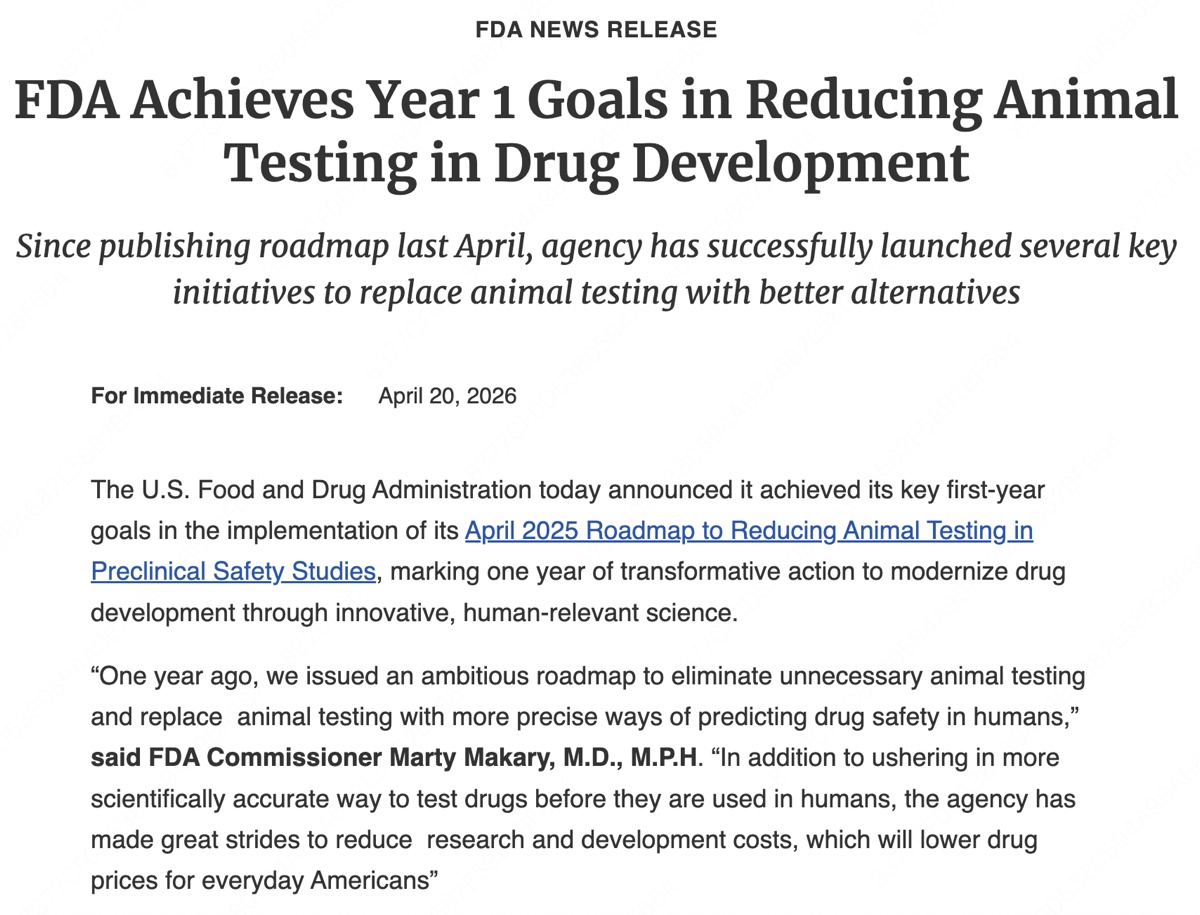
I. Key Events
• On April 20th, the U.S. Food and Drug Administration (FDA) released an official report and statement, reviewing the progress made since the FDA issued the "Roadmap for Reducing Animal Testing in Preclinical Safety Studies" in April 2025;
• The report confirmed that the FDA has completed all first-year goals as scheduled, including publishing draft guidance for waiving non-human primate (NHP) experiments and establishing a validation framework for New Approach Methodologies (NAMs);
• Dr. Marty Makary, the current FDA Commissioner, emphasized at the press conference that traditional animal models have a failure rate as high as 90% in predicting human clinical responses (i.e., "translational gap");
• It was explicitly stated that NAMs (such as organoids, organ-on-a-chip, AI simulations) are not only an ethical choice but also aim to build a scientific system more aligned with human physiology, thereby reducing final drug prices by lowering R&D costs.
II. Xigene Biotech: Organoid-driven
• Direct benefit: In traditional new drug development, the probability of cancer drugs being effective in mice but ineffective in humans is extremely high (low translation rate). Xigene Biotech utilizes patient-derived organoids (PDOs) for high-throughput screening;
• Policy dividend: As the FDA accepts NAMs as alternatives to animal testing, the efficacy and toxicology data generated by Xigene Biotech based on organoids will gain higher regulatory acceptance;
• Progress: Its first targeted drug for diffuse gastric cancer, SIGX1094, was discovered and advanced precisely through the "AI + organoid" platform. The FDA's roadmap will significantly shorten the approval cycle for such drugs from preclinical to IND.
III. Yaosu Technology: Organ-on-a-chip-driven
• Direct benefit: Organ-on-a-chip is considered the best method to replace animal testing for toxicity evaluation. It can simulate the microenvironment of human organs (e.g., blood flow pressure, multi-cell interactions);
• Policy dividend: The "reconstruction of the safety evaluation system" mentioned by the FDA Commissioner is centered on promoting this chip technology that can accurately predict human toxicity. Yaosu Technology's platform directly corresponds to the goal of "reducing safety evaluation costs" in the roadmap;
• Competitive advantage: As the industry shifts from animal testing to new methodologies, Yaosu Technology's underlying technology platform, which possesses automated high-throughput validation capabilities, will transform from a "niche laboratory technique" into "essential infrastructure" for pharmaceutical companies.
Recording thoughts: As a cutting-edge regulatory development, drug review is undergoing a paradigm shift from "animal testing is king" to "human biology data-driven." For Jingtai Holdings and its incubated companies, application costs will be significantly reduced, success rates will be greatly improved, and when a mature AI+NAMs digital R&D closed-loop is established, industry barriers will become apparent.
$XTALPI(02228.HK)

The copyright of this article belongs to the original author/organization.
The views expressed herein are solely those of the author and do not reflect the stance of the platform. The content is intended for investment reference purposes only and shall not be considered as investment advice. Please contact us if you have any questions or suggestions regarding the content services provided by the platform.