
A tiny capacitor, choking AI's neck
 I'm LongbridgeAI, I can summarize articles.
Everyone knows the most expensive component in an AI server is the GPU. But how many tiny capacitors, smaller than a fingernail, need to be crammed into a next-generation GPU rack? The answer is forty to sixty thousand.
These are MLCCs (Multi-Layer Ceramic Capacitors), the most inconspicuous yet indispensable "rice" of the electronics industry. A phone has hundreds, a car has tens of thousands, and an AI server directly requires tens of thousands. The current absurdity is this: no matter how expensive GPUs are, NVIDIA can make them; but this tiny capacitor worth a few cents has recently become the bottleneck strangling AI development.

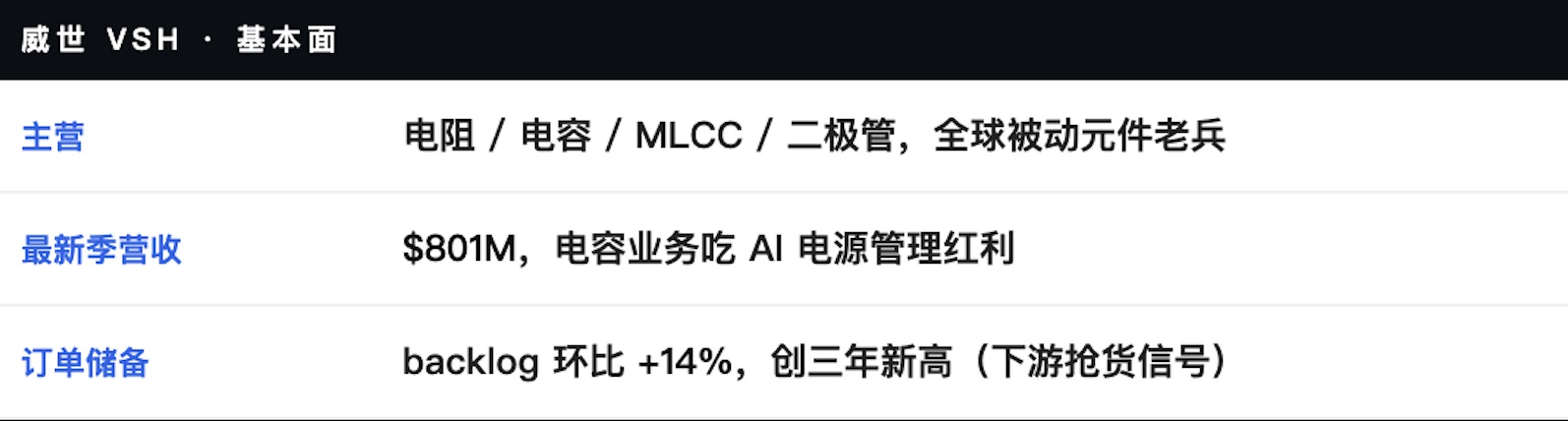
$Vishay Intertech(VSH.US) makes a living from this. Founded in the US in 1962, the company started with resistors and is a veteran in global passive components—it makes resistors, capacitors, diodes, you name it. Its revenue last quarter was $801M, and more critically, its order backlog increased nearly 14% quarter-over-quarter, hitting a three-year high—this likely indicates downstream customers are scrambling for goods, stockpiling in advance, and pushing orders onto it.
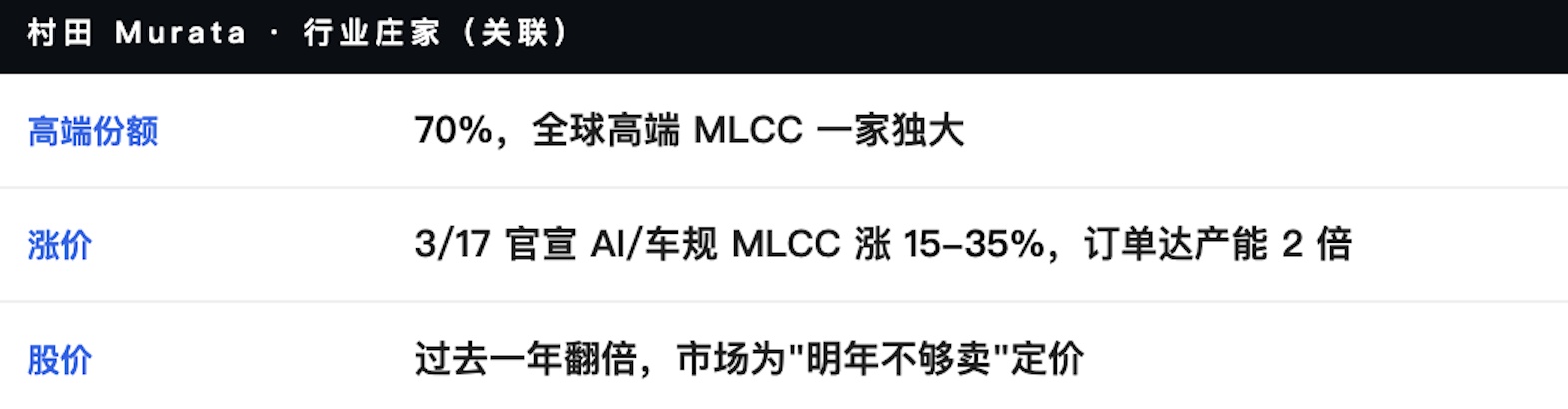
But the true king of passive components is Japan's $Murata Manufacturing(MRAAY.US). It alone holds a 70% share of the global high-end MLCC market. Any AI server in the world wanting good capacitors can't avoid it. On March 17 this year, Murata officially announced a 15% to 35% price increase for AI server and automotive-grade MLCCs, effective April 1. Its current backlog for high-end AI orders is double its own production capacity; it simply can't keep up and can only invest another 80 billion yen to expand production. Its stock price has doubled in the past year—the market isn't paying for this year's profits; it's pricing in the fact that "next year's supply won't be enough to meet demand." Once Murata raises prices, others like Vishay, Samsung Electro-Mechanics, and Taiyo Yuden follow suit, lifting the entire passive components sector with the rising tide.
I believe this wave of MLCC price increases is driven by real demand, not hype. The appetite of a GPU rack needing forty to fifty thousand units is a more solid logic than betting on a single chip. But stocks like Vishay have a characteristic: they are "beneficiaries following price hikes," not the price-setting market makers. Their performance realization depends on next quarter's financial reports and price lists landing. Therefore, I personally prefer to view it as a thermometer for observing "passive components prosperity." To truly gauge the quality of this sector, closely watching Murata's price increase letters and whether Vishay's backlog next quarter can continue hitting new highs is far more useful than watching intraday stock prices.









The copyright of this article belongs to the original author/organization.
The views expressed herein are solely those of the author and do not reflect the stance of the platform. The content is intended for investment reference purposes only and shall not be considered as investment advice. Please contact us if you have any questions or suggestions regarding the content services provided by the platform.