
Off-season rental prices plummeted by 23.7%! Is there still hope for CICC Vipoutlet REIT's 5.65% dividend target?
 I'm LongbridgeAI, I can summarize articles.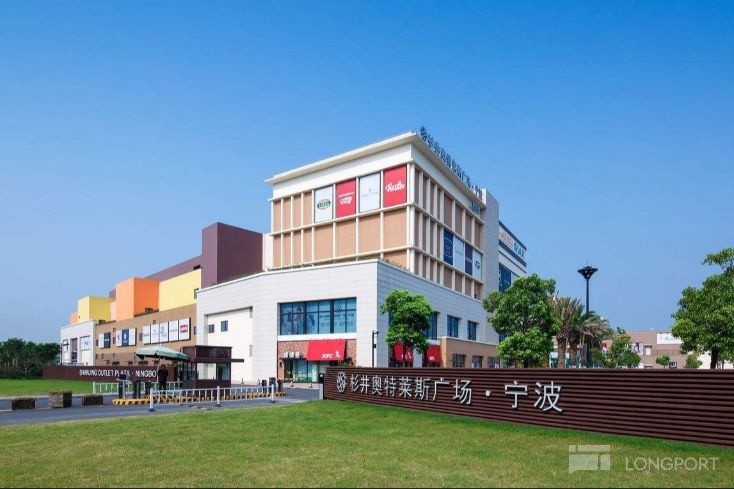
The secondary market has long harbored a simplified pricing mindset: many ordinary investors and short-term capital rely solely on the single business format label of Outlets, simply benchmarking against static distribution rates horizontally, habitually viewing them as low-volatility fixed-income-like assets, ignoring the revenue differentiation brought by different underlying operational structures, liabilities, and lease terms of various Outlets. On September 12, 2025, CICC Vipshop Outlets REIT listed on the Shanghai Stock Exchange, with a fundraising scale of 3.48 billion yuan setting a peak for consumer REITs in the same period. The closing price on the first day of listing rose nearly 27% relative to the issue price. Relying on continuously rising operational data from 2022 to 2024, the manager built a cash flow projection model, providing an annualized distribution expectation of 5.65% for all of 2026 (projection basis: 3.48 billion yuan issue size × 5.65% annualized distribution rate).
The fourth quarter of 2025 and the first quarter of 2026 belong to the traditional winter-spring sales peak season for Outlets. The market once relied on two quarterly high-revenue data points to reinforce the inherent impression of "Outlets being counter-cyclical." At that time, funds mostly focused on single-quarter sales performance, failing to fully benchmark against the full-year 5.65% projection center, with a general expectation that full-year returns would meet targets. However, the actual annualized distributions for these two peak seasons were only 3.89% and 4.30%, already falling short of the full-year projection target; until the disclosure of Q2 operational data on July 21, when the full picture of the spring-summer off-season operations landed, the 当期 annualized distribution rate fell back to 4.15%, further widening the expectation gap with the issuance projection value.
Many ordinary investors seeing large 账面 losses on paper will directly equate this to deteriorating offline store operations. Here, we first clarify the two core accounting differences in public REITs: the current period consolidated net profit of -14.5089 million yuan does not represent true operating losses for the mall. On one hand, property depreciation and amortization are non-cash costs, which is the core reason why public REIT statements often show negative net profits; on the other hand, the current period net operating cash flow of -34.9074 million yuan is merely a 阶段性账面表现. The root cause is the concentrated payment of the full-year dividend of the previous year at the end of the quarter, amounting to 57.02 million yuan. The underlying layer implements a unified cashier mechanism for all stores, with all merchant sales proceeds transferred in full to regulatory accounts, eliminating rent arrears and collection delays. In Q2, there was still 40.98 million yuan in distributable funds, fully meeting the statutory dividend bottom line.
Joint Operation Tied to Apparel Cycle, Projection Model Has Inherent Shortcomings
The comprehensive rental unit price in Q2 was 351.45 yuan/sqm/month, a 环比 decline of 23.7% compared to 460.71 yuan/sqm/month in Q1. Single-quarter total revenue was 67.44 million yuan. Compared to the winter-spring peak season revenues of 87.05 million yuan in Q4 2025 and 88.39 million yuan in Q1 2026, revenue shrank by nearly 20 million yuan. Reviewing the 2024 same-period operational data attached to the 2025 annual report confirms that seasonal declines in revenue are inherent operational patterns for Outlet apparel retail, not a sudden operational negative appearing separately in 2026.
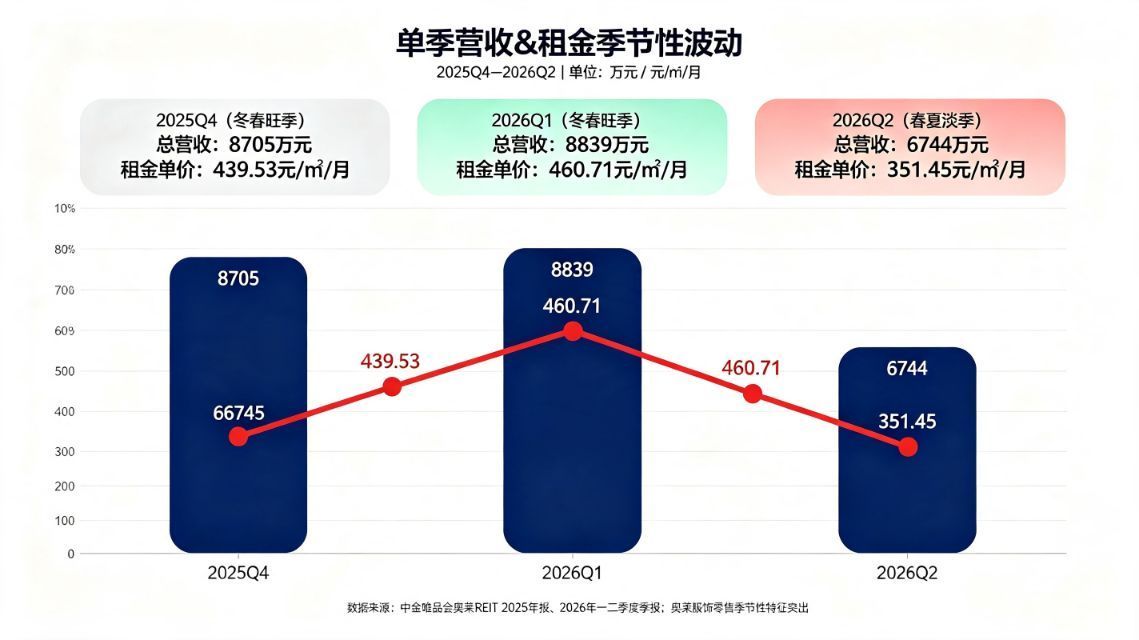
The core root cause of revenue fluctuation lies in the project's heavy reliance on joint operation sharing: Joint operation sharing income this period was 49.3936 million yuan, accounting for 73.71% of total revenue. Fixed site rent was only 5.3353 million yuan. Revenue from diverse businesses such as property management, advertising, and parking lots totaled less than 9%, resulting in extremely thin revenue buffers, making it difficult to hedge against sales fluctuations caused by seasonal changes. The project's long-term average joint operation deduction rate reached 13.02%, higher than the conventional domestic Outlet range of 10%-11%. High deduction rates amplify performance elasticity: during winter clothing and New Year goods peak seasons, customer unit prices are high and sales are booming, leading to synchronized increases in joint operation returns; whereas in spring-summer, thin clothing has lower pricing and brands concentrate on clearance sales, causing merchants' overall GMV to naturally fall back, and project revenue shrinks significantly accordingly. This kind of cyclical fluctuation is hard to smooth out through basic operations alone.
The cash flow projection model built during the issuance phase only selected upward cycle samples from 2022 to 2024, failing to include conservative scenarios such as off-season revenue declines and renewal-based guaranteed rent reductions. This is the core reason for the significant expectation gap between the projection target and the actual performance in 2026. Meanwhile, the project's leasable area of 51,427.27 sqm is already 100% fully leased, with no new stalls as growth buffers. Long-term performance can only rely on sales and deduction adjustments of existing merchants, with no stable incremental gains from property expansion.
Although the operations side launched a second-half hedging plan, including upgrading Arc'teryx stores, introducing the first Shan Huan Huan Outlet store, and hosting multiple themed marketing events, such actions can only slightly boost foot traffic and cannot change the underlying revenue structure tied to the apparel cycle via high joint operations. Within an 80-kilometer radius of the project, there is only one differentiated cultural tourism Outlet, posing no direct diversion pressure in the short term. The original equity holder promised to invest no less than 85% of the fundraising proceeds into new Outlets in Changsha and Wuhan, but this content is merely a 远期规划 in the prospectus, with no announcement of expanded fund implementation yet, so it cannot be counted towards realizable performance increments.
2.509 Billion Yuan Shareholder Payables: Rigid Costs Lock Dividend Elasticity
Compared to seasonal revenue fluctuations that can be temporarily alleviated through brand adjustments and marketing activities, the large shareholder payables formed by asset acquisition are dividend constraints that exist long-term and are unaffected by peak/off-peak seasons.
As of the end of Q2, the balance sheet of the project company showed a liability balance of 2.509 billion yuan. The creditor is the original equity holder, Shanshan Commercial Group. This item is a special inter-company loan formed by the acquisition of underlying assets, with no fixed repayment schedule for principal and interest, clearly differing from conventional bank credit. The project company and the fund contract did not stipulate autonomous early repayment of this shareholder inter-company loan; if planning to initiate debt replacement to reduce long-term financial expenses, a fund unit holders' meeting must be convened to fulfill the complete review process. As of the Q2 disclosure node, the manager has not yet publicized related preparatory work, and the market should not simply interpret this liability arrangement as the original equity holder deliberately maintaining long-term high financial costs.
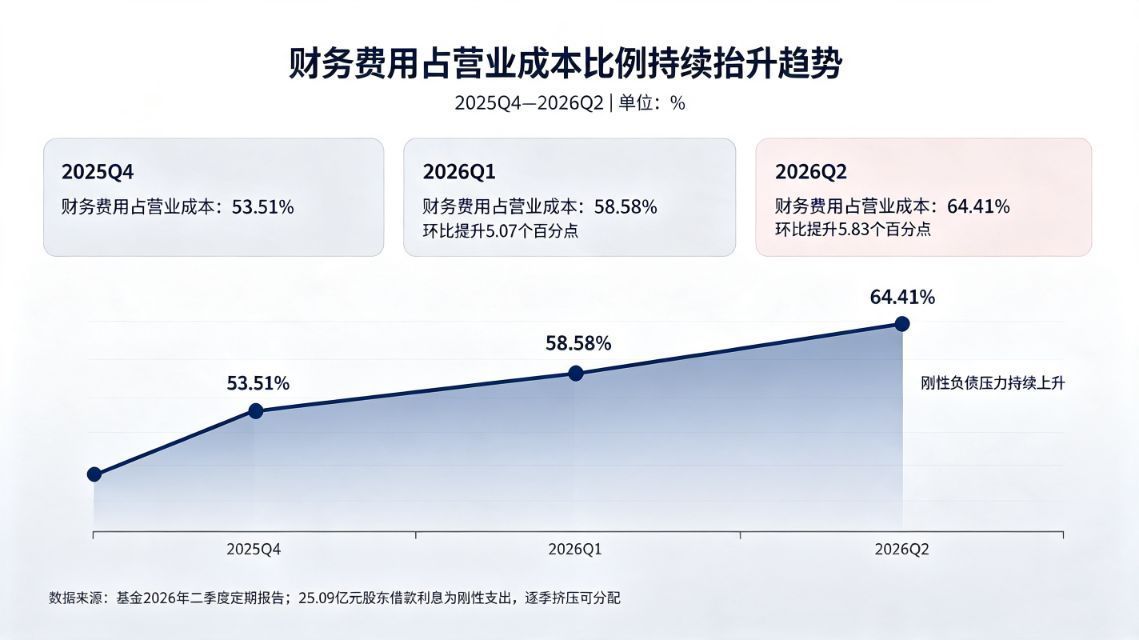
Three consecutive financial reports clearly present a trend of rising costs, with financial expenses listed in the statements corresponding to the interest generated by this shareholder loan: Financial expenses accounted for 53.51% of operating costs in Q4 2025, rose to 58.58% in Q1 2026, and further increased to 64.41% in Q2. The rising ratio has a clear underlying logic: interest belongs to rigid fixed expenditures and does not vary with increases or decreases in store sales volume; however, the contraction in joint operation revenue scale during spring and summer narrows the denominator of operating costs, directly pushing up the proportion of financial expenses. Quarterly interest must be paid on schedule. During the winter-spring peak season, joint operation income can cover most financial expenditures, but entering the spring-summer off-season, cost pressures will directly squeeze distributable cash flow.
Horizontally comparing Huaxia Capital Outlets REIT, the underlying layer does not have shareholder acquisition loans with interest payments of the same scale, and annual financial expenses remain low, creating a natural gap in their dividend centers. Objectively distinguishing from a financial boundary perspective, the 2.5 billion yuan accounts payable only appears in the standalone statements of the project company, completely isolated from the financials of the Vipshop listed entity, posing no risk of group liabilities transmitting to the REIT. There is a institutional operational channel for debt replacement, with no immediate implementation plans in the short term.
1.74 Years Lease Term: A Two-Way Window for Concentrated Renewals in Two Years
As of the end of Q2, the weighted remaining lease term for all shops in the project was only 1.74 years. A large number of leases will expire centrally from the end of 2026 to 2027, forming a concentrated renewal window period, which is also a core medium-to-long-term variable distinguishing it from warehousing and long-term rental shopping centers. The Outlet business format generally adopts short-term leasing models to facilitate brand iteration, a feature that simultaneously brings dual possibilities of rent reduction and increase.
The rent decline in Q2 was not solely due to weak consumption. The operations side has stabilized shop positions through methods such as lowering annual guarantees and moderately relaxing joint operation deduction rates as concessions. However, the announcement only disclosed current short-term stabilization actions, without issuing medium-to-long-term projections for merchant guarantees and deduction adjustments. If offline consumption continues to be weak, operators may continue to make concessions, directly compressing the full-year distributable scale. The top five tenants' combined revenue share is 20.06%, but neither the Q1 report, Q2 report, nor the prospectus disclosed quantitative ranges for revenue adjustments during the renewal stage, making it impossible to predict in advance the extent to which full-year revenue will be affected by concessions.
Horizontally comparing the already listed Huaxia Capital dual projects, the combined weighted remaining lease term is only 1.76 years, also facing short-term concentrated renewal pressure. With the project's 51,427.27 sqm leasable area already 100% fully leased, there are no new stalls to hedge against revenue fluctuations. Over the next 12 to 24 months, continuous bargaining over rents and deduction rates with merchants is required. Even if brand upgrade actions such as Arc'teryx store renovations and introducing the first Shan Huan Huan Outlet store land in the second half of the year, they can only optimize the customer flow structure and cannot change the underlying volatility bound to the consumption cycle by the high joint operation model. Complete renewal and leasing data at the end of the year will be the key basis for judging medium-to-long-term returns.
Divergence Among Three Outlet REITs, Unified Valuation Framework Fails
As of July 2026, there are three listed Outlet-type REITs in the entire market. The comparison indicators below are all taken from the periodic announcements of each target on the Shanghai Stock Exchange in the same period. The market has long had a simplified pricing habit, with most institutions directly categorizing the three types of Outlets into the same interval and pricing solely based on static distribution rate benchmarks. Only a minority of institutions break down the underlying structure for layered calculations. This homogenized valuation approach has become difficult to adapt to the currently obvious divergence in asset fundamentals.
Huaxia Capital Outlets REIT is 布局 ed in two non-local projects in Jinan and Wuhan, lacking large-scale interest-bearing shareholder loans formed by acquisitions. Annual financial expenses remain low, and peak/off-peak customer flows in the two locations can offset each other, smoothing out full-year revenue fluctuations. It still recorded positive net profit in Q2 2026, with a significantly narrowed performance fluctuation range. Guotai Haitong Sasseur completed its listing in June 2026, operating only a single store in Xi'an. Its joint operation revenue share and stock liability scale are both at industry median levels, with full-year performance fluctuation amplitude lying between the other two products. In contrast, CICC Vipshop Outlets faces four fluctuation factors: a single Ningbo property superimposed with a 73.71% high joint operation revenue structure, 2.5 billion yuan long-term interest-bearing shareholder liabilities, and a short lease term of less than 2 years, resulting in a significantly larger space for full-year distribution ups and downs.
Combining the disclosure information of the three targets allows us to summarize the core valuation observation dimensions for retail Outlet assets: the higher the proportion of joint operation sharing income, the more prominent the performance discount brought by the apparel consumption cycle; carrying large acquisition shareholder debts at the underlying level will naturally lower the center of long-term distributable cash flow; with remaining leases of less than two years, valuation layers need to factor in advance the revenue uncertainty brought by concentrated merchant renewals. Horizontally comparing traditional infrastructure REITs such as warehousing, industrial parks, and highways, these assets rely on years of rigid fixed rents, with extremely small revenue fluctuations and solid fixed-income attributes. However, Outlets are deeply bound to residents' discretionary apparel consumption, amplifying both return elasticity and volatility. The two cannot simply share the same static distribution fixed-income pricing ruler.
Full-Year Distribution Deduction: Threshold Raised Under Peak Season Reference
This full-year 5.65% distribution target comes from the appendix table "Calculation Table of Distributable Amount of Funds During the Forecast Period" in the prospectus. Combined with multiple periodic reports, the actual achievement space for the 2026 target can be fully deduced: under the issuance projection caliber, the total required distributable funds for the full year are approximately 196.62 million yuan (projection basis: 3.48 billion yuan issue size × 5.65% annualized distribution rate).
In Q1 2026, single-quarter distributable funds were 46.67 million yuan, and Q2 recorded 40.98 million yuan, totaling 87.65 million yuan cumulatively in the first half of the year. Theoretically, the second half needs to achieve 108.35 million yuan in distributable funds to catch up with the issuance phase projection center. Looking back at the winter promotion peak season in Q4 2025, which was also the cash flow peak window since the product's listing, the single-quarter distributable funds were only 41.08 million yuan. Even conservatively assuming that customer flow and sales scale in Q4 2026 fully recover to last year's high points, plus adding the approximately 12 million yuan in 历年 cumulative undistributed distributable reserves retained at the end of 2025 (which can be adjusted across years to supplement dividends according to public REIT regulatory rules), the total distributable funds available for the full year are only 128.73 million yuan, leaving a considerable gap with the prospectus projection total.
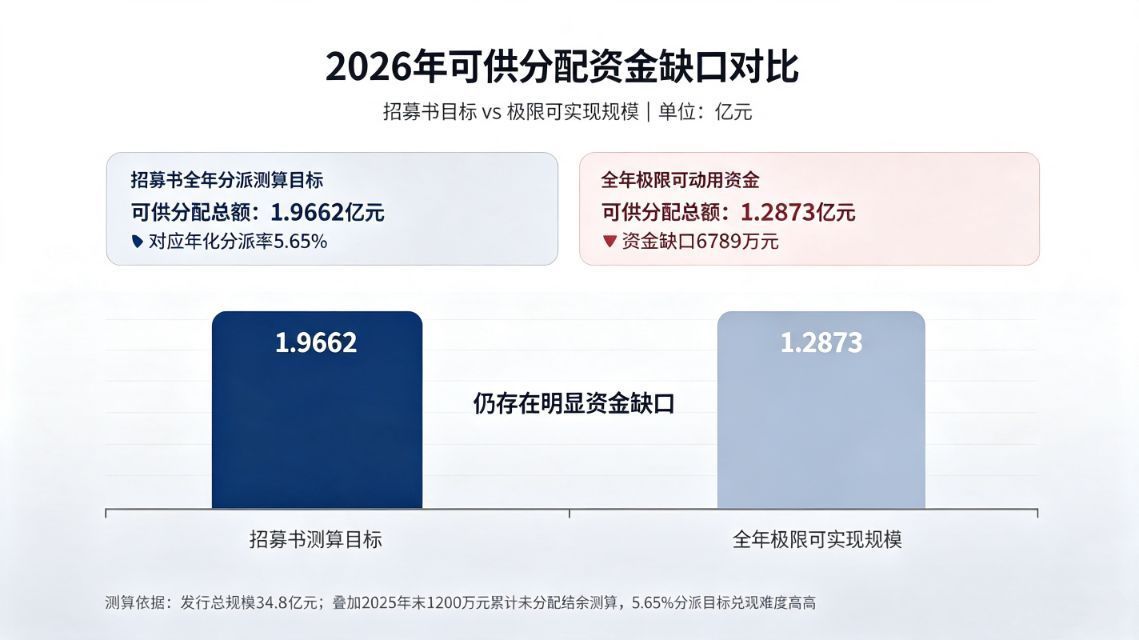
Although Q4 is the annual sales peak for Outlets, variables affecting cash flow can be divided into rigid and elastic categories: the interest corresponding to the 2.5 billion yuan shareholder loan is accrued fixedly every quarter and will not be reduced due to increased sales during the peak season; while the degree of recovery in offline winter-autumn consumption and the adjustments to guaranteed sales volumes and joint operation deduction rates during the concentrated renewal stage at the end of the year all carry strong uncertainties. The volume of 12 million yuan in historical reserves is limited and hard to smooth out the revenue suppression brought by multiple structural constraints. The market need not be overly pessimistic based solely on single-quarter off-season operational data, but the 5.65% full-year distribution target calculated based on upward cycle samples has a relatively high difficulty in short-term landing and realization.
Step Out of a Single Ruler, Reconstruct Retail Real Estate Pricing Logic
A single off-season quarterly report cannot completely negate the long-term operational value of Ningbo Shanjing Outlets. A 100% occupancy and collection rate, regional differentiated customer flow, and continuous brand iteration remain the safety floor of the asset. Short-term customer flow fluctuations can be moderately hedged through operational means. However, the core industry significance of this report lies in breaking the market's long-standing label-based pricing thinking—cannot simply use the "Outlet" business format to categorize all projects into low-volatility fixed-income assets.
Single-city Outlets easily superimpose multiple constraints such as high joint operations, rigid interest-bearing liabilities from acquisitions, and short-term concentrated renewals. The sample of Huaxia Capital's dual non-local layout and light liabilities clearly proves that there are obvious magnitude gaps in the revenue stability of similar formats. Scaling up to the entire consumer REITs track, warehousing, highways, and industrial parks rely on long-term fixed rents, with a solid foundation for fixed-income attributes. Outlets and community commerce are deeply bound to residents' discretionary consumption, with stronger performance volatility elasticity. Valuation logic cannot directly copy the pricing ideas of traditional infrastructure fixed-income.
Q4 2026 superimposes Double 11 and the winter apparel sales peak season. Full-year joint operation turnover and cumulative distributable funds will undergo a complete performance verification. The expectation gap exposed by this round of Q2 reports also fully illustrates that static distribution calculations made solely relying on upward cycle operational data are hard to cover the fluctuations of the complete operational cycle of retail real estate. After verification by this data, institutions and ordinary investors need to update their pricing systems. When evaluating Outlet-type assets, they should simultaneously consider the three core dimensions of revenue model, stock rigid liabilities, and remaining leases, gradually abandoning the one-size-fits-all single distribution rate benchmarking approach, and establishing a layered, differentiated retail real estate valuation ruler.
Data Sources and Disclaimer: Operating, financial, and projection data in the article are all from publicly disclosed prospectuses, periodic operational reports, and financial reports of CICC Vipshop Outlets, Huaxia Capital Outlets, and Guotai Haitong Sasseur REITs on the Shanghai Stock Exchange; industry operational data is public industry statistical information, and projections are completed based on public materials. This article is 仅为 objective in-depth industry analysis and does not constitute any investment advice.

The copyright of this article belongs to the original author/organization.
The views expressed herein are solely those of the author and do not reflect the stance of the platform. The content is intended for investment reference purposes only and shall not be considered as investment advice. Please contact us if you have any questions or suggestions regarding the content services provided by the platform.