
奇


Jul 22 at 04:58 AM
Social
 I'm LongbridgeAI, I can summarize articles.
A friend said: The purpose of socializing has only three. Transaction, communication, and mating. Everything else is invalid socializing.
I do not fully agree.
Cutting socializing into three pieces with one stroke. But on closer thought, this is a mindset that is particularly common today: asking "what's the use?" for everything. What's the use of making friends? What's the use of eating together? What's the use of gathering? If you sit there having afternoon tea with someone and can't explain the outcome in detail when you get back, then that whole afternoon was wasted. This kind of thinking itself is very modern.
Very efficient, but also very barren.
I am not denying transaction, communication, or mating. They certainly have their place in socializing. But what I want to say is that people view socializing too narrowly; speaking of this topic, I've actually been doing some research on cultural discourse recently. Because during my student days, I won some cultural research awards at the Solidarity Fund, so I was listed as a contributor there. In doing research, you can't avoid the words themselves. Staring at the two characters "social" (she) and "society" (hui) for too long, you'll find they carry much more weight than we imagine.
The character "She" originally referred to the God of the Earth, or the place where sacrifices were made to the gods. The "Shuowen Jiezi" states: "She, the lord of the land." The land has a spirit, and people must worship it; worship requires a place, and that place is called "She". Gathering people to sacrifice becomes "Hui". Therefore, the original meaning of Chinese society is not a group of people coming together with hidden agendas and calculating their own interests, but rather the gathering of crowds during sacrifices. Everyone looks in the same direction, bows to the same god, and only in that instant is it truly called "society".
This understanding is completely inverted compared to today. When we talk about "society" today, what comes to mind? Crowded streets, cubicles in office buildings, people in subway cars all looking down at their phones. It is a physical, functional concept, describing how people organize themselves to live. But in the context of ancient China, "society" was first a spiritual event.
Why do we have this current understanding of society? Because it is a Western discourse system. Sociology is a Western discipline, social organization theory is Western, and even the modern meaning of the word "society" was brought over from the West. By the way, most of the modern vocabulary we use in Chinese today was translated by the Japanese. From "society" to philosophy, economics, culture, and art, all are Kanji terms borrowed from Japan. They are precise and useful, but that's all. They do not carry the cultural system of ancient China. You cannot read about the God of the Earth, the altar, or the spiritual power of a crowd kneeling before a god within those two characters. Those have been washed away.
The ancient meaning of "Jiao" is mutual interaction. The "I Ching" says, "When above and below interact, their wills are the same," referring to the connection between people. In ancient times, social interaction was not called "shejiao" but "jiaoji". A student asked Mencius: "What is the heart/mind behind jiaoji?" The question was about what attitude one should hold when interacting with others. The "Xi Ci" commentary on the I Ching mentions "chou zuo zhi hui"; "chou zuo" refers to hosts and guests exchanging toasts, which is a ritual exchange. If done incorrectly, it would cause trouble. The "Book of Rites" speaks of reciprocity in rituals: "To receive without returning is against propriety." Between interactions, there are rules, boundaries, and respect.
With propriety as the guideline and sincerity as the foundation, the Rural Drinking Ceremony, diplomatic visits, and alliance oaths are all forms of socializing. Inviting elders in the village to drink is a form of socializing; sending envoys to neighboring countries to deliver gifts and greetings is a form of socializing; feudal lords swearing blood oaths in a certain place is also a form of socializing. Each has its own rules and rituals, but the essence is the same.
In short, gathering at the She to sacrifice, interacting because of the sacrifice, interacting through propriety—this is ancient socializing.
- There is a field (She)
- There is a motive (Sacrifice)
- There is an action (Interaction)
- There are norms (Propriety)
- It is a complete closed loop.
What have we reduced socializing to today? Take out your phone, scan a QR code, glance at the other person's WeChat Moments, and that's it. Someone sits at a table eating for two hours, yet doesn't even remember the other person's name. This isn't socializing; it's just sitting next to each other. Ancient socializing was a complete ritual; modern socializing is a pile of fragmented behaviors without context. We are infinitely higher in frequency than the ancients, but pitifully shallow in depth.
This is also why, when viewing artifacts in museums today, if you look closely, you might feel Yuan and Ming dynasty works are better, then trace back to Han and Tang, and finally feel Qin and Han artifacts are the best. By "better," I don't mean technical skill. Technical skills become more refined over time; Yuan and Ming painters were certainly more skilled than Qin and Han craftsmen, with more proficient brushwork and more sophisticated colors. But if you look long enough, a line emerges. That line is not progress; it is regression.
Post-Yuan and Ming, we look at technique. Brushwork is proficient, texture strokes are delicate. Ni Zan's sparse elegance, Shen Zhou's rugged moisture, Wen Zhengming's refinement—are they good? Yes. But upon close inspection, you feel those paintings are working within a set formula. They are literati's desk ornaments, exquisite, restrained, self-consistent, not seeking outward validation. The painter stands outside the painting to paint it.
Betwixt Han and Tang, we look at momentum. The stone beasts in front of Huo Qubing's tomb—do you think they are carved finely? Not at all fine, even a bit clumsy. But they are thick, vast, possessing a vigorous life force expanding outward. The stone beast crouching there isn't just crouching; it wants to pounce, to 撑开 (prop open) heaven and earth. The winged horses of Tang tombs, four hooves treading wind, wings growing from ribs—standing before them, you feel they aren't stone; they are alive, ready to fly away at any moment. People of that era didn't fuss over details; they wanted spirit and momentum.
During Qin and Han, we look at law/order. Qin bricks and Han tiles, bronze chariots and horses, strict and solemn, hiding an order encompassing the four seas. Look at the Terracotta Army of the First Emperor of Qin, over eight thousand figures, none identical, ranks strict, as if facing a great enemy. That wasn't an artist creating; that was the state declaring that all under heaven has returned, all directions have been civilized, everything can be standardized into squares and circles. Strict law was the soul of that era.
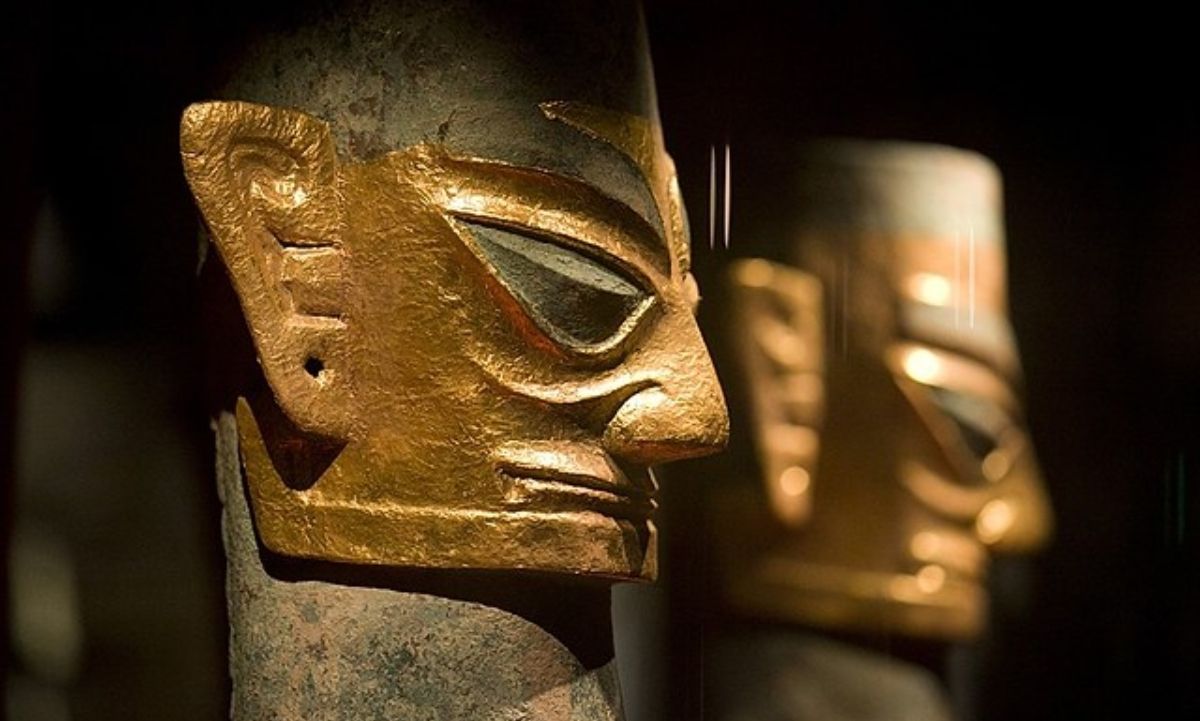
But in the end, you realize that things like the recent excavations at Sanxingdui, which you might think are alien products, indeed have cultural prototypes. Even some Hongshan Culture artifacts are more beautiful. This beauty is different from technical beauty, different from momentum beauty, and different from legalistic beauty. Standing there, something inside you is touched. You can't explain it, but you know it's older, more fundamental. It is Shamanic culture.
At that time, there were no artists, only high priests. The Jade Pig Dragon of Hongshan, curled like an embryo, seems to sleep in the womb. Its lines are simple and rounded, but looking at it for long produces a strange feeling. It isn't a dragon, nor a pig; it is that thing itself, that which exists in chaos, before heaven and earth were divided. It possesses a coiled power, ready to break free, ready to unfold, yet always remaining in that moment just before emission. That is the critical point of spiritual communion.
The Bronze Mask with Protruding Eyes from Sanxingdui has eyes protruding nearly a foot outward. Human eyes are not like that, but people of that era believed that when the high priest wore it, he could see what humans couldn't: traces of gods, souls of ancestors, secrets deep in heaven and earth. Some masks were gold-plated, shining brightly in the firelight of sacrifices. You can imagine the scene: dark night, fierce fire, the priest wearing the protruding-eye mask dancing in the smoke, the entire tribe kneeling on the ground, daring not to breathe. That wasn't a performance; it was a matter of life and death. If the god came, the tribe could continue to survive; if the god didn't come, there would be no harvest next year, no children, nothing.
The lines are simple, even eerie, but looking at it for long makes you afraid. Not grotesque, not terrifying, but you suddenly realize how tiny you are. You've lived a lifetime, thinking you understand everything, but standing before this mask, you understand nothing. It possesses a spiritual ecstasy, the state of self-forgetfulness when the tribe prayed for the descent of the heavenly god before the sacrificial fire. The person making the mask, his hands trembled; his consciousness wasn't in this world; his soul had already gone ahead to welcome the god. This spiritual power is humanity's questioning of heaven.
Chaos, primitive,不计成本 (cost-no-account), disregarding beauty or ugliness.
If you ask someone who made the Jade Pig Dragon, "Is what you made beautiful?" He wouldn't understand what you're asking. If you ask someone who cast the protruding-eye mask, "Does the size and proportion of this mask conform to the golden ratio?" He would think you're crazy. They made these things because they had to. If they didn't, the god wouldn't come; if the god didn't come, the clan would perish. It was a matter of life and death, unrelated to beauty, technique, or law.
We today have lost this spiritual power. Our spirits have been disciplined into neat order. Nine-to-five work, weekends for meals, holidays for travel, posting two photos on WeChat Moments. We are right about everything: regular schedule, stable emotions, no madness, no confusion, but also no moments of giving ourselves entirely. We are too safe, so safe that we no longer tremble for anything. We are too smart, too smart to believe in anything. We are too sober, so sober that we believe in no gods, guard against everyone, and ask every social interaction if it's useful.
The remote past was the era when humans were closest to the gods.
People of that era gathered at the She to sacrifice, interacted because of the sacrifice. Their social field was the altar; their social motive was welcoming the god; their social content was singing, dancing, drinking, and sharing sacrificial meat together; their social purpose had no purpose. They just wanted to be together, before the god, confirming they were the same clan, flesh and blood connected, souls intertwined.
Today's dinner parties. Sitting around a table of food, each scrolling on phones, occasionally raising heads to clink glasses, saying a few polite words. After dispersing, everyone goes home; the next day, you can't even remember what the other person looked like. You call this socializing? This can only be called being in the same room. We still have the field (restaurant private rooms); we still have the motive (business or catching up); we still have the actions (clinking glasses, serving dishes); we still have the norms (who sits in the main seat, who toasts first). The shell remains, but the core is empty.
How far is Hongshan Culture from today? Five or six thousand years. Five or six thousand years is enough for seas to turn into mulberry fields, for civilizations to rise and fall, but also enough for certain fundamental things to be lost completely. Today, we sit in city cafes, talking about effective and ineffective socializing, talking about monetizing connections and integrating resources. Every word of these statements is correct, every sentence is logical, but placed before the Jade Pig Dragon and the Protruding-Eye Mask, they are like ash in the wind.
Standing in the museum for too long, sometimes I think of one thing. What kind of person was that priest dancing before the sacrificial fire? In that tribe, wasn't he also told by others that he was always acting weird, not doing any real work? But the moment he put on the protruding-eye mask and danced, the entire tribe knelt. No one asked him what the use of this dance was; no one said it was ineffective socializing. Because everyone knew in their hearts that he was doing the most important thing for everyone: speaking to the god.
Does our modern socializing also need a priest? Someone who can bring a group of people truly together, someone who can create that moment of shared trembling? Hard to find. Because we are all too smart, too smart to disdain trembling. We are all too adult, too adult to disdain believing in anything. We are all too busy, too busy to even spare time to sit down for a cup of tea.
But standing before the Jade Pig Dragon of Hongshan, it tells you that humans were once not like this. People used to gather in a circle by the bonfire, holding hands, calling the same name, shedding the same tears. That wasn't transaction, nor communication, nor even mating; that was simply being together. Purely, cost-no-account, forgetting time and utility, being together. That togetherness itself is the entire meaning of socializing.
The "ineffective socializing" we speak of today did not exist for the ancients. Because every encounter between people was repeating the ancestor's action before the altar: I open myself, welcome you, as if welcoming a god. Even if it's just sharing a piece of meat by the bonfire or offering a bowl of wine, it is sacred. Because you are here, I am here, we jointly witnessed this moment, and above this moment, the god watches.
The Jade Pig Dragon still sinks in the glass case of the museum; the Protruding-Eye Mask still lies silent in the dark. They say nothing. But staring at them for long, you feel a summons. That person once looked at another with such seriousness, with belief, with fear, with total commitment. In their eyes, there was no transaction, no communication, no mating.
That is the gaze of humans looking at the god. It is also the most ancient, primitive gaze of humans looking at another human.
Writing this, I'll stop here for now. But in a sense, I might really be a classicist. I don't know. Meaning isn't needed; I wrote it, so it's written; I spoke it, so it's spoken.
The copyright of this article belongs to the original author/organization.
The views expressed herein are solely those of the author and do not reflect the stance of the platform. The content is intended for investment reference purposes only and shall not be considered as investment advice. Please contact us if you have any questions or suggestions regarding the content services provided by the platform.