
奇


Jul 28 at 04:08 PM
The essence of investment is trust.
 I'm LongbridgeAI, I can summarize articles.
The foundation of investment is trust, followed by numbers.
Everyone who steps into the capital market initially believes they are dealing with numbers: price-to-earnings ratios, growth rates, dividend yields. However, as you progress to a certain level, you will realize that ultimately, it comes down to a matter of trust.
When you buy a stock, you are essentially handing over your current capital to a distant management team, trusting them to create value in the future and treat you well as an owner. When you buy an index fund, you are essentially trusting that the mechanism of survival of the fittest within an economy will remain effective in the long term. When you buy REITs or BDCs, you are essentially trusting that the rigid constraints of legal contracts will safeguard your cash flow. And no matter which asset you choose, you cannot avoid the need to trust that the credit system behind the currency will not collapse during your lifetime.
All the complexity of investment is condensed into gradients of trust. Some trust is soft and variable; some trust is hard and statutory; and the source of all returns lies in uncertainty. This creates a paradox in the investment world: the more you pursue certainty, the more you sacrifice the upside potential of returns; the more you embrace uncertainty, the more you must face the risk of trust collapsing.
Profit and loss stem from the same source, as it were.
Next, I will analyze the differences in the logic of trust between index investing and individual stock investing layer by layer, starting from the contractual hardness of asset classes, ultimately attempting to construct a cognitive framework for investors that combines philosophical depth with practical guidance.
I. The Institutional Advantages of REITs and BDCs
What are REITs and BDCs?
REITs (Real Estate Investment Trusts) and BDCs (Business Development Companies) are two special forms of corporate organization in the U.S. capital market. Their common feature is that they exchange tax advantages for mandatory profit distribution obligations. Specifically, according to the provisions of the U.S. Internal Revenue Code:
- REITs must distribute more than 90% of their annual taxable income to shareholders in the form of dividends to be exempt from corporate income tax.
- $Realty Income MD(O.US)
- $Stag Industrial(STAG.US)
- $LTC Properties(LTC.US)
- BDCs, registered as closed-end funds under the Investment Company Act of 1940, are also required to distribute at least 90% of their taxable income to investors to avoid double taxation.
- $Ares Capital(ARCC.US)
- $Main Street Capital(MAIN.US)
Management teams holding large amounts of free cash flow inevitably face the risk of misuse or inefficient investment, while mandatory dividends elevate this risk from the level of moral self-discipline to legal compulsion.
Where exactly does this "hardness" lie? Compared to ordinary listed companies, the superiority of this hardness is reflected in three dimensions:
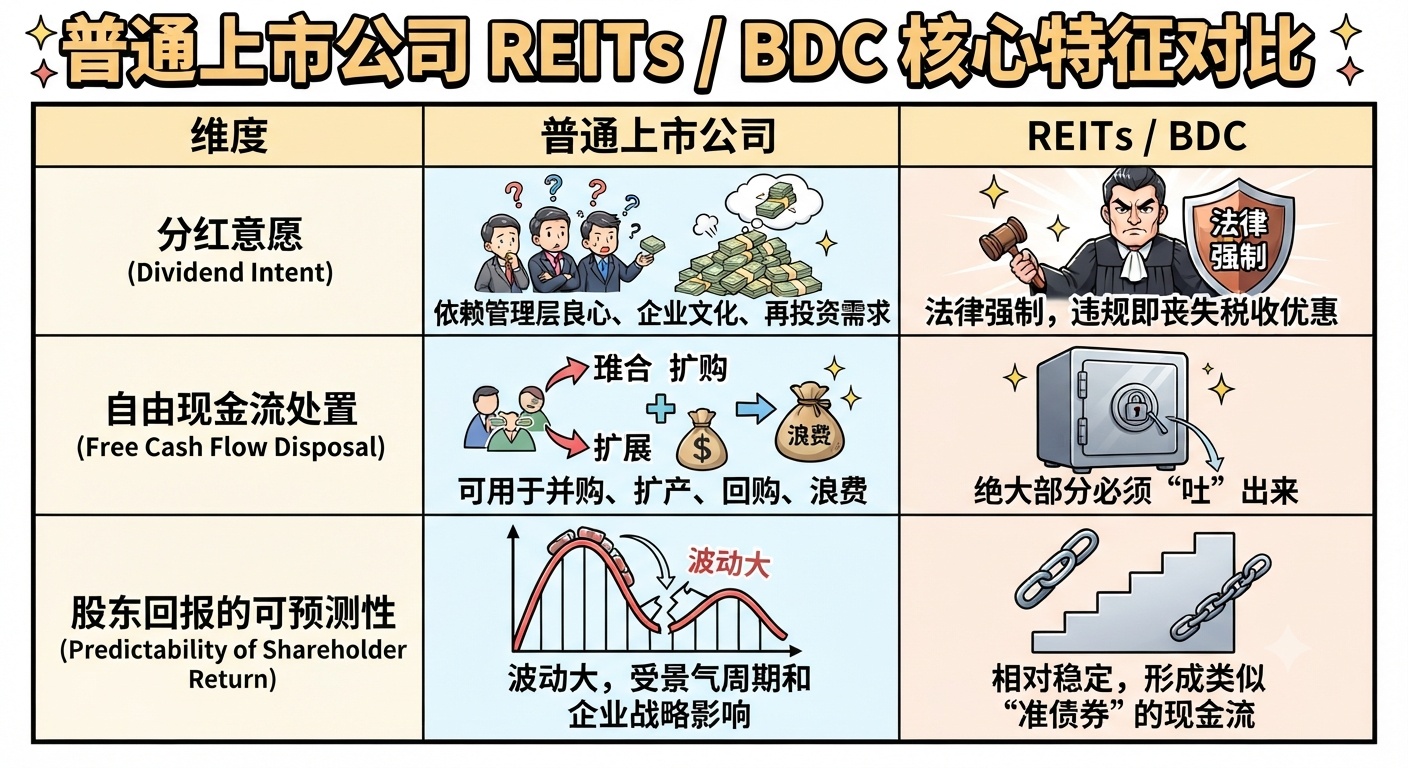
For this reason, REITs and BDCs are viewed by many income-oriented investors as substitutes for hard assets. During economic downturns, their dividends can form a cash safety cushion; during periods of falling interest rates, their relatively high dividend yields attract a large amount of yield-chasing capital.
The cost of hardness is the sacrificed compound growth of capital appreciation.
Mandatory dividends mean that companies cannot retain large amounts of profits for reinvestment. In the formula for compound interest, retained earnings multiplied by the return on capital is the core driver of long-term growth. When this driver is artificially weakened, the company's endogenous growth potential is inevitably limited.
In the long run, the price growth center of REITs and BDCs is significantly lower than that of high-quality growth stocks. Their total returns come more from dividend reinvestment than from stock price appreciation itself. This means that if you choose these types of assets, you are essentially trading off the ceiling of capital gains for the floor of cash flow.
When you choose REITs and BDCs because of their "hardness," the choice you are truly making is to accept a ceiling on returns in exchange for a legally guaranteed floor.
Individual stock investing involves risk, culture, and micro-trust.
Individual stock investing is often simply summarized as having higher risk, but the connotation of this risk needs to be precisely deconstructed:
- Idiosyncratic Risk: Operational failures, management moral hazards, product cycle failures, technological disruptions, etc., of a single company. These risks can be significantly reduced through diversification, but at the individual stock level, they may directly lead to a total loss of principal.
- Information Asymmetry Risk: As an external minority shareholder, your grasp of the company's true internal situation is always lagging and incomplete.
- Valuation Risk: Even if a company has good fundamentals, buying at an excessively high valuation may result in years of negative returns during a prolonged mean reversion.
Under the 叠加 of these three risks, the win rate of individual stock investing is naturally low. In the long term, about 40% of individual stocks in the U.S. stock market have negative lifetime returns, while a very small number of top companies contribute the vast majority of market gains. This means that choosing individual stocks is essentially making a minority bet in a winner-takes-all game.
Corporate culture is the softest yet most critical variable.
When we ask why some companies can continuously create excess returns for shareholders while others head towards destruction, the answer ultimately points to a variable that cannot be quantified nor written into a contract: I call it corporate culture. Corporate culture determines a company's choices when facing the following critical moments:
- When short-term profits conflict with long-term customer value, which one does it choose?
- When free cash flow is abundant, does it use it for generous dividends, wise share buybacks, or squander it on high-priced M&A expansion?
- When encountering a crisis, does it honestly inform shareholders, or does it cover up and embellish?
I personally believe that when acquiring a company, the most important thing you get is not assets, products, or business, but culture.
When you buy an individual stock, you are essentially buying the future decision-making quality of a collective of people. And the values, incentive structures, and moral bottom lines of these people cannot be fully constrained by contracts. When trust is lacking, you indeed should not invest. If we acknowledge that corporate culture is the decisive variable, then the natural extension of logic is that if you lack confidence in a company's culture, you indeed should not invest in it.
In a world full of uncertainty, a company's value is created amidst uncertainty, but at the same time, destruction also occurs amidst uncertainty. If you do not trust the people who navigate this uncertainty, then the risk you bear has no corresponding expected return compensation, which mathematically is a bet with negative expected value.
Index investing is the superposition of systemic trust and probabilistic thinking; it is also a leap from micro-trust to macro-trust.
When investors shift from individual stocks to index funds, they often think they are reducing risk. In reality, they are merely shifting the object of trust from a micro-entity to a macro-system. The core assumption of index investing is this:
Although individual companies may decline or even perish, high-quality enterprises within the overall market (or economy) will continue to create value. The index compilation mechanism will automatically eliminate losers and include winners, causing the index to rise over the long term. Therefore, index investors do not need to judge the corporate culture of any single company. They only need to believe in two things:
- Long-term economic growth (positive-sum game)
- The effectiveness of the market screening mechanism (survival of the fittest)
Compared to individual stocks, index investing has an extremely important structural advantage: extremely low error-correction costs.
- In individual stock investing, if your judgment of a company's culture is wrong, your loss could be the entire or most of your principal. Correcting the error means cutting losses and exiting, involving huge sunk costs and psychological friction.
- In index investing, the failure of any single company has a limited impact on the whole. Index component adjustments are automatic; bad companies are removed, good companies are added, and you don't even need to do anything.
In this sense, index investing is an acknowledgment of the imperfection of human judgment. You don't need to precisely identify the next great company; you just need to believe that the entire system has sufficient fault tolerance. Good examples include:
- $Schwab US Div Eq(SCHD.US)
- $State Street® Bridgewater®AllWeather®ETF(ALLW.US)
But does index investing truly eliminate trust? Index investing does not truly eliminate trust but shifts trust from individuals to the system as a whole:
- You trust that the market pricing mechanism will not fail in the long term.
- You trust that the rule of law environment can protect property rights.
- You trust that the central bank's monetary policy will not lead to hyperinflation.
- You trust that long-term economic growth is not an illusion.
These trusts are equally grand and fragile. The 2008 financial crisis, the 2020 pandemic circuit breakers, and the 2022 inflation and interest rate hike cycle. Every major market shock challenges these systemic foundations of trust. When systemic crises occur, significant drawdowns in indices can also bring profound pain.
Therefore, index investing is not trust-free investing, but rather a broad-spectrum trust. It disperses your trust across multiple dimensions to avoid losing everything due to the collapse of a single link.
The underlying color of the monetary system is also an anchor of trust; the essence of fiat currency is an abstract symbol based on credit.
No matter whether we talk about individual stocks, indices, or REITs, the final unit of account is currency. And modern currency (fiat money) itself is, in my opinion, the grandest trust experiment in human history.
Fiat currency has no physical backing. It is not a convertible certificate under the gold standard. Its value does not come from intrinsic precious metal content, nor from a statutory redemption promise, but purely from social consensus. You believe that others are willing to exchange goods or services of equal value in the future for this piece of paper in your hand, and thus it has value.
Kynes called fiat money an accounting symbol built on convention, while Friedman pointed out that inflation is always and everywhere a monetary phenomenon. When this trust is abused, the purchasing power of paper money suffers systematic erosion.
Equity is the most effective hedge against fiat currency.
Understanding the credit nature of fiat currency makes it clear that equity or any other investment is essentially a hedge against the fiat currency system, not a vassal to it.
When you hold equity, you possess residual claim rights to a company's future output. If the purchasing power of money declines due to inflation, excellent companies can usually maintain their real profitability by raising prices. Commodities, services, patents, and customer relationships—these real assets' values are actually re-priced upwards in an inflationary environment.
Therefore, when choosing between trusting currency and trusting enterprises, investors are essentially making a structural judgment: Do I prefer to trust the creation capability of tangible output (enterprises), or the maintenance capability of purchasing power of an abstract symbol (currency)?
In the long run, the real returns of stocks significantly outperform bonds and cash. The equity structure naturally possesses attributes resistant to fiat currency erosion.
The Paradox of Trust
The logic of equity hedging against currency risk has a premise: the enterprise you invest in must continuously create real value. And for an enterprise to continuously create value, it relies on a stable rule-of-law environment, an predictable policy framework, and a normally functioning monetary and financial system. This constitutes a paradox of trust:
- You cannot discuss equity value apart from the monetary system.
- You also cannot equate equity value with the monetary system itself.
Acknowledging the tendency of fiat currency to depreciate in the long term is the reason to persist in long-term equity investment, not an excuse to retreat.
Profit and loss stem from the same source; uncertainty is the sole source of value; the essence of value creation is crossing time amidst uncertainty.
This is the most core thought in my entire discourse, and also the hardest to express quantitatively.
If all futures were certain, asset prices would precisely equal the discounted value of their future cash flows, and no excess returns would exist. The sole source of excess returns is that your judgment regarding a certain uncertainty is ultimately proven correct, and the market had previously given you a risk premium as compensation.
- Investing in a startup tech company is believing in its technological path under the uncertainty of whether it can disrupt the industry.
- Investing in a REIT is believing in its asset quality and distribution contracts under the uncertainty of rent growth and interest rate trends.
- Investing in an index fund is believing in the long-term upward trajectory of human economic activity under the uncertainty of geopolitics and macroeconomic cycles.
All value is created in the 缝隙 s of uncertainty. If you completely eliminate uncertainty, you also completely eliminate the possibility of excess returns.
"Profit and loss stem from the same source" can be deconstructed into three levels in investing:
- The source of returns is the source of risk. You buy a stock for high growth, so below-expectation growth is your biggest risk. You buy a REIT for high dividends, so dividend cuts are your biggest risk. You cannot enjoy the returns brought by a factor while fantasizing that the risks it brings will not materialize.
- Consistency of methodology. You adopt a systematic investment framework; the logic that earns you excess returns in a bull market becomes the source of your largest drawdown in a bear market. Value investors underperform growth investors during bubble periods but outperform them during crashes. This is not a flaw in the method, but a manifestation of methodological consistency.
- Mirror image of cognition. Every penny you earn is a reward for correctly judging an uncertainty; every penny you lose is a punishment for incorrectly judging an uncertainty. Profit and loss are simply two sides of your cognitive level in a probabilistic game.
How to survive amidst profit and loss stemming from the same source?
Since profit and loss stemming from the same source is inescapable, the investor's only way out is not to avoid uncertainty, but to:
- Choose the category of uncertainty you can understand and bear, i.e., stay within your circle of competence;
- Use position management to limit the devastating consequences of a single erroneous cognition, i.e., diversification and asymmetric positions;
- Lengthen the odds over the time dimension, i.e., hold long-term, letting time become an ally of certainty.
Investors in REITs and BDCs have chosen a downside-controlled uncertainty; growth stock investors have chosen a massive upside uncertainty; index investors have chosen a systemic but diversifiable uncertainty. No choice is inherently superior to another; only the choice that best fits your cognitive boundaries and psychological tolerance.
The Integrated Framework is a Hierarchical Investment Decision Tree
Based on all the above discourse, we can construct an integrated investment decision framework. Examine your baseline of trust and ask yourself: what is the way of trust failure you can accept the most?
- If you cannot tolerate trust in individuals being betrayed (e.g., management fraud, company bankruptcy), then index investing is your 底线 choice.
- If you are willing to accept uncertainty at the individual level but require hard legal guarantees, then REITs and BDCs are ideal directions.
- If you deeply believe in your own micro-judgment capabilities and can bear the full cost of judgment errors, then individual stock investing is the path worth trying.
Clarify your source of returns: where do you plan to earn excess returns?
- Earn from institutional contracts (mandatory dividends) → REITs / BDC
- Earn from systemic growth (economic upturn) → Index Funds
- Earn from individual cognitive gaps (undervalued stocks) → Selected Individual Stocks
Each type of return source corresponds to specific risk exposures. Do not confuse them. Build an anti-fragile portfolio structure.
Even if you choose individual stock investing, you should not ignore the error-correction advantage of indices; even if you choose REITs, you should not ignore the revaluation impact of interest rate changes on their prices. True stability is not betting on a single category, but establishing portfolio logic among assets with different trust hardens. For example:
- Core Position: Broad-based Indices (Systemic Trust)
- Satellite Position: REITs / BDC (Contractual Trust)
- Exploratory Position: Selected Individual Stocks (Micro-trust, strictly controlling position limits)
Such a structure enjoys systemic growth, obtains hard dividend cash flows, retains the possibility of capturing individual excess returns, and ensures that the failure of any single level will not lead to the collapse of the whole.
Returning to the initial question. In investing, what exactly is "hard"?
Legal constraints are hard, but they sacrifice growth elasticity. System screening mechanisms are hard, but they cannot 免除 the fragility of the macro system. Corporate culture is soft, but it is precisely the deepest source of excess returns. The monetary system is soft, but it is the prerequisite for us to conduct all economic activities.
Investing is not about finding the hardest trust anchor, but clearly realizing the boundaries, costs, and failure conditions of each type of trust, and then, based on a deep understanding of oneself, finding the position in this trust spectrum where one can best settle one's cognition and temperament.
Profit and loss stem from the same source. You cannot take only the returns brought by uncertainty while refusing to bear the risks it brings. The only thing you can do is choose who to bear uncertainty with, and how large a position to bear it with.
When you enjoy cash flows in the mandatory dividends of REITs, when you bet on the system in the long-term upward trend of indices, when you bet on the values of a certain entrepreneur in the deep research of individual stocks, please remember that every choice you make is carefully placing a part of your life on this invisible network of trust. And this caution itself is the starting point and the end of investment ethics.



The copyright of this article belongs to the original author/organization.
The views expressed herein are solely those of the author and do not reflect the stance of the platform. The content is intended for investment reference purposes only and shall not be considered as investment advice. Please contact us if you have any questions or suggestions regarding the content services provided by the platform.