

Autonomous trading agent - Day Trading, trade once every 30 mins
 I'm LongbridgeAI, I can summarize articles.
Flint July Monthly Report
2026-07-01 → 2026-07-31 · Longbridge Paper Trading · Report generated on 2026-07-31
Flint is a fully autonomous AI trading Agent I built in my spare time: Claude handles reading the market and news to generate trading intents, while code manages risk control, order execution, and reconciliation. It runs unattended on a Mac mini, trading US stocks via Longbridge's paper trading account. This monthly report covers its first full natural month after upgrading to a resident daemon.
+$292.51 July realized PnL (approx. +3.0%) | $10,063.87 End-of-month equity (starting from $10,000) | 42.9% Win rate (15 wins, 20 losses) | 1.78 Profit/Loss ratio (avg profit $78 / avg loss $44) |
I. How long has Flint been running?
By the end of July, Flint had been running for a total of 101 days, undergoing one architecture rewrite in between:
| Phase | Timeframe | Morphology |
| v1 · Arena | 04-21 → 06-15 | Launched periodically by launchd running run.sh, "waking up" every half hour to "check the market—make decisions—go back to sleep." With a principal of $1,200 and a single-position strategy, it executed 39 trades, realizing a profit of +$12.28—basically breaking even, but validating that the path of "LLM only analyzes, code executes" works. |
| v2 · Daemon | 06-17 to present | Rewritten as a resident process: concurrent multi-signal sources, multi-position portfolio, short-selling support, with reflective memory. Principal $10,000. Late June was its "tuition period" (realizing −$294), July was its first full natural month, realizing +$292.51, earning back the tuition. |
Actual trading in July was concentrated in the 17 trading days from 7/1–7/24, totaling 69 trades and 35 closed position rounds. Starting from 7/26, the daemon's news and reflection threads stopped heartbeats (the risk monitoring thread was still running), and no new positions were opened in the last week of the month—this counts as an operational incident, recorded truthfully in this month's ledger, with fixes prioritized for August.
II. Strategy: Perception — Arbitration — Execution — Dreaming
Flint is not a toy that "lets GPT help me trade stocks." Its core design boils down to one sentence: The LLM never touches the broker interface; it only outputs structured trading intents (intent); all intents queue up through the same risk control gate, executed by a single executor. Here is how it operated in July:
- Two signal sources working concurrently. The technical cycle scans 12 targets (US Tech Seven Giants + Gold/Silver/Oil ETFs) every 30 minutes, scoring them 0–8 using VWAP / EMA20 / MACD / RSI / Volume Ratio, letting Claude decide if it's worth acting; the event cycle digests the news stream every 60 seconds, capturing earnings, macro, and geopolitical catalysts.
- Risk control is code, not prompts. Single-trade risk ≤2%, concurrency ≤3 positions, portfolio total risk ≤4%, single stock ≤40%, same sector ≤60%, daily circuit breaker −5%, no new positions 30 mins before close, 60-minute cooldown after losing on the same target. In July, 124 intents were generated, 31 (25%) rejected by risk control—the gate is not just for show.
- Trading across all four sessions, both long and short. Pre-market, intraday, post-market, and night sessions fully covered; since v2, short selling is supported, and the two most beautiful profits this month came from short positions.
- Dreaming every night. After market close, the reflection thread reviews every closed position (whether the thesis was correct, rating entry/exit), then distills scattered reviews into experience (lessons) with confidence levels, injecting them into the decision context the next day. This is the biggest difference from backtesting scripts: it is accumulating precedents for its own next decision.
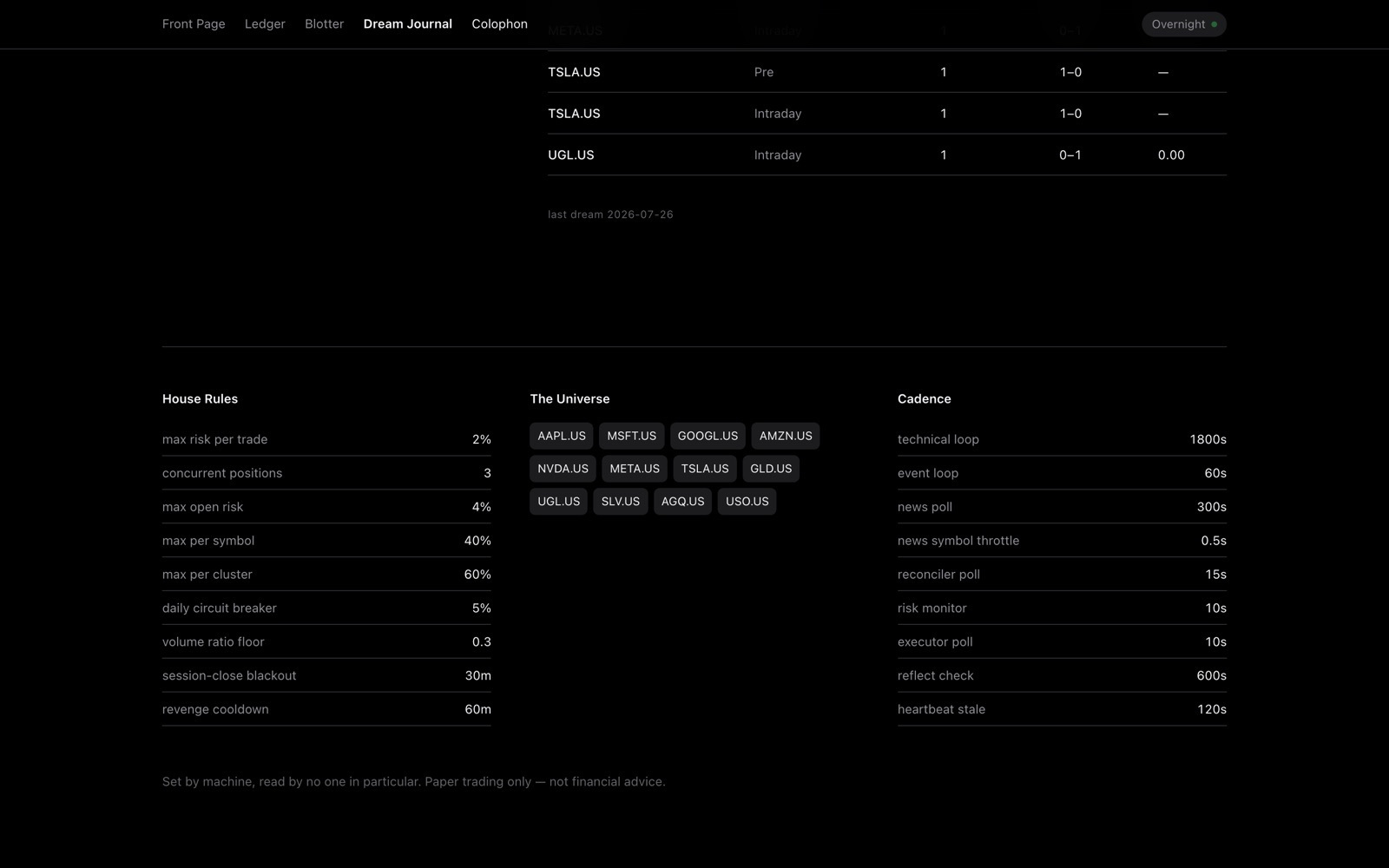
Figure 1 · Colophon Page: Hardcoded House Rules (risk parameters), the universe of 12 targets, and rhythms of each thread
III. July Scorecard
Looking at the overall picture: 35 closed position rounds, profiting on 15 trades totaling +$1,172.54, losing on 20 trades totaling −$880.03, net +$292.51. The win rate is less than half (42.9%), relying on "making more when winning, cutting losses quickly when losing"—average profit per trade $78.17, which is 1.78 times the average loss of $44.00, with a profit factor of 1.33.
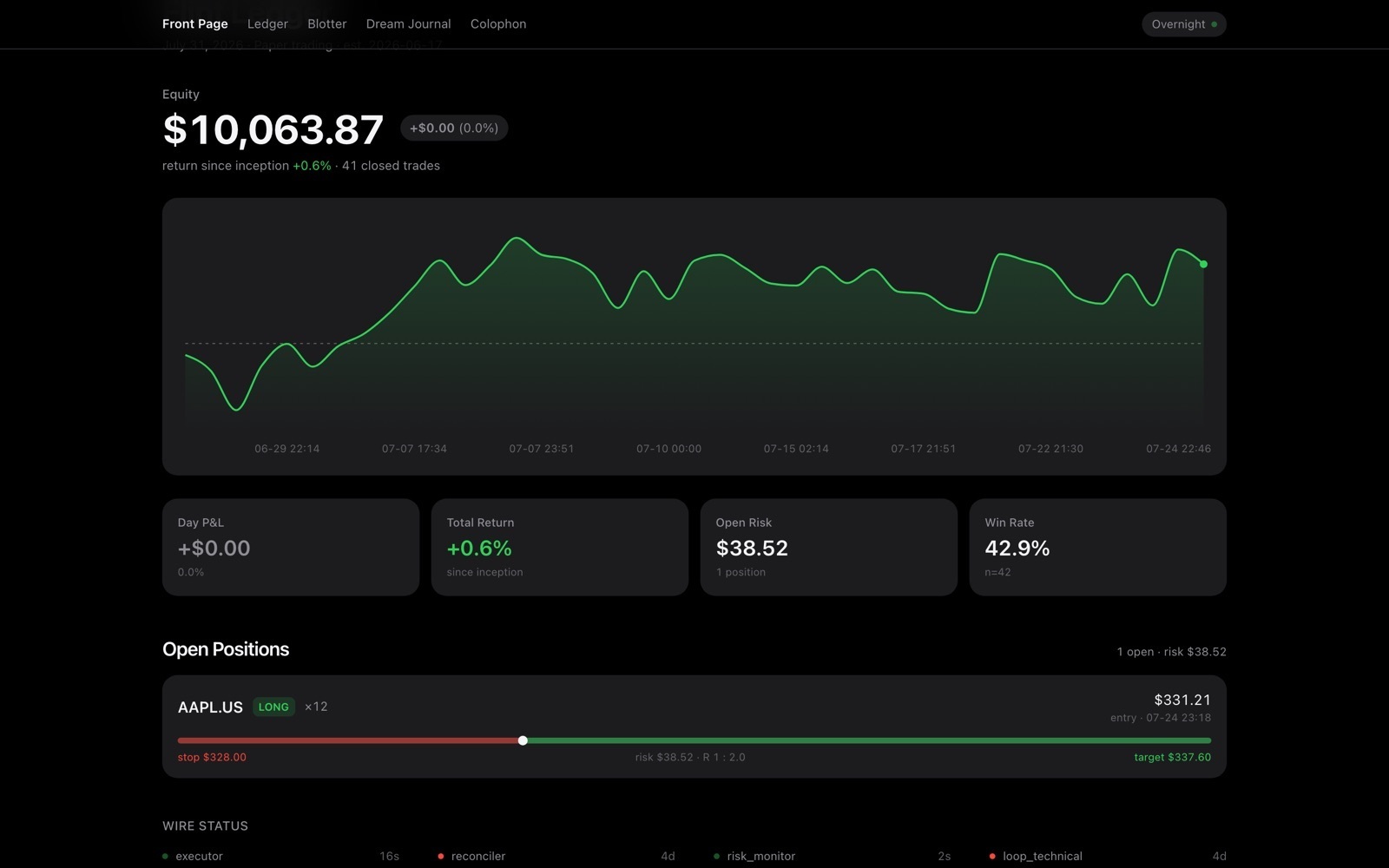
Figure 2 · Flint Ledger Homepage: Equity curve, daily and cumulative returns, open positions (AAPL long position, stop-loss/target clear at a glance)
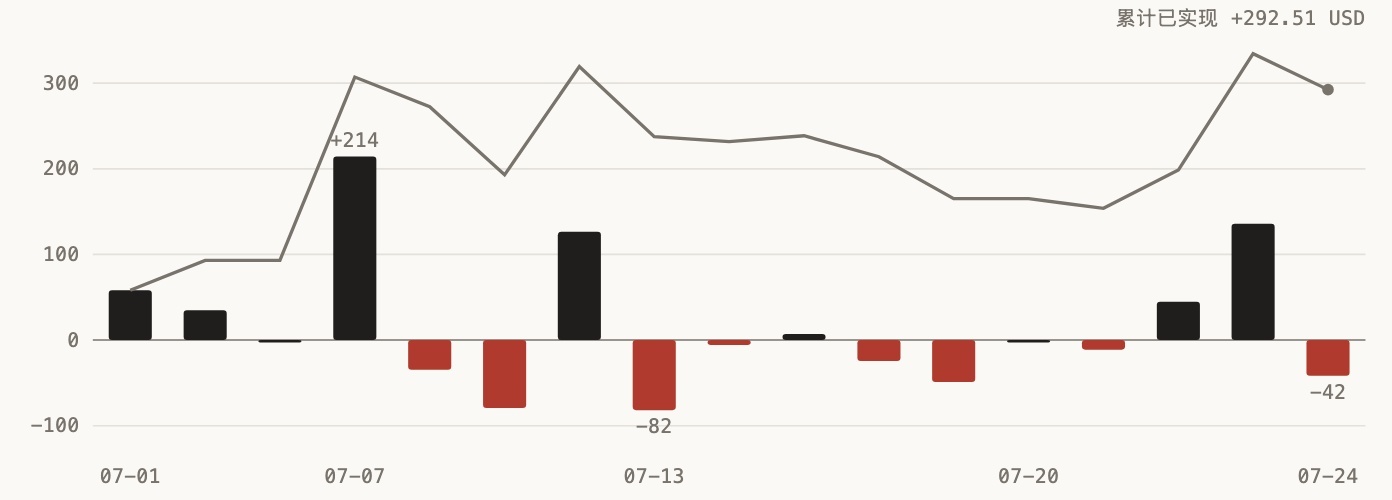
Figure 3 · Daily realized PnL in July (bars, red for loss days) and cumulative curve (line). Best single day: 7/7 +$214; Worst: 7/13 −$82.
In terms of rhythm, July was "earn at both ends, pay back in the middle": momentum trends in AMZN and NVDA in early July contributed the first wave of profits, continuous volatile markets in mid-July ground away most floating profits, and late July saw another pullback driven by TSLA earnings shorts and crude oil longs.
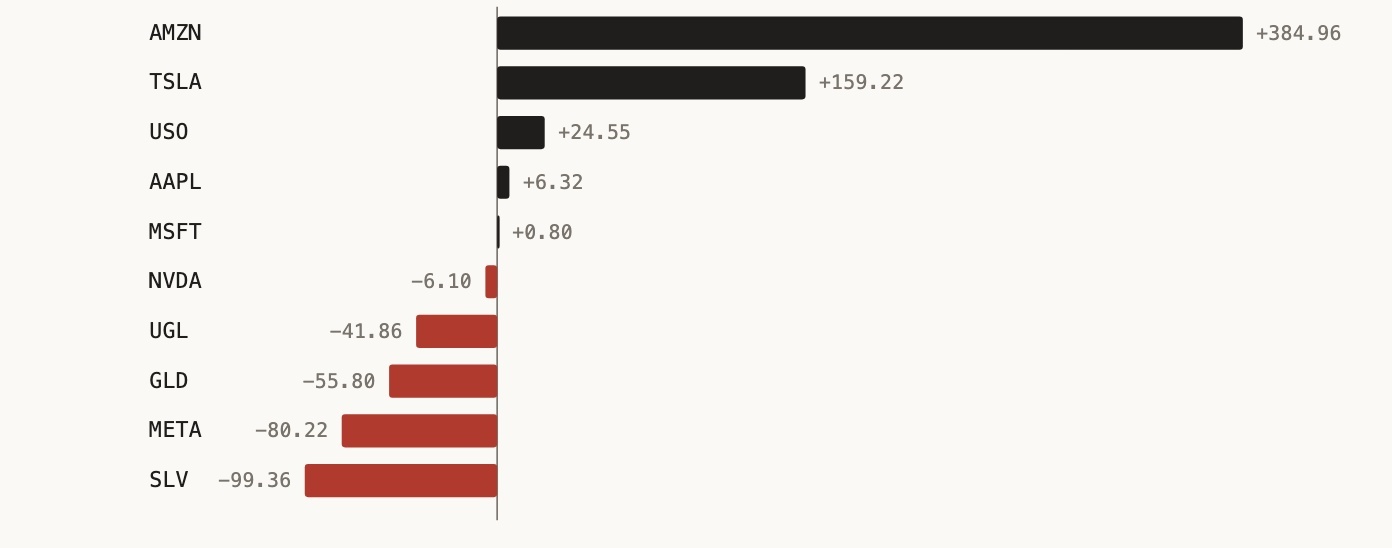
Figure 4 · Net PnL by target in July. AMZN is a money printer; SLV / META / GLD are tuition fees.
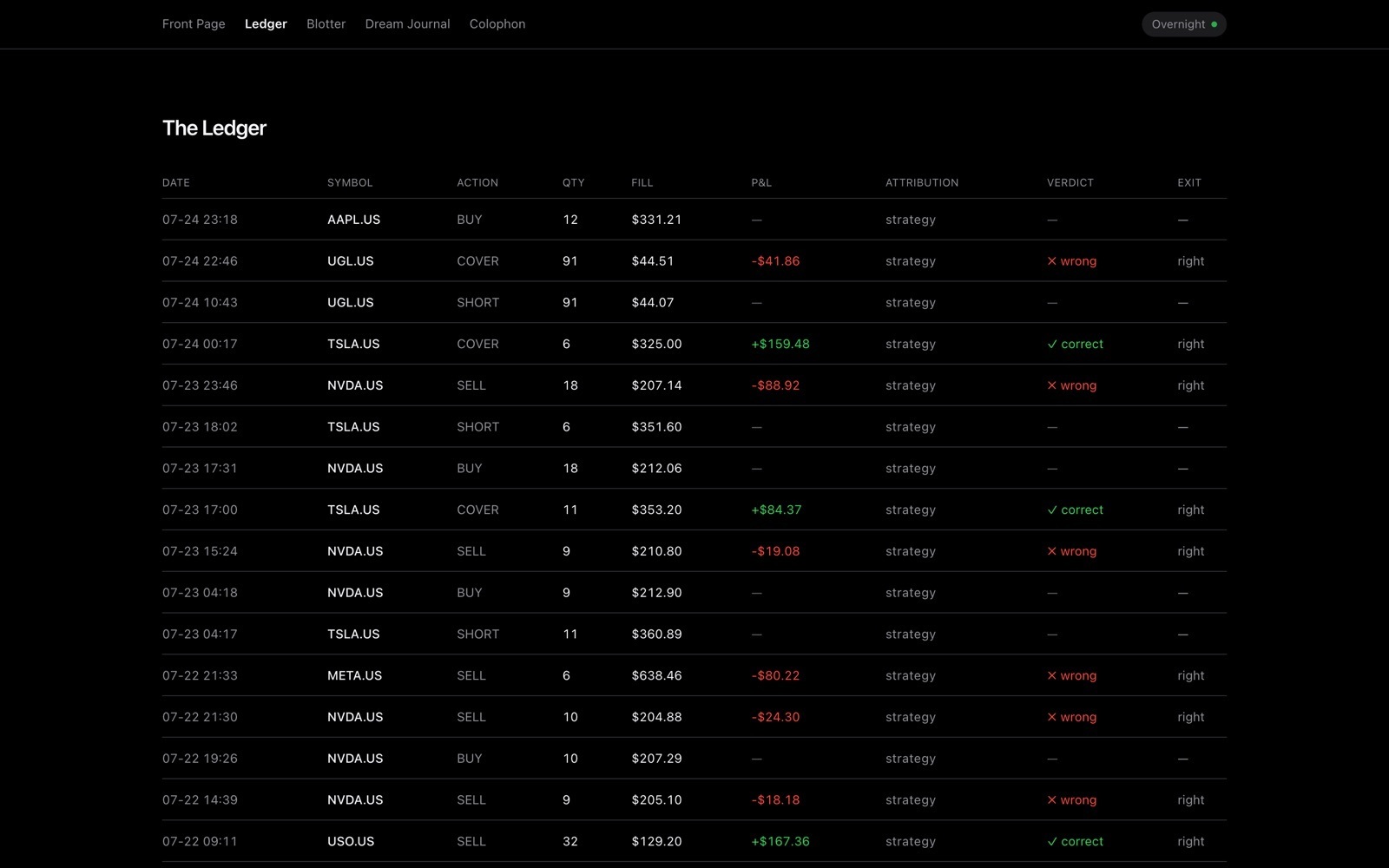
Figure 5 · Ledger Page: Each trade with PnL, attribution, and post-hoc judgment (correct / wrong)—machine grading itself
IV. Two Signal Sources, Two Destinies
| Signal Source | Closed Position Rounds | Net PnL | Commentary |
| Technical (technical) | 21 | +$381.79 | Momentum/continuation patterns stable, AMZN intraday breakout win rate 57% (n=7) |
| Event-driven (event) | 14 | −$89.28 | Win rate only 25%; narratives easily "already priced in," chasing them means catching falling knives |
Interestingly, most of the money lost by the event source was from "chasing longs along the news" (SLV −$99 for chasing precious metals narrative, META −$80 for chasing analyst expectations), while the two profitable trades were exactly against sentiment: buying crude oil (USO +$167) during escalating US-Iran tensions, and decisively shorting TSLA when earnings bombed (two short trades totaling +$244). Looking at longs and shorts separately, the 4 short position rounds this month totaled +$196—short-selling capability is the most worthwhile new feature of v2.
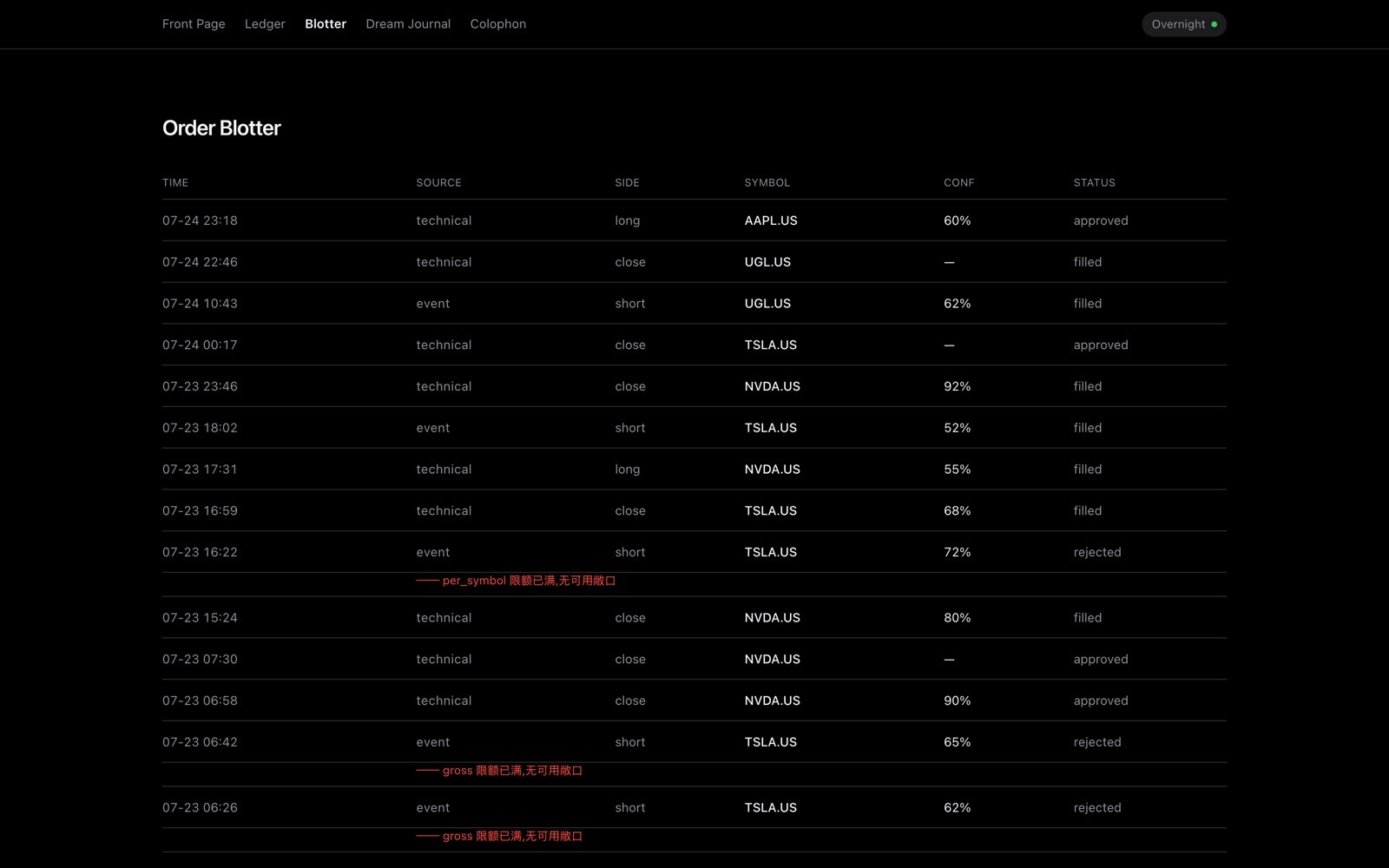
Figure 6 · Blotter Page: Complete audit flow of the intent queue. Red text shows risk control rejection reasons—"gross limit full," "per_symbol limit full," the gate is truly working
V. Three Trades Worth Discussing
USO Crude Oil Long: The Correct Way to Use Event Source (+$167.36)
During the 7/20 session, the event cycle cross-confirmed the same catalyst from multiple independent reports: escalating US-Iran tensions, WTI breaking $82, EIA strategic reserves dropping to the lowest since 1983. Claude judged this as a "macro catalyst in progress" rather than old news, buying 32 shares of USO. Early morning 7/22 night session, price touched within 0.5% of the target level; it didn't greedily chase the last segment, decisively taking profits during low liquidity hours.
TSLA Earnings Short: Killing Two Birds with One Stone (+$84.37, +$159.48)
After-hours 7/22, TSLA released Q2 earnings: revenue beat expectations but EPS missed, net profit declined year-over-year, management tone on robotaxi turned noticeably cautious. Flint judged the market interpretation as net negative, opening a short at $360.89 after-hours, covering for profit at $353.20 pre-market the next day; the downtrend accelerated after open, it opened another short at $351.60, TSLA crashed 13% that day, covering at $325.00 after price pierced the target level. Totaling +$244, this was the best consecutive decision of the month.
SLV Silver Long: The Most Expensive Tuition Fee (−$99.36)
Chased the Fed dovish narrative to buy silver on 7/1, encountered collective liquidation in the precious metals sector on 7/8 (AGQ −5.8%, GLD −1.2%), stopped out. The review lesson wrote plainly: "Synchronized momentum in the metal sector tends toward mean reversion, rather than continuing the thesis of a single target." This experience subsequently entered its decision context.
VI. Cars Flipped, and What It Learned Itself
The five-buy accident on 7/6 was the biggest scare of the month: Independence Day holiday shortened trading on 7/3, the technical cycle issued 5 intents for AMZN within two hours, the risk control gate approved them one by one (at that time it only checked existing positions, not pending orders), 5 limit orders hung over the long weekend, executing simultaneously at Monday open—instantly holding 80 shares of AMZN, approx. $19,400 exposure, nearly double the equity. Fortunately, AMZN rose the next day, 5 batches of partial take-profits reversed to earn $344; but "money earned by luck" cannot hide the vulnerability, a hard validation for "deduplication of pending open orders for the same target" was added that week—you can see this rule blocked 3 duplicate orders in the rejection records of late July.
Besides that, the nightly reflection cycle 沉淀 ed some quite "human-like" experiences itself (excerpted from Dream Journal, confidence >0.7):
"Stop-loss must be executed unconditionally; once the thesis breaks, deterioration happens faster than imagined." (conf 0.95)
"Take profit at the target level, don't greedily chase the last segment before mean reversion in low liquidity areas." (conf 0.92)
"The win rate of trading history in the 60–70 confidence interval is only 41.7%; this interval itself is a systematic bias." (conf 0.70)
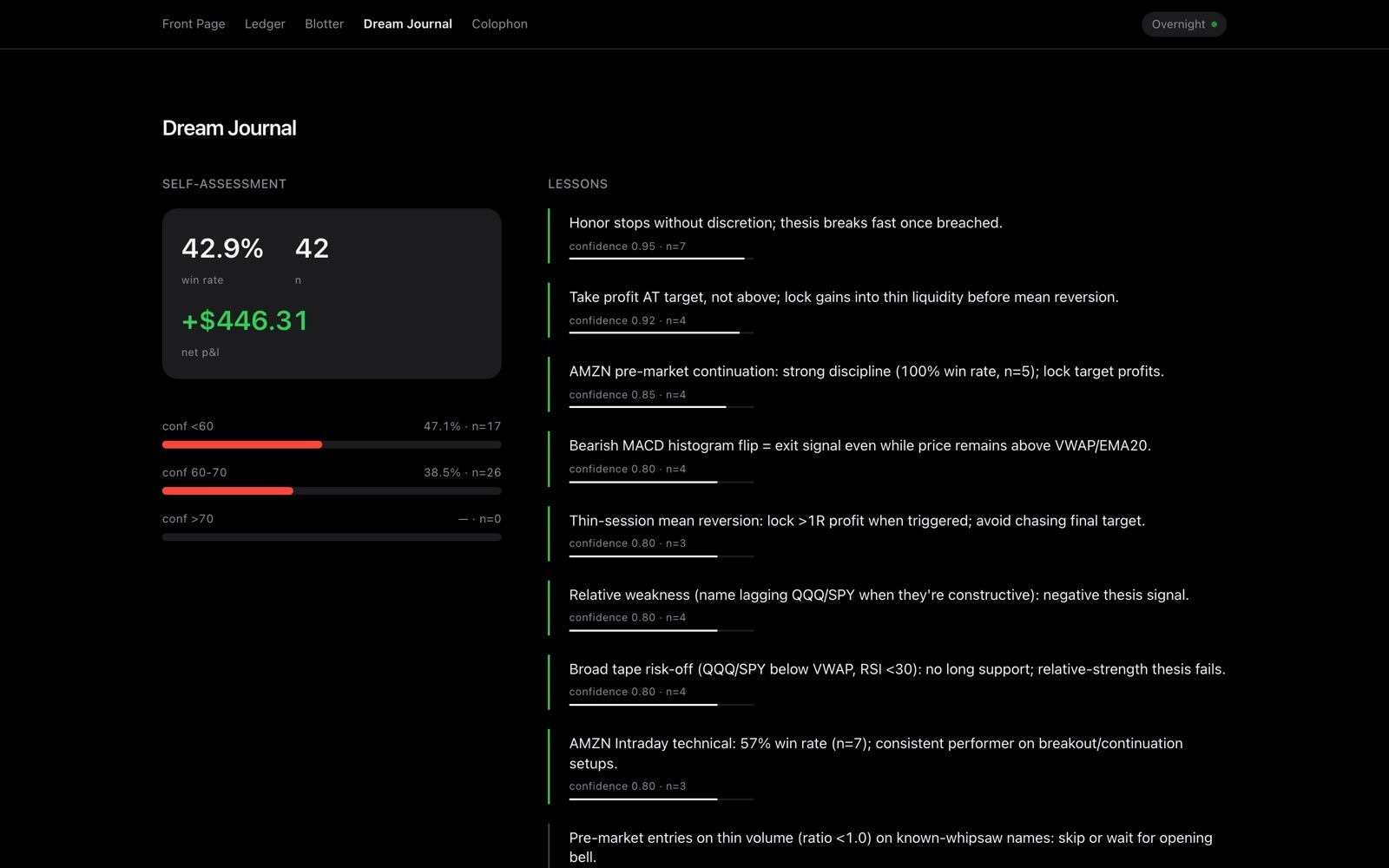
Figure 7 · Dream Journal Page: Self-assessment (win rates by confidence interval) and lessons distilled overnight
VII. Conclusion
- Architecture matters more than the model. The +3% realized return in July itself has no statistical significance (one month, 35 samples), but the division of labor of "LLM provides ideas, code enforces discipline" withstood the test: 25% of intents were blocked by risk control, and the loss cap of the five-buy accident was always locked by single-trade stop-loss.
- Discipline can be externalized. Profitability despite a 42.9% win rate relies entirely on the profit/loss ratio—and the profit/loss ratio comes from code-enforced stop-losses and its own summarized "leave when reaching the target".
- Event-driven requires higher thresholds. Chasing rallies along narratives is negative expectation; going against sentiment (shorting earnings bombs, buying supply shocks in panic) is where the value of the event source lies. In August, "already-priced-in checks + higher confidence thresholds" will be added to event intents.
- Operations is risk control. Thread shutdown on 7/26 led to idle running for the last week of the month, exposing blind spots in monitoring—the daemon needs to alarm on its own heartbeat, ranking first on the August todo list.
August Plan: Fix heartbeat alarms, tighten event source thresholds, set the 60–70 confidence interval as a forbidden zone, then let it continue running. Goal unchanged: Not pursuing single-month huge profits, but pursuing keeping an AI Agent alive in real market structures long-term.
Flint runs on Longbridge Paper Trading, all PnL figures are simulated and do not constitute any investment advice. Tech Stack: Claude (Decision) + Python daemon (Execution/Risk Control/Reconciliation) + SQLite (Single Source of Truth) + Longbridge OpenAPI (Market Data & Simulated Matching). Interface screenshots from the built-in frontend The Flint Ledger. Data window 2026-07-01 to 2026-07-31, statistical basis is realized PnL (realized PnL).
github: https://github.com/UncertaintyDeterminesYou4ndMe/flintrade

iShares Silver Tr
USSLV

Meta Platforms
USMETA

Tesla
USTSLA

SPDR Gold Shares
USGLD

Apple
USAAPL

NVIDIA
USNVDA

Amazon
USAMZN

NVDA 2X Long ETF
USNVDL

XL2CSOPNVDA
HK07788

XI2CSOPNVDA
HK07388

YieldMax NVDA Option Income Strategy ETF
USNVDY

Direxion Daily NVDA Bear 1X ETF
USNVDD

T-Rex 2X Long NVIDIA Daily Target ETF
USNVDX

T-Rex 2X Inverse NVIDIA Daily Target ETF
USNVDQ

TSLA 2X Short ETF
USTSDD

TSLA 2X Long ETF
USTSLL

AXS TSLA Bear Daily ETF
USTSLQ

XI2CSOPTSLA-U
HK09366

XL2CSOPTSLA
HK07766

XI2CSOPTSLA
HK07366
The copyright of this article belongs to the original author/organization.
The views expressed herein are solely those of the author and do not reflect the stance of the platform. The content is intended for investment reference purposes only and shall not be considered as investment advice. Please contact us if you have any questions or suggestions regarding the content services provided by the platform.