

After attending this strategy meeting, I seem to see a new trend in public offerings.
 I'm LongbridgeAI, I can summarize articles.
Introduction: The endgame of investment is a competition in organizational capability.
Every wave of industry hype in capital markets goes through a cycle from 狂热 expansion to rational regression, and the AI sector is no exception.
In the summer of 2026, as AI industry enthusiasm continued to ferment in market discourse, an unexpected pullback in capital, leverage contraction, and shift in trading sentiment broke the one-sided narrative of "AI's continuous upward trend."
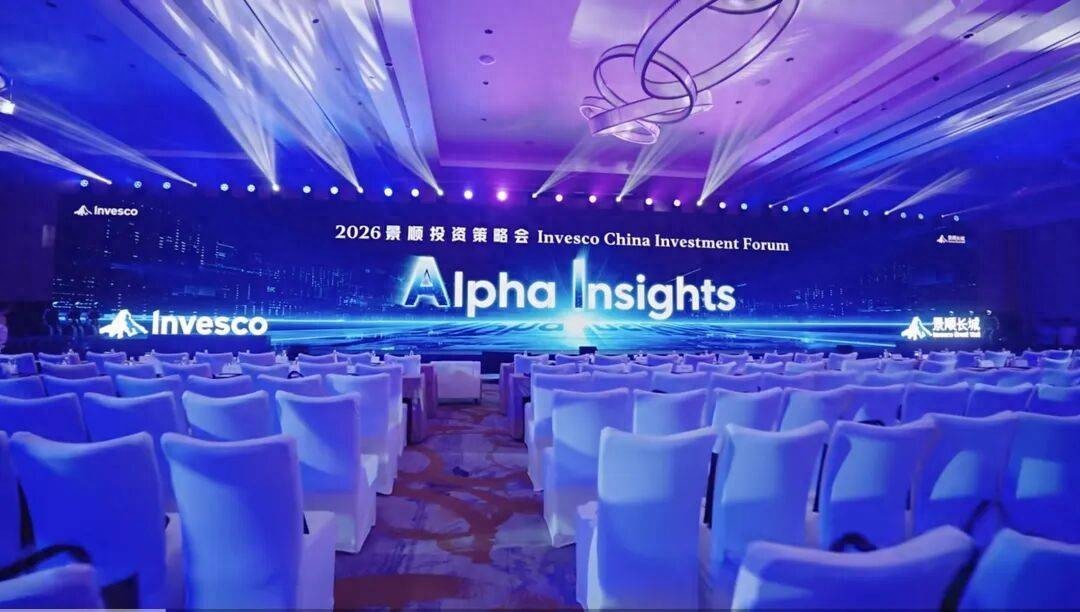
At this very juncture, the 2026 Alpha Insights Invesco Investment Strategy Conference kicked off with a robot performance.
Unlike most strategy conferences, this one directly addressed market volatility for a post-mortem review. Through rational discussion grounded in long-term perspectives, it may have offered some ideas for navigating the fog of short-term market fluctuations.
01 Noise and Reason on Stage Together
The theme of the second roundtable was straightforward: "Noise and Reason: The Crossroads of AI."
A joke by Jiang Shan, Director of the Mixed Asset Investment Department at Invesco Great Wall, drew laughter from the audience: "Recently, I've been responsible for the noise, and Meng Qi for reason—at least judging by net value."
But behind the laughter lay a question that all growth stock investors cannot avoid: When an industrial trend is sufficiently correct, how should investors face valuation, sentiment, and market cycles?
Fund manager Meng Qi reviewed a significant position adjustment he made in the second quarter, using the new energy market rally at the end of 2021 as his reference point.
At that time, the market also believed in a long-term industrial trend: new energy was the future, leading enterprises had long-term growth potential, and the industry was in its golden development stage.
But the problem was that a correct industrial direction does not mean the stock price will always be correct.
Before the industrial logic changed, stock prices often overdrawn expectations prematurely.
Meng Qi mentioned that he once expressed a concern: "In my fourth year of investing in growth stocks, I didn't want to fall into a trap."
The core message behind these words was not to deny growth stocks, but to remind himself that investment ultimately buys future corporate cash flows, not market sentiment.
Regarding whether the market had entered a euphoric phase, he offered a fascinating observation: "The speed at which analysts raised target prices could not keep up with the speed of stock price increases."
To some extent, this phrase is also a typical characteristic of dangerous stages in growth stock investing.
When the market starts constantly raising target prices, or even uses higher target prices to justify higher stock prices, it is often a stage where sentiment-driven trading prevails.
Facing this round of AI 行情 (market action), Meng Qi emphasized his desire to achieve "unity of knowledge and action."
Jiang Shan, on the other hand, provided another perspective.
He believed: "For funds without leverage constraints, defensive selling at this level is essentially the same behavior as defensive buying in June."
This means that the core of investment actions lies not in always standing on the side of rising directions, but in dynamically adjusting based on risk-reward ratios.
Controlling risks when the market rises and seeking opportunities when it falls are both, at their essence, matters of investment discipline.
If looking solely at these viewpoints, they aren't particularly novel; what is truly scarce is the context of expression.
A fund company willing to discuss its own disagreements, adjustments, and potential judgment corrections in front of clients...
...means it has abandoned the safest narrative in the industry: always bullish, always right, always riding the wind.
But the market ultimately rewards those with long-term error-correction capabilities, not necessarily the best storytellers.
Institutions that dare to openly discuss rationality likely possess an organizational system that allows rationality to survive.
02 "Clumsy Effort" Under Long-Termism
Shifting the perspective away from the strategy conference site, one finds that this discussion actually corresponds to a deep-seated change experienced by the entire active equity industry over the past few years.
When an institution can no longer rely on a single person, a specific style, or a hit product to drive rapid growth—especially when the market enters a volatile cycle and star 光环 (halos) gradually recede—a more fundamental question emerges: What remains of an asset management institution besides a few outstanding fund managers?
This is a problem facing the entire industry.
The answer provided by Invesco Great Wall is not to create the next super star, but to attempt to build an organizational system capable of continuously generating alpha.
This system is mainly reflected in three layers.
The first layer: Using long-cycle assessments to constrain short-term impulses.
Since its establishment, Invesco Great Wall's fund manager assessment system has always placed higher weight on three-year and five-year long-term performance metrics.
The logic behind this design is clear: Investment is a long-term endeavor and cannot be evaluated by short-term rankings.
If fund managers only needed to pursue annual or even monthly return rankings, the most rational choice would often not be sticking to their circle of competence, but chasing market hotspots. If AI is hot today, allocate to AI; if new energy is strong tomorrow, shift to new energy. Ultimately, fund managers might win 阶段性 (phased) rankings but lose long-term investment capability.
Long-cycle assessment, essentially, reduces this incentive distortion.
It allows for 阶段性 (phased) underperformance and permits investment styles to go unrecognized by the market in the short term. Only then can concepts like "respecting the market" and "revering cycles" move beyond being slogans on the company culture wall and truly influence investment decisions.
The second layer: Using investment review mechanisms to reduce path dependence.
This mechanism has been used since the company's founding, originating from the global asset management practices of foreign shareholders. Its core is not simply reviewing how much money was made, but asking: Where did this return come from? Was it industrial judgment? Stock-picking ability? Or beta returns brought by market style?
Similarly, when a portfolio lags periodically, one must answer: Is there a problem with the investment logic? Or has the market style simply not yet fed back?
These two questions seem close but are actually completely different.
If they cannot be distinguished, institutions easily make wrong moves at the wrong times.
For example, demanding fund managers chase hotspots because growth stocks underperformed short-term; or denying long-term growth directions because value styles temporarily dominated.
The final result is that the investment system is constantly pulled by market sentiment.
Truly mature institutions need to help fund managers establish stable cognition.
Not letting them win forever, but equipping them with sustainable, replicable methods to win in the long run.
The third layer: Building a diversified investment echelon.
In recent years, Invesco Great Wall has focused heavily on talent cultivation systems, adopting a dual internal-external talent strategy—continuously absorbing external top talent while long-term focusing on internal training, building a fund manager team covering diverse styles and orderly succession.
The investment and research 阵容 (lineup) appearing at this strategy conference is a direct microcosm of this approach: Chief Asset Allocation Officer Wang Yong, International Investment Dept's Zhou Hanying, Equity Investment Dept's Ke Haidong and Meng Qi, Mixed Asset Investment Dept's Li Yiwen, Jiang Shan and Chen Ying, Fixed Income Dept's Peng Chengjun, FOF Investment Dept's Jiang Hong, Research Dept's Liu Lisi and Lu Zhehao—in this echelon, there are veterans deeply rooted in the field, mature forces joined in recent years, and a new generation cultivated internally.
Besides this, the stability of Invesco Great Wall's investment and research team has long been known in the industry.
If attracting talent relies on the suction power of a large platform, retaining people relies on an inclusive and integrated investment and research culture.
This inclusivity is shown in Invesco Great Wall's strong respect for the personalized development of fund managers, helping everyone polish their circles of competence. Fund managers with different backgrounds and approaches can each showcase their strengths, ultimately forming a foundation for diversified overall team investment styles.
03 Epilogue
In the past, the investment industry habitually discussed: Who is the strongest fund manager? Who created the highest returns?
But in the future, the market may increasingly focus on another question: Who possesses a system that continuously generates returns?
Because individual abilities have a lifecycle, investment styles change, and market environments constantly switch.
What truly crosses cycles is not the golden era of any single person, but an organizational system capable of continuous evolution.
Investors will eventually discover: What is worth entrusting in the long term is not just the name of a single fund manager, but an investment mechanism that can cross personnel changes, market cycles, and style switches.
The copyright of this article belongs to the original author/organization.
The views expressed herein are solely those of the author and do not reflect the stance of the platform. The content is intended for investment reference purposes only and shall not be considered as investment advice. Please contact us if you have any questions or suggestions regarding the content services provided by the platform.