
 我是 LongbridgeAI,我可以总结文章信息。
美国清洁能源资本支出预计将在 2026 年达到创纪录的 1800 亿美元,尽管联邦激励措施减少,但仍受到人工智能需求和市场韧性的推动。公用事业规模的电池储能达到了 52 吉瓦,年增长率为 70%,仅在 2026 年上半年就增加了 8.3 吉瓦。电网运营商在 2028 年前有 54 吉瓦的项目排队。全球范围内,中国占据了一半的储能容量,而欧盟计划到 2030 年将其储能容量增加三倍
Authored by Haley Zaremba via OilPrice.com,
- U.S. utility-scale battery storage has reached 52 GW after three years of 70 percent average annual growth, with 8.3 GW of that added in the first six months of 2026 alone.
- Clean energy capital spending hit $74 billion in the first half and is on pace for a record $180 billion this year, even after the rollback of federal incentives.
- Grid operators have another 54 GW queued through 2028, while China holds roughly half of global capacity and the EU moves to triple its own by 2030.
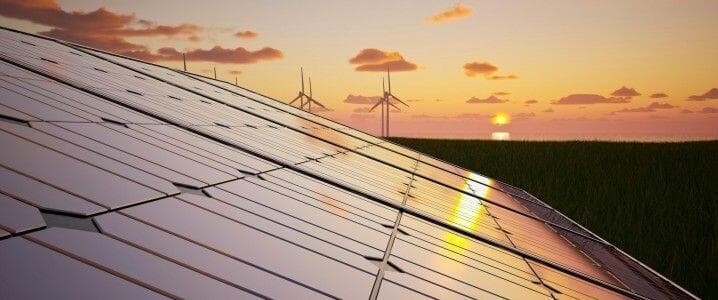
Donald Trump is accidentally overseeing a massive buildout of the country's renewable energy capacity and infrastructure. Not only are investments in renewable technologies soaring to new highs, the national energy grid is rapidly transforming to accommodate an increasingly solar- and wind-powered energy mix.
Despite massive rollbacks of Biden- and Obama-era clean energy incentives and financial supports, investment in clean energy tech keeps soaring to new heights, buoyed by market forces far outside of the federal government's control. Clean energy capital expenditures already reached $74 billion in the first half of 2026, and they're on track to reach a record $180 billion by the end of the year, according to fintech firm Crux's State of Clean Energy Finance: 2026 Mid-Year Market Intelligence Report.
"The market is proving resilient," Crux CEO and co-founder Alfred Johnson was recently quoted by Politico's E&E News. "We're seeing a significant amount of investment subsequent to the tax law changes of last year."
The insatiable energy demand coming from data center hyperscalers and the artificial intelligence boom has spurred a tidal wave of investment into all kinds of energy projects, and especially renewables due to their noted advantages when it comes to energy security and affordability. These advantages have been underscored in recent months by extreme volatility in fossil fuel markets thanks to the war in Iran and resultant supply chain vulnerabilities. "Renewables and storage continue to be the fastest way to get new electrons on the grid until additional gas-fired generation can be built," NextEra Energy CEO John Ketchum was recently quoted by Reuters.
As a result, we are currently "living in what arguably is one of the best periods to invest in renewables in the US over the last 20 years" according to Miguel Stilwell d'Andrade, chief executive officer of Portuguese electric utilities company EDP. Accordingly, EDP is directing approximately USD $5.3 billion - more than half of its capital expenditures - toward United States renewables projects over the next three years.
All of that renewable energy buildout is being accompanied by a massive and unprecedented uptick in battery storage buildout, resulting in a rapid transformation of the nation's energy grid. Over the past three years, utility-scale battery storage capacity increased at a blistering rate of 70 percent per year on average to reach 52 gigawatts (GW) today. Nearly 16 percent of that - 8.3 GW - was added in the first half of this year alone.
"This expansion depends mostly on co-locating batteries with solar photovoltaic (PV) plants to capitalize on wholesale price arbitrage across major energy markets," Interesting Engineering reported earlier this week. Connecting battery packs directly to solar farms allows the farms' operators to store excess clean energy at peak production hours until the evening hours, when production wanes, demand rises, and rates reach a premium. "This lucrative business model has sparked a massive construction boom across solar-heavy states, turning temporary energy storage into a primary driver of modern grid infrastructure," Interesting Engineering goes on to report.
As stunning as this year's figures are, the battery storage revolution is just getting started. Grid operators already have plans to add another 54 GW of battery capacity by the end of 2028. That means that the nation's energy storage capacity will double again by 2030, compared to current levels.
And the United States is not alone - the energy storage renaissance is proving to be a global trend. China is leading buildout by a wide margin, controlling more than half of global capacity. But other major global leaders are hurrying to get a foothold into the rapidly expanding market. Just this month, the European Union formalized a plan to triple the bloc's energy storage capacity by 2030. European Leaders are banking on energy storage - alongside renewable energy expansion - to steady the continent's energy markets and protect member states from the next energy crisis.