AI Investing Platforms Comparison — Which One Is Right for You?
AI 交易软件并非千篇一律。本文比较七类 AI 投资工具,涵盖通用大型语言模型到一体化平台,助你找到最契合自身策略的选择。
"AI trading platform" is one of the most overloaded phrases in finance right now. It can mean a chatbot grafted onto a legacy brokerage app, a fully personalised system that learns your portfolio over months, or anything in between. Choosing the right AI trading software starts with knowing which category you're actually looking at.
This guide maps the landscape into seven distinct types. Each has a clear profile — who it suits, and where it falls short.
1. For Learners & Explorers: General-purpose large language models
Examples: ChatGPT, Claude, Gemini used directly for investment queries
Best for: Building financial literacy and thinking through ideas. Not a substitute for dedicated AI trading software when real decisions are on the table.
Most people start here. You ask an LLM to explain a balance sheet, summarise a sector, or pressure-test a thesis. For learning and exploratory thinking, it genuinely delivers.
But there's a hard ceiling. These models have a training data cutoff, no access to live prices, and no visibility into your actual holdings. Every answer is calibrated for a hypothetical investor, not you specifically. And there's no path from analysis to action — the moment you want to trade, you're on your own.
2. For Deep-Dive Researchers: AI-powered research platforms
Examples: Seeking Alpha AI, Morningstar AI features, quantitative screeners with AI layers
Best for: Investors who enjoy going deep on fundamentals. Less suited to anyone who wants their analysis and trading in the same flow.
These platforms are built for investors who treat research as a discipline in itself. Factor analysis, earnings history, back-tested signals, valuation models — the depth is real, and the data coverage tends to be broad.
The structural problem is that research and execution live in different places. You spend an hour building conviction, then leave the platform entirely to act on it. Personalisation is also limited: the tool doesn't know what you already hold, what your risk appetite looks like, or how a new idea fits your current exposure.
3. For Platform-Loyal Investors: Broker-native AI
Examples: AI assistant features embedded in traditional brokerage apps
Best for: Investors who want incremental AI improvement on a platform they already use, without switching anything.
The natural advantage here is data access — your holdings, transaction history, and cash balance are already in the system. A broker-native AI can work with that context without any setup on your part.
The limitation is institutional: these features are built by teams whose core job is running a brokerage, not shipping AI products. Capability tends to lag behind specialist tools, update cycles are slow, and "AI-enhanced" often amounts to natural language layered over functions that already existed. That ceiling is real, even if it's difficult to gauge before you're already using the product.
4. For Quants & Developers: Open APIs and developer tools
Examples: Webull Open API, Futu OpenD, institutional-grade data feeds
Best for: Quantitative developers and systematic traders who want to build rather than consume.
Maximum flexibility, maximum friction. If you can write Python, you can build a custom signal pipeline, connect any AI model you like, and design your strategy logic from scratch. The data quality at this tier is typically excellent.
The trade-off is that you're not using an AI trading platform — you're building one. That means infrastructure decisions, ongoing maintenance, and the kind of compounding technical debt that tends to arrive quietly. For most retail investors, this is the wrong category entirely.
5. For Power AI Users: MCP-based financial skills
Examples: Longbridge Skill, Futu Skills, moomoo Skills Hub
Best for: Investors who already work regularly with AI assistants and want to add professional-grade financial capability without changing their setup.
Unlike the build-it-yourself approach of developer tools, MCP takes a different path — and it's recent enough that many retail investors haven't encountered it yet. The idea is straightforward: rather than building a new AI tool from scratch, you extend an existing one — injecting real-time market data and account information into a conversation with Claude or another model you already use.
The practical difference from developer API tools is meaningful. You're not writing integration code or maintaining infrastructure; you're adding a layer to an interface you already have a workflow inside. Personalisation can go deep because you're shaping the context directly. That said, implementations vary. Longbridge Skill is built around a cloud-to-cloud connection model designed for continuity between sessions; alternatives tend to suit users who prefer managing their own local environment.
6. For Serious Retail Investors: Integrated AI investment platforms
Examples: LongbridgeAI and similar end-to-end platforms
Best for: Retail investors who want AI embedded in their actual investment process, not added on top of it.
This is the category most retail investors have in mind when they picture a proper AI trading platform. Signal discovery, analysis, position sizing, trade planning, and execution all sit in the same product. The AI develops a picture of your preferences over time — your risk tolerance, the kinds of ideas you act on, the positions you already hold — and surfaces opportunities in that context rather than in the abstract.
Transparency has become a meaningful differentiator in this space. The better platforms show their reasoning, not just a signal or a rating. That matters for trust, and it also matters for your own development — you learn more from a recommendation when you can see why it was made.
Two things are worth knowing going in. First, genuine personalisation is earned over sessions, not instant — early use will feel less tailored than later use. Second, account linkage is required, which is a real consideration if data privacy is a priority for you.
7. For Beginners Finding Their Feet: Social-AI hybrid platforms
Examples: eToro's AI features, copy-trading platforms with AI signal layers
Best for: Beginners getting comfortable with markets. Worth reassessing as a framework once you've built your own views.
These platforms combine AI analysis with real investor behaviour data. You can see what other traders are doing, follow their positions, and use AI to surface patterns in crowd activity. For someone new to investing, the social dimension removes some of the isolation that comes with making decisions alone.
The risk is structural rather than technical. Copy-trading can quietly replace independent judgement rather than support it. When a popular strategy unwinds, concentrated exits tend to amplify losses — the crowd that moved you in can accelerate the move against you. The better implementations in this category are starting to treat crowd behaviour as one signal among many, rather than the primary input, which changes the risk profile considerably.
A quick decision guide
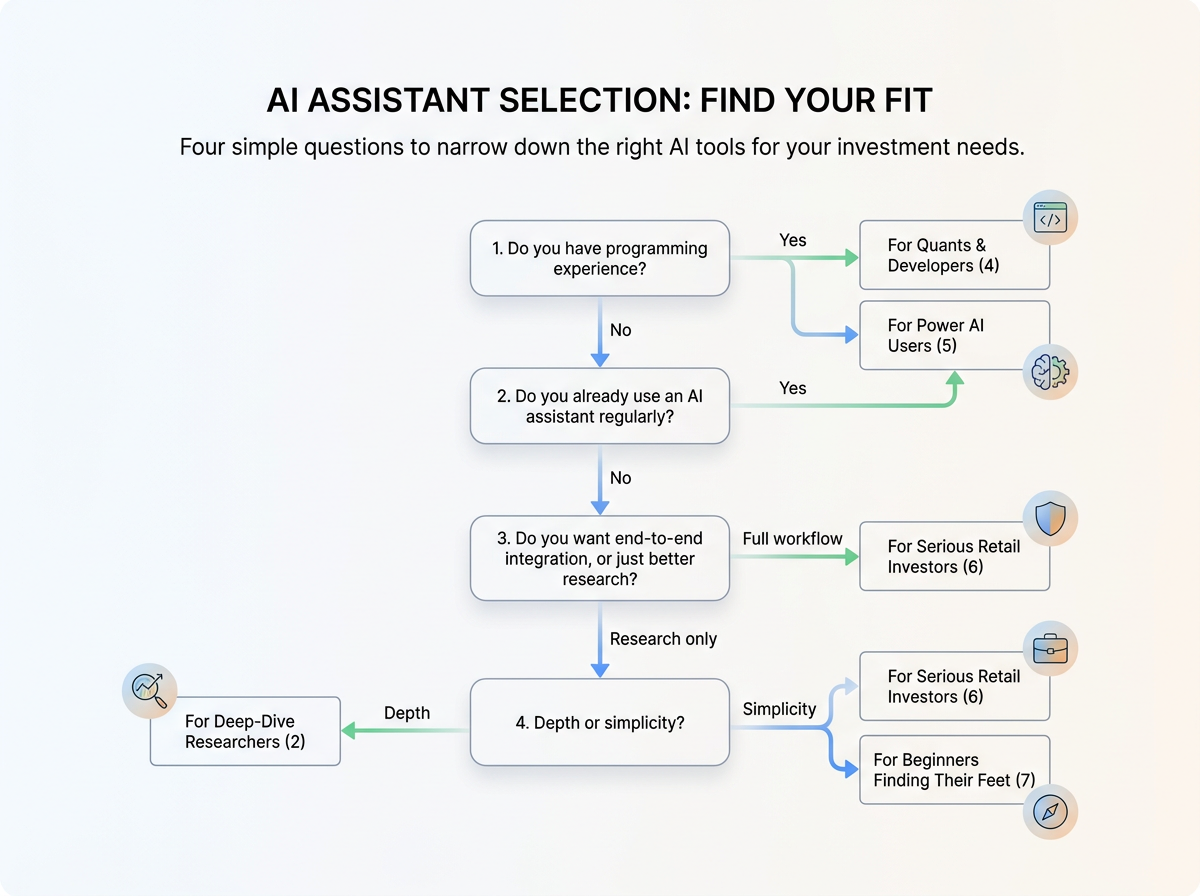
Four questions are usually enough to narrow this down:
Do you have programming experience? Yes → For Quants & Developers (4) or For Power AI Users (5). No → next question.
Do you already use an AI assistant regularly? Yes → For Power AI Users (5) is worth a serious look. No → next question.
Do you want end-to-end integration, or just better research? Full workflow → For Serious Retail Investors (6). Research only → For Deep-Dive Researchers (2) or For Platform-Loyal Investors (3).
Depth or simplicity? Depth → For Deep-Dive Researchers (2). Simplicity → For Serious Retail Investors (6) or For Beginners Finding Their Feet (7).
The comparison at a glance
The five dimensions worth comparing across each type are: real-time data, account integration, personalisation depth, technical barrier, and execution integration.
Each type of AI investing platform comes with its own strengths and trade-offs:
General LLMs and social-AI platforms have the lowest barriers to entry but the shallowest personalisation.
Developer tools offer the highest ceiling but demand continuous investment of time and technical skill.
Integrated AI platforms are the only category that scores high on personalisation while remaining accessible to investors without a technical background — which is why they've become the default starting point for retail investors who take their portfolios seriously.
Discover how LongbridgeAI reads your portfolio and delivers genuinely personalised investment recommendations.
Where this is heading
These categories are real distinctions today, but the boundaries are moving. MCP-based integrations are maturing quickly, and the gap between Type 5 and Type 6 will likely narrow as integrated platforms add protocol-level extensibility. The social-AI category is also evolving — crowd behaviour used as a signal input rather than a follow mechanism is a different product than copy-trading with an AI label.
The underlying question, though, doesn't change with the technology: does this tool make you a more deliberate investor, or just a faster one?
Frequently Asked Questions
Q1: Does AI trading software really work?
It depends on what "work" means to you. AI trading platforms are genuinely useful for processing large amounts of information quickly, surfacing patterns humans would miss, and removing emotional bias. Where they fall short is predicting the unpredictable — no AI eliminates market risk, and tools that imply otherwise are overpromising. The most realistic framing: good AI trading software makes you a more deliberate investor. It augments your judgement rather than replacing it.
Q2: Is there AI that does trading?
Yes, at multiple levels. Institutional algorithmic systems have executed trades autonomously for decades. At the retail level, tools range from AI that recommends actions (you still click the button) to platforms that execute within pre-set parameters. Most retail-facing products today sit closer to the "assist and recommend" end — regulatory frameworks in many markets require a human to remain in the loop for retail accounts.
Q3: What precautions should you take when using AI tools to trade?
A few principles worth keeping in mind:
Understand the reasoning, not just the output. If a tool gives you a signal without explaining why, treat it with caution.
Don't over-automate early. Use AI to inform your decisions before extending it more autonomy.
Check data privacy terms. Account-linked platforms access your holdings and transaction history — know what's stored and how it's used.
Remember that past performance logic has limits. Models trained on historical data can underperform when market conditions shift.
Ask LongbridgeAI anything — start your AI-powered research experience.