U.S. Equity ETF Backtesting Analysis: A Comprehensive Guide to Historical Strategy Validation
ETF backtesting helps investors use historical data to validate a strategy before committing real capital. This article covers backtesting steps, how to interpret performance metrics, and common pitfalls.
TL;DR: ETF backtesting analysis uses historical market data to test investment strategies, helping investors evaluate strategy performance before deploying real capital. This article introduces the core steps of backtesting, key performance indicators, and common pitfalls.
Before investing in U.S.-listed exchange-traded funds (ETFs), many experienced investors conduct ETF backtesting analysis to understand how a given strategy actually performed in past market environments. Backtesting refers to applying a set of clearly defined trading rules to historical data to evaluate a strategy’s returns and risks across different market cycles. Effective ETF backtesting analysis not only deepens market understanding, but also builds a more solid foundation when formulating an investment plan.
什麼是 ETF 回測分析?
ETF backtesting analysis is a systematic testing approach that applies an investment strategy to historical market data to simulate potential trading outcomes over a specific period. The core premise is: if a strategy performs consistently across multiple market environments, it may be more likely to work under similar conditions in the future.
It must be emphasized that historical performance does not guarantee future results. The primary purpose of ETF backtesting analysis is to help investors identify potential risks and assess the reasonableness of a strategy, rather than to predict market direction. Backtests are “hypothetical simulations,” whereas live trading faces real-world market uncertainty—including factors such as insufficient liquidity and market sentiment—so there is inevitably a gap between the two.
ETF 回測分析的核心步驟
To conduct meaningful ETF backtesting analysis, you need to follow a systematic process.
第一步:定義交易規則
Backtesting starts with setting clear and quantifiable trading rules, including entry conditions, exit conditions, and position sizing. The more specific the rules, the more accurately the backtest results will reflect the strategy’s true characteristics. For example, you can set “buy an ETF when the Relative Strength Index (RSI) falls below 30, and sell when the RSI rises above 70” as a basic strategy framework.
第二步:選取優質歷史數據
Data quality is critical to backtest accuracy. Historical price data should be dividend-adjusted to reflect investors’ actual total returns. Avoid datasets with survivorship bias—that is, those that include only ETFs still trading today while omitting funds that have been delisted or liquidated.
提示: The longer the backtest period, the more diverse the covered market environments tend to be, and the higher the reference value of the results often is.
第三步:納入交易成本
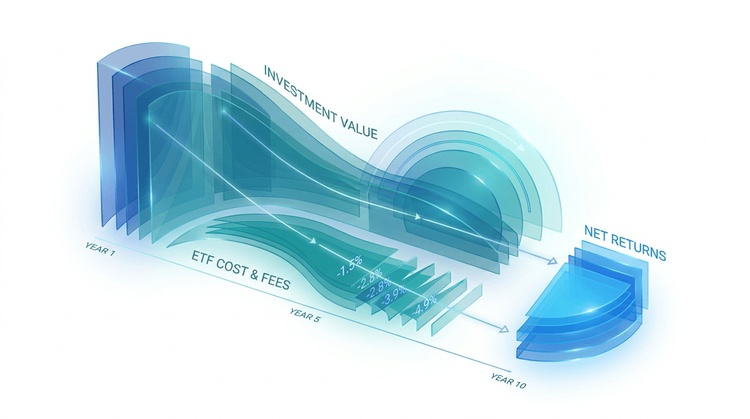
Many backtested strategies underperform in real-world execution because trading costs and slippage (Slippage) are ignored. A backtest should incorporate commissions and the impact of bid-ask spreads to produce results that are closer to reality.
回測的關鍵績效指標
Below are several commonly used performance metrics in ETF backtesting analysis:
Compound Annual Growth Rate (CAGR) reflects the portfolio’s annualized return over the test period and is a foundational metric for assessing overall profitability. Maximum drawdown (Max Drawdown) represents the magnitude of the portfolio’s decline from a historical peak to its lowest point; a smaller figure indicates stronger drawdown resilience. Sharpe ratio (Sharpe Ratio) measures the excess return earned per unit of risk; values above 1.0 are generally considered relatively desirable. Win rate and profit factor represent, respectively, the proportion of profitable trades and the ratio of total profits to total losses; they should be analyzed together to be meaningful.
提示: It is recommended to review multiple performance metrics simultaneously. You may also refer to the Longbridge Academy’s basic guide to fund investing to learn more about asset allocation.
常見誤區與注意事項
Over-optimization (Curve Fitting) refers to repeatedly adjusting strategy parameters to make performance look impressive on historical data, while having little to no predictive power in real markets. A solution is to split historical data into a “training” period and a “testing” period—optimize only on the training period, then validate using the testing period.
Ignoring changes in market environments is also a common issue. A strategy that performed exceptionally well during a past tech bull market may not maintain the same performance after the market environment changes; therefore, a backtest should cover different market cycles.
Leveraged and inverse ETFs are subject to “compounding decay” due to their daily rebalancing mechanism when held over the long term, causing actual returns to deviate significantly from the theoretical multiple. This requires special attention in backtesting.
常用 ETF 回測工具
Portfolio Visualizer is a widely used free tool that supports ETF portfolio backtesting and provides analyses such as returns, risk characteristics, and maximum drawdown, making it relatively easy for investors without programming skills to use. Testfolio supports backtesting of customized asset allocation schemes and can simulate the impact of periodic rebalancing on a portfolio. Investors with a technical background may also consider building their own backtesting system in Python.
If you would like to further explore U.S. stock knowledge, you can refer to the Beginner’s Guide to U.S. Stock Investing.
從回測到實盤
After completing ETF backtesting analysis, it is recommended to begin with a “paper trading” phase—placing simulated orders according to the strategy rules—to verify the strategy’s execution feasibility in real-time markets. Establishing a clear risk management plan, including a maximum loss limit per trade, is essential for long-term sustainability. Longbridge Securities provides U.S. ETF trading services, and investors can access multi-market real-time quotes on the platform. You may visit Longbridge Market Data Services to learn more.
常見問題
回測結果能夠預測未來表現嗎?
No. Backtest results only reflect simulated performance under specific historical market conditions, and past performance does not represent future results. The main value of backtesting lies in identifying a strategy’s potential risks and limitations.
ETF 回測分析適合新手嗎?
The basic concepts are not complicated, but producing analysis with meaningful reference value requires a certain understanding of market data and performance metrics. Beginners are advised to first learn the basic principles of backtesting and common pitfalls, and then gradually deepen their analytical capabilities.
結論
ETF backtesting analysis is an important tool to help investors assess strategy feasibility before implementing it in practice. By following a systematic backtesting process, accurately interpreting performance metrics, and avoiding common pitfalls such as over-optimization, investors can build a more evidence-based framework for investment decision-making. Backtest results are for reference only and do not constitute investment advice. Any investment strategy involves risks, including the possibility of principal loss.
Which tool to choose depends on your investment objectives, risk tolerance, market views, and level of experience. Regardless of which investment tool you choose, you must fully understand its operating mechanism, risk characteristics, and trading rules, and establish a robust risk management plan. You can learn more via Longbridge Academy or download the Longbridge App.