
D


Feb 7, 2024 at 01:07 AM
Shuffling in mature processes takes 4-5 years (SMIC 4Q23 conference call)
SMIC (0981.HK/688981.SH) released its 2023 fourth quarter earnings report (as of December 2023) after the Hong Kong stock market closed on the evening of February 6, 2023. The key points of the conference call are as follows:
1. Review of Core Financial Information:
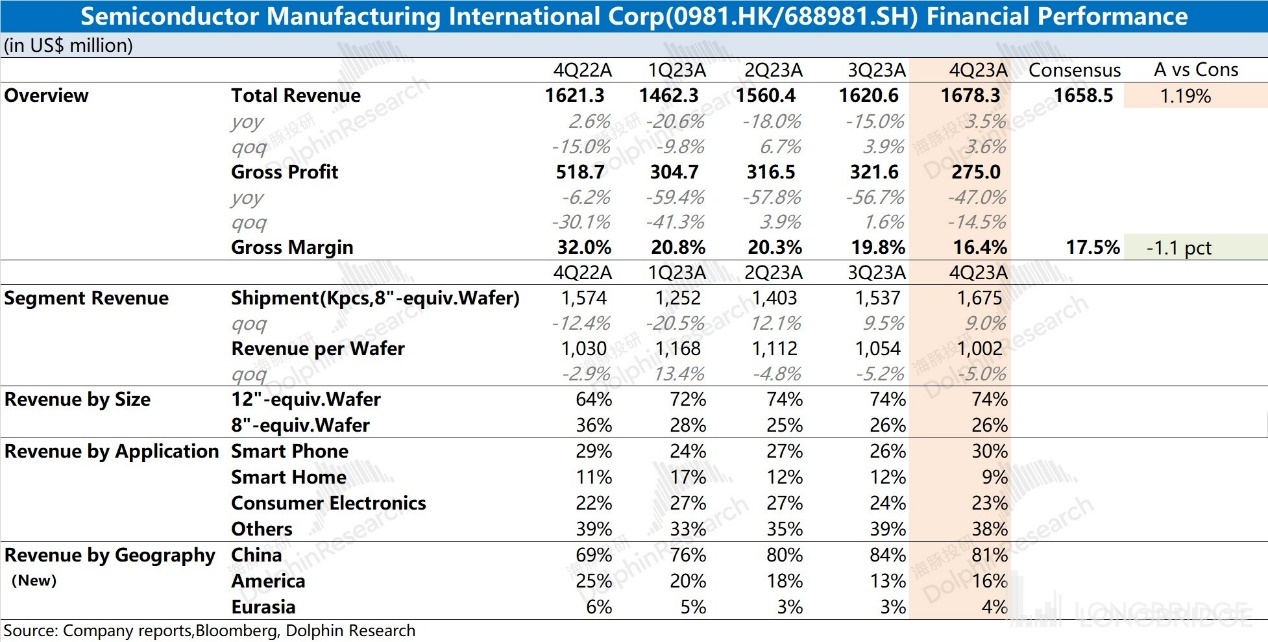
The following is a summary of SMIC's 2023 fourth quarter earnings conference call. For an interpretation of the earnings report, please refer to " SMIC: Counter-cyclical Expansion, Guided by Collapse ".
2. $SMIC(00981.HK) Detailed Content of the Earnings Conference Call
2.1. Key Points from Management's Statement:
- Financial Introduction: a) 4Q23 Operating Performance: Revenue of USD 1.678 billion, a MoM growth of 3.6%. Gross margin of 16.4%, a MoM decrease of 3.4 percentage points. Operating profit of USD 107 million, a MoM growth of 22.8%. EBITDA of USD 1.011 billion. EBITDA margin of 60.2%. Profit attributable to the company and non-controlling interests were USD 175 million and USD 63 million, respectively. b) Full-year 2023 Operating Performance: Revenue of USD 6.322 billion, gross margin of 19.3%, operating profit of USD 358 million, EBITDA of USD 4.064 billion. EBITDA margin of 64.3%. Profit attributable to the company was USD 903 million. Capital expenditure was USD 7.47 billion. Turning to the balance sheet. As of the end of 2023, the company's total assets were USD 47.8 billion, with a cash balance of USD 16.7 billion, total liabilities of USD 16.9 billion, including total debt of USD 10.2 billion, total equity of USD 30.8 billion, debt-to-equity ratio of 33.1%, and net debt-to-equity ratio of -21.1%. In terms of cash flow in 2023, we generated USD 3.358 billion in cash from operating activities. Net cash used in investing activities was USD 6.208 billion. Net cash generated from financing activities was USD 2.466 billion. c) 1Q24 Guidance: Revenue is expected to grow in the low single digits YoY (5%), with a MoM revenue growth of 0-2%, but gross margin is expected to decline to 9-11%. The company attributes this to the depreciation period of SMIC's Beijing plant, declining product prices, and changes in product mix. Capital expenditure in 2024 is expected to be roughly the same as in 2023.
- Business Introduction: a) Industry Situation: The industry has been in a downturn for 23 years, with a double-digit decline in annual output. The semiconductor industry is facing challenges such as high inventory, geopolitical issues, and weak demand, which continue to persist. In the second half of 23H1, there was a slight recovery in inventory, but the order volume for SMIC did not significantly improve. The industry is not expected to fully recover by 2024. b) SMIC reached its lowest point in 23Q1 and started to rebound afterwards. In 23Q4, revenue and gross margin met expectations. Sensors, display drivers, and other products performed well, with a MoM growth of 60%. DDIC and TDDI saw a MoM growth of 30%. The 40-55nm process remained competitive. c) In 23, revenue was 6.322 billion RMB, a YoY decrease of 13%. The gross margin was 19.3%, in line with expectations. Capital expenditure was 7.5 billion USD, with a capacity of 806,000 wafers per month and a UTR of 75%. d) In 24, the company will still face challenges such as macroeconomic factors, geopolitical issues, and competition within the industry. The semiconductor industry will experience moderate growth, but the recovery is not strong enough to support a full rebound. The expansion of production driven by geopolitical factors is increasing. There is still pressure on UTR to recover this year. China is a large market for chip applications, and the company has great opportunities in production. The company has a strong ability to withstand cyclical fluctuations and is actively promoting the localization of the supply chain.
2.2, SMIC Q&A Analyst Questions and Answers
Q: What is the trend of gross margin for the full year of 24? Can the company remain profitable in 24?
A: The gross margin is expected to have a moderate growth for the full year, but the increase in volume and decrease in price will have a negative impact on the gross margin in 24. Additionally, capital expenditure and depreciation will also put pressure on the gross margin. Therefore, the company faces relatively high operational pressure for the full year. The company has decided to tap into its internal potential and enhance cost control to improve operational efficiency (UTR), aiming to alleviate the downward trend of gross margin and ensure a reasonable level of profitability. The main reason for the decline in gross margin is the increase in depreciation expenses. As the company's capacity expands, newly invested equipment starts to depreciate, which has a negative impact on the gross margin.
Q: Will there be an oversupply of mature processes when expanding capacity? When will it happen? What is the normal level of capacity? How will the expanded capacity be filled?
A: From a global foundry industry perspective, everyone is currently investing heavily in mature processes, leading to increasingly fierce market competition. This competition will eventually result in industry consolidation, but the specific timing is difficult to predict and may take around 4-5 years. Based on SMIC's market positioning and the projects that have been established, we are not solely relying on the development of Moore's Law to meet future capacity demands. Our factories typically operate for around 20 years once established. Therefore, even if we increase capacity, it will not have a significant impact on the global market, as our market share is relatively small. Q: What is the proportion of special processes?
A: The vast majority of them are.
Q: Will the competition for special processes be smaller?
A: Yes. The competition for Moore's Law iterates quickly, while special processes require meticulous work.
Q: How are they classified now?
A: Previously, our 8-inch processes were all above 40nm, with at least 3 nodes in each factory and at least 4 products per node. These three nodes need to have equipment that is mutually compatible. Now they are divided into 2 categories: one is based on scenarios, and the other is based on product classification. Currently, they are classified by product, such as MCUs.
Q: Under geopolitical circumstances, there has been a significant increase in mature process capacity in recent years. Is there more caution in releasing subsequent capacity?
A: In the past, our idea was that companies like SMIC should not be too hot or too cold. Everyone chooses to develop capacity during the hottest times, which is not convenient for developing customers. We believe that it is best to have a consistent amount of construction each year. When there are urgent orders, 3-5wpm per year may be considered slow. Therefore, we will still release capacity at a steady pace. There are opportunities in the market, and competition will form.
Q: From a global perspective, industry sales have been improving continuously in recent months, but factors such as inventory, UTR, and ASP have not rebounded. What is the reason?
A: In the Chinese market, this situation happened earlier. Specifically, starting from October 2022, there was a sudden freeze and stop, which led to a large number of products being unsold and a significant decrease in order volume from tens of thousands of pieces to a few thousand pieces. After 8-9 months of adjustment, the market gradually recovered shipments from June to July last year. However, the inventory of old products from Chinese customers is still high and may be difficult to sell completely. On the contrary, there is a strong demand for new products such as smartphones and computers, which is our main focus. Currently, the quantity of old products in inventory is relatively high, while the demand for new products is strong. In addition, the European and American markets have faced challenges since this year, such as analog, which announced a decline in revenue this year. The Chinese market has faced similar challenges since the year before last. The highlight of the overseas market is AI technology, while the highlight of the domestic market is smartphones. In the first and second quarters, although there were many urgent orders, the shipments of smartphones and computers did not reach the expected high level. It is expected that the industry's shipments will exceed 20% this year, but due to a decrease of about 10% in the average selling price (ASP), the actual growth rate of the entire industry will be lower than 20%.
Q: UTR is decreasing, but wafer count is increasing on a quarterly basis. Does this consider the expansion of production capacity? It seems that the increase in capacity is not as large as the demand?
A: Monthly production capacity has increased by 10wpm, so UTR will slightly decrease, mainly because the denominator has increased.
Q: What are the reasons for the change in ASP?
A: There have been adjustments in product structure and price changes. Many of the prices were negotiated last year but did not happen in that period, and instead happened in subsequent orders.
Q: What is the price trend?
A: It is gradually stabilizing. It is not possible for a production company to produce at a price lower than the cost. Some companies may do so during difficult times, but after a period of time, they will switch to another product. We have already seen that the prices of some products have stabilized. Q: What is the depreciation rhythm for the quarter?
A: It's similar for each quarter, but there are fluctuations. Due to several years of high investment, there will be additional depreciation in 2023, and it is expected to increase by approximately 30% in 2024.
Q: Regarding the revenue breakdown, is there a decline in the industrial and automotive sectors?
A: Last year, due to supply shortages, major companies accumulated inventory. It is estimated that the automobile production reached 30 million units last year, while this year's forecasted production is around 32 million units. However, due to the high inventory levels, this growth trend is reflected more rapidly in our business. Customers have expressed that their focus this year will be on destocking rather than further growth. For 2024, we expect the main growth to come from the consumer electronics sector, such as smartphones, smart homes, and PCs. Although we have seen some rush orders, some customers have achieved victory in price wars, but we are also concerned that this may consume the order volume in the second half of the year.
Q: The proportion of computers and tablets exceeds 10%. Is this a seasonal change or the introduction of new products?
A: It includes rush orders. Long-term customers of Zhongxin have been stable, and now there are rush orders. There are more people in the market making computers, and new customers have emerged. There are also product upgrades for computers. Currently, there are quite a few rush orders. There have been some changes in the supply chain for smartphones, but the order volume is still significant, as well as for computers.
Risk Disclosure and Statement for this article: Dolphin Research Disclaimer and General Disclosure
Login to unlock11,212characters for free
This content is only available to signed-in users. Sign in to your Longbridge account to read the full post.

