
D
Nov 4, 2024 at 10:40 PM
What Makes Palantir's AI Different in Capturing More Allies? (3Q24 Conference Call)
Palantir FY24Q3 Conference Call Summary:
The following is the summary of Palantir's Q3 2024 earnings call. For the earnings interpretation, please refer to Palantir: AI Faith Ticket Brings Hope Again.
I. Core Information Review of the Earnings Report:
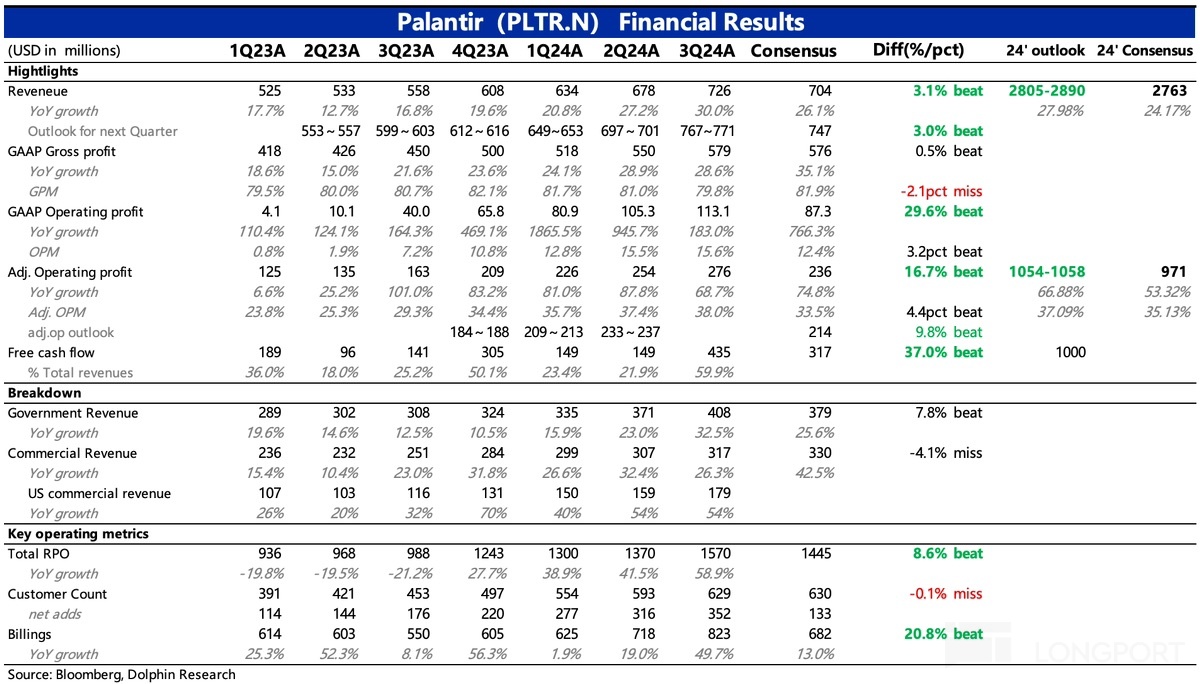
II. Detailed Content of the Earnings Call
2.1 Key Information from Executives:
2.1.1 Business Progress
1) Overall Revenue:
- Q3 revenue was $726 million, a year-on-year increase of 30%.
- Revenue from U.S. commercial business achieved a 44% year-on-year increase and a 14% quarter-on-quarter increase.
- Revenue from U.S. government business increased by 40% year-on-year and 15% quarter-on-quarter; revenue from U.S. commercial business increased by 54% year-on-year and 13% quarter-on-quarter.
2) The S&P 500 Index has included Palantir in its index, demonstrating the company's profitability and market leadership.
3) AIP Applications:
- In a leading global insurance organization, AIP helped automate key underwriting workflows, reducing the typical underwriting response time from over 2 weeks to 3 hours.
- Within 9 months, AIP implemented over 10 business use cases at Associated Materials, increasing its on-time delivery rate from 40% to 90%.
- At Trinity Rail, a functional workflow was completed in just 3 months, impacting the company's profits by $30 million.
- Palantir provides artificial intelligence through the Maven intelligent system, extending the AI/ML capabilities of the Maven intelligent system to all branches of the U.S. military, including the Army, Air Force, Space Force, Navy, and Marine Corps.
4) Customer Count
- The number of customers increased by 39% year-on-year and 6% quarter-on-quarter, reaching 629 customers.
- Revenue from large customers continues to expand. Revenue from the top 20 customers over the past 12 months increased by 12% year-on-year, averaging $60 million per customer.
5) Commercial Segment
- Commercial Revenue: Commercial revenue increased by 27% year-on-year, and 3% quarter-on-quarter, reaching $317 million. Excluding the impact of strategic commercial contracts, commercial revenue increased by 30% year-on-year, and 3% quarter-on-quarter. The commercial TCV size was $612 million, a year-on-year increase of 52%, and a quarter-on-quarter increase of 62%
- U.S. Commercial Revenue: U.S. commercial revenue was $179 million, a year-on-year increase of 54% and a quarter-on-quarter increase of 13%. Excluding strategic commercial contract revenue, U.S. commercial revenue increased by 59% year-on-year and 12% quarter-on-quarter. U.S. commercial TCV bookings were $297 million, a quarter-on-quarter increase of 13%. The total remaining transaction value for U.S. commercial business increased by 73% year-on-year and 7% quarter-on-quarter. The number of U.S. commercial customers grew to 321, a year-on-year increase of 77% and a quarter-on-quarter increase of 9%.
- International Commercial Revenue: International commercial revenue reached $138 million, a year-on-year increase of 3%, but due to ongoing environmental headwinds in Europe and a decline in revenue from government-sponsored enterprises in the Middle East, international commercial revenue decreased by 7% quarter-on-quarter.
- Strategic Commercial Contracts: Strategic commercial contract revenue reached $9.6 million. Revenue from these customers is expected to decline to $6 million to $7.5 million in the fourth quarter, with full-year revenue from these customers expected to be less than 2% of total annual revenue.
6) Government Segment
- Government Revenue: Government revenue for the third quarter was $408 million, a year-on-year increase of 33% and a quarter-on-quarter increase of 10%.
- U.S. Government Revenue: U.S. government revenue increased by $320 million, a year-on-year increase of 40% and a quarter-on-quarter increase of 15%.
- International Government Revenue: International government revenue was $89 million, a year-on-year increase of 13%, but due to significant revenue growth in the previous quarter and less favorable conditions for deal-making in Q3, it decreased by 5% quarter-on-quarter.
7) Total Contract Value (TCV): TCV for the third quarter was $1.1 billion, a year-on-year increase of 33% and a quarter-on-quarter increase of 16%.
8) Net Dollar Retention Rate: The net dollar retention rate was 118%, an increase of 400 basis points from the previous quarter.
9) Contract Scale: As of the third quarter, the total remaining contract transaction value (TCV) was $4.5 billion, a year-on-year increase of 22% and a quarter-on-quarter increase of 4%; the remaining performance obligations (RPO) (irrevocable) amounted to $1.6 billion, a year-on-year increase of 59% and a quarter-on-quarter increase of 15%.
2.2.2 Financial Performance
1) Revenue Side
Third-quarter revenue was $726 million, a year-on-year increase of 30% and a quarter-on-quarter increase of 7%, exceeding the previous guidance by nearly 450 basis points. Excluding the impact of strategic commercial contract revenue, third-quarter revenue increased by 32% year-on-year and 7% quarter-on-quarter.
2) Expense Side
Adjusted expenses were $450 million, a year-on-year increase of 14% and a quarter-on-quarter increase of 6%.
3) Profit Side
a. Gross Margin: The adjusted gross margin (excluding stock-based compensation expenses) was 82%.
b. Operating Margin: The adjusted operating profit (excluding stock compensation expenses and related employer payroll taxes) was $276 million, with an adjusted operating margin of 38%
c. In the third quarter, we generated $113 million in GAAP operating income, with a margin of 16%. We generated $144 million in GAAP net income, with a margin of 20%.
4) Cash Flow
Free cash flow was $420 million, and adjusted free cash flow was $435 million, representing year-over-year growth of 58% and 60%, respectively.
5) Earnings Per Share
Adjusted earnings per share for the third quarter were $0.10, and GAAP earnings per share were $0.06.
6) Fourth Quarter Guidance
- Revenue Side: Fourth quarter revenue is expected to be between $767 million and $771 million, with adjusted operating income between $298 million and $302 million. For the full year 2024, revenue guidance has been raised to $2.805 billion to $2.809 billion. The midpoint of the full-year revenue guidance has been raised to $2.807 billion, a year-over-year increase of 26%.
- Expenditures: Expenditures are expected to continue to increase in the fourth quarter as investments in product lines and the acceleration from AI prototypes to production ramp up.
- U.S. Commercial Revenue: U.S. commercial revenue guidance has been raised to over $687 million, with a growth rate of at least 50%. Adjusted revenue for operating guidance has been raised to $1.054 billion to $1.058 billion.
- Free Cash Flow: Adjusted free cash flow guidance is expected to be raised to over $1 billion.
2.2 Q&A Analyst Q&A
Q: How will Palantir differentiate its AI products from other products (including model creators)? What is different about AIP? How will Palantir maintain its competitive advantage?
A: While models are continuously improving, open-source and closed-source models are becoming increasingly similar, and their prices are continuously declining. However, the company has a ten-year lead in building and implementing AI applications, driving AIP through ontology (organizing business logic through ontology SDK or underlying architecture to mobilize independent components and integrate them into decision systems), which creates differentiation from this point.
Customers are gradually recognizing the value the company can extract from large language models. The company's products have advantages in understanding how businesses actually operate, handling data security and privacy, such as in battlefield target localization, insurance underwriting, and healthcare. Customers have found significant efficiency improvements through practical applications, while the company's products can be internally optimized to enhance competitiveness.
Q: As Palantir continues to invest in new AI technologies and expand globally, how will it balance these investments while maintaining or improving profitability and operating margins, especially in the current macroeconomic challenges?
A: The company achieved a 30% revenue growth in the third quarter (with U.S. business growing 44%) while improving margins, with an adjusted operating margin of 38% and an adjusted free cash flow margin of 60%, marking eight consecutive quarters of margin expansion, with a Rule of 40 value of 68
In the future, the company will continue to invest in technical talent and product development, while raising its full-year profit guidance, with adjusted free cash flow exceeding $1 billion and adjusted operating income exceeding $1 billion (with a fourth-quarter profit margin of 39%), indicating that the company is capable of balancing investment and profitability while investing in the early stages of the AI revolution.
The company attracts high-quality customers through in-depth product research and development rather than pursuing a large number of customers, believing that high profit margins and high growth mutually promote each other. Maintaining a balance between the two reflects the world-class level of the company's products, and the company will continue to maintain this advantage to drive business growth.
Q: Is it surprising how quickly potential customers convert from participating in training camps to making large transactions? What does this imply for the company's processes and Palantir's position in the AI revolution?
A: The growth of the U.S. business (44% year-on-year growth, with U.S. commercial business growing 54% year-on-year) and the rapid conversion from training camps to signing large contracts (such as seven-figure ACV contracts) completed in less than two months indicate significant business growth for the company. Customers have a high acceptance of AI technology and make quick decisions, which can be felt in conversations with customers, pushing products from prototype to production, and customer expansion.
An increasing number of customers understand and quickly adopt the company's products, and through personnel movement and word-of-mouth, the business is rapidly expanding in the U.S. and other countries. Customers are not only focused on external results; AI technology has also enhanced the internal scalability of the company's products. There is cross-application and communication among customers from different industries, promoting business development.
Q: With U.S. government business growing by 40%, and companies like L3Harris, Anduril, and Shield AI announcing partnerships with Palantir, what has prompted them to genuinely want to become partners? Additionally, can you provide an update on the strategic commercial contract situation and how you view the remaining transaction value (considering news about Lilium and stock rewards as a form of payment)?
A: The acceleration of U.S. government business cooperation has two dimensions. First, through Mission Manager, using software infrastructure (Rubix and Apollo) as an accelerator, it helps partners profit and expand their markets, benefiting the government, partners, and the company. Second, it helps these companies produce better, such as assisting companies like L3 in improving weapon systems and increasing profit margins under fixed pricing.
The company previously faced friction in government business; although we are fully focused on prioritizing assistance to the U.S. government (to combat American and its allies' hegemony), some still believe the company profits too much. Shyam and others have opened some product functionalities, allowing partners to safely handle government data, changing the company's image, gaining the trust of innovative technology companies, and positioning the company as an ally, thereby enhancing market entry capabilities.
Strategic business contracts account for a very small proportion of the business, only 1% of revenue in the third quarter, with minimal impact on forward-looking indicators. This project ended three years ago and is basically no longer relevant.
Risk disclosure and statement: Dolphin Investment Research Disclaimer and General Disclosure
Login to unlock12,204characters for free
This content is only available to signed-in users. Sign in to your Longbridge account to read the full post.
