
D
Aug 6, 2025 at 11:42 AM
Shopify (Minutes): Strong European and North American markets are the main reasons for GMV exceeding expectations
The following are the Minutes of the FY25Q2 earnings call for$Shopify (SHOP.US) compiled by Dolphin Research. For earnings interpretation, please refer to "Shopify: As long as growth explodes, other issues are not issues"
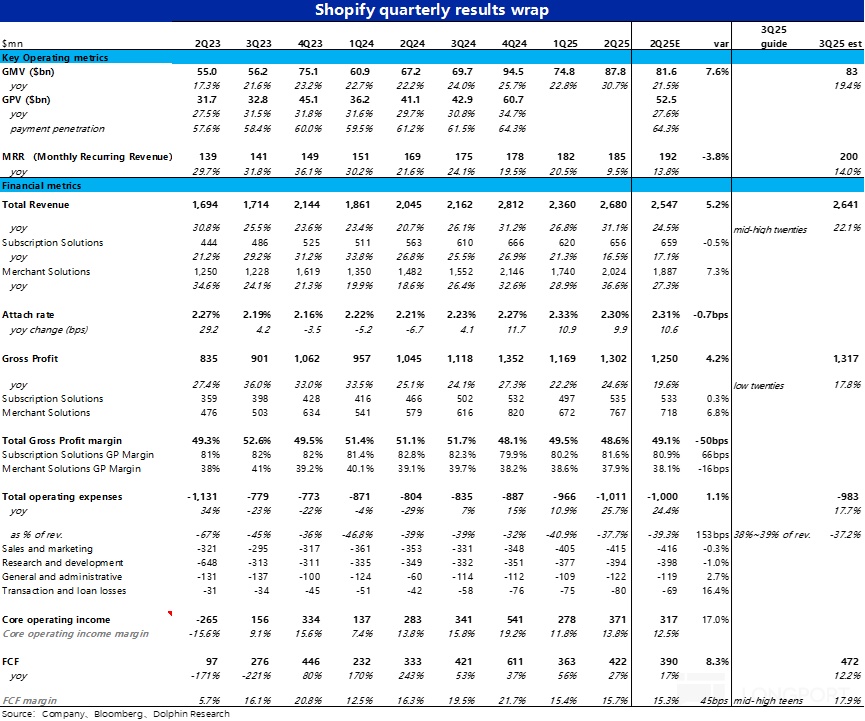
I. Review of Core Financial Information
1. Revenue Performance:
a) Total Revenue: Increased by 31% year-over-year. Merchant Solutions revenue grew by 37%, mainly benefiting from enhanced GMV and Shopify Payments penetration (reaching 64%); Subscription Solutions revenue grew by 17%, primarily driven by an increase in the proportion of higher-priced plan subscriptions.
b) Monthly Recurring Revenue (MRR): Increased by 9% year-over-year, with Plus plan accounting for 35% of MRR.
c) Free Cash Flow: USD 422 million (16% of revenue), achieving positive free cash flow for 11 consecutive quarters, with double-digit figures in 8 quarters.
2. GMV and Segment Growth:
- Total GMV: USD 88 billion, up 31% year-over-year (29% growth at constant exchange rates). Offline GMV grew by 29%, B2B GMV increased by 101% year-over-year; cross-border GMV accounted for 15% of total GMV.
- Regional Performance: Europe: GMV grew by 49% (42% growth at constant exchange rates), with merchant GMV growth consistently exceeding the overall e-commerce market by 4 to 5 times. United States: GMV and revenue growth accelerated year-over-year, with growth across all major verticals and merchant segments.
3. Profitability and Expenses:
a) Gross Profit: Increased by 25% year-over-year. Subscription Solutions gross margin at 81.6%; Merchant Solutions gross margin at 37.9%; overall gross margin at 48.6%.
b) Operating Profit: USD 291 million (11% of revenue).
c) Expenses: Operating expenses were USD 1 billion, with a year-over-year decrease of 400 basis points in revenue proportion (38% this quarter). Transaction loans and losses accounted for 3% of revenue.
d) Stock-based Compensation: USD 120 million.
e) Capital Expenditure: USD 6 million.
4. Outlook for FY2025 Q3:
- Revenue Growth: Expected to grow in the mid-to-high twenties year-over-year, supported by continued growth in Merchant Solutions and favorable exchange rates.
- Gross Profit: Expected to grow in the low twenties in dollar terms, lagging behind revenue growth.
- Operating Expenses: Expected to account for 38% to 39% of revenue, reflecting increased marketing spend and changes in compensation structure.
- Free Cash Flow Margin: Expected to reach mid-to-high teens, prioritizing long-term growth over optimizing near-term margins.
- Expected Q3 stock-based compensation expense of USD 130 million.
- A USD 920 million convertible bond will mature on November 1st (before the next earnings call), with plans to settle the principal and excess value in cash.
II. Detailed Content of the Earnings Call
2.1 Key Information from Executive Statements
1. Strategic Priorities:
a) Unified Commerce Platform: Continuously enhancing offline and B2B onboarding channels, committed to creating a truly unified commerce platform.
b) Growth and Profitability: Committed to balancing growth and profitability by investing in key areas such as core platform, international expansion, enterprise, and offline to support long-term growth. Continuously focused on driving growth rather than optimizing near-term margins.
c) Forecasting and Innovation: Positioned at the core of commercial activity, forecasting consumer trends and proactively building infrastructure to drive Agentic Commerce.
2. Product Releases and Innovations:
- AI Applications: Launched Catalog and Universal Cart to easily integrate shopping experiences into the AI platform. Sidekick assists merchants with data analysis and performance insights, actively helping merchants solve business challenges. Introduced AI store-building tools that can create customized online stores in seconds.
- Payment Tools: Shopify Payments global payment penetration reached 64%, expanded to more countries. Launched multi-entity support and USDC stablecoin option. Shop Pay user base more than doubled in the past 2.5 years, GMB grew by 65% to USD 27 billion; Shop Pay installment GMV grew by 38%.
- Shop App: Shop app native GMB grew by 140% year-over-year, Shop login volume increased by 46%. Enhanced engagement and conversion rates through AI-driven search and recommendations.
- Offline Business (POS): Offline GMV grew by 29% in the second quarter. Launched a newly designed version of the POS application, making it faster, simpler, and enhancing the connection between in-store and online.
3. Market Expansion and Merchant Collaboration:
- International Growth: International regions increasingly contribute to Shopify's quarterly growth. Shopify Capital launched in Germany and the Netherlands, Shop Pay installment launched in Canada.
- Top Merchant Onboarding: Canada Goose plans to migrate its online business and approximately 50 physical stores to Shopify starting in 2026. Successfully signed large brands such as Tatcha under Unilever, high-end appliance manufacturer Miele, Amazon Woot, Beachbody, Signet Jewelers, and Boart Longyear.
- Vertical Performance: Apparel and accessories performed well; health and beauty, home and garden, and food and beverage sectors showed strong momentum; emerging fields such as pet supplies, furniture, and arts and entertainment experienced rapid growth.
4. Trade Policy and Market Resilience:
- Macroeconomic Environment: Merchant base remains resilient, adapting to changes in economic conditions and continuing to perform well. U.S. demand has not declined and is accelerating, with many merchants raising prices.
- Tax-Free Policy: Globally, only about 4% of GMV is shipped under the minimum tax-free threshold; since the change in China's related regulations in May this year, no significant changes have been observed in GMV levels related to merchants shipping products under China's minimum tax-free threshold.
5. AI and Operational Efficiency:
a) Efficiency Improvement: Operating expenses as a proportion of revenue decreased by 400 basis points year-over-year, indicating ongoing efforts to improve operational efficiency. The non-homogeneous management approach to employee numbers continues to provide strong operational leverage. b) Merchant Empowerment: Sidekick's unique data analysis capabilities continue to shine, helping merchants solve business challenges. AI store-building tools further lower the entry barrier for merchants.
2.2 Q&A Session
Q: Regarding the macroeconomic environment, how would you describe the current demand situation, and is there any phenomenon of consumers making purchases in advance to avoid tariff increases?
A: The company has not observed any substantial phenomenon of advance consumption. The consistency between the company's second-quarter performance and performance guidance indicates that business performance remains stable. From a tariff perspective, no meaningful changes have been observed in cross-border activities or buyer behavior. The company's business condition is excellent, with no internal data indicating advance consumption. Current business performance remains strong, specifically reflected in significant growth in the European and North American markets, as well as outstanding performance across all GMV ranges and product categories.
Q: Given the strong growth of Shopify's international business, how do you assess the progress of the company's localization of products and merchant solutions in international markets, and is there still a huge opportunity for further expansion beyond current success?
A: Shopify has long been advancing product updates for international business and continuously expanding merchant solutions. For example, Shopify Payments has expanded to 60 new countries, multi-currency features have been launched in 20 countries, and Capital services now cover Germany and the Netherlands. He emphasized that the results of international business (international GMV grew by 42% year-over-year) are the result of product optimization and market promotion engines (including cooperation with system integrators and the internal team's understanding of product-market fit) working together. The company's performance in the Asia-Pacific region has also achieved significant success, while the European market continues to be strong and shows accelerated growth. Although Shopify dominates the English-speaking world and North American markets, international business is still seen as an important growth opportunity for the future, with significant room for expansion.
Q: Considering Shopify's organic growth despite its expanding scale, how does the company view its long-term growth strategy? Do you believe it can maintain a growth range of around 25% to 30% in the coming years?
A: Shopify's sustained growth is attributed to investments made over the past few years, and the company believes it will continue to perform well in terms of revenue growth and profitability. He noted that merchant acquisition is accelerating, especially in international markets, while new "onboarding channels" such as large enterprises and B2B sales points are driving growth. Shopify's growth runway remains long, including entering new verticals such as drilling and mining, and adding value to subscription services through Audiences, Plus, and B2B. Although specific long-term growth data cannot be provided, the persistence of this growth is the result of all new product features introduced by the company over the past few years, such as tax, B2B, and POS revitalization, as well as international expansion. He emphasized that broader entrepreneurial trends and market changes are prompting more merchants to choose the Shopify platform, while e-commerce growth rates and penetration continue to rise. The company is confident in the sustainability of growth over the coming years.
Q: Regarding Universal Cart and Checkout Kit, given that large language models have become shopping gateways, will these features be widely launched before the holiday season? How do you view their potential impact in the second half of the year?
A: Shopify has been building infrastructure to seamlessly integrate native shopping experiences into every AI conversation. He mentioned that Universal Cart is part of Checkout Kit, allowing consumers to consolidate items from multiple stores in one place. Checkout Kit was launched last year, and Microsoft's Copilot is currently using this feature. Shopify's goal is to ensure consumers receive personalized, conversation-guided shopping experiences and enable partners to easily integrate. At the same time, this also means that Shopify merchants' products and brands will be showcased on all AI platforms. Harley emphasized that Shopify's "unfair advantage" lies in the fact that the majority of brands loved by consumers are on the Shopify platform, making it the preferred partner for all AI companies seeking collaboration. He noted that most of the products discussed by the company, including Checkout Kit, are already online, and companies are already collaborating.
Q: Shopify has excelled in product innovation, how do you view its long-term product pricing strategy? Is there an opportunity to price the various services added in the past 18 months on an a la carte basis?
A: Shopify's business model is built on merchant success, meaning the better merchants perform, the better Shopify's performance, which is a GMV-based revenue model. Regarding specific product pricing, he noted that Shopify launched Commerce Components, allowing merchants to choose different products in a modular way, such as only selecting checkout or Shop Pay. This not only provides independent pricing for standalone products but also creates more "onboarding channels" for Shopify. He mentioned that large retailers like Burton, Starbucks, and Canada Goose have joined, partly through these components, and Shopify believes that over time, they will adopt more products and services. The company's goal is to have as many merchants as possible use Shopify and its services and products, achieving growth through mutual success, and believes this pricing model is very effective.
Q: Regarding Shopify's collaboration with OpenAI, do you see this as a new GMV growth opportunity or a shift from existing purchasing channels to Agentic Shopping?
A: The company is extremely excited about the potential of AI in discovery and shopping. Shopify is inherently collaborative and is one of the best companies in the tech field for partnerships, maintaining good relationships with all AI companies. Just as Shopify historically integrated with platforms like Instagram, Snap, TikTok, YouTube, and Spotify to adapt to social commerce and video commerce, Agentic Commerce is another area where commercial activity may occur. The company hopes to be prepared for this, ensuring that merchants on Shopify have an advantage over non-Shopify merchants. He believes that the special aspect of Agentic Commerce is that it is not necessarily based on company size but on consumer demand. Shopify's "unfair advantage" lies in the fact that the majority of brands and products loved by consumers are on the Shopify platform, placing it in a key position in collaboration with AI companies.
Q: Regarding the drilling and mining service cases you mentioned, can you elaborate on their specific application scenarios and how this model applies to other potential clients in this field?
A: Mentioning new verticals such as drilling and mining (like Boart Longyear) aims to highlight Shopify's entry into industries historically untouched, such as automotive, education, food and beverage, and industrial sectors. He noted that this significantly expands Shopify's total addressable market (TAM) and the types of merchants it can attract. These new fields represent opportunities for enterprises to modernize their commercial technology, whether for direct-to-consumer (D2C) or B2B business. Many industrial brands are migrating from outdated tech stacks to Shopify's innovative, user-friendly commercial stack.
This diversification into new industries helps increase merchant base and buyer stability and enhances the company's ability to serve large enterprises and global brands. Both parties see this as a new opportunity where Shopify can achieve great success.
Q: Regarding the increase in performance marketing spend in the third quarter, what specific factors are driving this growth? Is it due to improved return trends, new customer acquisition opportunities, or more focus on the high-end market?
A: Shopify observes strong performance in GMV, merchant base, and revenue growth. The company's continued investment in performance marketing is partly due to ongoing improvements in internal models, allowing them to identify signals from data faster and optimize investments. These models' continuous refinement is a key factor in Shopify's ability to maintain leadership in performance marketing. The company continues to increase marketing investment to support markets that perform well and have specific successful products. The performance marketing engine is currently running well, and investments are broad, covering different regions and products, with no specific segments needing strategic catch-up.
Q: How has the company's performance been since it first increased performance marketing spend a year ago? Can you provide any updates on the investment recovery period or return line?
A: The company is currently observing strong growth in GMV, merchant base, and revenue, indicating that performance marketing investments are working well. About a year ago, the company made some adjustments and updates to performance marketing, and through ongoing improvements in internal models, they have become more efficient in viewing and quickly analyzing data. He emphasized that these models continue to improve and perform better, which is one of the reasons the company believes it can continue to maintain leadership in performance marketing.
Q: Regarding Shopify's significant success in the high-end and enterprise markets, what are the main driving factors behind this? Are there any changes in market promotion, particularly in channel strategy, and has the input from system integrators (SIs) helped?
A: Shopify's success in the high-end and enterprise markets is the result of multiple factors working together. The product is excellent, and the value-to-cost ratio is highly attractive. The company continuously adds new features, such as Agentic Commerce, enabling large retailers to "future-proof" after choosing Shopify.
Collaboration with system integrators (SIs) and continuous improvement of the product itself have played a positive role. Commerce Components allow merchants to choose only features like Shop Pay, resulting in improved conversion rates, which opens the door for further collaboration between merchants and Shopify.
Shopify has the largest ecosystem in the commercial field, excellent innovation capabilities, and a growing network. The company releases products every quarter at a speed that even surpasses some competitors' five-year release volume, and this rapid innovation attracts the world's most important brands to Shopify.
Q: Regarding AI assistants, given your deep understanding of merchant traffic patterns, can you elaborate on how traffic is shifting to AI assistants? What are the main limiting factors for AI assistants in commercial use cases or shelf use case growth, or what conditions are needed to make it a larger channel?
A: Shopify is actively preparing to ensure that when Agentic Commerce and more traffic flow to AI, Shopify and its merchants can be at the core. The company is launching multiple innovations, such as Catalog, Universal Cart, and Checkout Kit, aiming to be the best partner for AI companies and agents. It is still too early to judge whether traffic is shifting from other channels to AI assistants. However, Shopify is prepared, and if this happens, Shopify's merchants will be better prepared, and Shopify will be at the core of these changes. Shopify's innovation, products, and collaboration pace in Agentic Commerce are second to none. Shopify is a robust, strong, and disciplined platform designed to help merchants of all sizes succeed and continuously explore new growth areas.
<End here>
Risk Disclosure and Statement of this Article:Dolphin Research Disclaimer and General Disclosure
Login to unlock18,403characters for free
This content is only available to signed-in users. Sign in to your Longbridge account to read the full post.
