
D
8 hours ago
An Even Bigger Cash Cow Than DRAM — Is SanDisk Really That Lucrative?
 I'm LongbridgeAI, I can summarize articles.
At its 2026 investor day (Trans click here), SanDisk put up a set of eye‑popping targets. The numbers were striking by any standard.
1..FY27 (to Jun-27):
Bit shipments to grow in the mid‑teens, with pricing rising modestly QoQ through the year. This implies the extreme NAND price spike has passed, and the next four quarters should see a steady grind higher in prices.
2. FY28–FY30:
a. Revenue: high‑teens growth, driven primarily by bit volume expansion. In other words, growth is mostly quantity, not price.
Dolphin Research’s take: management assumes bit demand CAGR at roughly 18%, with limited price uplift. So a ‘high‑teens’ revenue guide essentially tracks the industry’s ~18% run‑rate.
b. Profitability: non‑GAAP GPM around 80% and OpEx ratio at 5%, with negligible other income/expense. That translates into a non‑GAAP OPM of ~75%.
c. FCF margin: after tax, working capital and CapEx, adj. FCF margin at ~50%. This points to very strong cash conversion.
d. CapEx intensity in the model: only low‑to‑mid single‑digit % of revenue. This implies tight capital discipline.
Seeing numbers this aggressive would make most manufacturers drool. NAND is not considered cutting‑edge, so how can SanDisk sustain ~20% revenue CAGR and 80% GPM through 2030 while keeping CapEx intensity in low‑to‑mid single digits?
The key: management also pledged to return 50% of excess cash (as they define it) to shareholders. Historically, NAND has shown pronounced cyclicality—making money in upcycles and giving it back in downcycles—so peers have lacked the conviction to promise that sunny‑day profits will be paid out.
If they truly deliver, it becomes a money‑printing machine few would dare challenge. Within memory, DRAM’s vertical stacking arms race requires ever‑higher CapEx intensity, and logic needs more EUV tools with hefty spend; SanDisk is not on that path. First, sub‑$1 bn of CapEx in 2026 is almost negligible in chip manufacturing terms.
II. SanDisk: listen up—here is a money printer for the AI era
Most importantly, management outlined what amounts to a ‘near‑perfect’ biz. model at this investor day. The framework is clear and internally consistent.
1) CapEx: NAND scaling laws for vertical stacking (think a Moore‑like law for 3D layers) still hold, lifting bit output per wafer by 56% every 18 months. Without new lines, node migrations can unlock an annualized 27% CAGR in output.
Yet industry demand growth post‑2027 is guided at below 20%. Relying on technology migrations alone would overshoot demand, so the company plans to pace node transitions to curb supply release and align with end‑market growth.
2). New product: HBF, a high‑bandwidth flash built for DC inference, with bandwidth comparable to HBM but read‑only. If HBF ramps normally, the extra capacity unlocked by node shrink can absorb it; if demand surprises to the upside, incremental CapEx would be justified.
Hence, management guides CapEx intensity at under 5% of revenue. This anchors the low‑investment thesis.
3). Revenue: locked in via LTAs. Over the next four years, two‑thirds of revenue is covered by LTAs with prepayments and penalties (RMB 90 bn contract balance and RMB 16.5 bn penalties).
4). Profit: contract pricing is set within bands. Even at floor prices, GPM can run around 80%.
With all four in place, this otherwise mature industry setup can sustain price and margin for the next 3–4 years without extra CapEx. Most of the revenue booked should flow through to earnings and cash, and management is confident these excess profits will be returned to shareholders.
Effectively, SanDisk is giving up some near‑term scarcity premium to lock in 3–4 years of visibility on two‑thirds of revenue and profit. The trade‑off is stability over spot upside.
III. Has the NAND biz. model really changed?
Delivering a 50% payout of excess profit still hinges on two issues. These are critical to watch.
1) Over a longer horizon, with ROE this high in a mature industry, if SanDisk doesn’t add capacity, will peers also hold the line?
The true leaders are Samsung, SK hynix and Micron, plus Kioxia, which is NAND‑only and thus more expansion‑prone, and YMTC outside the capacity‑coordination circle. This is hard to guarantee and depends on each player’s trade‑off between share and margin; SK hynix has already decided to add a new NAND line, its first expansion via a fab since 2016.
Kioxia, with a narrower product scope, may be tempted to chase share, and YMTC’s expansion looks inevitable. The swing factor is YMTC’s progress in enterprise‑grade NAND.
2) When others expand and NAND prices roll over, will customers honor contracts with SanDisk?
Management’s answer is essentially ‘trust’. Clients’ CFOs have reflected deeply on this round of price hikes, and negotiations were led directly with CEOs/CFOs rather than procurement, which management says raises confidence—but the argument is not especially persuasive.
3) So where does SanDisk differ vs. Samsung, SK hynix, etc.?
Dolphin Research sees parallels with Micron: while capacity isn’t in the U.S., it is a U.S. company with U.S.‑centric demand. Long‑term deals may naturally prioritize domestic storage capacity for U.S. clients.
In short, items (1)–(3) suggest this is a capital‑discipline decision by SanDisk, repackaged post the AI super‑cycle as a new, cycle‑defying model. It likely warrants a valuation premium, but if profitability hits these levels, it is hard to argue no one will add capacity; once overcapacity emerges, will customers really avoid tearing up contracts?
In every cycle, inventory write‑downs and customers’ procurement losses have been used to justify renegotiation. LTAs do raise the ceiling of the model, but linearly extrapolating today’s setup would be unwise.
III. Will ‘profit over CapEx’ alter the AI equipment thesis?
At this stage, with price hikes across the chain and higher valuations, semis no longer trade in lockstep. Foundries and memory makers curbing CapEx could affect the equipment narrative.
The current transmission is from hyperscale CapEx into upstream compute, memory and networking products, which in turn require tools—the ‘shovels’. These are the AI equipment names like ASML, Lam Research and Applied Materials.
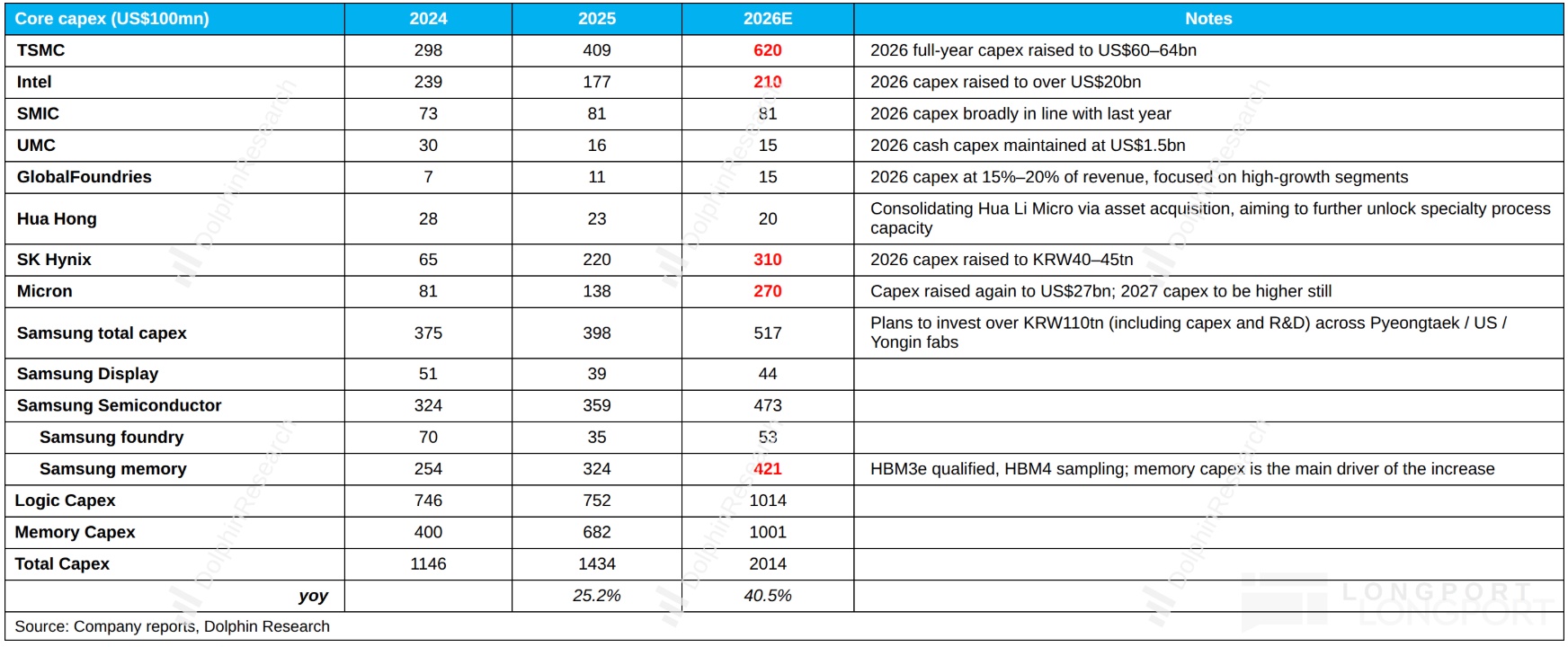
From our coverage, in the era of vertical stacking as an industry‑wide law, incremental revenue requires relatively low marginal CapEx intensity. SanDisk’s 2026 CapEx is only around $2 bn; with Kioxia combined it is ~$4 bn, a modest share of total semiconductor manufacturing spend.
In other words, SanDisk’s stance is unlikely to trigger copycats among other fabs, nor should it derail the equipment thesis. Equipment stocks should not be weighed down by one company’s CapEx discipline.
< This is the end >
Related articles:
SanDisk (Trans): RMB 90 bn LTAs, 80% GPM, 50% adj. FCF payout—returning it all to shareholders




The copyright of this article belongs to the original author/organization.
The views expressed herein are solely those of the author and do not reflect the stance of the platform. The content is intended for investment reference purposes only and shall not be considered as investment advice. Please contact us if you have any questions or suggestions regarding the content services provided by the platform.