
D
3 hours ago
Webull: Finally Turned Bullish
 I'm LongbridgeAI, I can summarize articles.
$Webull(BULL.US) Q2 results are out, and Dolphin Research has a quick take.
I. Rare Alpha Delivered
Webull historically has shown limited alpha, with performance closely tied to U.S. equities. Only in the latest quarter did it generate excess returns vs. the market.
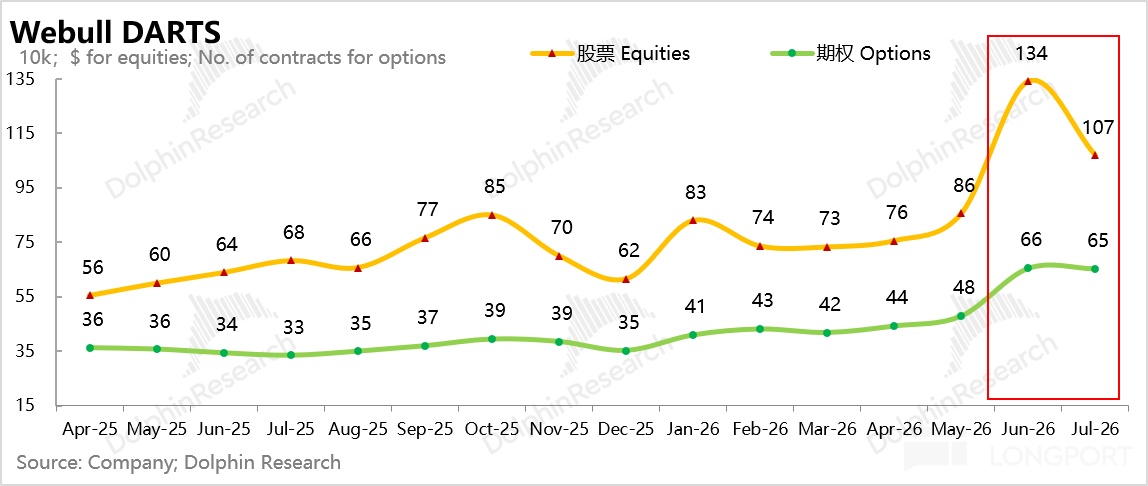
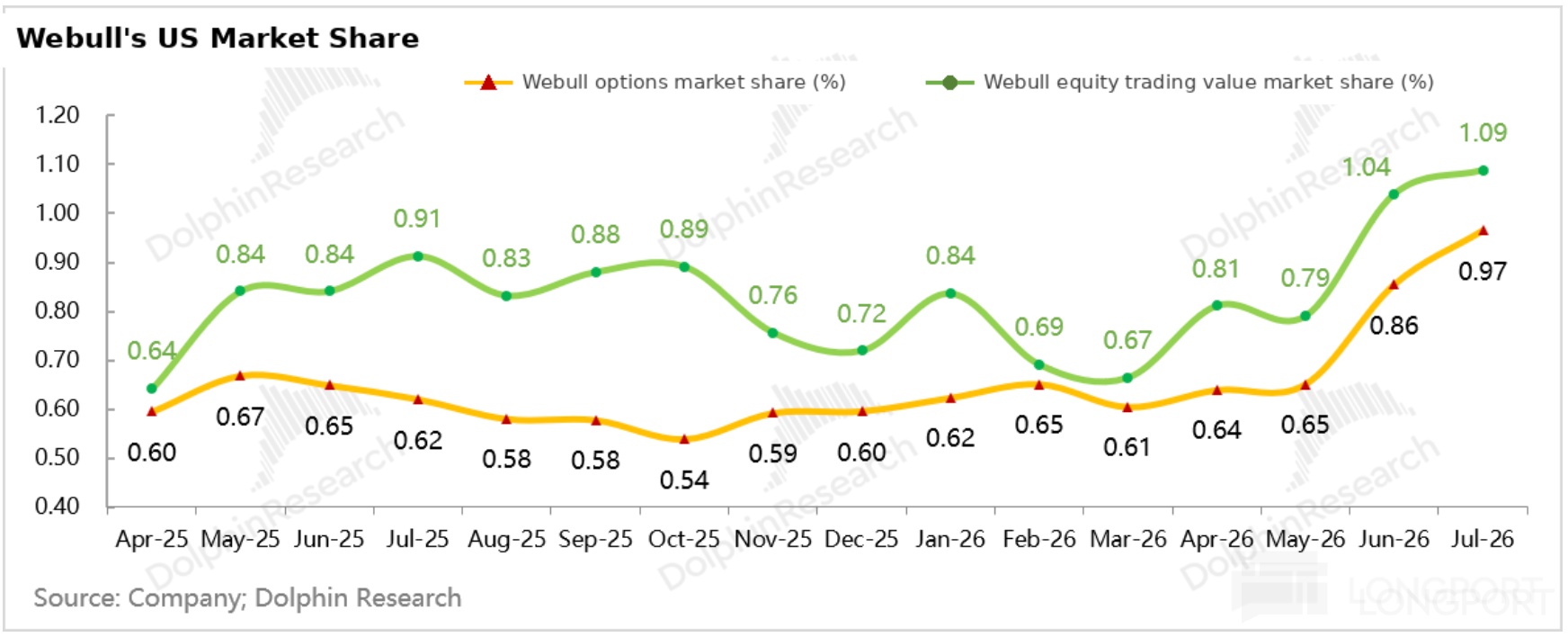
The first chart shows Avg. daily trades for stocks and options, which rose sharply in Jun and Jul. Jun was a strong tape, yet activity held resilient during Jul’s decline. Options, with higher revenue per trade, gained share faster than stocks (chart 2).
II. Can Alpha Stick?
Since listing, Webull largely tracked market trends and showed limited alpha, then suddenly began taking share in U.S. stock and options trading. What changed?
Dolphin Research links the timing of share gains with management’s call commentary, which aligns with the relaxation of the PDT rule. Here are the details:
A: What is PDT? What changed?
PDT = Pattern Day Trader
1) Old rule
1. In a margin account, making 4 or more round-trip day trades within 5 consecutive trading days triggers a PDT label. 2. Once labeled, the account must maintain at least $25,000 equity at all times; otherwise it is restricted to 3 day trades every 5 days, and violations face a 90-day freeze. 3. Many users opened multiple brokerage accounts to bypass the limit and increase weekly day-trade capacity.
2) Reform timeline
1. Sep 2025: The FINRA BOD approved a full replacement framework, and the plan was filed to the SEC on Dec 29. 2. Jan 14, 2026: Published in the Federal Register for public comment. 3. Feb 4, 2026: Comment period ended with 100+ letters, all but one supportive, including Schwab, Robinhood, E*TRADE, and SIFMA. 4. Apr 14, 2026: The SEC granted accelerated approval. On Apr 20, FINRA issued Regulatory Notice 26-10, effective Jun 4. 6. Brokers may phase in system changes within 18 months, through Oct 20, 2027.
3) New rule
The reform addresses modern day-trading products such as 0DTE options, which did not exist in 2001. The new framework shifts from counting trades to assessing real-time risk.
a) The PDT label is eliminated, day trades are no longer counted, and the $25,000 threshold is removed. b) Qualified margin accounts must have equity above $2,000 (statutory minimum for leverage). c) Brokers set intraday buying power based on current positions and maintenance margin, and can choose one of two approaches:
- Real-time monitoring of margin shortfall to block trades that cause or widen intraday deficits; or
- End-of-day checks only.
The new rule favors active traders, small accounts, and 0DTE users, whose activity naturally consumes day-trade counts. For Webull, with per-client AUM below $5,000, this is a targeted tailwind.
The company moved quickly around Apr 15, committing to adopt the new framework immediately upon SEC approval. It welcomed the policy boon.
The surge in options and equities trading coincided almost exactly with the Jun effective date. Jul options contracts did not drop meaningfully despite weaker markets.
B: Can market share gains hold?
The PDT reform is a structural lift for the company.
First, users previously restricted under the old PDT regime were unblocked, and operations were run to re-activate them. Over the past six years, more than 1 mn active funded accounts were closed.
Second, in consolidating accounts across brokers, more users chose to trade at Webull. Since they typically transfer cash rather than positions, flows are hard to track precisely, and only the incremental deposits can be observed.
Management guided that PDT can structurally lift trading volume by ~20%, and implied this is conservative. Jul options volume was close to Jun’s elevated level, and Aug to date is tracking Jun and is stronger than Jul. Volumes are unlikely to revert to the pre-PDT regime.
This is a structural uplift, and Dolphin Research agrees. The key question is whether Webull will enter a sustained market-share upcycle or slip back to a flat share phase.
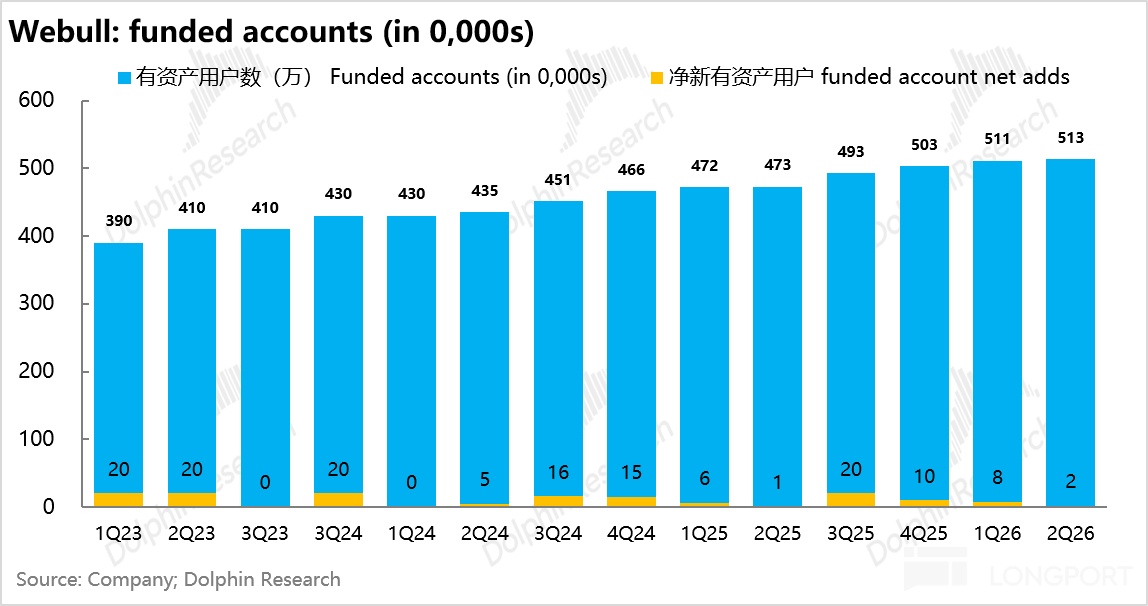
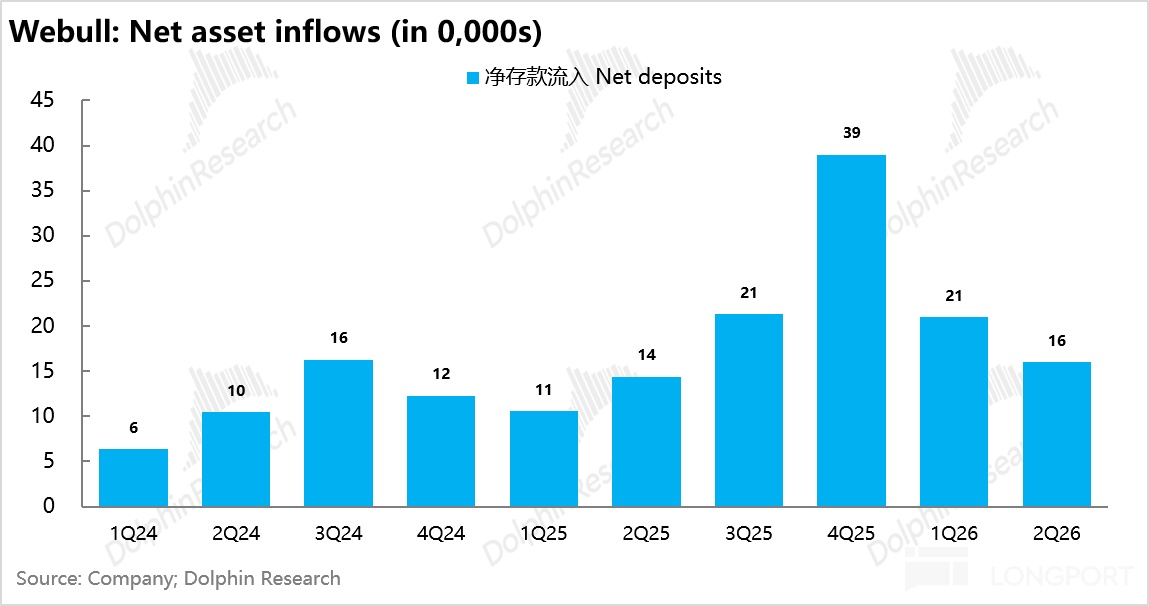
For now, user acquisition and funding do not point to sustained share gains. To keep gaining share, the platform needs ongoing large-scale user inflows and net asset inflows. Unlike Robinhood, Webull is lukewarm on both metrics.
In Q2, net adds of asset users were only 20,000. Net asset inflows were $1.6 bn despite a hot tape, not a new high.
Whether PDT traffic can become a breakout event that drives new inflows still needs observation. There is no clear evidence yet.
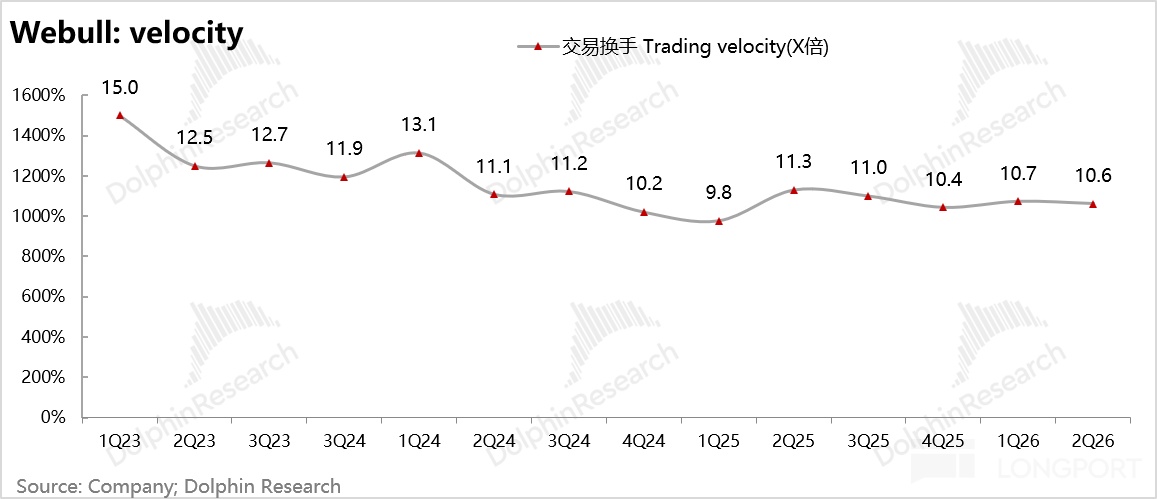
Even Q2 trading activity did not improve materially. Turnover stayed around 10.6x.
III. Starting a true cash-cow model?
Because Webull’s share was unstable or drifting down, revenue struggled to scale and hovered around breakeven. With the trading surge this quarter, it finally shows signs of scaled profitability.
Incremental disclosure: monetization ticked up, especially on equities flow, where take-rate rose from $0.000178 per $1 traded to $0.000213. DART revenue reached $1.71, the second-highest since IPO.
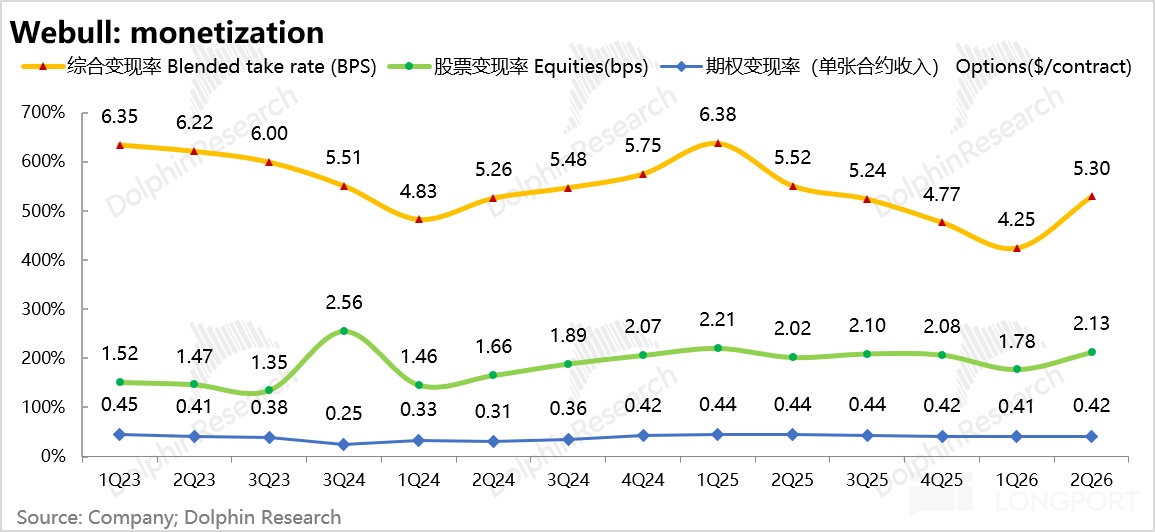
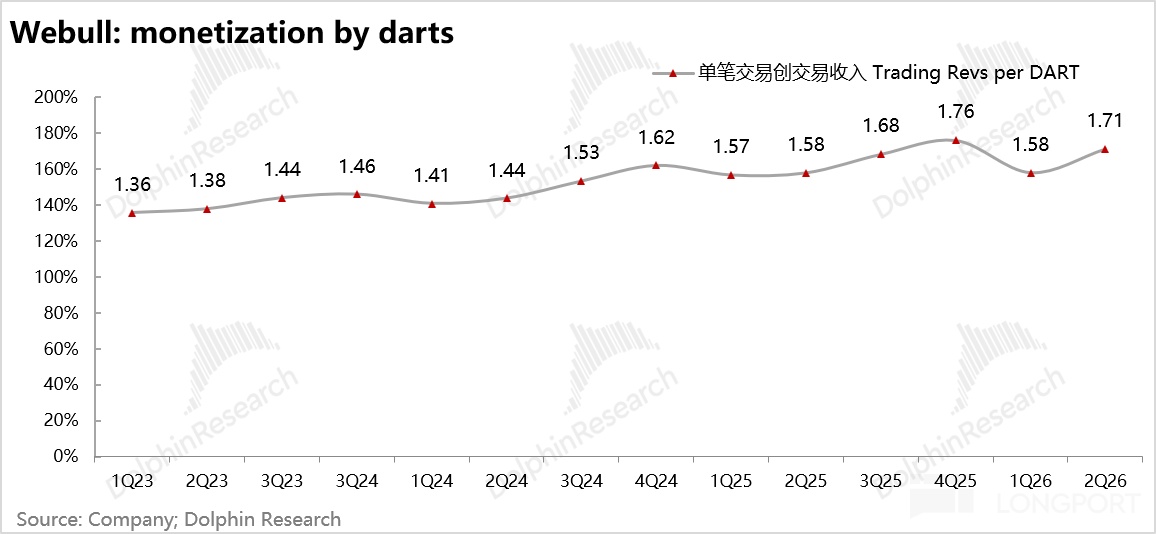
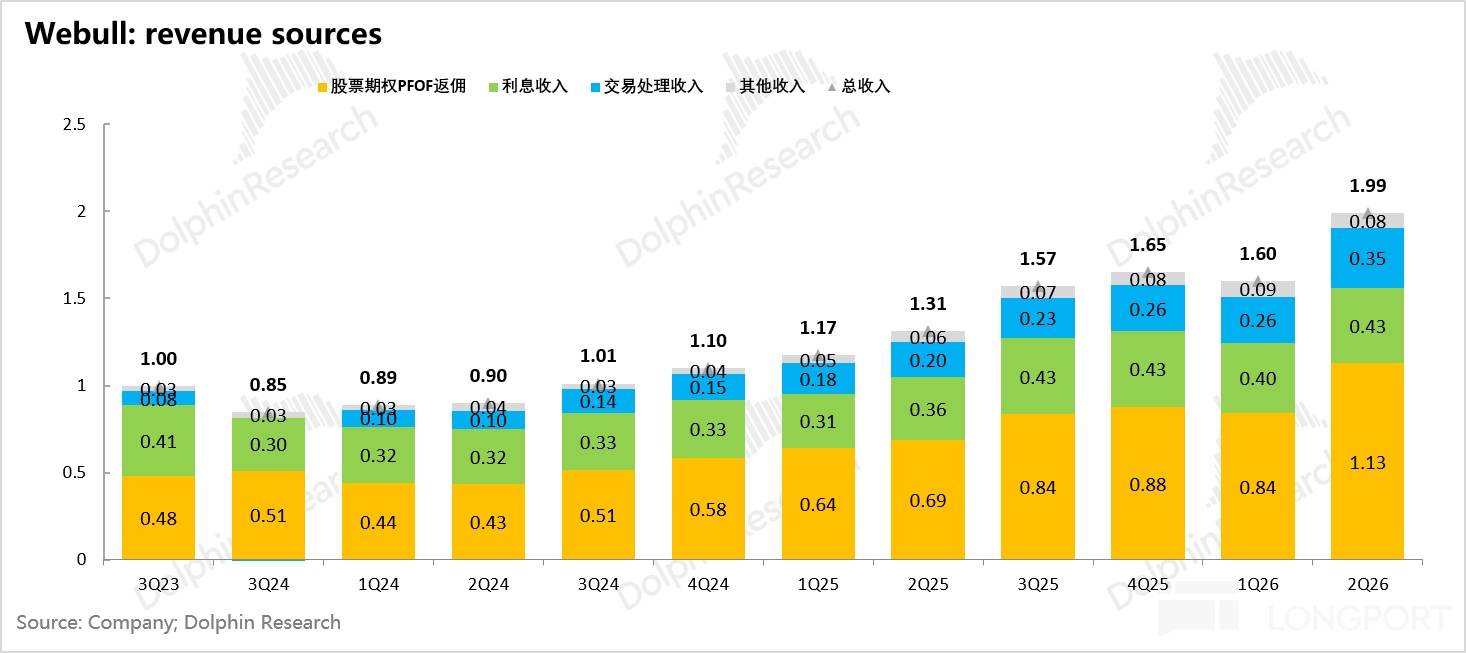
Additionally, PDT reform lifted margin balances from $800 mn in May to $1 bn. Interest income did not rise much, up only $1 mn QoQ, implying much of the added margin is intraday leverage and effectively non-interest-bearing.
Q2 total revenue was $199 mn (+24% QoQ). Growth was broad-based across trading-related streams.
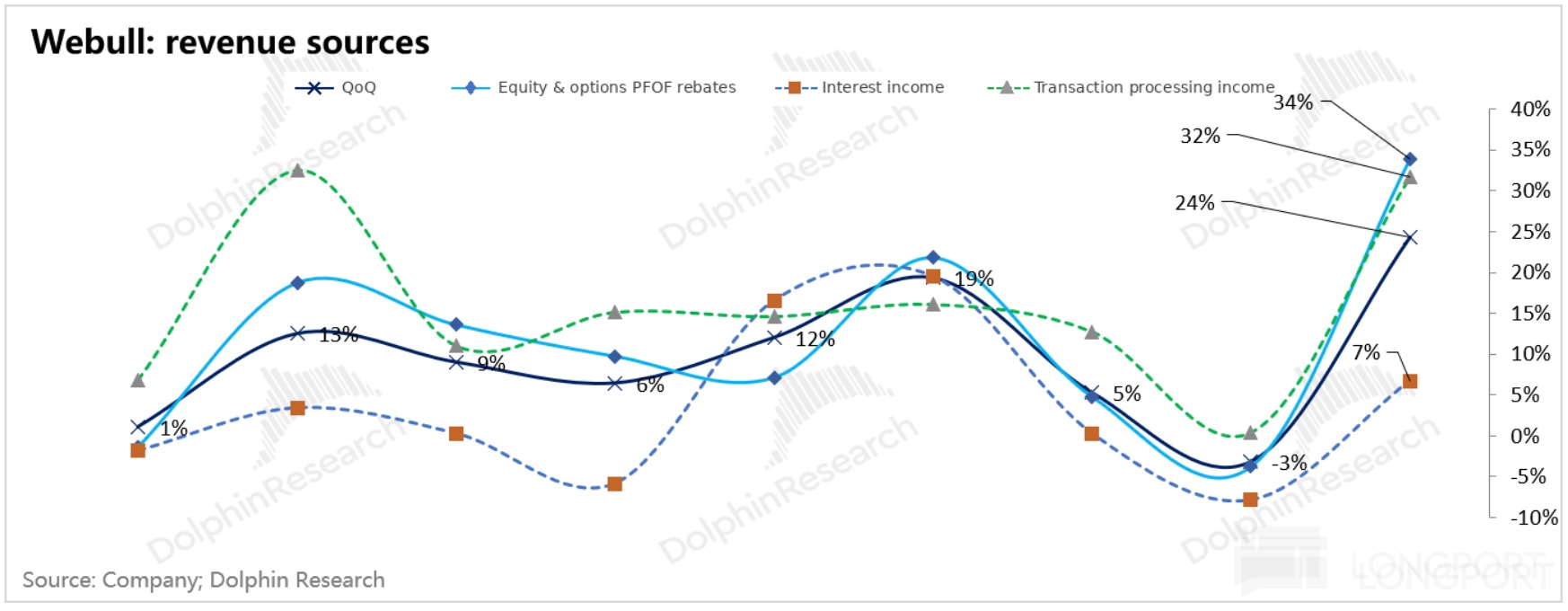
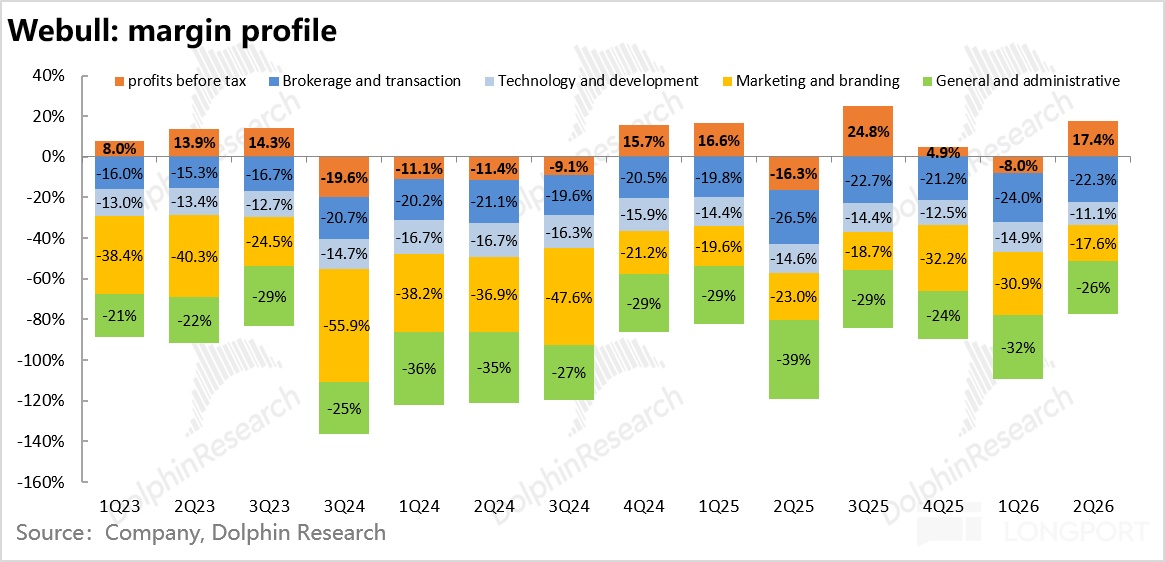
Expenses fell by 5.5% QoQ, mainly because marketing dropped 29% QoQ. Management noted last year’s transfer cash-back incentives were sizable and amortized, which inflated the prior quarter and had a smaller impact this quarter.
Going forward, amortization effects will fade. Marketing spend will reflect current-period deployment rather than historical amortization, and should be more controllable.
Within opex, G&A appears notably high. It likely reflects early investment to expand internationally.
As a result, Q2 core OP (revenue minus cost and opex, excluding other gains/losses) reached $45 mn with a 22% OPM. Adj. OP excluding non-cash option comp was $63 mn, with a 31.5% OPM.
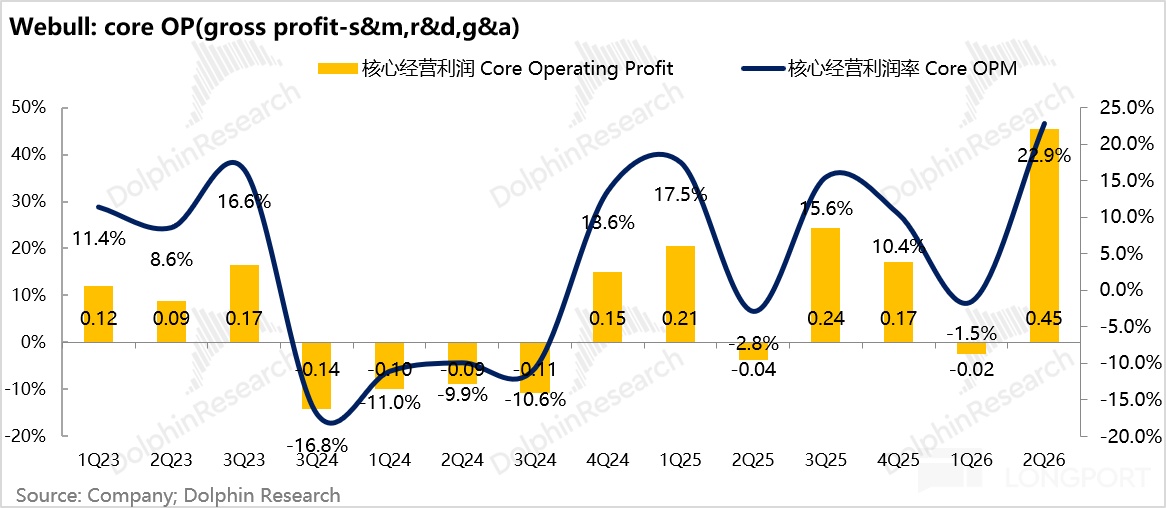
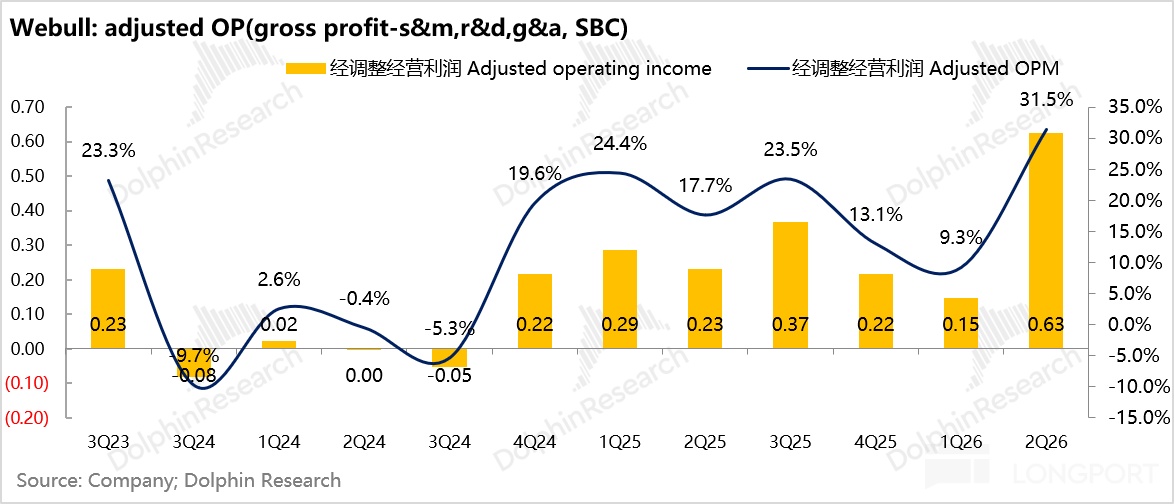
Overall, the previously low-profile Webull has clearly strengthened under the PDT reform, delivering structural market-share gains. Annualizing Q2 profit, which includes Apr–May before the reform’s benefit, and applying a 25x PE (vs. ~29x for the S&P 500) implies about $6.3 bn, with room for upside.
<End here>
Risk disclosure and statement:Dolphin Research Disclaimer and General Disclosure




The copyright of this article belongs to the original author/organization.
The views expressed herein are solely those of the author and do not reflect the stance of the platform. The content is intended for investment reference purposes only and shall not be considered as investment advice. Please contact us if you have any questions or suggestions regarding the content services provided by the platform.