
D
4 hours ago
No doubt: 2026 is the 'Zhipu Year' for China LLMs.
 I'm LongbridgeAI, I can summarize articles.
If 2025 belonged to DeepSeek among domestic foundation models, calling 2026 the 'Zhipu year' is fair. From an early-year rally on the scarce 'China’s Anthropic' narrative to a swift pullback after Kimi K3 launched in mid-Jul, 2026 has been a roller coaster for $Z.AI(02513.HK).
Does Zhipu deserve the 'Zhipu year' crown among China models? Will 2027 see a new champion, or will Zhipu stay on top? From the vantage point of 2H26, we review 1H26 and the signals it sent:
I. Revenue: ARR at $1.6bn for open platform + API by end-Aug alone is a big deal
1) $1.6bn ARR by end-Aug — stunning
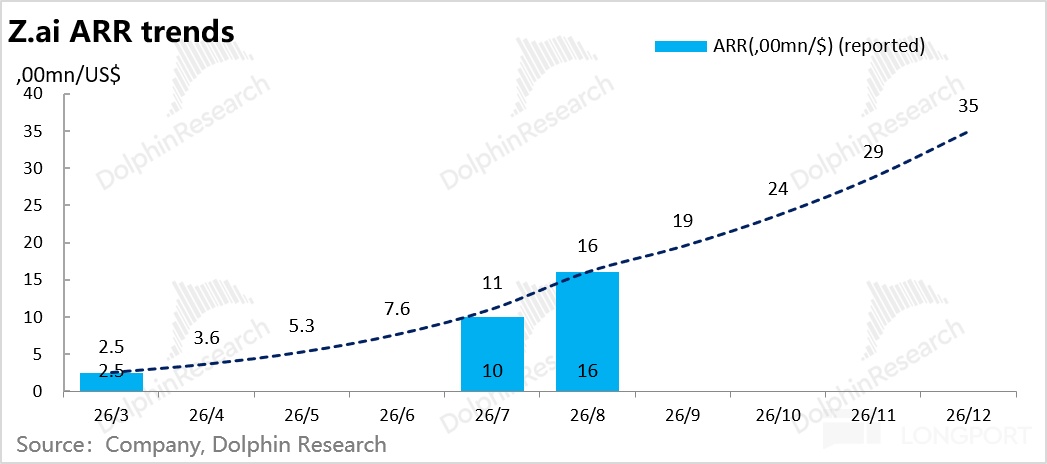
At a ~$70bn valuation, management knew a plain 1H print wouldn’t wow the market. Beyond the half-year results, they separately disclosed via media that by end-Aug, open platform + API ARR had surged to $1.6bn.
Public datapoints: end-Mar ARR was $250mn, early Jul reached $1.0bn, and end-Aug hit $1.6bn. While MiniMax annualizes differently, Zhipu clarified the $1.6bn is monthly annualized; even under conservative monthly growth for the last four months, ARR could stand around $3.5bn by YE26.
This is well above the ~$2.0bn+ street consensus.

2) 1H revenue was average, but the mix was excellent
Among independent domestic model vendors, Zhipu is a pure-play 'domestic LLM' with talent rooted in academia and a client base largely in Gov. and SOEs, i.e., to-B heavyweights.
Given the on-prem nature of deployments, the market has long worried about renewals. Even with a Coding boom that Zhipu capitalized on, investors feared delivery intensity could keep revenues project-like.
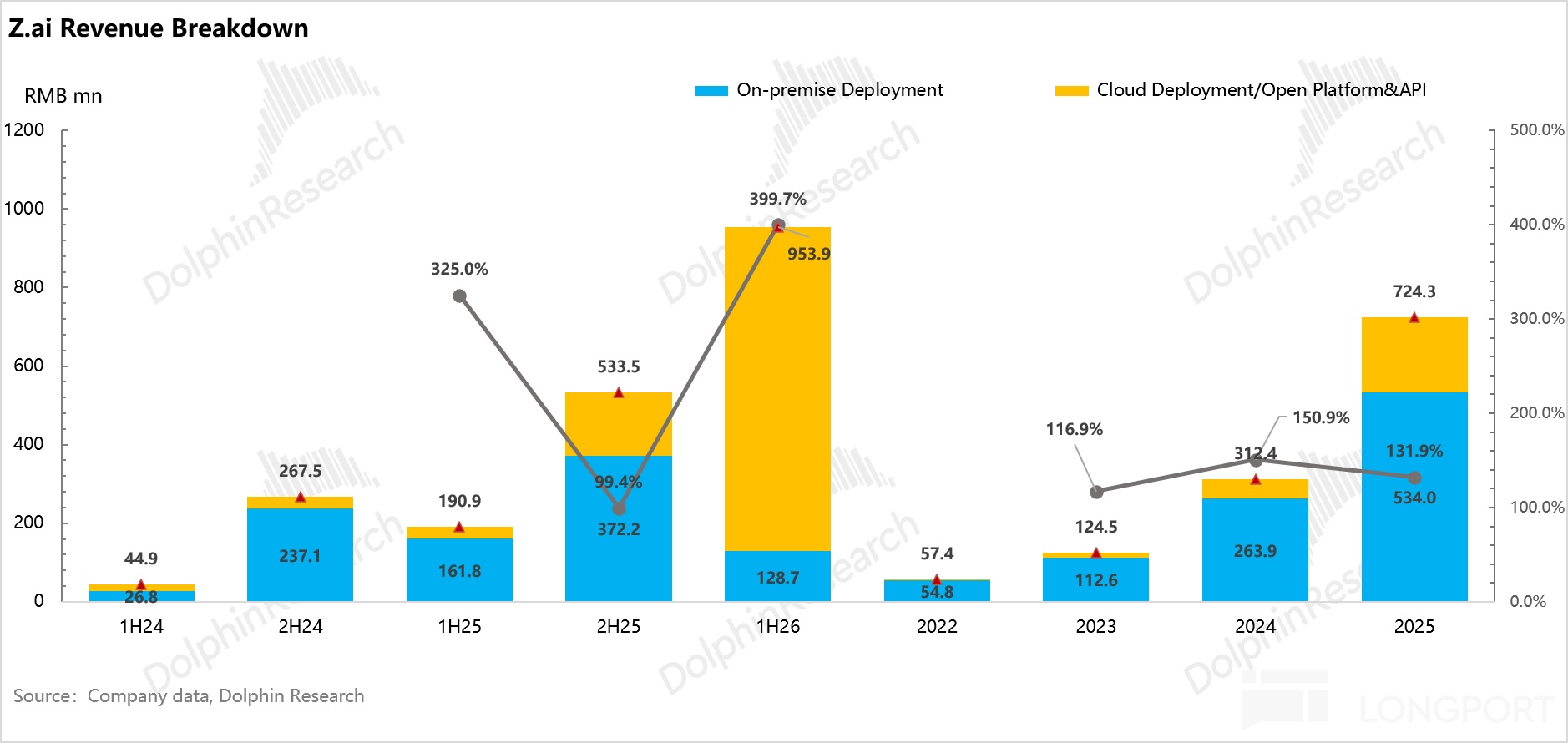
In reality, 1H mix shift was impressive: total revenue was RMB 950mn. With ARR disclosed at $250mn (end-Mar) and $1.0bn (early Jul), the market had lifted 1H revenue expectations to RMB 1.1bn, so the print was middling vs. raised bars.
But the miss sat mainly in on-prem, project-style revenues:
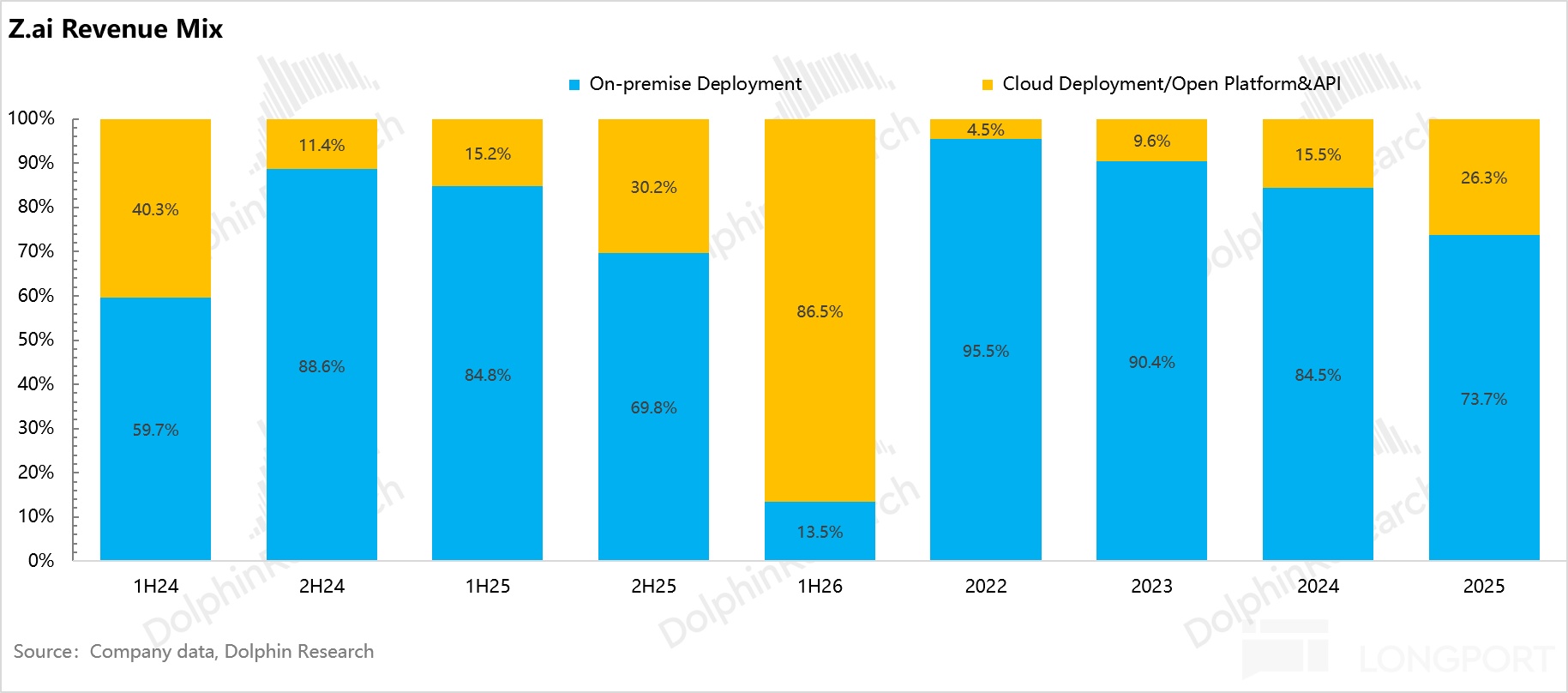
a. On-prem deployments: 1H revenue shrank to RMB 130mn, roughly flat YoY, far below the market’s USD 400mn expectation. In other words, for large enterprises, a pure 'model drop-in' without clear biz integration looks increasingly like pseudo-demand.
b. Cloud revenue: Open platform + API (including compute consumption from projects) reached RMB 830mn, >86% of revenue.
By riding the Coding wave, the biz model effectively leapt from 'sell model → sell calls → sell subscriptions → sell end-to-end tasks' to the subscription stage.
II. Zhipu: Is $1.0bn revenue the breakeven bar?
DeepSeek’s Liang Wenfeng once framed the unit economics: at $1.0bn revenue and 50% GPM (inference costs consuming half of revenue), the remaining $500mn can roughly cover training, R&D headcount, and opex.
Let’s cross-check with Zhipu’s results in 1H:
1. GPM: Not enough compute? The price war remains fierce
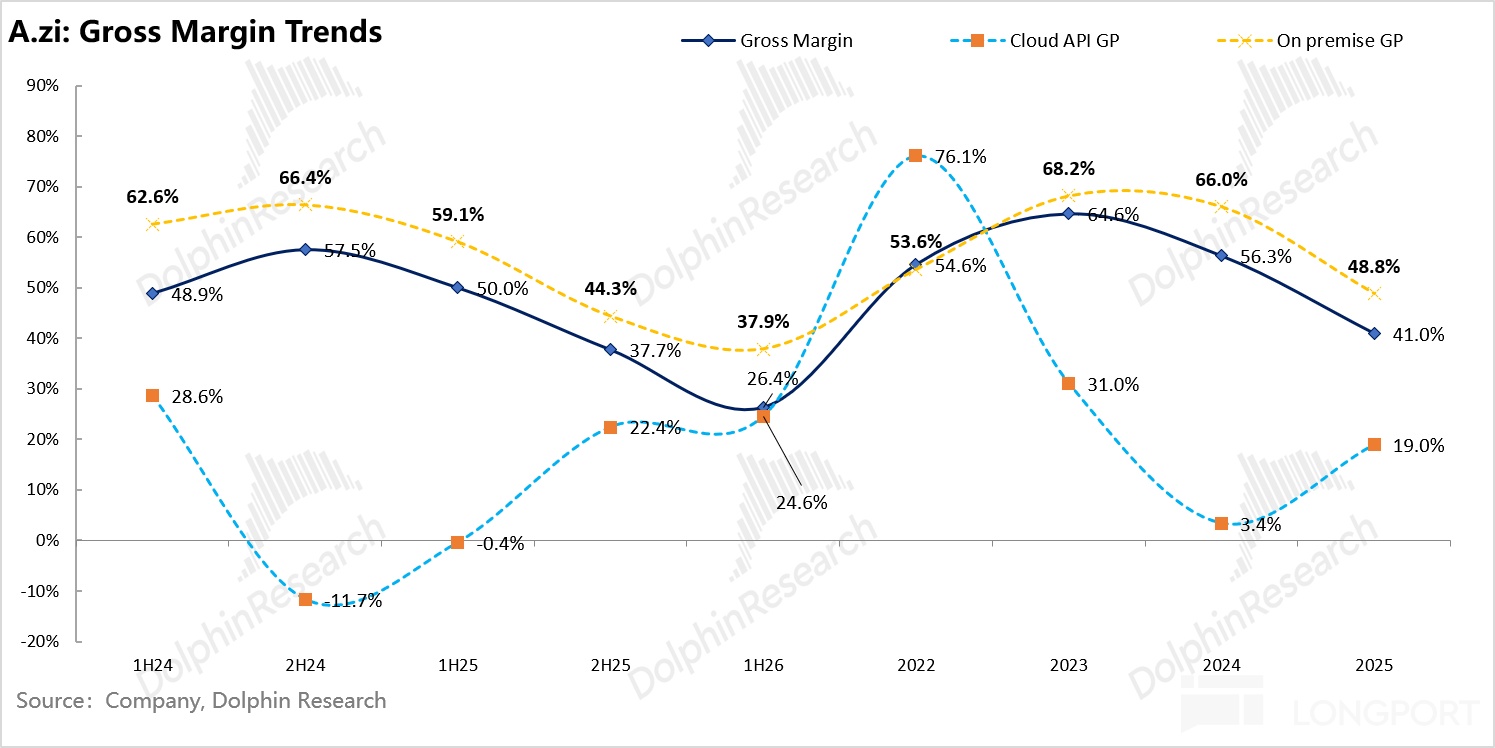
First, the Q1 token price hike barely lifted GPM. API/open platform, 86% of 1H revenue, saw GPM rise from 22% in 2H25 to just under 25%, while on-prem GPM fell to 38%.As a result, overall GPM was only 26.4%. Despite tight compute supply, unlike Anthropic, Zhipu did not capture premium margins, underscoring a brutal domestic token price war.
With the 'price-slasher' GLM-5.3 Flash launched in late Aug, we remain concerned about 2H GPM trajectory. It likely comes down to inference cost-down vs. API pricing.
2. Opex: R&D has to keep climbing
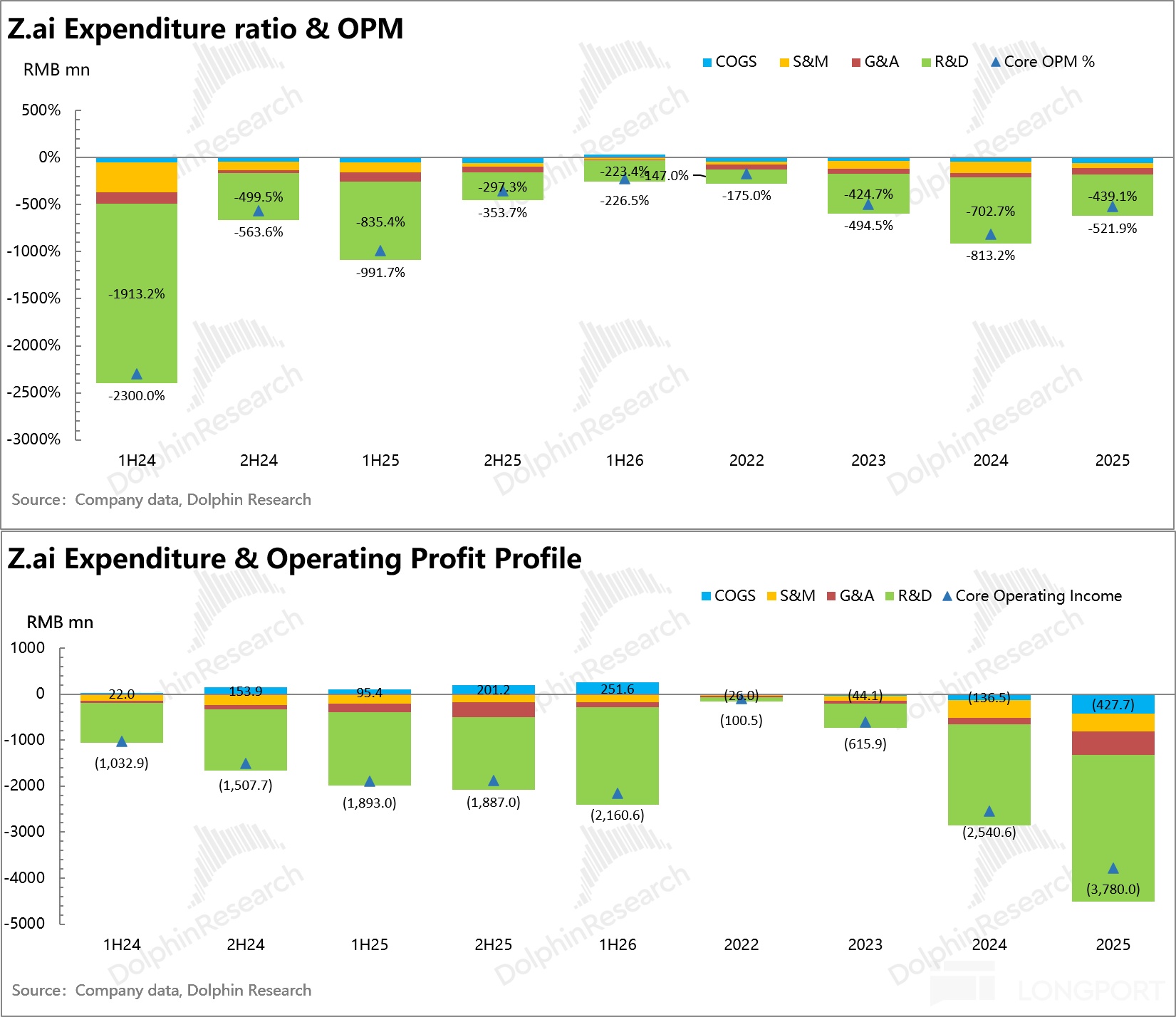
a. S&M: RMB 180mn, -15% YoY. b. G&A: RMB 100mn, -44% YoY.c. R&D: RMB 2.1bn — savings from S&M/G&A were plowed into R&D; the 'meds' can’t stop.
Total 1H opex was RMB 2.4bn; simple annualization is RMB 4.8bn (~$680mn). Likely due to multimodal training and the quest for peak IQ, training costs are higher, and $500mn wouldn’t suffice to cover internal costs.
Two numbers tell the story. Inference COGS is heavy while opex is also elevated; assuming scale and cost-down lift GPM to ~40%, Zhipu likely needs $1.7–2.0bn revenue (RMB 12–14bn) to breakeven, higher than DeepSeek.
For 1H, revenue was RMB 950mn with a loss of RMB 2.2bn (revenue – GP – opex), a -227% margin.
This P&L implies near-term losses aren’t the key lens. What matters is ARR clearing >$2.0bn; with Aug already at $1.6bn, conversion from ARR to revenue is a timing issue rather than a question of whether it can breakeven.
III. 'China’s Anthropic': painful but rewarding?
From a doubted 'project-based' model vendor to 'China’s Anthropic', Zhipu’s 1H print and $1.6bn ARR reflect the steepest ARR slope domestically. Yet compute anxiety rises as models enter production validation.
Unlike MiniMax, which is still proving model capability, Zhipu — beyond raw IQ — has started a 'buy, buy, buy' ecosystem strategy. The aim is to fully sweat hardware assets, lower inference cost, and secure enough compute for demand spikes.
a. Jul: acquisition of Zhongke Jiahe announced: strong in virtual ISAs and the SigInfer inference engine. It tackles scheduling and resource management for heterogeneous clusters, including efficient KV cache handling.
b. Ecosystem investments — JiFlow Tech, Wuwen Xinqiong, and SiliconFlow.JiFlow can be viewed as a builder of compute clusters. Wuwen Xinqiong operates the middleware between 'M models' and 'N chips', overlapping somewhat with Zhongke Jiahe’s positioning.SiliconFlow hosts models for those without servers or wanting to avoid private deployments, running on cloud services so customers can onboard and pay as they go.
c. Self-built compute: multiple media reports suggest Zhipu plans a 1GW compute center using all domestic accelerators, with part already online.
d. Self-designed chips? Early discussions only, with no partners or timeline.
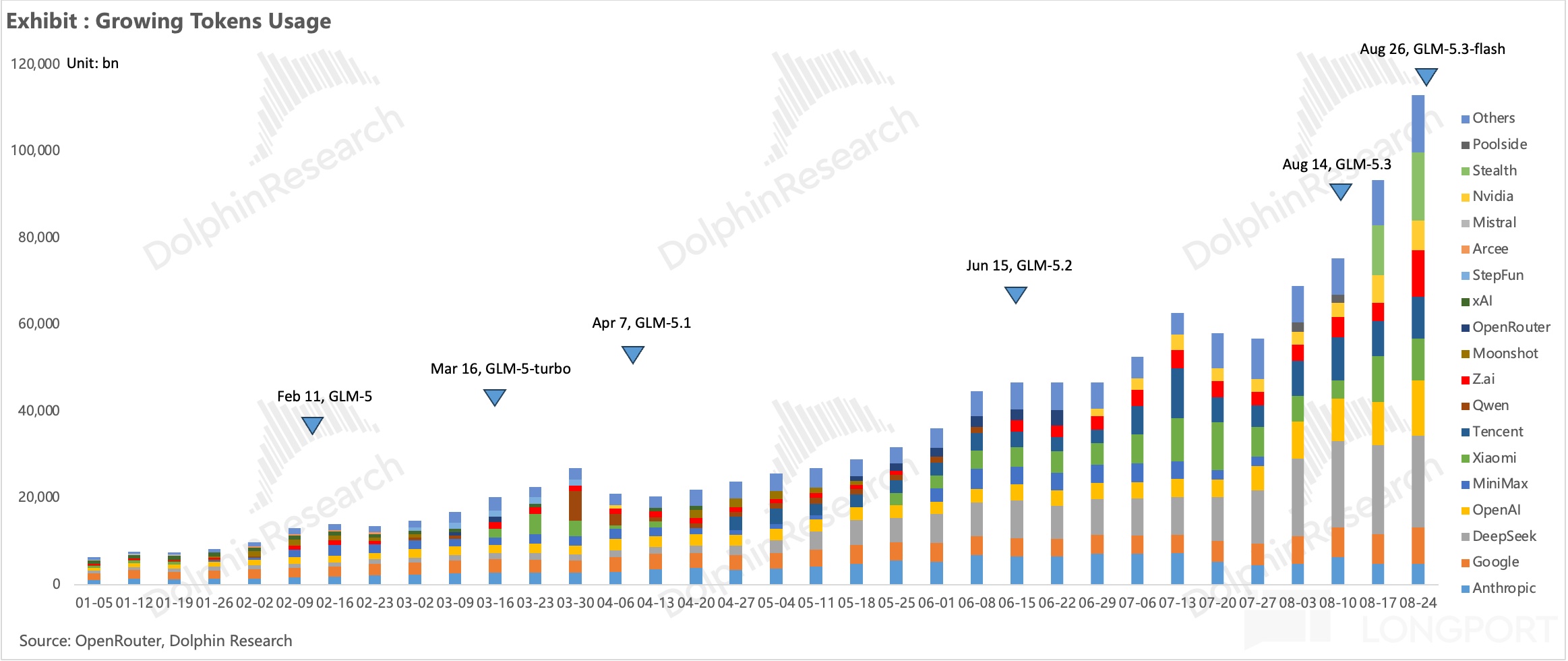
On product, Dolphin Research sees a 'climb peaks, lay eggs along the way' approach — a potential lower-dimensional strike against pure value models. Reviewing this year’s releases: pretraining set the base early in the year, then training pushed the ceiling mid-to-late year.
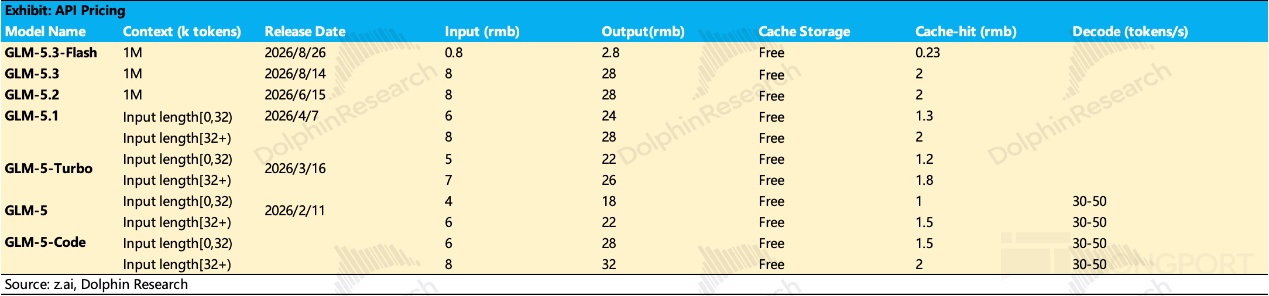
a. Base models: in Feb, GLM-5 scaled from 355B params (32B active) to 744B (40B active). Four months later, GLM-5.2 arrived, emphasizing long-context and long-horizon RL.
b. Post-training enhanced GLM-5.3: launched mid-Aug, same base but higher capability via post-training.
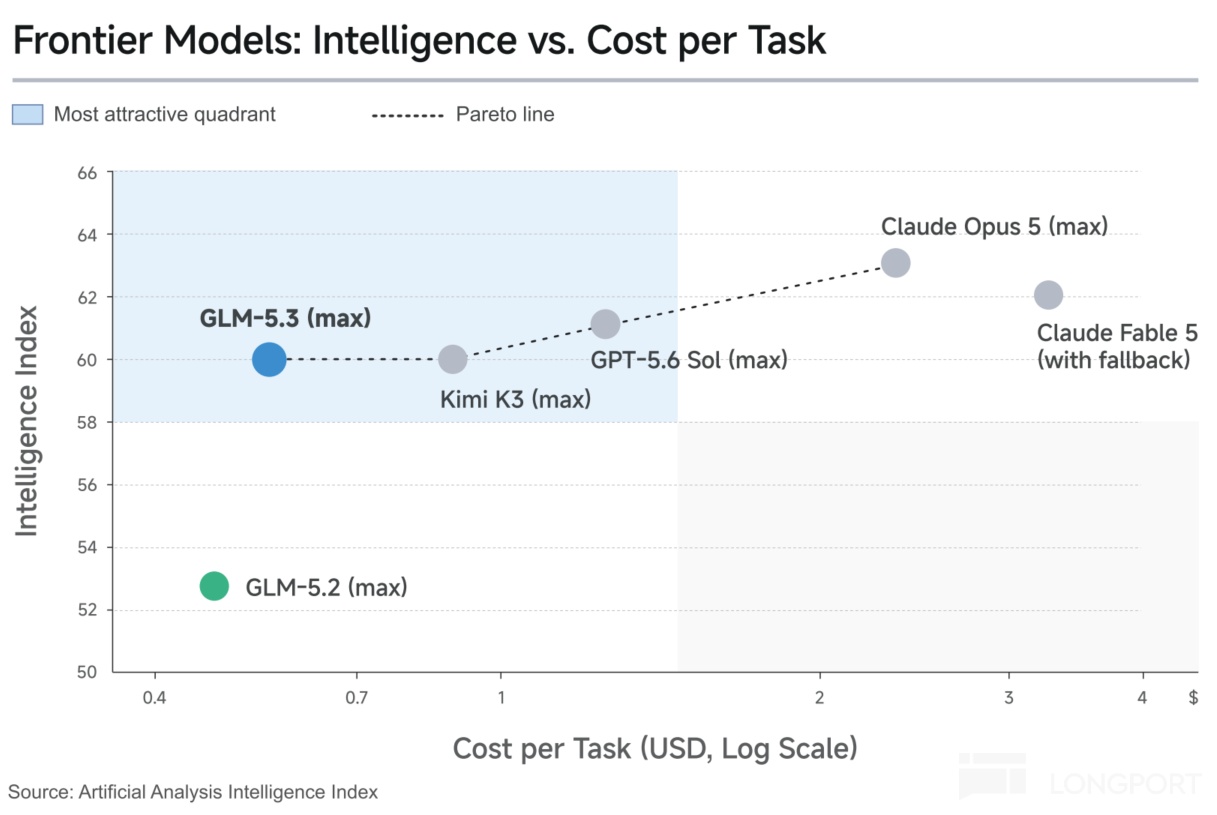
These target sticky users willing to pay higher prices, driving API and Coding revenue.
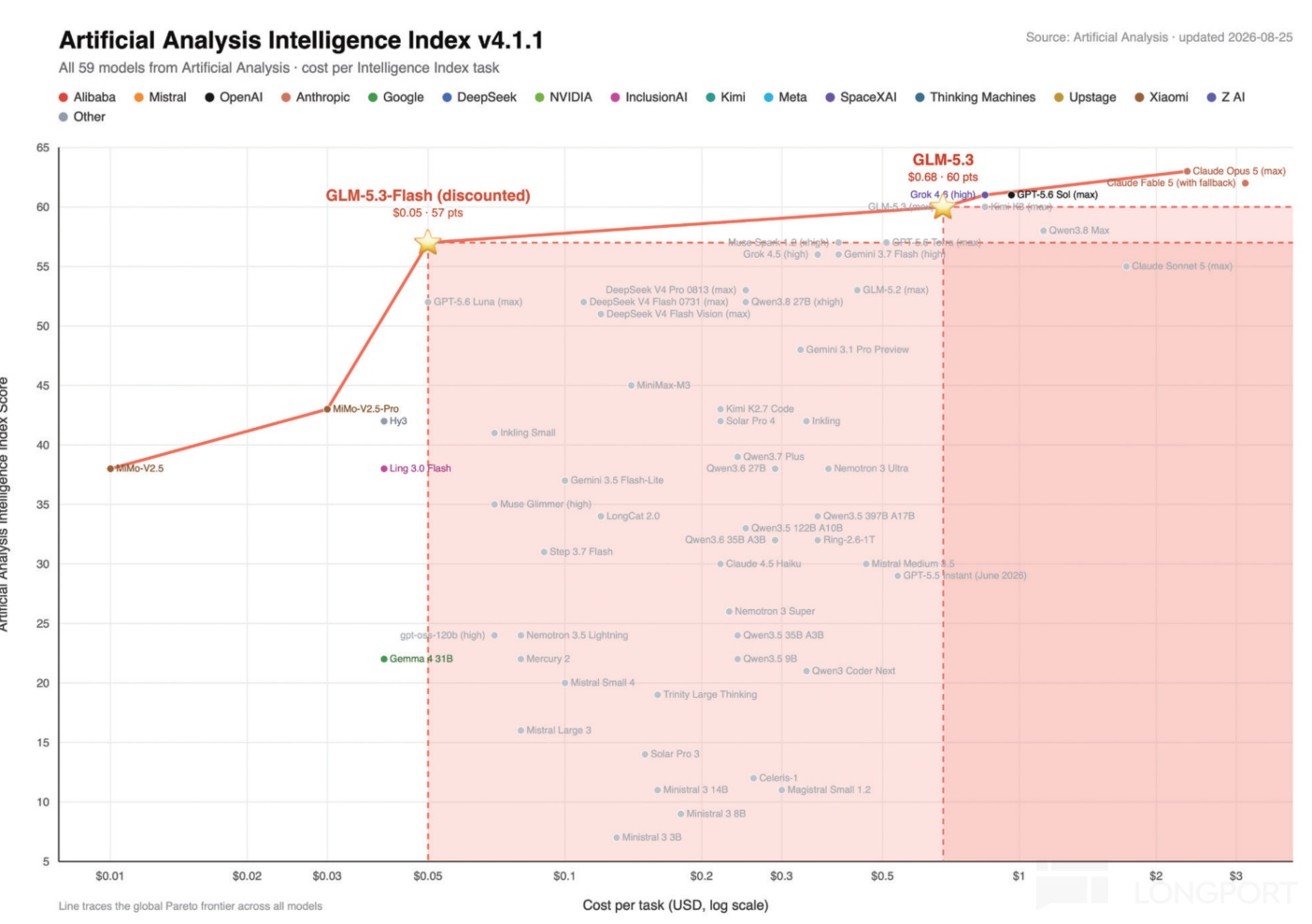
c. Price-war version: end-Aug saw GLM-5.3-Flash, with more-than-halved params and depth but added multimodality, closer to real-world use. Think of it as a distilled, lighter, cheaper variant from the high-IQ GLM line.
d. Another parameter push by YE: GLM 6.0 is rumored for YE26/early-27 with 3T params — a next-gen base vs. Kimi K3.

From a cumulative +83% price hike in Q1 to Flash taking on the price-killer role in 2H, this reflects intensifying competition, with one peer pushing IQ (K3) and another pushing value (DeepSeek). More importantly, it signals a product stance: use cheap + open-source to acquire users, then monetize via high-price closed-source or first-party models as users become sticky.
In short, use GLM-5.3-Flash for acquisition and token habit formation, and the full-fat GLM-5.3 to harvest API/open platform revenue. If so, we will watch whether flagship base model pricing can hold or keep trending up.
Dolphin Research’s take:
This iteration cycle suggests Scaling Law still holds; model intelligence remains the key edge. Few domestic models exceeded tens of billions of parameters in 1H, yet post-training already lifted IQ, reinforcing that Scaling Law persists.
Positioned for maximal intelligence, Zhipu spends to build high-IQ models (i.e., China’s Anthropic), then self-distills to spin off price-killer lightweight models, with some multimodal capability.
This self-competition strategy is lethal for MiniMax’s value-for-money multimodal thesis. With Flash priced below MiniMax M3 while offering comparable specs, it seriously challenges the MiniMax narrative.
Put differently, true value means DeepSeek-style pricing while still earning 50–70% GPM.
On that basis, Zhipu deserves a premium among domestic model vendors.
Caveat: China’s model leadership has rotated in recent years. 2026 may be Zhipu’s year, but 2027 is a big question mark; linear extrapolation is risky.
On annualized revenue, the 1H surge came from Coding where big platforms were absent and independents hadn’t scaled. As large-parameter models roll out in 2H, competition may intensify and Zhipu’s QoQ growth could moderate.
We estimate YE26 ARR at ~$3.5bn and apply a 25–30x PS, implying ~$85–100bn valuation. There is upside, but with a hefty premium, investors should mind the risk that Zhipu fails to defend the crown next year.
<End>
Related reading:
Mar 31, 2026 'Zhipu (Trans): Anchored by upper-bound model capability and tech-driven approach'
Mar 31, 2026 'Zhipu: Aiming high, small losses are just noise'
'Deep dive on MiniMax vs. Zhipu: Foundation models, compute intensity, and financing stamina'
Risk disclosure and disclaimer: Dolphin Research Disclaimer and General Disclosures


The copyright of this article belongs to the original author/organization.
The views expressed herein are solely those of the author and do not reflect the stance of the platform. The content is intended for investment reference purposes only and shall not be considered as investment advice. Please contact us if you have any questions or suggestions regarding the content services provided by the platform.