
D
6 hours ago
Muted guidance: Can NIO pull off a comeback?
 I'm LongbridgeAI, I can summarize articles.
$NIO Inc(NIO.US) released Q2 2026 results pre-US market and post-HK market on Sept 1 (Beijing time). The quarter was solid, but Q3 guidance missed.
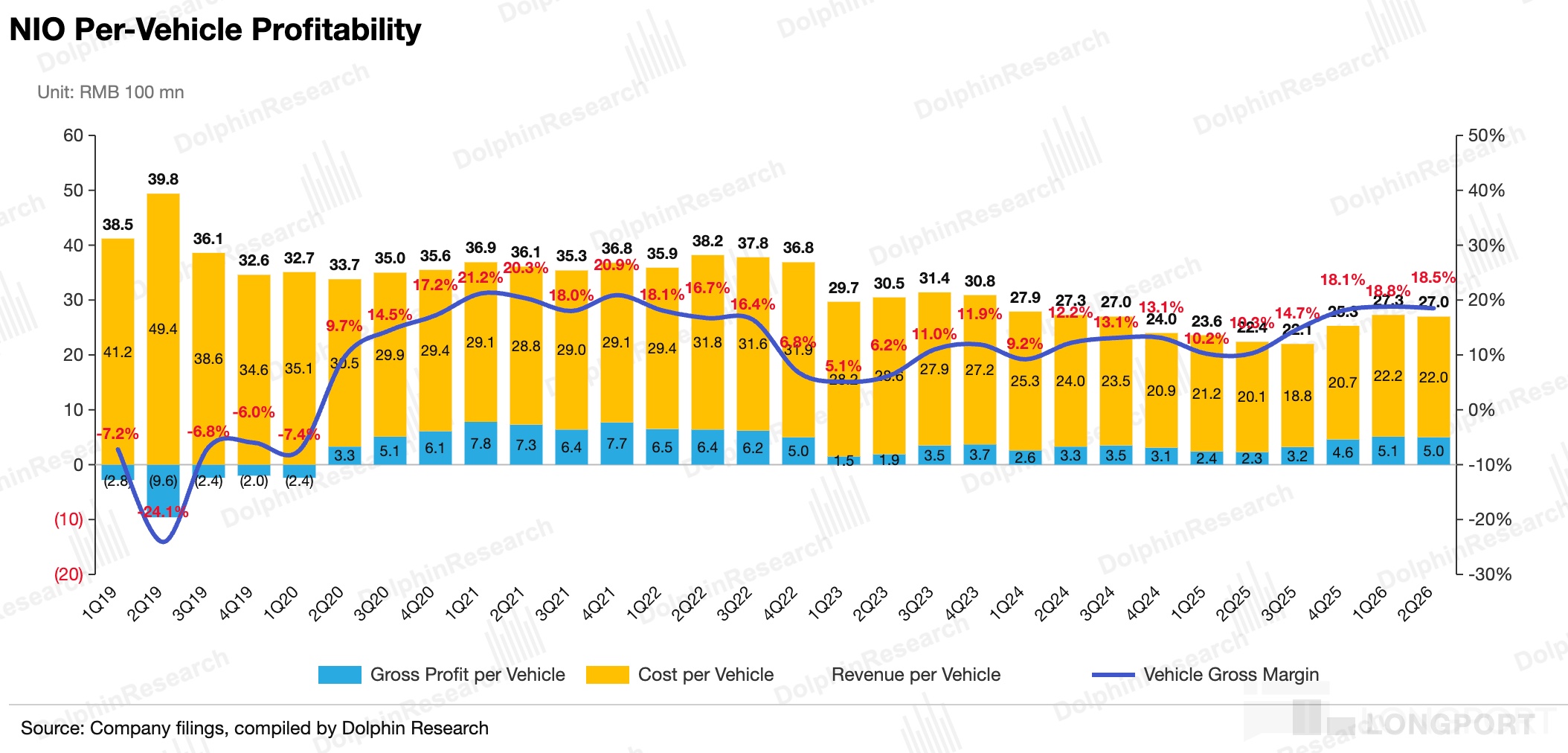
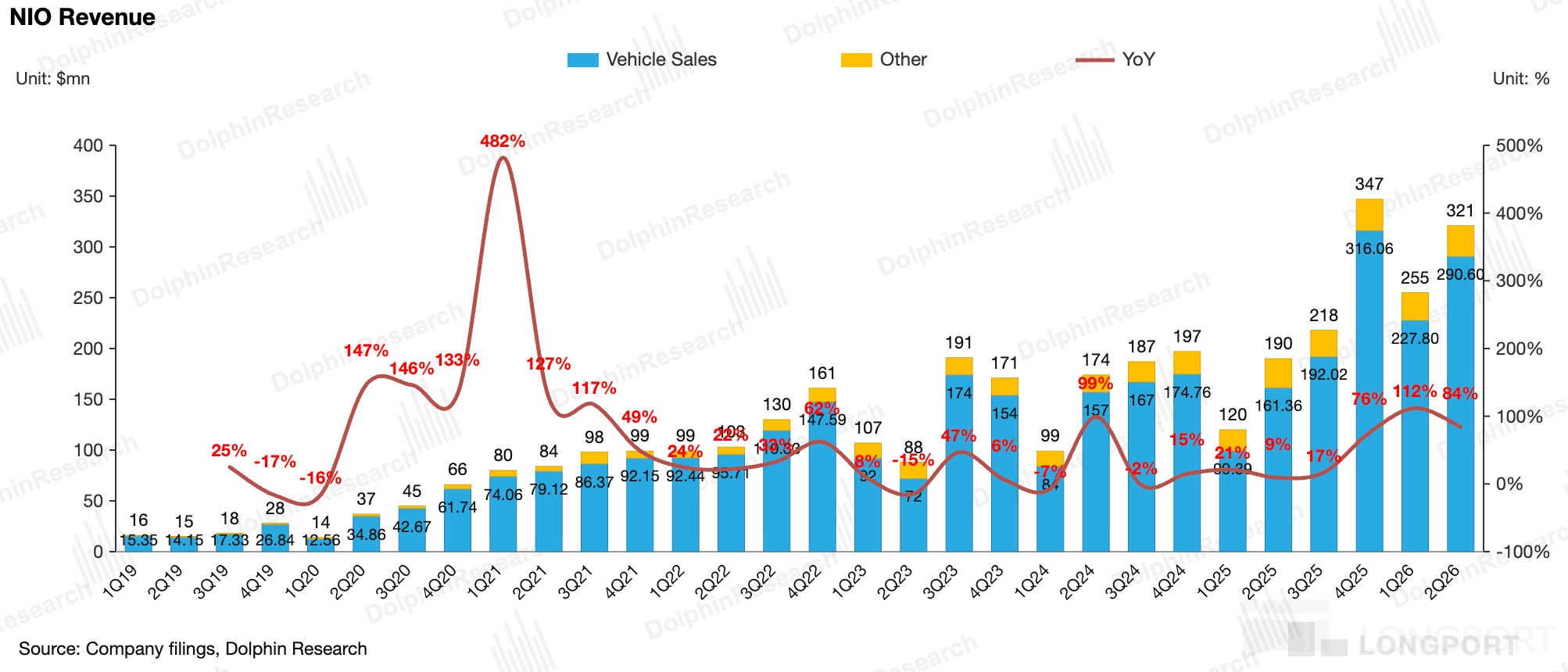
1. Vehicle revenue beat on higher-than-expected ASP: Q2 vehicle revenue was RMB 29.1bn, up 80% YoY, above the Street's RMB 28.6bn. ASP was about RMB 270k, down ~RMB 3k QoQ, but above the RMB 265k consensus due to:
a. High-priced ES9 continued to support the mix. ES8's share fell 23ppt QoQ to 31%, but the flagship SUV ES9, with a higher ASP, filled the gap, with its share up 11ppt QoQ to 11%.
b. Most model-level promo policies remained stable.
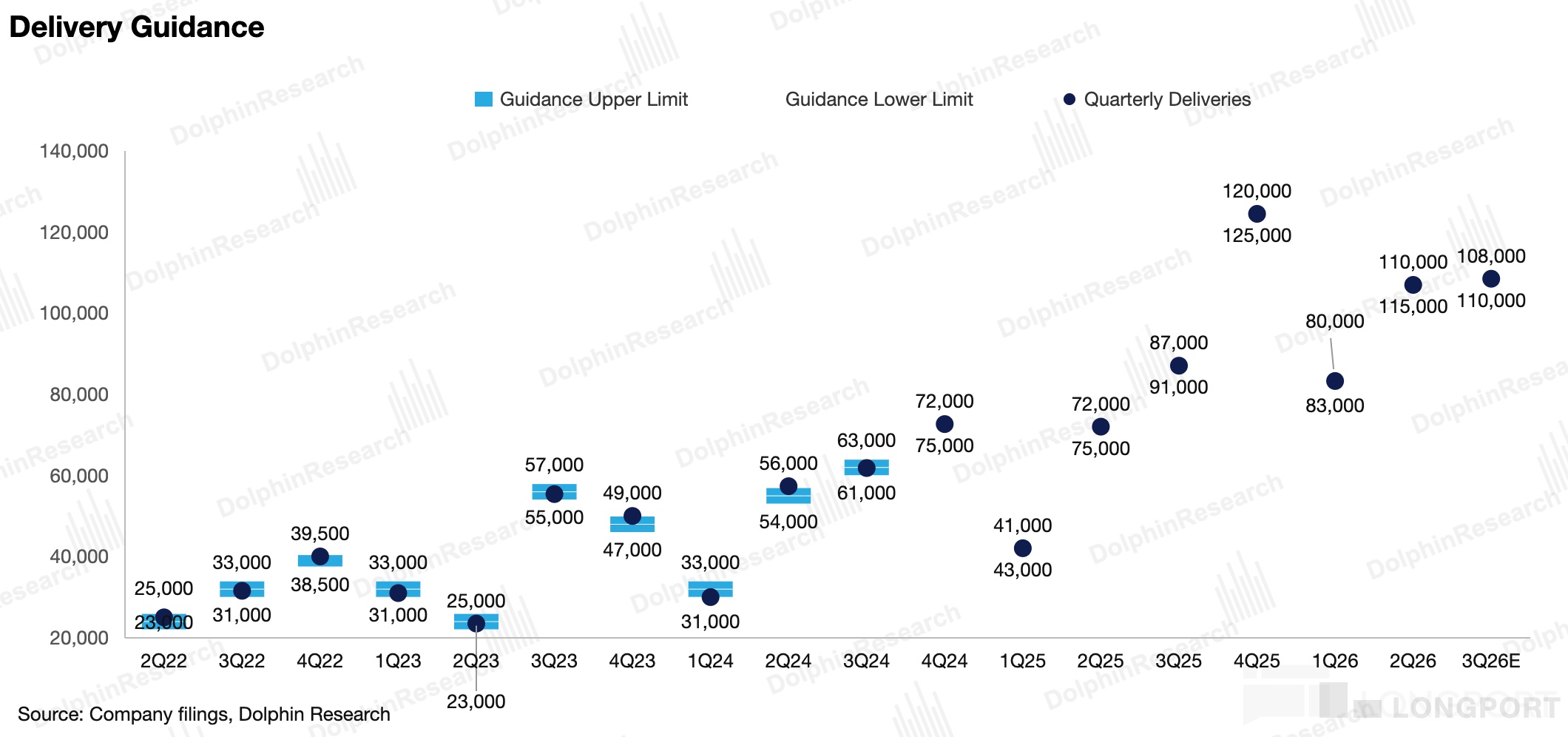
2. Vehicle GPM beat: Q2 vehicle GPM came in at 18.5%, topping the Street's 17.6% and slightly above management's 17%-18% range high end. The upside was driven by higher ASP and scale benefits lowering per-car unit costs as volume rose 29% QoQ to 108k units, offsetting part of the cost pressure from higher lithium, copper and memory prices.
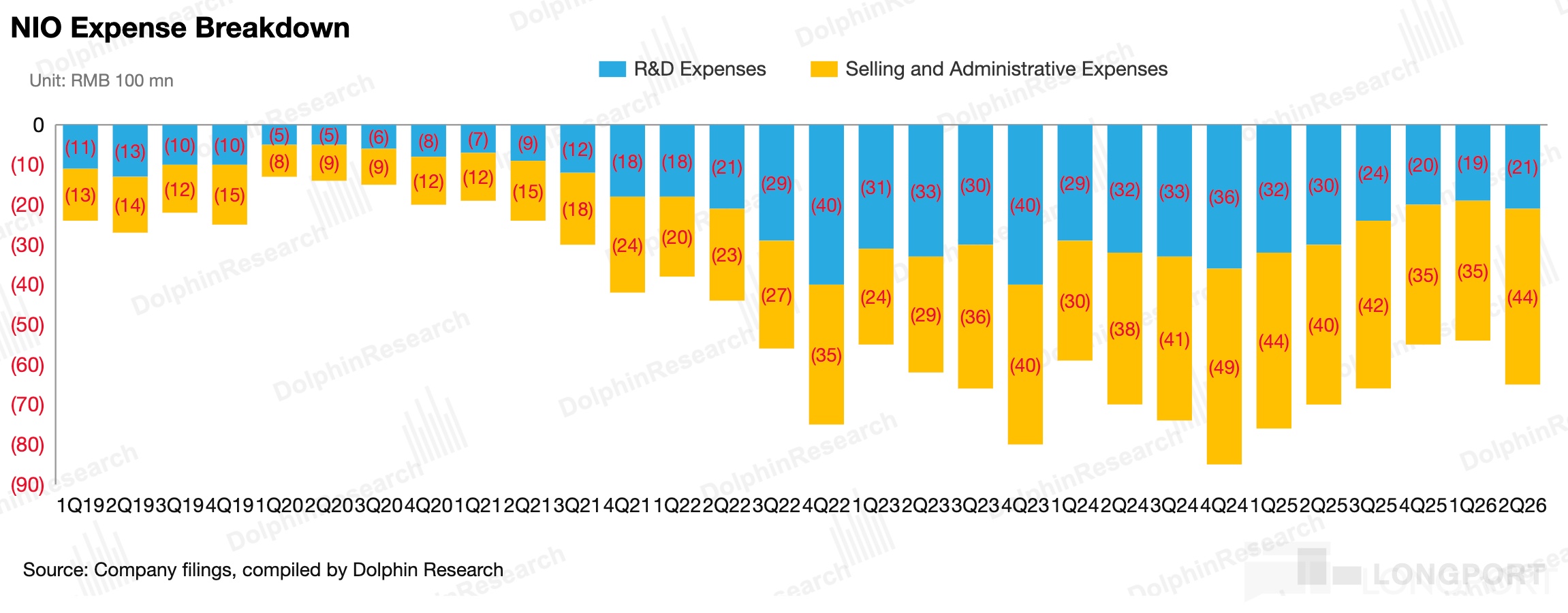
3. SG&A rose sharply, while R&D was reasonably contained: Q2 SG&A was RMB 4.42bn, up RMB 920mn QoQ, mainly due to heavier marketing for ES9/L80/ES8 five-seat launches, plus higher personnel-related costs and SBC.
Q2 R&D was RMB 2.14bn, below the Street's RMB 2.4bn and within the company's RMB 2.0-2.5bn per quarter guidance range, indicating disciplined control. Investments focused on AD and new models:
a. AD model upgrades: Nio rolled out its 'World Model (NWM) 2.0' early in the year and upgraded to NWM 2.5 in Jun, featuring a three-layer stack of 'world model + supervised fine-tuning + closed-loop RL'. It now runs on about 800k vehicles, with a notable uptick in user AD usage.
Two major upgrades are planned for H2, with the next to integrate AD and the chassis domain.
AD chip development: Nio's in-house AD chip NX9031 (Shenji) uses a 5nm process and is the world's first auto-grade 5nm chip, already deployed on almost all Nio models. The chip business entity completed its first external financing via new share issuance, with Nio retaining control.
In parallel, the second-gen 5nm AD chip has successfully taped out, and a mid-end product line is planned to cover a broader customer base. The chip business is evolving from a single-point in-house effort to a product matrix, laying the groundwork for external commercialization and a potential spin-off IPO.
New models: In Q2, Nio launched three models — ES9 SUV, L80 SUV and the five-seat ES8. It expects to roll out facelifts for L60 and L90 later this year.
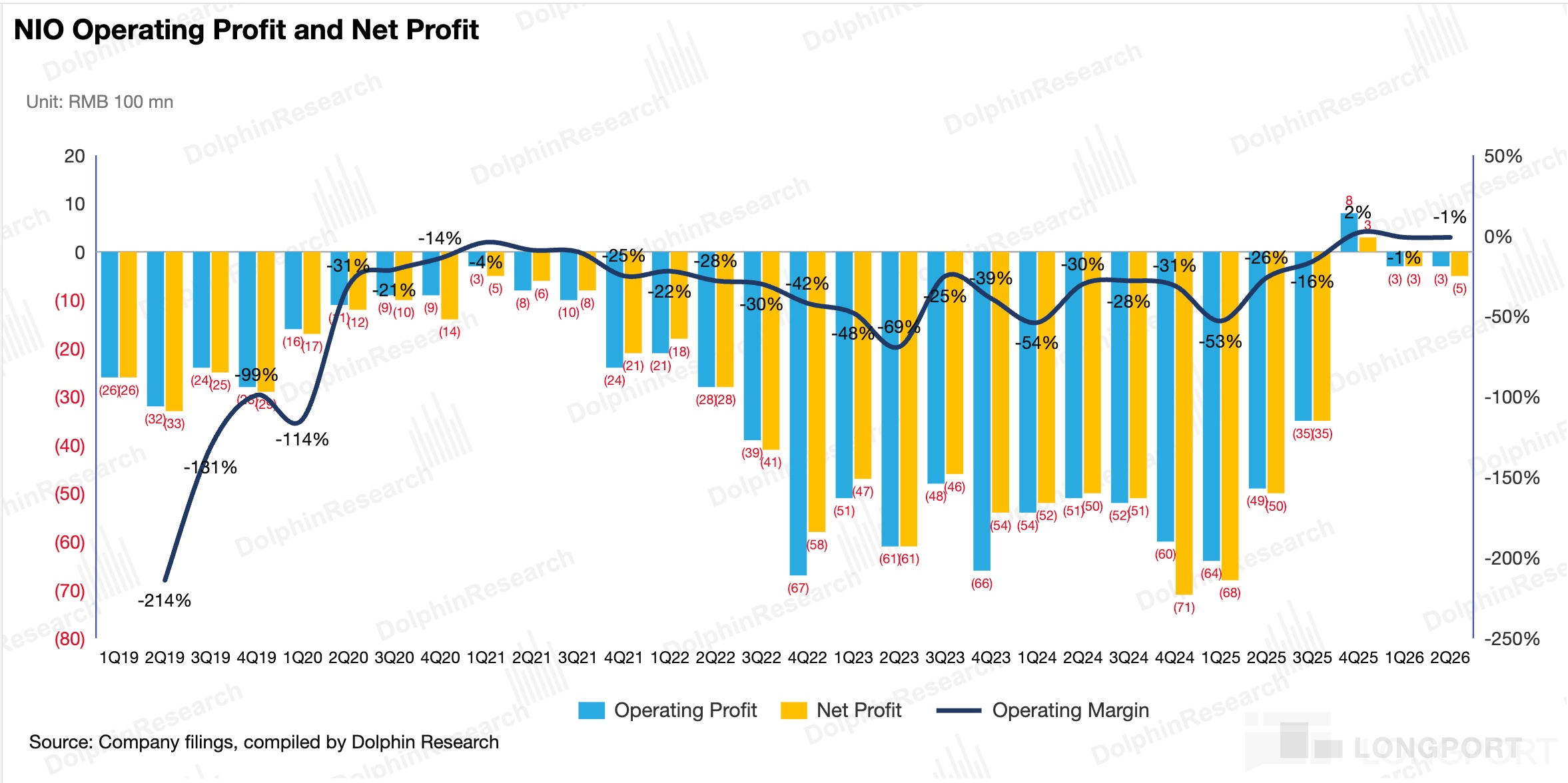
4. OP beat: Q2 operating loss was RMB 360mn, better than the Street's RMB 790mn loss. OPM was -1.1%, roughly flat QoQ, as a richer ES9 mix and scale benefits lifted vehicle revenue and GPM, offsetting higher SG&A.
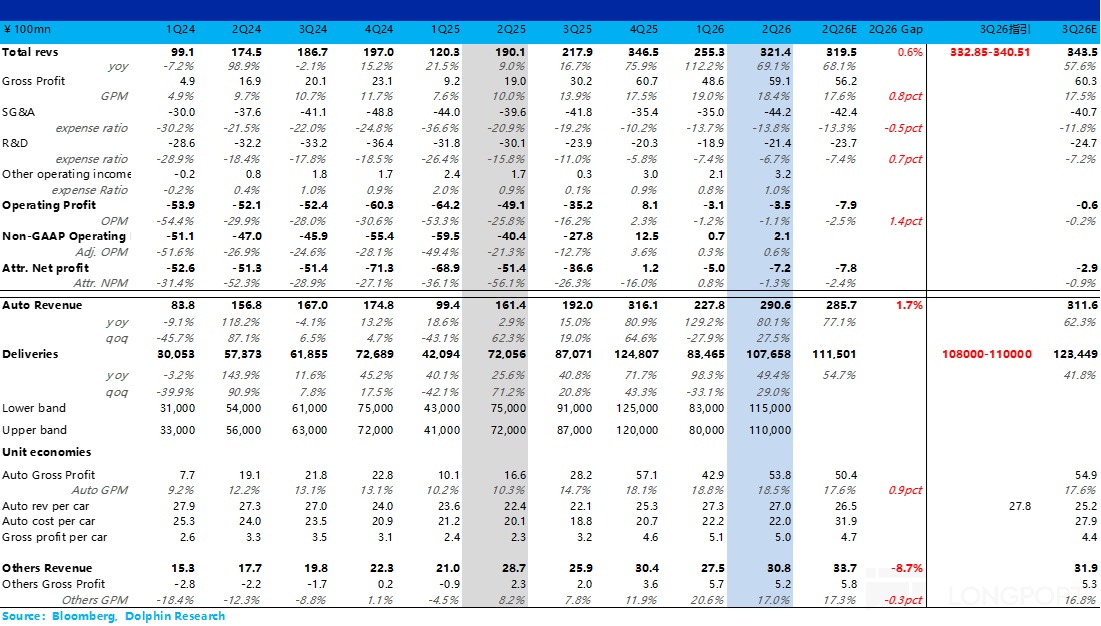
Overall, Q2 was decent, but the issue lies in weaker-than-expected Q3 guidance.
Q2 ASP was RMB 270k vs. the RMB 265k consensus. ES8 mix fell sharply QoQ, but the high-ASP flagship ES9 stepped up, limiting QoQ ASP decline to just RMB 3k.
Vehicle GPM was 18.5%, roughly flat QoQ and above the Street's 17.6%, driven by a tilt toward higher-margin ES8/ES9 SUVs and stable promo policies on most models. Part of the benefit was offset by higher lithium, copper and memory costs.
But Q3 volume and revenue guidance both missed:
a. Q3 deliveries guided to 108k-110k units, essentially flat QoQ and below the 123k expectation. With Jul/Aug deliveries of 36k each already disclosed, the guide implies 36k-38k in Sept, suggesting limited incremental volume despite three new launches (ES9/L80/ES8 five-seat), and pointing to average order intake for these models.
b. Revenue guided to RMB 33.3bn-34.05bn, below the RMB 34.4bn consensus, mainly on lower volumes. Implied Q3 ASP of RMB 278k-280k is up from RMB 270k in Q2 and above the Street's RMB 252k, reflecting a continued mix shift toward ES8 and ES9, which should help sustain or lift vehicle GPM.
For full-year 2026:
Management had guided to a bullish 40%-50% YoY delivery growth (about 456k-490k units), underpinned by a product supercycle ramping from Q2:
Nio ES9 (launched and delivered on May 27): a 5.4m flagship SUV bringing ET9 core tech downstream, priced at RMB 528k-658k (RMB 420k-550k with BaaS). With best-in-class cabin space (5,365mm length, 3,250mm wheelbase) and a luxury interior/exterior as key selling points, dealers expect steady-state monthly sales to exceed 5,000 units.
ONVO L80 (launched and delivered in May): a large five-seat version of the L90 with a starting price of RMB 242.8k, precisely targeting the RMB 200k-250k incremental market at a lower entry point.
Nio ES8 five-seat version (to be released in Q3): aims to extend ES8's success and further cement the premium base. ES8 has surpassed 100k cumulative deliveries, and the five-seat variant could deliver a '1 + 1 > 1.5' effect.
For existing models, the prior best-sellers ES6/EC6/ET5/ET5T received facelifts in Apr. The ES8, which was a big success in 2025, will contribute a full 12 months in 2026, while ONVO L60 got a facelift in Jun and L90 is expected to follow.
This robust 2026 pipeline underpins management's prior high-growth guidance, with a clear strategic tilt toward large SUVs and premiumization.
But 2026 brings industry headwinds: NEV market growth is set to slow vs. 2025, while domestic auto demand is under pressure (Jan-Jul retail -18% YoY). In this context, Nio's BaaS offers an edge by excluding the battery from the invoice, materially lowering the tax base, and with BaaS penetration above 80%, Nio buyers pay less purchase tax vs. peers, partially offsetting macro drags.
However, for full-year 2026 deliveries, despite BaaS cushioning the purchase tax rollback, domestic demand pressure and flat QoQ guidance for Q3 despite three launches suggest limited momentum. Dolphin Research assumes 26%-29% YoY growth to 410k-420k units.
Management's margin guidance also looks relatively optimistic:
Since Q2, the sector has faced rising raw material costs for memory, Li2CO3, NCM, and copper/aluminum, with per-vehicle cost impact exceeding RMB 10k on Avg. Even so, the full-year vehicle GPM target remains 17%-18% (down from 20%), to be achieved via three levers.
First, increase the mix of higher-priced, higher-margin models like ES8 and ES9. Second, maintain stable pricing and promo discipline on mid-margin models, prioritizing margin over volume. Third, deepen supplier collaboration to drive engineering improvements, efficiency gains and commercial negotiations to absorb cost pressure.
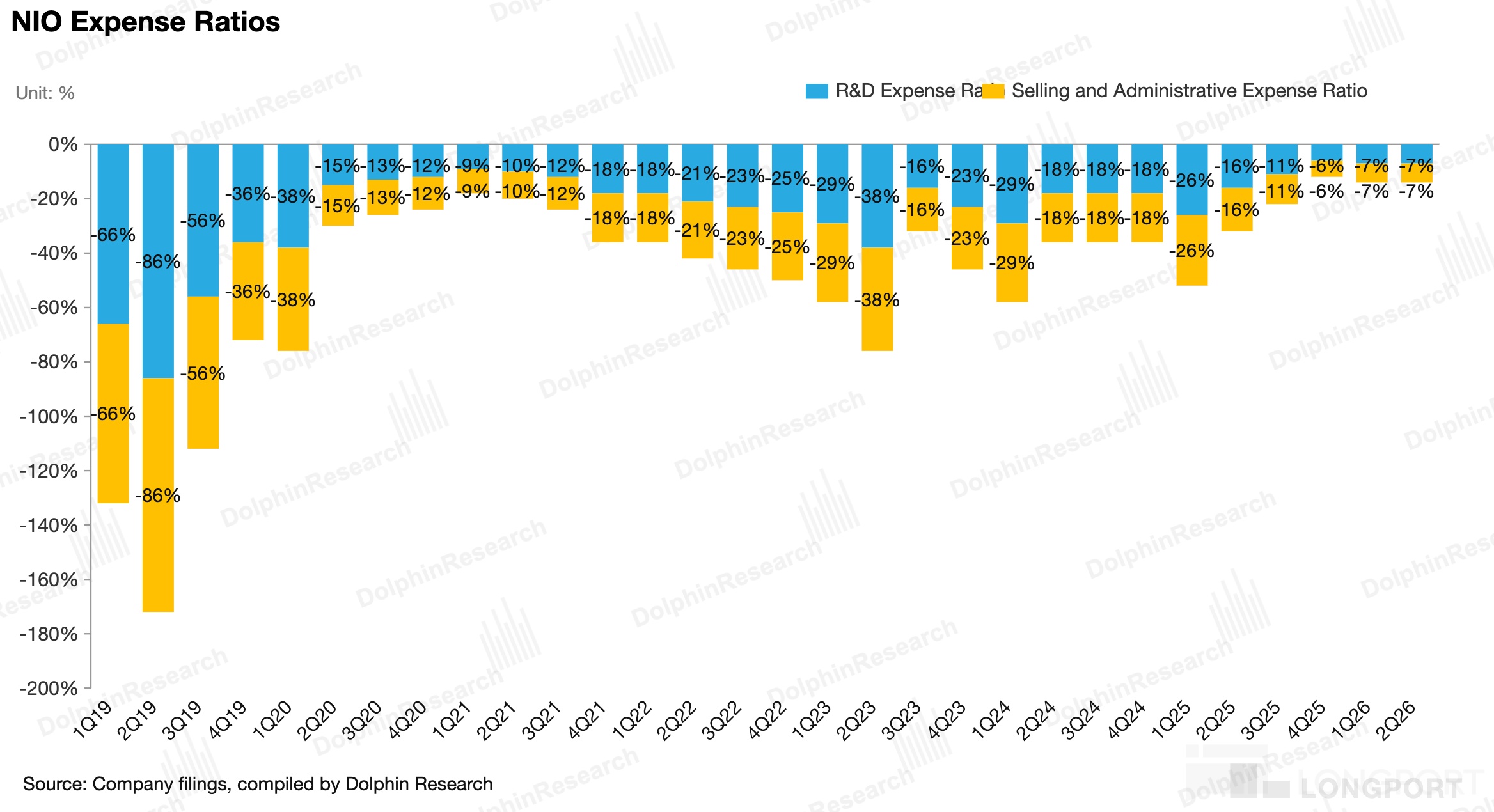
On expenses, Nio is tightening further: 2026 full-year R&D spend is expected to be in line with Q4 2025 annualized levels (Non-GAAP RMB 2.0-2.5bn per quarter), while SG&A as a share of revenue is targeted to decline to around 10%. With higher volume, better vehicle GPM, and tight R&D and SG&A control, Nio aims to turn Non-GAAP OP positive in 2026.
On valuation, based on 410k-420k full-year 2026 deliveries, Dolphin Research estimates 2026 revenue of RMB 125.1bn-127.8bn (+43%-46% YoY). At a current US mkt cap of RMB 71.2bn, Nio's 2026 P/S is just 0.56x-0.57x, near the lower bound of the 0.5x-1.0x range for new-energy upstarts.
Thus, even with a softer Q3 guide and slower growth, downside in the stock looks limited as the auto group has largely priced in bearish expectations. Downside risk appears contained.
Assigning a neutral 0.8x P/S implies a mkt cap of RMB 100.0bn-102.3bn, suggesting 40%-44% upside vs. current levels.
<End here>
For more in-depth Nio coverage from Dolphin Research:
Earnings:
Sept 2, 2025, Earnings Take 'Dropping 'price' to survive — is Nio's turnaround convincing?'
Sept 3, 2025, Trans 'Nio (2Q25 Trans): Still targeting break-even in Q4'
Jun 3, 2025, Earnings Take 'Nio: Vision is cheap — survival comes first'
Jun 4, 2025, Trans 'Nio (1Q25 Trans): Cutting opex and narrowing scope — can Nio self-rescue?'
Mar 23, 2025, Trans 'Nio (Trans): 2025 plans — Nio brand GPM 20%, ONVO brand 15%'
Mar 22, 2025, Earnings Take 'Nio: Nio struggles, ONVO stalls — does Nio still have a future?'
Events
Sept 9, 2025, 'Finally 'figured it out' — can Nio truly be reborn?'
Risk disclosure and disclaimer for this article:Dolphin Research Disclaimer and General Disclosure




The copyright of this article belongs to the original author/organization.
The views expressed herein are solely those of the author and do not reflect the stance of the platform. The content is intended for investment reference purposes only and shall not be considered as investment advice. Please contact us if you have any questions or suggestions regarding the content services provided by the platform.