
D
1 day ago, 09:11 AM
Cybercab Launch: From Concept to Reality—Ushering in the Robotaxi Era?
 I'm LongbridgeAI, I can summarize articles.
On Sep 3, $Tesla(TSLA.US) hosted its Cybercab launch in Austin, Texas. The event is pivotal to Tesla’s valuation framework.
Of Tesla’s roughly $1.4tn market cap, nearly two-thirds (~$1tn) hinges on AI monetization. Within AI, Robotaxi has far clearer near-term monetization than Optimus — paid rides have begun, while Optimus remains in early pilot build — and can underpin cash flow as auto GPM stays under pressure (2Q26 automotive GPM 16.3%, -300bps QoQ) and capex remains heavy (2026E >$25bn).
The launch marks a shift from a concept demo to live passenger operations. Austin already has 45 Cybercabs registered, weekly output ramping to 500–600 units with ample inventory, and driverless paid rides start immediately post-event. Tesla has finally moved from demo → production → real paid service.
In parallel, Tesla rolled out a major FSD V15 upgrade. Model parameters are ~10x V14, response latency improves by ~20%, and it shares the same AI foundation with Optimus.
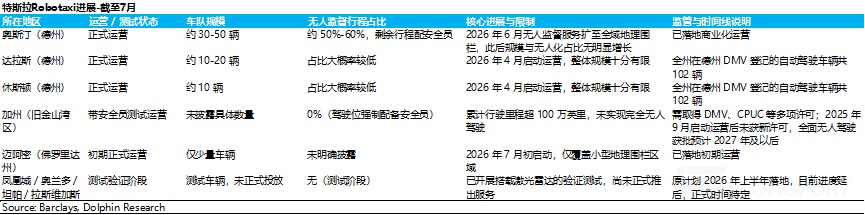
On the current Robotaxi rollout:
Meanwhile, third-party Robotaxi trackers show Tesla’s unsupervised fleet has expanded by ~200% since late Jun, from 57 vehicles on Jun 30 to 156 on Aug 31. Commercial scale still trails Waymo materially — Waymo has ~3,800 vehicles across 30+ cities — leaving Tesla in the early commercialization phase.
The key watch item from here is Cybercab’s pace of scale-up. If the fleet can ramp quickly from 45 units to the hundreds or thousands, the odds of Robotaxi monetization rise substantially and the stock could rally toward Dolphin Research’s bull-case $2tn target (equivalent to $602/share). This is especially so with FSD/Robotaxi as Tesla’s most potent near-term AI growth engine — Robotaxi now covers seven U.S. cities with >1mn driverless miles.
Conversely, if Cybercab scales much slower than expected and the fleet struggles to reach the hundreds, confidence in Robotaxi monetization could be hit again. A repeat of the prior drawdown — when delays saw the stock slide from $420 to the $300–350 range — cannot be ruled out, and shares may come under pressure post-event.
For more on Tesla’s target price, see Dolphin Research’s in-depth report 'From Building Cars to Building Dreams: Is a $1.5tn AI Tesla Really Expensive?'. Also: 'Can a Robotaxi Mobility Empire Rebuild Tesla?'.
Key takeaways from the event:
1. Cybercab:
a. Model: Purpose-built for driverless ride-hailing, a two-seater fully autonomous model with a gold exterior, butterfly doors, and a large center screen. No steering wheel, accelerator, or brake pedals; vs. Model Y it further emphasizes dedicated Robotaxi use. This is Tesla’s new model designed to scale the Robotaxi network.
b. Sensors: Built on HW4.0. A pure-vision setup with eight cameras, no LiDAR.
c. Battery: 48kWh on a 400V platform, curb weight 1,412kg, Cd 0.19. Optimized for high-frequency short urban trips.
d. Cost
Manufacturing cost: Target unit manufacturing cost below $30,000.
Operating cost: Target all-in cost of ~$0.20 per mile. Fares will be well below current Uber rates.
e. In-cabin entertainment: A single central display for route viewing, entertainment, and settings. Passengers can see the AI’s real-time perception of the road.
f. Positioning: Designed for both Tesla’s own fleet and commercial clients; fleet or single-unit commercial intents can be submitted. Not for sale to individual consumers for now.
g. Cybercab rollout status:
In Austin, 45 Cybercabs have been registered (Tesla has ~420 autonomous vehicles registered in Texas). Driverless paid rides begin in Austin immediately after the event.
Rollout will then expand to other U.S. cities over time; no China timetable disclosed.
Note: Not all registered vehicles are operational; some may still be in testing or run with safety operators.
h. Vertically integrated ops model: Tesla’s own ride-hailing app + in-house Robotaxi vehicles + self-operated fleet. Riders request a trip in-app, select pickup, tap 'Start Ride' on arrival, and adjust climate, entertainment, and destination via the app or center screen. The car parks automatically at drop-off, and feedback is provided in-app, enabling full-stack control of the mobility journey.
i. Private-car sharing network: Household Teslas can join the Robotaxi network in the future, automatically taking jobs when idle to generate income. Owners receive a platform revenue share.
2. FSD V15 major update
a. Model parameters are ~10x V14 with a full end-to-end neural network, sharply reducing hand-coded rules.
b. Response speed is ~20% faster vs. V14.3, with a built-in world model to predict pedestrians’ and vehicles’ future behavior.
c. Hardware limitation: V15 is unsupported on legacy HW3 vehicles; only HW4 (AI4) can receive V15.
d. The Robotaxi fleet is already running early V15 builds. Consumer Teslas will receive the official V15 via phased OTA.
e. Shares the same AI foundation with the Optimus humanoid — core visual understanding, perception, and decision-making capabilities can transfer. This is critical, as progress in FSD V15 can spill over directly to the robot.



The copyright of this article belongs to the original author/organization.
The views expressed herein are solely those of the author and do not reflect the stance of the platform. The content is intended for investment reference purposes only and shall not be considered as investment advice. Please contact us if you have any questions or suggestions regarding the content services provided by the platform.